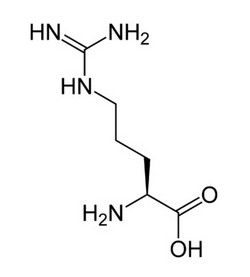
Arginine is one of the 20 most common natural amino acids. Most healthy people do not need to supplement with arginine because the body usually produces sufficient quantities. The pathway for arginine synthesis was studied using cells from a red bread mold. This natural form of arginine is illustrated below.
The red bread mold Neurospora crassa grows well on a cultural plate with "minimal" medium which is a fluid containing only a few simple sugars, inorganic salts, and vitamin. Neurospora that grows normally in nature (wild type) has enzymes that convert these simple substances into the amino acids necessary for growth. Mutating any one of the genes that makes an enzyme can produce a Neurospora strain that cannot grow on minimal medium. The mutant would only grow if the enzyme product were to be added as a supplement. On the other hand, if a "complete" medium is provided, containing all required amino acids, then Neurospora would grow, with or without mutation.
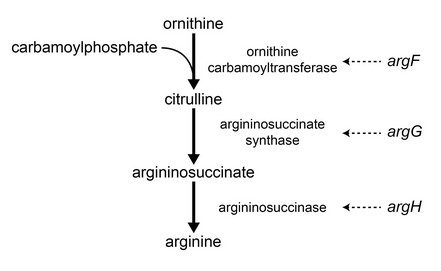
Figure 1 A synthesis pathway for the amino acid arginine. Each gene in italics in the diagram produces one enzyme necessary for the synthesis of this essential amino acid required for growth.

Table 1 Growth response of mutant strains in "minimal" media with supplements (ornithine, citrulline, argininosuccinate, and arginine) as indicated. Strain growth is indicated by (+) and no strain growth is indicated by (-).
Consider tetrapeptides containing 2 equivalents each of the natural forms of arginine and proline.
How many different linear tetrapeptides can be synthesized?