Several models have been developed for relating changes in dissociation constants to changes in the
tertiary and quaternary structures of oligomeric proteins. One model suggests that the protein's subunits can exist in either of two distinct conformations, R and T. At equilibrium, there are few R conformation molecules: 10 000 T to 1 R and it is an important feature of the enzyme that this ratio does not change.
The substrate is assumed to bind more tightly to the R form than to the T form, which means that binding of the substrate favors the transition from the T conformation to R.
The conformational transitions of the individual subunits are assumed to be tightly linked, so that if one subunit flips from T to R the others must do the same. The binding of the first molecule of substrate thus promotes the binding of the second and if substrate is added continuously, all of the enzyme will be in the R form and act on the substrate. Because the concerted transition of all of the subunits from T to R or back, preserves the overall symmetry of the protein, this model is called the symmetry model. The model further predicts that allosteric activating enzymes make the R conformation even more reactive with the substrate while allosteric inhibitors react with the T conformation so that most of the enzyme is held back in the T shape.
Experiment Evaluating Non-Symmetry Model Enzymes
Experiments were performed with enzyme conformers that did not obey the symmetry model. The data is summarized in Figure 1.
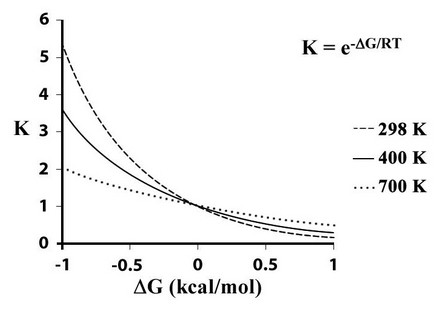
Figure 1: Equilibrium distribution of two conformers at different temperatures given the free energy of their interconversion. (modified from Mr.Holmium).
The substrate binds more tightly to R because: