Synthetic dyes constitute a commercially significant area of organic chemistry. The color producing properties of these compounds are the result of highly delocalized electron systems giving rise to electronic transitions whose absorptions occur in the visible region. Most commercially useful dyes can be classified as one of three types -- anthraquinones, azo dyes, or triarylmethyl salts. Examples of each type are illustrated in Figure 1.
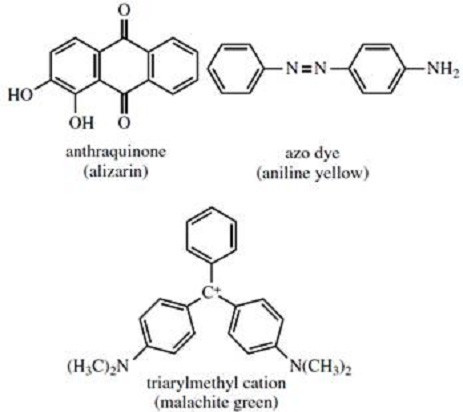
Figure 1
In order for a dye to be useful in the fabric industry, it must have sufficient affinity for the polymeric fibers of
which the material is composed; the dye must not only impart a color to the fabric, but must also do so in a
relatively permanent manner (color fastness). Proper design of synthetic polymers requires the placement of acidic or basic side chains along the polymer backbone such that binding sites are available for dying.
Similarly, dyes must be produced not only with the appropriate color-producing structure, but also with an affinity for the fabric in question. The structural units of several common synthetic fibers are shown in Figure 2.
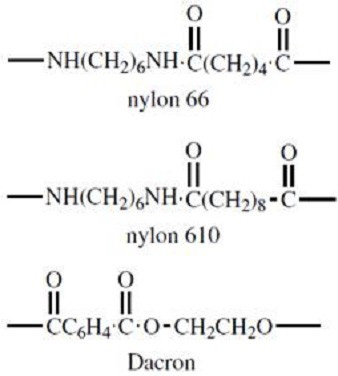
Figure 2
Dacron belongs to which of the following general classifications?