Artificial kidneys have been used for almost 50 years to treat patients with different forms of renal failure.
The artificial kidney (dialysis machine) removes unwanted substances from the blood by diffusion. A patient's blood is passed through channels bounded by a porous, semi-permeable membrane that allows the free diffusion in both directions of all plasma constituents except the plasma proteins. Erythrocytes and other cellular components of blood cannot pass through the membrane. The other side of the membrane is exposed to the dialyzing fluid which carries away the unwanted materials.
If the concentration of a material in the blood is greater than in the dialyzing fluid, there will be a net flow of the material from the plasma to the dialyzing fluid. If the concentration of a material in the blood is less than in the dialyzing fluid, there will be a net flow of the material from the dialyzing fluid into the blood. The composition of normal plasma, plasma in an individual suffering renal failure, and dialyzing fluid are shown in Table 1.
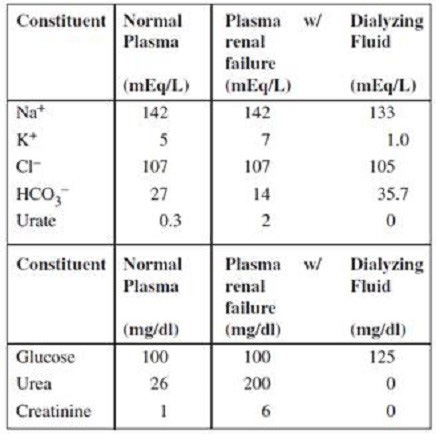
Table 1
Dialysis replaces some functions of the kidneys and attempts to correct the effects of renal failure. For example, patients with renal failure develop acidosis due to a buildup of metabolically produced acids in the circulation. Without dialysis, the pH of the blood will drop and coma may occur. Dialyzing fluid contains a relatively high concentration of bicarbonate which diffuses into the circulation and neutralizes the acid.
The semi-permeable membrane of the dialysis machine functions in a manner most analogous to which part of the kidney?