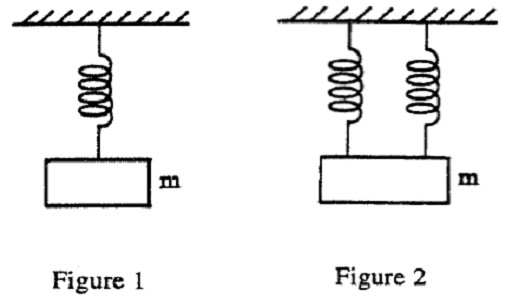
The simple harmonic motion of a mass suspended from vertical springs is investigated in two experiments.
The springs used in both experiments have a spring constant k and a natural length L0. The material used to make the springs has a Young's modulus of 2 x 10¹¹ Pa.
In the first experiment a mass m is suspended from a spring. The mass stretches the spring to a new length L, called the equilibrium length.
In the second experiment the mass m is suspended from two identical springs as shown in Figure 2 below.
When the mass m is in equilibrium, each spring is stretched from its natural length by the same amount xe.
In both experiments the masses of the springs are negligible, and the elastic limits of the springs are never exceeded.
The two springs in Experiment 2 are replaced by a single spring having a spring constant k' such that the equilibrium length xe does not change.
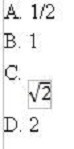
What is the ratio of k' to k?