Sugars are carbohydrates, that is, molecules usually with the empirical formula C(H2O), and structural formulas made up of polyhydroxy aldehydes or ketones. Because of their polyfunctional nature, sugars can undergo a wide variety of transformations upon treatment with acids, bases, or heat, and upon reaction with other simple reagents and enzymes. While many sugars occur in nature and are thus readily available, the synthesis and modification of simple sugars is a necessary step in studies of enzymatic processes.
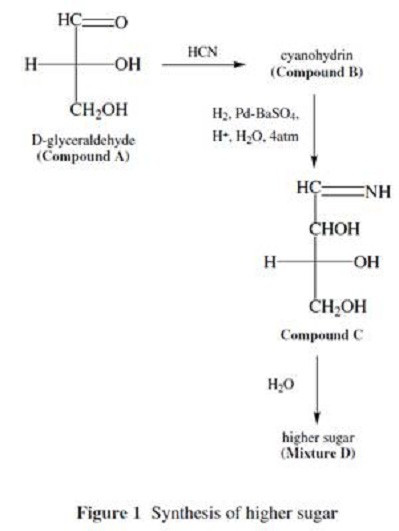
Higher sugars can be synthesized from the simple carbohydrate D-glyceraldehyde with the following procedure: D-glyceraldehyde (Compound A) is reacted with HCN to produce a cyanohydrin (Compound B).
Compound B is then treated with hydrogen gas and a modified palladium catalyst (similar to the Lindlar reagent) to give Compound C. Compound C is hydrolyzed to give the higher sugars in Mixture D. This reaction is summarized in Figure 1. Mixture D contains two compounds, which can be separated by crystallization. Two doublets near 9.5 (, ppm) are observed in the 1H NMR spectrum of mixture D, with each doublet corresponding to one of the two products present in the mixture. IR spectroscopy shows broad absorptions for both products around 3300 cm?.
The hydroxyl groups of carbohydrates can also participate in reactions. For example, D-glyceraldehyde can react with chloromethane under basic conditions to yield a completely methylated product. This SN2 reaction is shown in Figure 2.
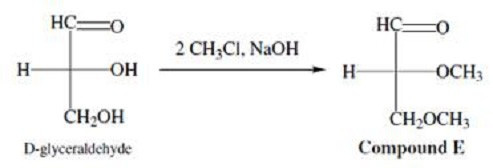
Figure 2 Methylation of D-glyceraldehyde
The two sugars in Mixture D are: