The equation of state of an ideal gas is given by the ideal gas law:
PV = nRT
where P is the pressure, V is the volume, n is the number of moles of gas, R is the ideal gas constant, and T is the temperature of the gas. The gas particles in a container are constantly moving at various speeds.
These speeds are characterized by the Maxwell shown in the figure below.
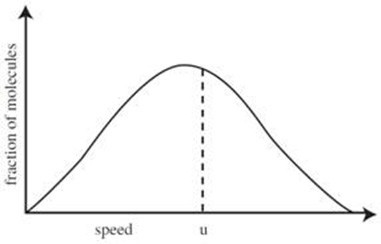
If two particles collide, their velocities change. However, if the gas is in thermal equilibrium, the velocity distribution of the gas as a whole will remain unchanged by the collision.
The average kinetic energy (E) of a gas particle is given by:
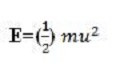
Equation 1
where m is the mass of one particle and u is the root mean square speed (rms speed) of the gas particles:
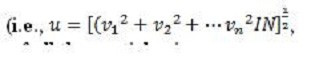
where N is the number of gas particles; this is different from the average speed). For an ideal gas, the
kinetic energy of all the particles is:
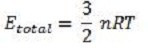
Equation 2
where n is the number of moles of gas. Combining these equations gives:
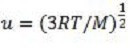
Equation 3
where M is the molar mass of the gas particles.
The average distance a particle travels between collisions is known as the mean free path l. Intuitively, the mean free path (mfp) could be expected to be larger for gases at low pressure, since there is a lot of space between particles. Similarly, the mfp should be larger when the gas particles are small. The following expression for the mfp shows this to be correct.
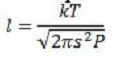
Equation 4
In this equation, s is the atomic diameter (typically on the order of 10?), k is the Boltzmann constant, and P is the pressure. In addition to colliding with one another, gas particles also collide with the walls of their container. If the container wall has a pinhole that is small compared to the mfp of the gas, and a pressure differential exists across the wall, the particles will effuse (or escape) through this pinhole without disturbing the Maxwellian distribution of the particles. The rate of effusion can be described by:
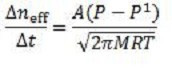
Equation 5
Where neff is the number of moles of effusing particles, A is the area of the pinhole, p and p1 are the
pressures on the inside and outside of the container wall respectively, and p>p1.
Which of the following gives values for both standard temperature and pressure?