
PMI-SP Real Exam Questions

PMI Scheduling Professional (PMI-SP)

323 questions available · Page 1 of 33

Updated Exam DumpsVerified AnswersPass Guarantee

Get Complete Exam Dumps
Question 1 Single choice

You are the project manager of the NHQ project. This project deals with a new technology that your company has never used before. You have petitioned the management to hire a consultant to help you and the project team to create the WBS, the activity list, and complete the duration estimates. The management is concerned about the costs of the consultant, but agrees to your request because of the nature of this new work.
The consultant can best be described as what type of resource for this project?

  1. A

    Direct expense

  2. B

    External requirement

  3. C

    Temporary resource

  4. D

    Expert judgment

Show answer and explanation

Correct answer: D

Explanation

Explanation:

The consultant is an example of expert judgment, as he is helping you and the project team to create the project elements. Expert judgment is a technique based on a set of criteria that has been acquired in a specific knowledge area or product area. It is obtained when the project manager or project team requires specialized knowledge that they do not possess. Expert judgment involves people most familiar with the work of creating estimates. Preferably, the project team member who will be doing the task should complete the estimates. Expert judgment is applied when performing administrative closure activities, and experts should ensure the project or phase closure is performed to the appropriate standards.
Answer option A is incorrect. The consultant may be considered a direct expense because the fees can only be assigned to your project work, but this is not the best choice for the question. Answer
option B is incorrect. An external requirement is not a valid choice for this question. Answer option C is incorrect. A temporary resource is not a valid project management term.
Question 2 Single choice

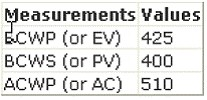
John works as a Project Manager for Blue Well Inc. He is measuring cost efficiency of his project. The key values are provided in the table below:

What is the cost performance index (CPI) of the project at the current point of time?

  1. A

    0.96

  2. B

    1.082

  3. C

    0.833

  4. D

    1.0625

Show answer and explanation

Correct answer: C

Explanation

Explanation:

According to the question, you are required to calculate the cost performance index (CPI) of the project.
Cost performance index (CPI) is used to calculate performance efficiencies. It is used in trend analysis to predict future performance. CPI is the ratio of earned value to actual cost. The CPI is calculated based on the following formula: CPI = Earned Value (EV) / Actual Cost (AC) If the CPI value is greater than 1, it indicates better than expected performance, whereas if the value is less than 1, it shows poor performance. The CPI value of 1 indicates that the project is right on target. Here, CPI is as follows: CPI = EV / AV = 425/510 = 0.833 As the CPI (0.833) is less than 1, it shows that the schedule performance is below expectation. What is BCWP (or EV)? Budgeted cost of work performed (BCWP) or Earned Value (EV) is the value of completed work. It is the budgeted amount for the work actually completed on the schedule activity during a given time period. What is BCWS (or PV)? Budgeted Cost of Work Scheduled (BCWS) or Planned Value (PV) is the authorized budget assigned to the scheduled work to be accomplished for a schedule activity or Work Breakdown Structure (WBS) component. What is ACWP (or AC)? Actual cost of work performed (ACWP) or Actual Cost (AC) is the total costs actually incurred and recorded in accomplishing work performed during a given time period for a schedule activity. It is the cost of the work to date, including direct and indirect costs. AC is money that has actually been expended to date.

Question 3 Single choice

You are the project manager for the NHQ project. The management has reminded you that you must not allocate any project team member for more than 25 hours per work week on your project. This policy is because your organization is in a weak matrix and the project team members are on several projects at once within the organization.
The 25-hour limit per resource is an example of which one of the following?

  1. A

    Expert judgment

  2. B

    Enterprise environmental factor

  3. C

    Resource limitation

  4. D

    Organizational process asset

Show answer and explanation

Correct answer: B

Explanation

Explanation:

The limit on each work is an organizational policy for each project. Policies, rules, and organizational requirements are the enterprise environmental factors.
Answer option D is incorrect. Organizational process assets are things that have been created for the project manager, such as software, templates, guidelines, and other resources that will assist the project manager in completing the project.
Answer option C is incorrect. While this could be a resource limitation, it is not a valid project management term. Resource leveling heuristics or a project constraint would have been acceptable answers.
Answer option A is incorrect. Expert judgment happens, when the project manager relies on someone with more knowledge on a topic to help the project manager make the best project decision.

Question 4 Single choice

You are the project manager of the QAQ Project. The QAQ Project has a BAC of $2,786,121. You are currently 20 percent complete with this project, though you should be 25 percent complete with the project work. The project has consumed $595,000 of the project budget to date. Management has asked you, based on the current project performance, what the project's estimate to complete will be considering the current project schedule variance.

What is the ETC for this project?

  1. A

    $2,975,000

  2. B

    1.02

  3. C

    $139,306

  4. D

    $2,380,000

Show answer and explanation

Correct answer: D

Explanation

Explanation:

The estimate to complete wants to know how much more money the project will need to complete its objectives. The estimate to complete (ETC) is the expected cost needed to complete all the remaining work for a scheduled activity, a group of activities, or the project. ETC helps project managers predict what the final cost of the project will be upon completion. The formula for the ETC is EAC-AC. The EAC is BAC/
CPI.
Answer option A is incorrect. This is the estimate at completion based on the current project performance.
Answer option C is incorrect. This is the current schedule variance. Answer
option B is incorrect. 1.02 is the to-complete performance index based on the BAC.

Question 5 Multiple choice

You work as a project manager for Honeywell Inc. You have been distributing performance information, including status reports, progress measurement, and forecasts to various stakeholders. A trainee of this company wants to know what are the inputs for generating performance reports.
Which of the following are the necessary inputs?
Each correct answer represents a part of the solution. Choose two.

  1. A

    Variance analysis

  2. B

    WPM

  3. C

    WPI

  4. D

    Change request

Show answer and explanation

Correct answers: B, C

Explanation

Explanation:

According to the scenario, you can use the following inputs in order to generate performance reports: WPI: Work performance information is the data gathered on the status of the project schedule activities that are performed to accomplish the project work. This data is collected as part of the Direct and Manage Project Execution processes. WPI includes the following: Deliverables status Schedule Progress Costs incurred WPM: Work performance measurements are created from the work performance information. WPMs are an output of Control schedule, Control cost, and Control scope processes, which are monitoring and controlling processes. WPMs consist of planned versus actual performance indicators with respect to scope, schedule, and cost. They are documented and communicated to the stakeholders and are used to make project activity metrics, such as the following: Planned vs. Actual Technical performance and Scope performance Planned vs. Actual Schedule performance Planned vs. Actual Cost performance Answer option A is incorrect. Variance analysis is an after-look at what caused a difference between the baseline and the actual performance. It is one of the tools and techniques used for report performance.
Answer option D is incorrect. Change requests are requests to expand or reduce the project scope, modify policies, processes, plans, or procedures, modify costs or budgets or revise schedules. These requests for a change can be direct or indirect, externally or internally initiated, and legally or contractually imposed or optional. A Project Manager needs to ensure that only formally documented requested changes are processed and only approved change requests are implemented.

Question 6 Single choice

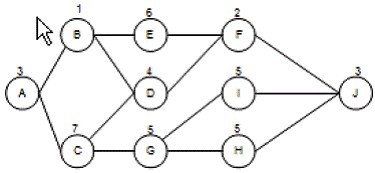
You are the project manager of the NHG. The following figure represents your project network diagram.

Management has asked that you add some features to the project scope. Through the change control system these changes are approved and they'll affect Activity I. The duration of Activity I, which is on the critical path, will decrease by three days.

What affect does this have on the critical path?

  1. A

    The critical path will now take 26 days.

  2. B

    The critical path will now take 17 days.

  3. C

    The critical path will now take 23 days.

  4. D

    The critical path will now take 20 days.

Show answer and explanation

Correct answer: C

Explanation

Explanation:

The critical path is the path in the project network diagram with the longest duration. In project management, a critical path is the sequence of project network activities which add up to the longest overall duration. This determines the shortest time possible to complete the project. Any delay of an activity on the critical path directly impacts the planned project completion date (i.e. there is no float on the critical path). This project actually has two critical paths. Path ACGIJ takes 23 days. Path ACGHJ also takes 23 days. When Activity I decreases by three days the critical will still take 23 days to complete as Path ACGHJ remains a critical path.
Answer option A is incorrect. The duration of the critical path did not increase. Answer
option D is incorrect. The duration of the path ACGIJ will decrease to 20 days but the critical path will remain at 23 days.
Answer option B is incorrect. The critical path did not reduce to 17 days.

Question 7 Single choice

What forecasting method would your project use if your project customer requires an autoregressive moving average for performance forecasting?

  1. A

    Judgmental methods

  2. B

    Time series method

  3. C

    Ensemble forecasting

  4. D

    Causal/econometric method

Show answer and explanation

Correct answer: D

Explanation

Explanation:

The autoregressive moving average is an example of a causal/econometric method for the forecasting project performance. The casual/econometric forecasting method uses the assumption that it is possible to identify the underlying factors, which might influence the variable being forecasted. For example, sales of umbrellas might be associated with weather conditions. If the causes are understood, projections of the influencing variables can be made and used in the forecast. Some examples of casual/econometric forecasting method are as follows: Regression analysis using linear regression or non-linear regression Autoregressive moving average (ARMA) Autoregressive integrated moving average (ARIMA)
Econometrics
Answer option B is incorrect. The time series method relies on the earned value, moving average, extrapolation, and growth curve.
Answer option A is incorrect. The judgmental methods use intuition, the Delphi method, and forecast by analogy.
Answer option C is incorrect. The ensemble forecasting is not part of the causal/econometric method for forecasting.

Question 8 Single choice

Amy is working on a project which is forty percent complete though it was scheduled to be fifty percent complete as of today. Management has asked Amy to report on the schedule variance for her project.
If Amy's project has a BAC of $750,000 and she has spent $485,000 to date, what is the schedule variance value?

  1. A

    -$75,000

  2. B

    -$42,000

  3. C

    -$45,000

  4. D

    -$65,000

Show answer and explanation

Correct answer: A

Explanation

Explanation:

The schedule variance is found by subtracting the planned value from the earned value. The earned value is the percentage of the project completeness multiplied by the BAC. Planned value is the percetage of where the project should be at this time multiplied by the BAC. Schedule variance (SV) is a measure of schedule performance on a project. The variance notifies that the schedule is ahead or behind what was planned for this period in time. The schedule variance is calculated based on the following formula:
SV = Earned Value (EV) - Planned Value (PV)
If the resulting schedule is negative, it indicates that the project is behind schedule. A value greater than 0 shows that the project is ahead of the planned schedule. A value of 0 indicates that the project is right on target. In this example,
EV = 40% of BAC
= 300,000, and
PV = 50% of BAC
= 375,000
SV = 300,000 - 375,000
= -75,000
Answer options C, B, and D are incorrect. These are not the correct values for the schedule variance.

Question 9 Single choice

Kay is the project manager of the QUI Project. This project is done but is also considerably over budget.
Kay has elected to crash the project in order to recoup schedule delays but this increased the project costs.

What should Kay do with the information regarding the schedule delays and cost overruns?

  1. A

    Create an entry in the lessons learned documentation and explain her reasoning behind the corrective actions.

  2. B

    Create an exceptions report.

  3. C

    Create a variance report.

  4. D

    File the information as part of the project final report.

Show answer and explanation

Correct answer: A

Explanation

Explanation:

When there have been significant corrective action decisions the reasoning behind the decision should be documented in the lessons learned documentation. What is lessons learned documentation? Lessons learned documentation is prepared to contribute to the lessons learned knowledge database of the organization. It includes the causes of issues, the reasoning behind the corrective action chosen, and other types of lessons learned about stakeholder management. Lessons learned are documented so that they become part of the historical database for the project/program and the performing organization. The lessons learned are compiled, formalized, and stored through out the project's/program's duration. Answer option C is incorrect. A variance report may be appropriate but cost and schedule variances are reported differently. Kay could create a cost variance report and a schedule variance report, but not one report for both project attributes.
Answer option B is incorrect. An exceptions report is the same as a variance report. Kay would create a separate exceptions report for cost, and another for schedule. Answer
option D is incorrect. The information may go into the project final report but it should be included in the project's lessons learned information when it is discovered.

Question 10 Single choice

Ned is the project manager for his organization. Ned is using a standard tool to capture, store, and distribute information to the stakeholders about the project costs, schedule, and performance.

What term is assigned to this communication tool?

  1. A

    Project management information system

  2. B

    Table reporting

  3. C

    Reporting system

  4. D

    Communications management system

Show answer and explanation

Correct answer: C

Explanation

Explanation:

This is simply an example of a reporting system. It can be part of the project management information system, but for your examination, the PMBOK acknowledges this tool directly as part of project performance reporting. Reporting system is a tool and technique used for reporting performance. It is a standard means to store, capture, and give out the information to the stakeholders about the project costs, performance, and schedule.
Answer option A is incorrect. The project management information system does more than just communicating the performance. It is a tool to help the project manager plan and monitor the project.
Answer option D is incorrect. The PMBOK does not mention a communications management system.
Answer option B is incorrect. Table reporting is one output of a reporting system, not the entire system.