Which of the following techniques is used to test customer acceptance of the solution and to measure marketplace demand?
Show answer and explanation
Correct answer: B
CBAP Real Exam Questions
498 questions available · Page 1 of 50
Updated Exam DumpsVerified AnswersPass Guarantee
Which of the following techniques is used to test customer acceptance of the solution and to measure marketplace demand?
Correct answer: B
A business unit of a transnational manufacturer wants to implement a robust process for addressing integrity-critical equipment deterioration incidents. Timely and complete resolution of such incidents is vital for the business unit's continuous safe and profitable operation. Treating each incident involves many employees from different departments extensively collaborating and exchanging information. That information is spread across multiple systems having their access limited to particular user groups. With the current manual process, some incidents get forgotten and remain unresolved for years.
The project's Sponsor is an Equipment Integrity and Reliability Advisor, who moved into this position from another business unit. That business unit implemented a proprietary application to integrate the information and to assist in tracking and managing the incidents. Having a positive experience with the application, the Sponsor is suggesting to customize it and reuse in the new business unit.
The business unit's Enterprise Architect (EA), who is responsible for assessing solution options and presenting them to executive decision makers, has a few concerns with adopting the existing application.
The application uses point-to-point interfaces with other data sources whereas the business unit's target architecture relies on a data warehouse-based integration. Moreover, the two business units use different legacy systems, as well as different front-end implementation technologies. Additionally, the existing application is monolingual, while the business unit needs user interfaces and some data to be presented in two languages. With all of this, it may be easier to build a new application from scratch than to customize the existing one. To understand which option is better, the EA asks a business analyst (BA) to define business requirements.
Through the elicitation process, the BA identifies the following requirement: "Particular incident-related activities require approval by authorized personnel before beginning them, as well as confirmation of acceptance of their completion."
What kind of asset should the BA provide to fully specify the approval requirement?
Correct answer: B
A local manufacturer that serves about 1000 retail stores is experiencing a slow yet steady decrease of its customer base over the last couple of years. Attributing the situation to increased competition, management has hired a team of sales representatives to attract new clients and promote the manufacturer's products. However, after four months there is still no progress. Management has engaged a business analyst (BA) to investigate this issue.
What should the BA do first?
Correct answer: C
You are the business analyst for your organization and are preparing for the conduct elicitation activities.
You'll have six inputs as you prepare for this activity.
Which one of the following is not a valid input for the requirements elicitation activity?
Correct answer: B
Martha is observing Gary complete several activities as part of her requirements elicitation process.
Martha is simply observing the steps Gary takes to complete his work and she is taking notes. In this
instance Martha does not ask Gary any questions.
What type of observation technique is Martha completing?
Correct answer: C
Company A is a nation-wide leader in commercial demolition. Having just celebrated its 100th year of operations, the company decided to begin doing work internationally. The current system used for reporting company finances is unable to keep pace with the potential demands of doing work in geographically dispersed locations. Therefore, the company decided to replace its client-based Profit &
Loss (P&L) reporting system with a more robust, web-based system. This will ensure transparency across the organization and enable better decision making.
The business analyst (BA) at Company A has recently completed several rounds of elicitation to determine the requirements for the new, web-based system. Over 1250 requirements were elicited. An initial Requirements Traceability Matrix (RTM) has been drafted, and a subset of the RTM can be seen below:
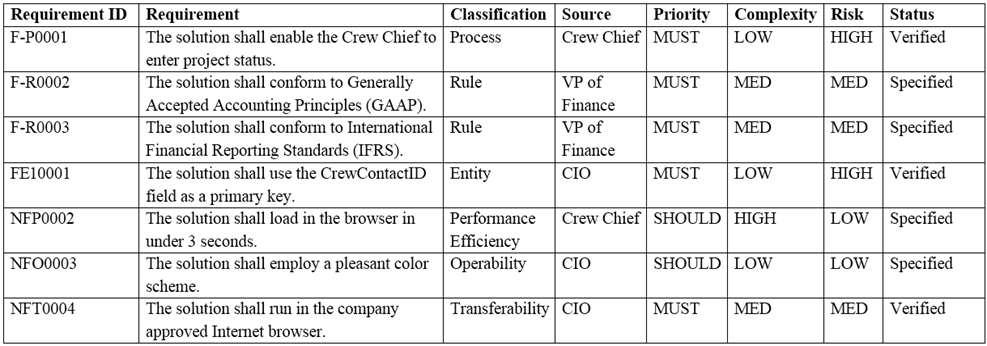
The BA is working on identifying additional improvement opportunities based on these requirements.
Which of the following improvement opportunities is reflected in Requirement ID NFP0002?
Correct answer: D
An insurance company wants to increase sales by 15% and customer retention by 10% within 1 calendar year. Various strategies to achieve this were considered and a restructure to the existing pricing model is selected to help achieve these goals.
A business analyst (BA) works with stakeholders such as actuaries, product specialists, sales staff, risk managers, and underwriters who agree to applying varying levels of discounts to customers based on:
- Total annual premium the customer has with the company (Financial worth)
- Time with the insurance company (Loyalty)
Various financial models are considered but the stakeholders agree that an initial applicable discount is determined based on the customer's overall premium:
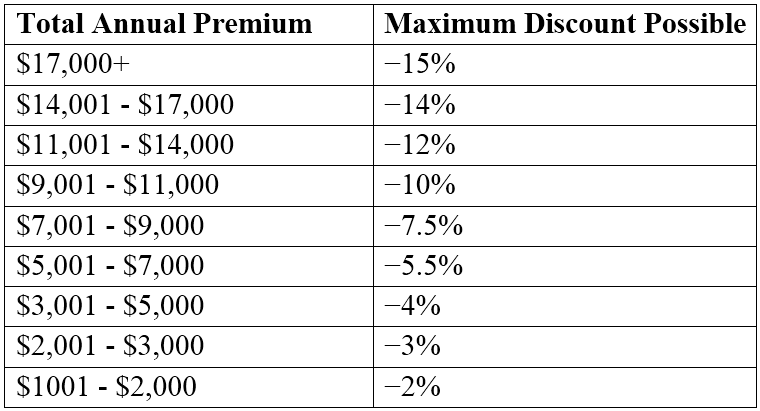
The percentage of the maximum possible discount available to the customer is adjusted based on time with the company:
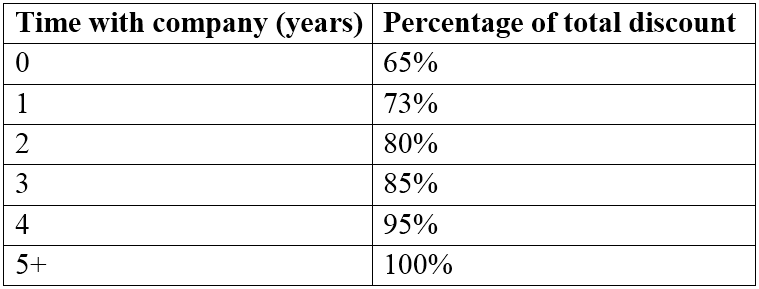
If within the first six months, customer retention increased by 5 % and sales increased by 6%, then when will the desired sales and retention goals be achieved assuming the trend continues at the same pace?
Correct answer: B
A major manufacturer of popular beverages has appointed a local distributor to serve a specific territory.
The demand for the beverages has a pronounced seasonal pattern. The distributor performs well overall, but is repeatedly unable to keep up with fulfilling many customer orders during peak demand periods. The distributor's current delivery capability is stretched to deliver 60 tons of merchandise per day whereas the season's peak demand periods need a daily delivery capability of up to 100 tons.
The distributor is under pressure to fully meet the year-round market demand in order to stay in business.
The distributor's management wants to identify and consider more cost-effective options as resorting to adding more trucks and drivers would not be economically feasible.
A business analyst (BA) has spent several days observing and measuring the warehouse activities to understand the situation and to gain insights into possible solutions. The delivery workflow is a four-step process: (1) picking the orders and assembling them on trays, (2) bringing the trays to the loading bay, (3) loading the orders into trucks, and (4) delivering the orders to customers. As the following table illustrates, overall performance depends is dependent on five major resources: (1) the workers who pick the orders and load them into trucks, (2) the tallyers who check the orders, (3) the drivers, (4) the trucks, and (5) eight loading bays (LBs).
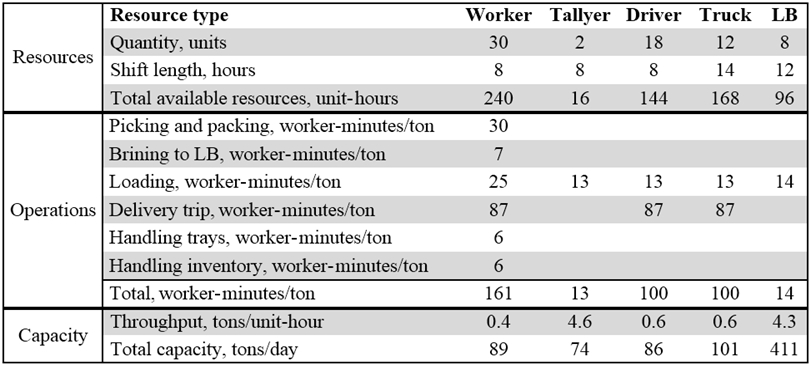
If the driver's average throughput is 0.6 tons/hour, how many hours per day would 15 drivers have to work to deliver 100 tons of merchandise?
Correct answer: D
Company A has been engaged to provide solution software to Company B as part of a combined service offering to Company C. This initiative requires a sub-project for Companies A and B to learn Company C's statutory requirements, a sub-project for Company A to write custom functionality for the solution, and a sub-project for Company B to develop infrastructure and support for the solution as well as the main project of implementation and cutover from Company C's current data processing solution to the service from Company B.
How does the business analyst (BA) assign requirements to the various solution components to ensure all objectives are met?
Correct answer: B
Which of the following types of elicitation allows each stakeholder to freely discuss their role in a particular process?
Correct answer: D