PMI-ACP Exam Details
-
Exam Code
:PMI-ACP -
Exam Name
:PMI Agile Certified Practitioner (PMI-ACP) -
Certification
:PMI Certifications -
Vendor
:PMI -
Total Questions
:999 Q&As -
Last Updated
:Jul 14, 2026
PMI PMI-ACP Online Questions & Answers
-
Question 951:
Which three of the following points about the daily Scrum are TRUE? (Choose three.)
A. It is time-boxed
B. It is held at the same place and time every day
C. The Product Owner provides an update
D. The Scrum Master enforces the rule that only Development Team members participate -
Question 952:
The ScrumMaster and the Product Owner disagree on the value of a Product Backlog item. In order to resolve the disagreement, the first step the ScrumMaster should take is to ask:
A. The Product Owner to clarify the requirement.
B. The business owner to resolve the problem.
C. The business analyst to research the product value.
D. Another project manager how to resolve the problem. -
Question 953:
Which type of estimate refers to estimating a story based on its relationship to one or more other stories?
A. Algorithmic
B. Computational
C. Triangulating
D. Rules of Thumb -
Question 954:
During a recent sprint review meeting with stakeholders, the product owner received detailed feedback indicating the critical changes needed for upgrading the legacy system to better align with the latest technologies and user needs. How should the product owner help ensure the product backlog is effectively managed, while helping the team remain focused?
A. Prioritize the stakeholder feedback, considering the impact on strategic objectives and current workload, and discuss these priorities with the team in the next sprint planning meeting to collaboratively decide on the next steps.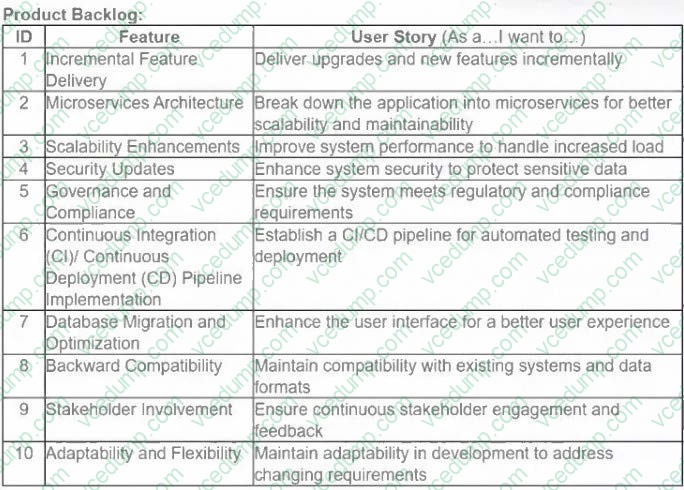
B. Implement the changes in the current sprint, reallocating resources and adjusting the sprint goals to accommodate the feedback immediately, regardless of the current workload and potential impact on ongoing tasks.
C. Update the product backlog immediately without consulting the team, ensuring that the most critical feedback is addressed as soon as possible, even if it disrupts the current work flow
D. Disregard the feedback until the next product release, focusing solely on the current sprint commitments to avoid any disruption and maintain the current work flow, even if it means delaying potentially valuable changes. -
Question 955:
The Kaizen philosophy is change:
A. For the better.
B. Driven by process improvement.
C. Driven by teams.
D. Forsmallgroups. -
Question 956:
Scrum is a container for other techniques and methodologies.
A. True
B. False -
Question 957:
A 4-hour Sprint Planning meeting is typical for a Sprint or Iteration that is how long?
A. Four weeks
B. Two weeks
C. One week
D. Four days -
Question 958:
In the Kano Model of customer satisfaction, this type of feature makes a product unique from its competitors and contributes 100% to positive customer satisfaction:
A. Excitement
B. Performance
C. Must-have
D. Threshold -
Question 959:
After a successful product deployment, a key stakeholder informs an agile team member that an implemented feature is failing to deliver its expected business value. The team member replies that the requirement was provided by the customer, and that the scope was clearly met. If the problem were an issue of requirement elicitation rather than delivery, what should have been done to avoid this situation?
A. Stakeholders should have regularly been engaged to obtain feedback and reduce the functionality risk.
B. The team should have used the lean principle of delay, so that actual facts could be considered rather than assumptions and predictions.
C. Interdependent teams should have been engaged using a collaborative approach to identify and leverage the best support.
D. An owner should have been identified to obtain timely stakeholder feedback. -
Question 960:
Refactoring, as it applies to the practice of extreme Programming (XP), refers to:
A. Restructuring the estimate by applying a higher cost performance index during "what if" analysis.
B. Modifying the project due to scope changes, resource availability, and cost and schedule variances.
C. Modifying the cost baseline due to an increased estimate at completion and a negative cost variance.
D. Restructuring of code so as to improve the code without changing its external behavior.
Related Exams:
-
CAPM
Certified Associate in Project Management (CAPM) -
CPMAI
Cognitive Project Management in AI CPMAI v7 - Training & Certification -
DASM
Disciplined Agile Scrum Master (DASM) -
DASSM
Disciplined Agile Senior Scrum Master (DASSM) -
PFMP
Portfolio Management Professional (PfMP) -
PGMP
Program Management Professional (PgMP) -
PMI-ACP
PMI Agile Certified Practitioner (PMI-ACP) -
PMI-CPMAI
PMI Certified Professional in Managing AI -
PMI-PBA
PMI Professional in Business Analysis (PMI-PBA) -
PMI-PMOCP
PMI Project Management Office Certified Professional
Tips on How to Prepare for the Exams
Nowadays, the certification exams become more and more important and required by more and more enterprises when applying for a job. But how to prepare for the exam effectively? How to prepare for the exam in a short time with less efforts? How to get a ideal result and how to find the most reliable resources? Here on Vcedump.com, you will find all the answers. Vcedump.com provide not only PMI exam questions, answers and explanations but also complete assistance on your exam preparation and certification application. If you are confused on your PMI-ACP exam preparations and PMI certification application, do not hesitate to visit our Vcedump.com to find your solutions here.