AICPA CPA-TEST Online Practice
Questions and Exam Preparation
CPA-TEST Exam Details
Exam Code
:CPA-TEST
Exam Name
:Certified Public Accountant Test: Auditing and Attestation, Business Environment and Concepts, Financial Accounting and Reporting, Regulation
Certification
:AICPA Certifications
Vendor
:AICPA
Total Questions
:1241 Q&As
Last Updated
:Aug 03, 2026
AICPA CPA-TEST Online Questions &
Answers
Question 461:
Which of the following methods of measuring transaction exposure to exchange rate risk uses standard deviation, coefficient of correlation and other formal statistical techniques?
A. Measurement of currency variability. II. Measurement of currency correlations. B. I only. C. II only. D. Both I and II. E. Neither I and II.
C. II only. Choice "c" is correct. The currency variability approach uses standard deviations as a means of predicting future exchange rates while the currency correlation approach is often applied to circumstances involving multiple currencies and evaluates exposure in relation to the statistically computed degree of correlation between the movements of different currencies. Choices "a", "b", and "d" are incorrect, per above Explanation.
Question 462:
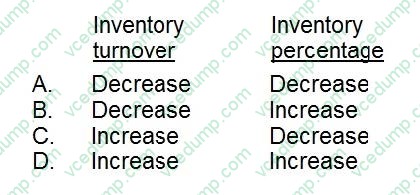
ABC Co. changed from a traditional manufacturing philosophy to a just-in-time philosophy. What are the expected effects of this change on ABC's inventory turnover and inventory as a percentage of total assets reported on ABC's balance sheet?
A. Option A B. Option B C. Option C D. Option D
C. Option C Choice "c" is correct. In a just-in-time system, products are produced just-in-time to be sold. Therefore, JIT systems maintain a much smaller level of inventory when compared to traditional systems. Inventory turnover (cost of goods sold divided by average inventory) increases with a switch to JIT, and inventory as a percentage of total assets decreases. Choices "a", "b", and "d" are incorrect based on the above Explanation.
Question 463:
Return on assets:
A. Is a measure of profitability and indicates how much is left of each sales dollar to cover operating expenses and profit. B. Is a profitability measure and can be used to evaluate the efficiency of asset usage and management, and the effectiveness of business strategies to create profits. C. Measures the amount of operating income earned above the imputed cost of capital for the operating unit. If the measure is positive, returns exceed the cost of financing the operating unit. D. Measures asset activity and the ability of the firm to generate sales through the use of assets. Generally, the more sales dollars generated per dollar of assets used, the better the net income of an entity.
B. Is a profitability measure and can be used to evaluate the efficiency of asset usage and management, and the effectiveness of business strategies to create profits. Choice "b" is correct. Return on assets is a profitability measure and can be used to evaluate the efficiency of asset usage and management, and the effectiveness of business strategies to create profits. Choice "a" is incorrect. This option defines gross profit margin. Choice "c" is incorrect. This option defines residual income. Choice "d" is incorrect. This option defines total asset turnover.
Question 464:
If a nation has superior conditions in which to grow coffee beans and firms are able to grow them at very low costs, which of the four major factors that Michael Porter has indicated impact the global competitive environment would allow this nation to fare better with respect to global competitive advantage?
A. Conditions of the factors of production. B. Conditions of domestic demand. C. Related and supporting industries. D. Firm strategy, structure, and rivalry.
A. Conditions of the factors of production. Choice "a" is correct. If a nation has a strong set of factors of production (such as low cost, high quality raw material inputs), that are required in a given industry, it will fare better with regard to competitive advantage. Choice "b" is incorrect. Conditions of domestic demand relate to the nation's domestic demand for the product, which is directly related to the ability of the nation to fare better with regard to competitive advantage. Choice "c" is incorrect. The factor of related and supporting industries deals with whether there are suppliers of material inputs that exist within a nation or whether there are rival firms who are competitive in the international environment, both of which would increase the nation's competitive advantage. Choice "d" is incorrect. The factor of firm strategy, structure, and rivalry relates to the practices of a nation with respect to how the companies are managed and organized, long with the laws of the nation that regulate the formation of the companies, and how intense the rivalry is with respect to competing firms in the nation.
Question 465:
When an auditor believes there is substantial doubt about the ability of an entity to continue as a going concern, all of the following should be included in the audit documentation, except:
A. The conditions that gave rise to the substantial doubt. B. The auditor's conclusion about whether substantial doubt remains or is alleviated. C. Management's conclusion regarding whether substantial doubt remains or is alleviated. D. The effect of the auditor's conclusion on the auditor's report.
C. Management's conclusion regarding whether substantial doubt remains or is alleviated. Choice "c" is correct. Whether substantial doubt remains or is alleviated is a judgment call made by the auditor, and there is no requirement to document management's opinion on the matter. Choices "a", "b", and "d" are incorrect. When an auditor believes there is substantial doubt about the ability of an entity to continue as a going concern, the conditions that gave rise to the substantial doubt, the auditor's conclusion about whether substantial doubt remains or is alleviated, and the effect of the auditor's conclusion on the auditor's report should all be documented.
Question 466:
An entity engaged a CPA to determine whether the client's web sites meet defined criteria for standard business practices and controls over transaction integrity and information protection. In performing this engagement, the CPA should comply with the provisions of:
A. Statements on Assurance Standards. B. Statements on Standards for Attestation Engagements. C. Statements on Standards for Management Consulting Services. D. Statements on Auditing Standards.
B. Statements on Standards for Attestation Engagements. Choice "b" is correct. A WebTrust engagement is an attestation engagement in which the CPA determines whether the client's web site meets defined criteria relating to transaction integrity, information protection, and disclosure of business practices. Attestation engagements should be performed in accordance with Statements on Standards for Attestation Engagements (SSAEs). Choice "a" is incorrect. Statements on Assurance Standards is a distracter. Choice "c" is incorrect. Consulting services provided by CPAs range from advice on accounting-related matters to a wide range of services involving diverse technical disciplines. Consulting services performed by CPAs should be performed in accordance with Statements on Standards for Consulting Services (SSCSs). Choice "d" is incorrect. Audits (generally of financial statements) performed by CPAs should be performed in accordance with Statements on Auditing Standards (SASs).
Question 467:
In which type of business organization are income taxes always required to be paid by the entity on profits earned as well as by the owners upon distribution thereof?
A. General partnership. B. Limited liability company. C. Subchapter C corporation. D. Subchapter S corporation.
C. Subchapter C corporation. Choice "c" is correct. A Subchapter C corporation is taxed as an entity for income tax purposes. Additionally, distributions made to stockholders are treated as taxable income to the stockholders. [Note that this type of corporation is more often called a C corporation instead of a Subchapter C corporation.] Choice "a" is incorrect. A general partnership is not taxed as a separate entity for income tax purposes. Choice "b" is incorrect. An LLC is not taxed as a separate entity for income tax purposes unless the LLC specifically elects to be taxed like a corporation. [Of course, the word "always" in the question takes care of that.] Choice "d" is incorrect. A Subchapter S corporation is taxed as a partnership. Thus, it is not taxed as a separate entity for income tax purposes. [Note that this type of corporation is more often called an S corporation instead of a Subchapter S corporation.]
Question 468:
Gearty and Duffy, certified public accountants, have been engaged to perform an audit of Sleepy Knoll Township in accordance with OMB Circular A-133. In connection with that engagement, Gearty and Duffy will determine major programs:
A. Using a list of programs included in the work plan of the Office of the Inspector General. B. By applying only a specific dollar threshold, where all programs exceeding the threshold would be considered major. C. By applying a risk-based approach. D. By testing enough grants to achieve a single specific coverage percentage.
C. By applying a risk-based approach. Choice "c" is correct. OMB Circular A-133 allows auditors to use a risk-based approach to determine major grants. Choice "a" is incorrect. The judgment of the Office of the Inspector General would not exclusively influence the selection of major programs. Choice "b" is incorrect. Programs in excess of $300,000 are generally considered to be major grants; however, the dollar threshold is not the exclusive determinant of major programs. Choice "d" is incorrect. Risk-based auditing allows auditors to test as little as 25 percent of total federal programs or as much as 50 percent of total federal programs, depending on circumstances and on the auditor's judgment.
Question 469:
Wallace purchased 500 shares of ABC, Inc. 15 years ago for $25,000. Wallace has worked as an owner/ employee and owned 40% of the company throughout this time. This year, ABC, which is not an S corporation, redeemed 100% of Wallace's stock for $200,000. What is the treatment and amount of income or gain that Wallace should report?
A. $0 B. $175,000 long-term capital gain. C. $175,000 ordinary income. D. $200,000 long-term capital gain.
B. $175,000 long-term capital gain. Choice "b" is correct. An investment in a capital asset (e.g., stock) results in the income being capital (either a capital loss or a capital gain). Ownership percentage is not a factor in the calculation, and, in this question, nor is the fact that the corporation is not an S corporation. The calculation is simple: Wallace invested $25,000 in the stock and received $200,000 for 100% of his investment 15 years later. The capital gain is $175,000 ($200,000 - $25,000), and it is considered long-term because the stock was held for greater than one year. Choice "a" is incorrect. There is $175,000 of gain on the transaction ($200,000 - $25,000). This type of transaction is not a transaction that is excluded from tax in the tax code. Choice "c" is incorrect. An investment in a capital asset (e.g., stock) results in the income being capital (either a capital loss or a capital gain). Although the calculation of the income is correct (i.e., $175,000), ordinary income is not the proper treatment for this transaction. Choice "d" is incorrect. Although this transaction does result in a long-term capital gain, Wallace has basis in the stock ($25,000), and the gain is calculated as the proceeds from the sale ($200,000) less the basis in the stock.
Question 470:
The net present value of a proposed investment is negative; therefore, the discount rate used must be:
A. Greater than the project's internal rate of return. B. Less than the project's internal rate of return. C. Greater than the firm's cost of equity. D. Less than the incremental borrowing rate.
A. Greater than the project's internal rate of return. Choice "a" is correct. If the NPV of a proposed investment is negative, the discount rate used must be greater than the project's internal rate of return (IRR). The IRR is the discount rate that results in a NPV of zero. If a discount rate used is greater than the project's IRR, the present value of future cash inflows will be lower resulting in a negative net present value. If a discount rate used is less than the project's IRR, the present value of future cash inflows will be higher resulting in a positive net present value. Choices "b", "c", and "d" are incorrect, per the above discussion.
Nowadays, the certification exams become more and more important and required by more and more
enterprises when applying for a job. But how to prepare for the exam effectively? How to prepare
for the exam in a short time with less efforts? How to get a ideal result and how to find the
most reliable resources? Here on Vcedump.com, you will find all the answers.
Vcedump.com provide not only AICPA exam questions,
answers and explanations but also complete assistance on your exam preparation and certification
application. If you are confused on your CPA-TEST exam preparations
and AICPA certification application, do not hesitate to visit our
Vcedump.com to find your solutions here.