CPA-TEST Exam Details
-
Exam Code
:CPA-TEST -
Exam Name
:Certified Public Accountant Test: Auditing and Attestation, Business Environment and Concepts, Financial Accounting and Reporting, Regulation -
Certification
:AICPA Certifications -
Vendor
:AICPA -
Total Questions
:1241 Q&As -
Last Updated
:Aug 03, 2026
AICPA CPA-TEST Online Questions & Answers
-
Question 481:
Under the uniform capitalization rules applicable to taxpayers with property acquired for resale, which of the following costs should be capitalized with respect to inventory if no exceptions have been met?
A. Option A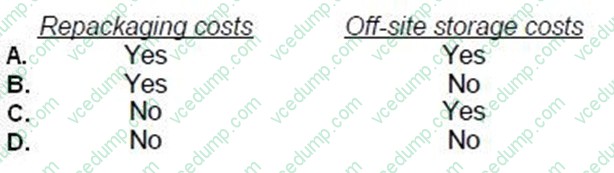
B. Option B
C. Option C
D. Option D -
Question 482:
In an audit of an issuer:
A. Management must assess and report on internal control. II. The auditor must assess and report on internal control.
B. I only.
C. II only.
D. Either I or II.
E. Both I and II. -
Question 483:
A large increase in nominal wages, perhaps orchestrated by unions, would most likely result in:
A. An increase in real GDP and a decrease in the price level.
B. A decrease in real GDP and an increase in the price level.
C. A decrease in real GDP and a decrease in the price level.
D. An increase in real GDP and an increase in the price level. -
Question 484:
The ABC Corporation is considering the acquisition of a new machine. The machine can be purchased for $90,000; it will cost $6,000 to transport to ABC's plant and $9,000 to install. It is estimated that the machine will last 10 years, and it is expected to have an estimated salvage value of $5,000. Over its 10-year life, the machine is expected to produce 2,000 units per year with a selling price of $500 and combined material and labor costs of $450 per unit. Federal tax regulations permit machines of this type to be depreciated using the straight-line method over 5 years with no estimated salvage value. ABC has a marginal tax rate of 40 percent.
What is the net cash outflow at the beginning of the first year that ABC Corporation should use in a capital budgeting analysis?
A. $(85,000)
B. $(90,000)
C. $(96,000)
D. $(105,000) -
Question 485:
ABC Corporation is evaluating a capital investment that would result in a $30,000 higher contribution margin benefit and increased annual personnel costs of $20,000. The effects of income taxes on the net present value computation on these benefits and costs for the project are to:
A. Decrease both benefits and costs.
B. Decrease benefits but increase costs.
C. Increase benefits but decrease costs.
D. Increase both benefits and costs. -
Question 486:
An auditor would least likely use computer software to:
A. Construct parallel simulations.
B. Access client data files.
C. Prepare spreadsheets.
D. Assess EDP control risk. -
Question 487:
When the Economic Order Quantity (EOQ) model is used for a firm, which manufactures its inventory, ordering costs consist primarily of:
A. Insurance and taxes.
B. Storage and handling.
C. Production set-up.
D. Cost of funds. -
Question 488:
In a competitive labor market, a minimum wage that is set above the equilibrium wage will result in which of the following:
A. A decrease in the quantity demanded of labor.
B. An increase in the quantity supplied of labor.
C. A decrease in total employment.
D. All of the above. -
Question 489:
Which of the following parties is liable to repay an illegal distribution to a corporation?
A. A director not breaching his or her duty in approving the distribution and the corporation is solvent.
B. A director not breaching his or her duty in approving the distribution and the corporation is insolvent.
C. A shareholder not knowing of the illegality of the distribution and the corporation is solvent.
D. A shareholder knowing of the illegality of the distribution and the corporation is insolvent. -
Question 490:
Greller owns 100 shares of ABC Corp., a publicly-traded company, which Greller purchased on January 1, 2001, for $10,000. On January 1, 2003, ABC declared a 2-for-1 stock split when the fair market value (FMV) of the stock was $120 per share. Immediately following the split, the FMV of ABC stock was $62 per share. On February 1, 2003, Greller had his broker specifically sell the 100 shares of ABC stock received in the split when the FMV of the stock was $65 per share. What is the basis of the 100 shares of ABC sold?
A. $5,000
B. $6,000
C. $6,200
D. $6,500
Tips on How to Prepare for the Exams
Nowadays, the certification exams become more and more important and required by more and more enterprises when applying for a job. But how to prepare for the exam effectively? How to prepare for the exam in a short time with less efforts? How to get a ideal result and how to find the most reliable resources? Here on Vcedump.com, you will find all the answers. Vcedump.com provide not only AICPA exam questions, answers and explanations but also complete assistance on your exam preparation and certification application. If you are confused on your CPA-TEST exam preparations and AICPA certification application, do not hesitate to visit our Vcedump.com to find your solutions here.