350-080 Exam Details
-
Exam Code
:350-080 -
Exam Name
:CCIE Data Center Written -
Certification
:Cisco Certifications -
Vendor
:Cisco -
Total Questions
:473 Q&As -
Last Updated
:Dec 06, 2021
Cisco 350-080 Online Questions & Answers
-
Question 251:
Which two statements about dynamic port binding are true? (Choose two.)
A. The port is connected when the VM is powered on and disconnected when the VM is powered off.
B. The port is created when the VM is powered on and destroyed when the VM is powered off.
C. The max-port limits are enforced.
D. The max-port limits are not enforced.
E. The port is always connected. -
Question 252:
A Cisco UCS fabric interconnects in end-host mode learns MAC addresses on which port types? (Choose four.)
A. Uplink Ethernet ports or border ports
B. Appliance ports
C. Server ports
D. Fabric ports
E. Backplane ports
F. vEth interfaces
G. A Fabric Interconnect doesn't learn MAC addresses in End Host mode. Pinning is used instead. -
Question 253:
Cisco FabricPath switches support ECMP forwarding for known unicast frames. If the destination switch ID can be reached through more than one output interface with equal cost, the forwarding engine uses a hash function to pick one of the interfaces. Which three options are valid for hash input for unicast frames? (Choose three.)
A. Use only the source parameters (layer-3, layer-4, or mixed).
B. Use the FabricPath switch ID in the FabricPath header.
C. Use only the destination parameters (layer-3, layer-4, or mixed).
D. Use both the source and the destination parameters (layer-3, layer-4, or mixed).
E. Include only Layer 2 input (source or destination MAC address). -
Question 254:
Which statement about ESS SW_ILS frames is true?
A. ESS SW_ILS frames are addressed from the management server of a requesting switch to the Management Server of a responding switch.
B. ESS SW_ILS frames are addressed from the name server of a requesting switch to the Name Server of a responding switch.
C. ESS SW_ILS frames are addressed from the domain controller of a requesting switch to the Domain Controller of a responding switch.
D. ESS SW_ILS frames are addressed from the alias server of a requesting switch to the Alias Server of a responding switch.
E. ESS SW_ILS frames are addressed from the time server of a requesting switch to the Time Server of a responding switch. -
Question 255:
Refer to the exhibit.
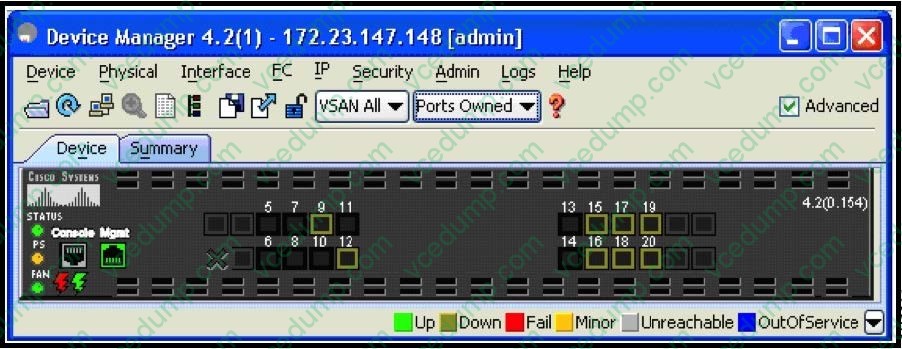
How is the VLAN configuration accomplished in the Device Manager?
A. This configuration is done under the IP selection.
B. This configuration is done under Interface selection.
C. This configuration cannot be done in Device Manager.
D. This configuration is done by clicking the VSAN drop-down list and choosing VLAN All. -
Question 256:
Nexus# 57ther igmp snooping vlan 120 IGMP Snooping information for vlan 120 IGMP snooping disabled Optimised Multicast Flood (OMF) disabled IGMP querier none Switch-querier enabled, address 1.1.1.1, currently not running IGMPv3 Explicit tracking enabled IGMPv2 Fast leave disabled IGMPv1/v2 Report suppression enabled IGMPv3 Report suppression disabled Link Local Groups suppression enabled Router port detection using PIM Hellos, IGMP Queries Number of router-ports: 0 Number of groups: 0 Active ports: Po100 Po111 Which statement best describes what is depicted in the show command output?
A. IGMP snooping is not active for VLAN 120 because the IGMP feature has not been enabled on the switch with the feature igmp command.
B. The IGMP snooping querier for VLAN 120 is not in a running state because the Loopback interface configured with 1.1.1.1/32 is currently in a down state.
C. IGMP snooping has been disabled on the VLAN 120 SVI.
D. IGMP snooping has been disabled for VLAN 120 in VLAN configuration mode.
E. IGMP snooping is not active for VLAN 120 because VLAN 120 does not exist in the VLAN database. -
Question 257:
The vPC peer-gateway capability allows a vPC switch to act as the active gateway for packets that are addressed to the router MAC address of the vPC peer. This feature enables local forwarding of such packets without the need to cross the vPC peer link.
Which statements are true about the vPC peer-gateway? (Choose two.)
A. The vPC peer-gateway feature is enabled by default.
B. The vPC peer-gateway feature can be configured globally under the vPC domain submode.
C. Enabling the peer-gateway feature automatically disables IP redirects on all interface VLANs mapped over a vPC VLAN to avoid generation of IP redirect messages for packets switched through the peer gateway router.
D. The vPC peer-gateway feature only works with HSRP protocol. -
Question 258:
Refer to the exhibit.
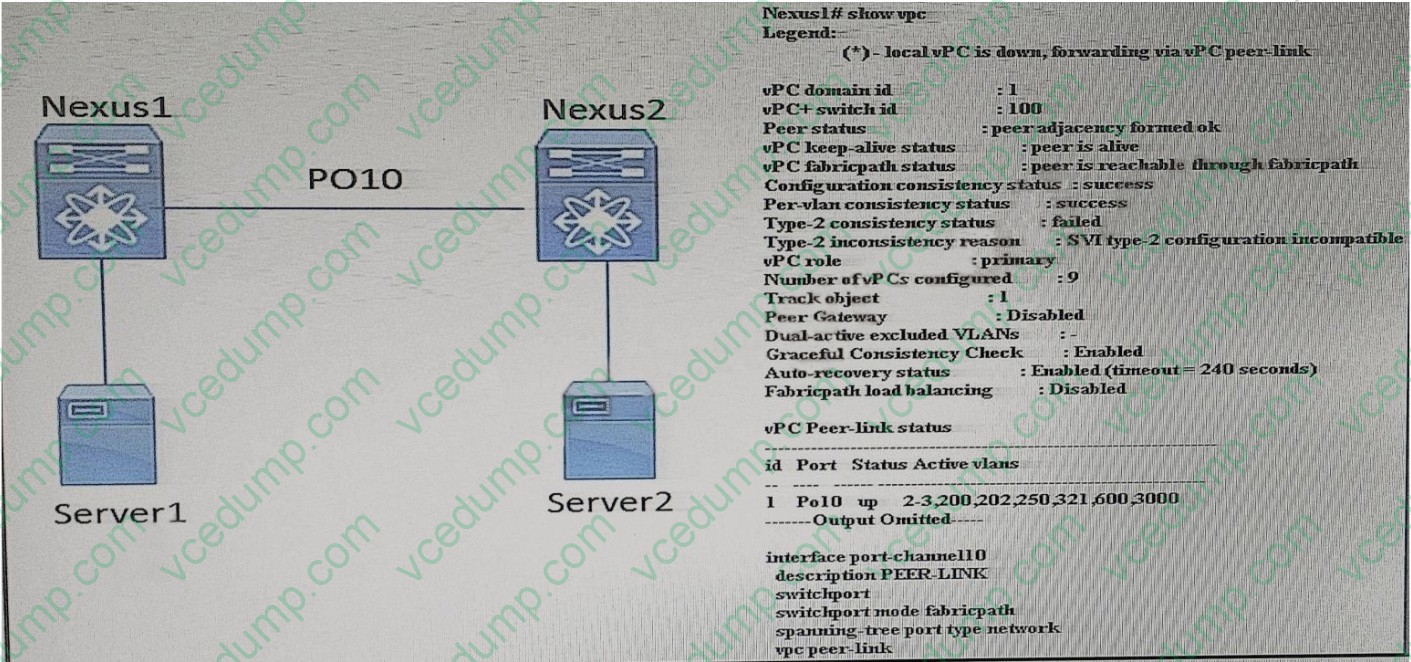
Server 1 and server 2 are on the same VLAN but cannot reach each other. Which option describes the reason?
A. Interface VALN (SVI) must be configured for this VLAN.
B. VLAN is not allowed on the peer link.
C. VLAN is not on FabricPath mode.
D. Type2 inconsistency prevents the communication. -
Question 259:
You have a customer with an MDS fabric that is experiencing a performance problem. You suspect that the problem is due to a BB credit starvation issue with a host HBA. The customer has both a DS-PAA-2 and a Fibre Channel Analyzer on location. You want to collect a trace and look at the R_RDY flows between the MDS and the host. Which of the following actions is the best way to start troubleshooting this problem?
A. Collect a Fibre Channel Analyzer local brief trace on the MDS and look for missing R_RDYs.
B. Collect a Fibre Channel Analyzer local trace with full detail on the MDS, because the detail is needed to examine the R_RDY flow.
C. Use the DS-PAA-2 and the MDS span feature to capture a trace and examine the R_RDY flow between the host and MDS.
D. Use the Finisar and the MDS span feature to capture a trace because the DS-PAA-2 cannot decode R_RDYs.
E. Break the physical connection between the host and MDS and insert the Fibre Channel Analyzer inline. -
Question 260:
What does the mac packet-classify command do when applied to an interface configuration?
A. It enables MAC ACLs to be applied to only IP packets that enter the interface.
B. It enables MAC ACLs to be applied to only non-IP packets that enter the interface.
C. It enables MAC ACLs to be applied to all packets that enter the interface.
D. It enables MAC ACLs to be used for QoS settings.
Related Exams:
-
300-745
Designing Cisco Security Infrastructure (300-745 SDSI) v1.0 -
350-101
Implementing and Operating Cisco Wireless Core Technologies (350-101 WLCOR)v1.0 -
352-011
Cisco Certified Design Expert Practical -
500-052
Cisco Unified Contact Center Express -
500-173
Designing the FlexPod Solution (FPDESIGN) -
500-201
Deploying Cisco Service Provider Mobile Backhaul Solutions -
500-210
SP Optical Technology Field Engineer Representative -
500-220
Engineering Cisco Meraki Solutions (ECMS) v2.2 -
500-230
Cisco Service Provider Routing Field Engineer -
500-240
Cisco Mobile Backhaul for Field Engineers
Tips on How to Prepare for the Exams
Nowadays, the certification exams become more and more important and required by more and more enterprises when applying for a job. But how to prepare for the exam effectively? How to prepare for the exam in a short time with less efforts? How to get a ideal result and how to find the most reliable resources? Here on Vcedump.com, you will find all the answers. Vcedump.com provide not only Cisco exam questions, answers and explanations but also complete assistance on your exam preparation and certification application. If you are confused on your 350-080 exam preparations and Cisco certification application, do not hesitate to visit our Vcedump.com to find your solutions here.