USMLE-STEP-3 Exam Details
-
Exam Code
:USMLE-STEP-3 -
Exam Name
:United States Medical Licensing Step 3 -
Certification
:USMLE Certifications -
Vendor
:USMLE -
Total Questions
:804 Q&As -
Last Updated
:Jul 29, 2026
USMLE USMLE-STEP-3 Online Questions & Answers
-
Question 731:
A 49-year-old male postal worker presents to your office for the evaluation of a lesion on his left arm. The lesion started about a week ago as a red pustule but has grown and now has a thick black scab. The lesion is painless. A coworker showed the patient a similar appearing lesion that she developed on her arm for which her doctor prescribed an oral antibiotic. Examination reveals a 5 cm circular black eschar with some surrounding vesicles. A Gram stain of fluid drained from a vesicle reveals chains of gram-positive bacilli. Which of the following is characteristic of Varicella (chickenpox) but not smallpox?
A. The mortality rate is high.
B. The lesions are commonly on the palms of the hands and soles of the feet.
C. The pox lesions evolve synchronously.
D. There is typically a 2- to 4-day prodrome of fever, malaise, headache, and backache before the development of the rash.
E. The vesicles typically occur on an erythematous base (described as dewdrops on a rose petal) -
Question 732:
A19-year-old male who moved to your city 3 months ago comes to your office complaining of dry cough for the past 23 months. Along with the cough, he has had some shortness of breath with exertion. He denies fever, chills, nausea, vomiting, wheezing, and sneezing. The cough occurs mostly in the morning and improves as the day goes on. He denies similar complaints in the past and has no history of allergies. He says that his father had eczema and an allergy to eggs.
The pulmonary function test that is most likely to be diagnostic in this patient is which of these?
A. increased total lung capacity
B. increased functional residual capacity
C. increased residual volume
D. decreased forced expiratory volume in 1 second (FEV1)
E. decreased forced inspiratory volume -
Question 733:
A 16-year-old girl is brought into the family practice clinic for her yearly health maintenance examination. Her height is average and her weight is above average. When this is mentioned to her, she blushes and quickly states that she is trying to lose weight. When asked further about her dieting habits, she eventually admits to routinely eating large amounts of food at one sitting, such as two pizzas, a large sandwich, and a gallon of ice cream. She also confides that she frequently will self-induce vomiting in order to compensate but denies laxative use. She realizes that her behavior is unhealthy, but she feels "out of control."
Routine blood work would most likely demonstrate which of the following?
A. acidosis
B. hyperchloremia
C. hypernatremia
D. hypokalemia
E. leucopenia -
Question 734:
A21-year-old Asian female, with past medical history of exertional asthma, comes to your office complaining of mild low back pain. It started after her working out in the gym 3 days ago. The pain is 24 out of 10 in intensity, has no radiation, increases with bending or lying down for a long time, and improves with warm showers. You examine the patient, diagnose her with paravertebral muscle spasm, and give her prescriptions for cyclobenzaprine and naproxen to use as needed for pain and stiffness. You receive a call from your patient 2 hours later. She is having generalized itching, dizziness, and swelling of the tongue and lips. She is having difficulty breathing. She tells you that she took the first dose of the medication you prescribed about 30 minutes ago.
What should you do at this time?
A. Advise patient to use her albuterol inhaler as she is having an asthma attack.
B. Advise her to take another dose of naproxen and stop cyclobenzaprine for now.
C. Assure her that this is a common side effect to cyclobenzaprine; she will get used to it as she takes the next dose.
D. Ask her to return to your clinic for evaluation.
E. Ask her to call 911 immediately. -
Question 735:
A 62-year-old man undergoes transplantation of a kidney from a cadaveric donor. The surgery is uncomplicated and his recovery proceeds well for the first week postoperatively. In the second postoperative week, he develops hypertension, peripheral edema, and decreased urinary output. He states that he has been taking his medications as ordered.
What is the most likely cause of this condition?
A. hyperacute organ rejection
B. acute organ rejection
C. chronic organ rejection
D. congestive heart failure
E. failure of physician to restart him on his preoperative furosemide -
Question 736:
A 34-year-old female sex worker presents with a several week history of fatigue, malaise, fever, and a 10- lb weight loss. Over the last 2 weeks, the patient noted a rash on her face, torso, arms, legs, palms, and soles. The patient is HIV negative on a test 2 months ago, has had hepatitis B, gonorrhea, and chlamydia. The patient has an oral temperature of 100.6, and generalized lymphadenopathy. The patient does not have any lesions in the mucous membranes.
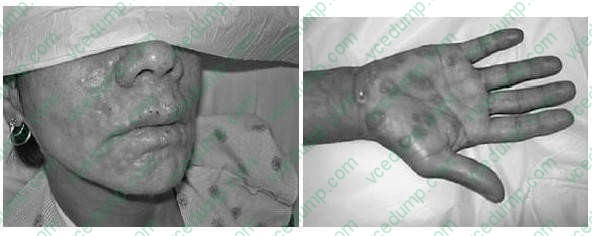
What is the appropriate treatment?
A. benzathine penicillin 2.4 million units IM weekly for 3 weeks
B. azythromycin 1 g orally
C. aqueous penicillin 4 million units intravenously every 4 hours for 14 days
D. doxycycline 100 mg twice a day for 2 weeks
E. oral corticosteroids over 5 days -
Question 737:
A 54-year-old man presents with a 3-cm right thyroid nodule that was found incidentally by the patient while shaving. He denies any pain or discomfort. He denies any history of thyroid disease, any family history of thyroid disease, and any history of head/neck irradiation. He notes a 10-lb weight loss over the past 6 months. His examination is only remarkable for the firm right thyroid nodule. The remainder of the thyroid is not palpable. There is no adenopathy. Heart rate is 90/minute and regular. The skin is warm and moist, and a fine tremor is present when he holds his hands out. TSH level is <.02 U/mL.
Which of the following is the most appropriate next step?
A. thyroid ultrasound
B. antithyroid peroxidase antibodies
C. thyroid-stimulating immunoglobulins
D. fine needle aspiration of the nodule
E. thyroid nuclear scan -
Question 738:
A 55-year-old woman presents to your office with painful hands, causing difficulty opening jars and turning the key in the ignition of her car. She is fatigued and she notices joint stiffness, but limbers up by lunch. She has trouble getting her rings off because of enlarging knuckles. About a year ago, she tried some OTC ibuprofen, which seemed to help, but led to the development of a bleeding ulcer severe enough to require transfusion and ICU care. Otherwise, her health is good, and her review of systems is negative. Your physical examination reveals tenderness and swelling at the index proximal interphalangeal and metacarpophalangeal joints bilaterally. There are small effusions on both knees. She has tenderness to lateral compression of the forefoot area bilaterally.
The test ordered above is negative and an anticyclic citrullinated peptide (anti-CCP) antibody is strongly positive (600). Which of the following is the probable source of her symptoms?
A. cryoglobulinemia
B. osteoarthritis
C. polymyalgia rheumatica
D. SLE
E. RA -
Question 739:
You see a 2-month-old infant in the emergency department for vomiting. The mother says that the baby has been spitting up more over the past few days and has become more irritable. She denies any fever, diarrhea, or change in formula. The mother tells you that there is a family history of "heartburn" and that her other children have all spit up. The infant has some emesis in the emergency department that seems to be formula mixed with some bile. The infant is intermittently irritable and sleepy.
What is the most concerning diagnosis that this could be?
A. biliary atresia
B. malrotation
C. pyloric stenosis
D. imperforate anus
E. diaphragmatic hernia -
Question 740:
Apatient with a known family history of multiple endocrine neoplasia (MEN) I, now presents with intractable ulcer disease.
Which of the following statements about his condition is most accurate?
A. Diarrhea is a frequent complaint.
B. Tumors are rarely multiple.
C. Tumors are rarely malignant.
D. An elevated fasting gastrin level is diagnostic for the Zollinger-Ellison syndrome.
E. CT is useful in localizing the tumor in greater than 75% of patients.
Tips on How to Prepare for the Exams
Nowadays, the certification exams become more and more important and required by more and more enterprises when applying for a job. But how to prepare for the exam effectively? How to prepare for the exam in a short time with less efforts? How to get a ideal result and how to find the most reliable resources? Here on Vcedump.com, you will find all the answers. Vcedump.com provide not only USMLE exam questions, answers and explanations but also complete assistance on your exam preparation and certification application. If you are confused on your USMLE-STEP-3 exam preparations and USMLE certification application, do not hesitate to visit our Vcedump.com to find your solutions here.