USMLE USMLE-STEP-3 Online Practice
Questions and Exam Preparation
USMLE-STEP-3 Exam Details
Exam Code
:USMLE-STEP-3
Exam Name
:United States Medical Licensing Step 3
Certification
:USMLE Certifications
Vendor
:USMLE
Total Questions
:804 Q&As
Last Updated
:Jul 29, 2026
USMLE USMLE-STEP-3 Online Questions &
Answers
Question 741:
A 26-year-old divorced woman is brought into the emergency room after being found wandering the streets aimlessly. She is a relatively good historian but gives few spontaneous answers to questions. She describes a 1-year history of the belief that she is being followed by "agents" of the Vatican, who watch her closely to "see if I'm a good Catholic." While they monitor her, they also use radio signals to tell her she is a "whore" and a "slut." Due to these experiences, she has been unable to work. She is afraid to associate with others for fears of being "judged." She enies any medical problems and takes no medications. Her parents were divorced when she was an infant. She does not know anything about her father, but her mother has "manic-depression" and is taking lithium. Her MSE is notable for significant psychomotor slowing, paucity of speech, and a flat affect.
Which of the above symptoms or signs is necessary in order to make a diagnosis of schizophrenia?
A. belief of being followed by the Vatican B. inability to work and social dysfunction C. psychomotor slowing and paucity of speech D. radio signals transmitting curses E. wandering in the streets
B. inability to work and social dysfunction
Explanation
Explanations:
This patient likely suffers from schizophrenia. While the paranoid and persecutory delusions, auditory hallucinations, disorganization, and negative symptoms (e.g., alogia) are all commonly seen in schizophrenia, none of these alone is necessary. Her occupational and social dysfunction, however, are necessary criteria when making the diagnosis of schizophrenia (DSM IV-TR). Even with appropriate antipsychotic treatment, the likelihood of maintaining a high level of functioning is low. Studies indicate that with treatment, approximately 50% of patients will still exhibit significant symptomatology and display poor functioning. Only 2040% of patients with schizophrenia will be able to lead somewhat unimpaired lives
Question 742:
The family of a patient recently diagnosed with esophageal cancer requests more information regarding the disease.
You tell them which of the following?
A. The incidence of SCC of the esophagus is rising more rapidly than adenocarcinoma. B. Premalignant conditions include caustic esophageal burns, Plummer-Vinson syndrome, and tylosis. C. It is more common in women than men. D. Smoking is not a risk factor for esophageal cancer. E. Barrett's esophagus increases the risk for esophageal SCC.
B. Premalignant conditions include caustic esophageal burns, Plummer-Vinson syndrome, and tylosis.
Explanation
Esophageal cancer is increasing in incidence in North America, largely due to the rise in incidence of esophageal adenocarcinoma. Premalignant lesions for esophageal cancer include: Barrett's changes, radiation esophagitis, caustic esophageal burns, Plummer-Vinson syndrome, leukoplakia, esophageal diverticula, ectopic gastric mucosa, and tylosis. It is more common in men, and smoking is clearly a risk factor along with alcohol. Barrett's esophagus requires frequent surveillance examinations with biopsies and increases the risk for adenocarcinomas of the esophagus at the gastroesophageal junction.
Question 743:
A24-year-old female presents to your office for excision of a nevus. After obtaining consent and prepping the site, you anesthetize the area with 1% lidocaine. However, as you start the procedure, you note that the patient is not sufficiently anesthetized. Your partner suggests the use of lidocaine with epinephrine. The addition of epinephrine with local anesthetics is useful because of which of the following properties?
A. It prolongs and increases the depth of local anesthesia. B. It neutralizes the irritant action of the local anesthetic agent. C. It increases the rate of systemic absorption and therefore hastens the onset of action of the anesthetic agent. D. It increases the pH of the anesthetic so that less anesthetic is required to produce nerve block. E. It blocks neurotransmitter release (thus decreasing pain perception) via stimulation of presynaptic alpha-adrenergic receptors.
A. It prolongs and increases the depth of local anesthesia.
Explanation
The duration of action of a local anesthetic is proportional to its contact time with the nerves. Therefore, if the drug can be localized at the nerve, the period of analgesia should be prolonged. Using a vasoconstrictor such as epinephrine decreases the systemic absorption of the local anesthetic. Once the absorption is decreased, the anesthetic remains longer at the desired site and is systemically absorbed at a slower rate, which allows destruction by enzymes and less systemic toxicity.
Question 744:
A concerned mother brings in her 18-monthold infant girl. The baby's developmental milestones have been normal. The mother states that there is a "funny glint" in her baby's eyes. She also states that sometimes the infant's eyes look crossed. Which of these supports the diagnosis of a serious life- threatening disease?
A. Baby reaches for small objects. B. Baby fusses when each eye is covered. C. Bright red reflex in one eye, a white reflex in the other. D. Baby rubs both eyes. E. Baby holds objects close to inspect them.
C. Bright red reflex in one eye, a white reflex in the other.
Explanation
Leukocoria, a white pupillary reflex, can be caused by several conditions. The most serious, and potentially life threatening, is retinoblastoma. Retinoblastoma is a malignant neoplasm of the retina that may appear as a white mass extending into the vitreous, a mass lesion underlying a retinal detachment or as a diffusely spreading lesion. Retinoblastomas may be unilateral, bilateral, or multifocal. The diagnosis is usually made between 1 and 2 years of age. Other causes of leukocoria may include retinopathy of prematurity, congenital cataracts, toxocarisis (a nematode infection), or Coats disease (a retinal vascular abnormality). The treatment of retinoblastoma may involve surgery, chemotherapy, or other modalities such as cryotherapy and photocoagulation.
Question 745:
A patient with a persistent headache following a postpartum hemorrhage is diagnosed with Sheehan's syndrome. If the patient were subsequently amenorrheic and infertile, what treatment would you recommend to assist this patient to conceive?
A. gonadotropin releasing hormone (GnRH) pump B. clomiphene citrate C. dopamine agonist D. in vitro fertilization E. gonadotropins (FSH and LH)
E. gonadotropins (FSH and LH)
Explanation
Sheehan syndrome describes damage to the pituitary gland classically resulting from hypotension following a postpartum hemorrhage. The clinical picture is variable due to the fact that the damage may involve one or more of the various cellular subtypes in the pituitary gland that secrete either adrenocorticotropic hormone (ACTH), GH, prolactin, TSH, or LH/FSH. An amenorrheic patient with a history of Sheehan's syndrome would not be expected to have functional pituitary gonadotropes so a GnRH pump or clomiphene citrate would not be useful because they both rely on a functional pituitary gland. Replacement of gonadotropins (LH and FSH) would be the best treatment option
Question 746:
In January, you see an 18-month-old boy in the middle of the night in the pediatric emergency department. The father relates that 1 hour ago his son started coughing. The father describes the cough as barking ("seal" like). The child has mild stridor at rest, but otherwise is not in respiratory distress. His RR is 45 breaths per minute. He has a temperature of 103.4 . What is the most common etiology of this illness in children?
A. HIB B. RSV C. influenza, type B D. parainfluenza, types 1 and 2 E. S. pneumoniae
D. parainfluenza, types 1 and 2
Explanation
This case is a common presentation for viral croup, with the symptoms of a seal-barking cough, stridor, tachypnea, and fever in the winter. Pneumonia must also be considered with tachypnea, cough, and fever, but it is less likely to cause stridor and may not have the seal-bark type of cough. Sinusitis may cause cough and fever, but would be more likely to have a purulent nasal discharge and less likely to have the typical croupy cough. Bronchiolitis due to RSV is a common cause of wintertime cough and fever. It is less likely to have stridor and more likely to have wheezing. Children with epiglottitis are typically found in the "tripod position" and may be drooling. It is, fortunately, becoming rare with the widespread use of the H. influenzae vaccine. Parainfluenza types 1 and 2 account for 6070% of all viral croup. HIB was a common cause of epiglottitis, but is now rare because of widespread vaccinations. Influenza B and RSV can cause croup, but not as commonly as parainfluenza types 1 and 2. S. pneumoniae would be the most common bacterial cause of pneumonia or sinusitis. (American Academy of Pediatrics, 2003, pp. 454455) The steeple sign is subglottic narrowing of the trachea seen on an AP view of the trachea or a CXR. The trachea is seen to narrow, almost to a point, like the steeple of a church. Swollen adenoids are difficult to identify in lateral neck x-rays. The presence of swollen adenoids is unrelated to the airway narrowing seen in croup. The thumb sign is a swollen epiglottis seen with epiglottitis.
Alobar pulmonary infiltrate may be seen with a typical bacterial pneumonia
Question 747:
You are working in the emergency department and are called to perform a lumbar puncture on a 3-month- old infant who presented with fever and lethargy. The spinal fluid that you obtain is turbid. The laboratory reports that there are 200 WBCs and 5 RBCs per high-power field (HPF). Ninety-five percent of the WBCs in the spinal fluid are neutrophils
If the laboratory result showed that 98% of the WBCs in the spinal fluid were lymphocytes, what would be the most likely etiology of the infection?
A. Mycobacterium tuberculosis B. HSV C. trachomatis D. RSV E. nonpolio enteroviruses
E. nonpolio enteroviruses
Explanation
In children over 1 month of age, the most common causes of bacterial meningitis are S. pneumoniae and Neisseria meningitidis. HIB was also a frequent cause of this disease prior to the widespread use of the HIB vaccine. GBS, E. coli, and HSV would be more common causes of CNS infections in neonates. (McMillin et al., 1999, Chap. 142) Nonpolio enteroviruses are the most common causes of aseptic meningitis in childhood. There are approximately 65 nonpolio enteroviruses, including the Coxsackieviruses, echoviruses, and enteroviruses. Children are the main susceptible population and transmission is from child to child, via fecal-oral or oraloral (respiratory) contact. Meningitis may result from viremic spread of the virus. Treatment of this is supportive.
Question 748:
A 44-year-old female has a history of endometriosis resulting in chronic pelvic pain. She presents to you 6 months after her total abdominal hysterectomy and bilateral salpingooophorectomy. She reports continued pelvic pain. Which of the following would be your most appropriate recommendation for medical management?
A. GnRH B. oral estrogens C. oral progestins D. tamoxifen E. GnRH antagonist
C. oral progestins
Explanation
There are a number of effective medical therapies for pain due to endometriosis. These include GnRH agonists, danazol, progestins, and oral contraceptives. Surgical menopause requires the use of GnRH agonists or antagonists in order to suppress of ovarian function. Unopposed estrogen would be contraindicated in this patient because of its stimulatory effect on any remaining endometriosis. Tamoxifen has not demonstrated efficacy in the treatment of endometriosis. Progestins are effective at improving endometriosis symptoms due to their atrophic effect.
Question 749:
A 60-year-old male presents to the office with a growth on the inside of his lower lip. It has been present for several months and is slowly growing. He is a nonsmoker but has a long history of chewing tobacco. Which of the following is the most likely to be found on biopsy of the lesion?
A. adenocarcinoma B. lymphoma C. basal cell carcinoma D. carcinoid tumor E. squamous cell carcinoma
E. squamous cell carcinoma
Explanation
Squamous cell carcinoma is the most common malignant tumor of the oral mucosa and may occur at any site. It most frequently involves the tongue, followed in descending order by the floor of the mouth, alveolar mucosa, palate, and buccal mucosa. The male to female ratio is 2:1 for the gum, but 10:1 for the lip. There are substantial variations in the geographical distribution of the oral cancer. For example, it is the single most common cancer of men in India.
Question 750:
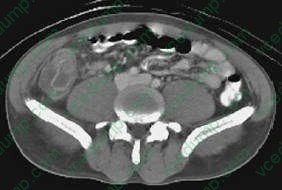
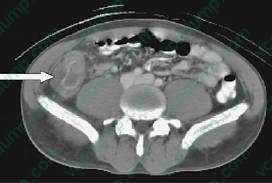
A patient presents with a 24-hour history of periumbilical pain, now localized to the right lower quadrant. An abdominal CT scan is obtained in the ER, which is shown in Figure.Which of the following is considered a physical sign often associated with this diagnosis?
A. concave and empty right lower quadrant B. pain on flexion of the right hip C. flank bruising D. pain in right lower quadrant with palpation in left lower quadrant E. inspiratory arrest while palpating under the right costal margin
D. pain in right lower quadrant with palpation in left lower quadrant
Explanation
The diagnosis of acute appendicitis can often be made based on the history and physical findings. The sequence of symptoms classically begins with anorexia followed by periumbilical pain that localizes to the right lower quadrant after 612 hours. The onset on nausea and emesis occur after the development of abdominal pain. If the patient has an appetite or if bouts of vomiting begin before the onset of abdominal pain, the diagnosis should be reconsidered. In this patient, the acute appendicitis has progressed to a rupture resulting in a localized right lower quadrant abscess (marked with arrow in Figure below)
The signs of acute appendicitis are also characteristic. On examination, tenderness is often maximal at McBurney's point, located approximately one-third the distance from the anterior superior iliac spine to the umbilicus. Other physical signs include Rovsing's sign (pain initiated in the right lower quadrant upon palpation in the left lower quadrant), Dunphy's sign (increased pain with coughing), the obturator sign (pain on internal rotation of the hip), and the psoas sign (pain during extension of the right hip).
Dance's sign (concave and empty right lower quadrant) is associated with ileocecal intussusception. Grey-Turner's sign is bruising of the flanks and may occur in severe, acute pancreatitis due to subcutaneous tracking of inflammatory, peripancreatic exudate along the retroperitoneum. Murphy's sign is defined as inspiratory arrest secondary to pain when palpating under the right costal margin. It is associated with a diagnosis of acute cholecystitis
Nowadays, the certification exams become more and more important and required by more and more
enterprises when applying for a job. But how to prepare for the exam effectively? How to prepare
for the exam in a short time with less efforts? How to get a ideal result and how to find the
most reliable resources? Here on Vcedump.com, you will find all the answers.
Vcedump.com provide not only USMLE exam questions,
answers and explanations but also complete assistance on your exam preparation and certification
application. If you are confused on your USMLE-STEP-3 exam preparations
and USMLE certification application, do not hesitate to visit our
Vcedump.com to find your solutions here.