USMLE-STEP-3 Exam Details
-
Exam Code
:USMLE-STEP-3 -
Exam Name
:United States Medical Licensing Step 3 -
Certification
:USMLE Certifications -
Vendor
:USMLE -
Total Questions
:804 Q&As -
Last Updated
:Jul 29, 2026
USMLE USMLE-STEP-3 Online Questions & Answers
-
Question 391:
A 63-year-old Native American male, with a 6-year history of DM, hypertension, and hyperlipidemia, comes to your office as a new patient for a routine examination. He has been experiencing frequent lower back pain and headaches for which he is taking ibuprofen daily for the past 5 weeks. Moreover, he is complaining of mild fatigue. In addition, he is taking aspirin, atorvastatin, verapamil, and glipizide. His physical examination shows a blood pressure of 165/80 and heart rate of 90 bpm. In general, he was not in any distress. His funduscopic examination reveals no signs of diabetic retinopathy. Cardiac examination reveals a regular rate and rhythm with an S4 gallop. His lungs are clear and abdominal examination is unremarkable without any bruit auscultated. He also has 2+ lower extremity pitting edema. Rectal examination reveals brown stool, negative for occult blood. His laboratory results are as follows:
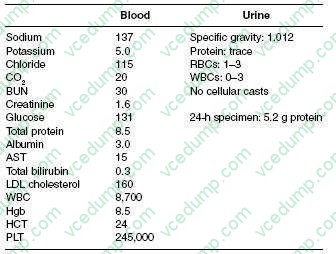
Which of the following is a typical finding in this patient's condition?
A. hypocalcemia
B. macrocytic anemia
C. elevated thyroxine levels
D. hypocomplementemia
E. hematuria -
Question 392:
The patient is a 70-year-old man brought to the primary care clinic by his family over concerns that he has Alzheimer's disease. They have noticed a worsening of his memory over the past 6 months. He does not seem to want to get out of bed, and he appears to have difficulty providing for his basic needs such as cleaning, dressing, and cooking for himself. He is hesitant when talking, but it is unclear whether he is unable or unmotivated to speak. His family has also noticed that he appears depressed and is often seen crying. A MSE of the patient is performed to help determine whether he is suffering from a dementing illness or a depressive illness (pseudodementia).
Further history, cognitive examinations, physical examination, and laboratory/radiographic studies are obtained. The results are consistent with Alzheimer's dementia. While the family had been able to take care of him initially, they have since returned to the clinic stating that they can no longer keep him at home. They feel that he is becoming much more agitated. He is staying up at night. Lately he has been rearranging the furniture, claiming to look for "the little people who are teasing me." They have noticed that he has difficulty walking, often moving slowly and dropping items. The family has pursued nursing home placement, but they wish to have something prescribed in order to help him sleep and keep him calm.
Which of the following medications should be avoided in this patient?
A. buspirone (Buspar)
B. donepezil (Aricept)
C. lorazepam (Ativan)
D. trazodone (Desyrel)
E. risperidone (Risperdal) -
Question 393:
A 60-year-old Asian male presents with early satiety and 40-lb weight loss over 3 months.Upper endoscopy shows an irregular mass in the antrum of the stomach. What can you tell him and his family about his situation?
A. Weight loss indicates distant metastases, and surgical resection is not indicated.
B. Antral tumors have a worse prognosis than tumors at other sites in the stomach.
C. CT is the most effective imaging modality for determining TNM (tumor, nodes, and metastases) stage.
D. 5-year survival for patients with gastric adenocarcinoma confined to the mucosa with no nodal metastasis approaches 90%.
E. Chemotherapy is an effective treatment modality in stage IV gastric adenocarcinoma, with significant benefit in overall survival. -
Question 394:
A healthy 38-year-old G4P3003 presents for amniocentesis. The karyotype returns as shown in the Figure You counsel the patient that which of the following was likely her biggest risk factor for the development of this karyotype?
A. cigarette smoking
B. lack of folic acid supplementation
C. maternal age at conception
D. family history
E. alcohol consumption -
Question 395:
A woman complains of amenorrhea for several months following a dilation and curettage.
Which of the following is the most likely reason?
A. occult perforation of uterus during the procedure
B. intrauterine scarring
C. infection of the endometrium (endometritis)
D. iron-deficiency anemia from blood loss during the procedure
E. premature menopause -
Question 396:
A 48-year-old woman presents for evaluation of progressively worsening dyspnea. She relates the onset of symptoms to a "walking pneumonia" that she had a year ago. Her breathing has worsened progressively since that time. She has a "smoker's cough" productive of some clear or white phlegm, for which she frequently sucks on cough drops. She started smoking regularly at the age of 18. She currently smokes about a pack of cigarettes a day, down from as much as two packs per day. She is not on any medications regularly. She has no history of heart disease and has always had normal blood pressure.
Which of the following physical examination findings are you most likely to find in this patient?
A. prolonged expiratory phase of respiration
B. supraclavicular adenopathy
C. rales one-quarter of the way up in both lungs
D. clubbing of fingers
E. prominent first heart sound -
Question 397:
A 39-year-old woman presents to the office for the evaluation of a mole on her left arm. It has been present and enlarging over the past 6 months. It itches and occasionally bleeds. Which of the following attributes would be considered high risk for skin cancer?
A. diameter of greater than 6 mm
B. a sharply demarcated, regular border
C. a uniform coloration
D. a symmetric, circular shape
E. a flat lesion -
Question 398:
A 5-year-old male is admitted to the hospital following a 3-week history of spiking fevers and fatigue. Your examination reveals pale mucous membranes and skin. You also find splenomegaly.
You are concerned about a possible malignancy. What is the most common malignancy of childhood?
A. medulloblastoma
B. Wilms' tumor
C. leukemia
D. neuroblastoma
E. rhabdomyosarcoma -
Question 399:
A 63-year-old Native American male, with a 6-year history of DM, hypertension, and hyperlipidemia, comes to your office as a new patient for a routine examination. He has been experiencing frequent lower back pain and headaches for which he is taking ibuprofen daily for the past 5 weeks. Moreover, he is complaining of mild fatigue. In addition, he is taking aspirin, atorvastatin, verapamil, and glipizide. His physical examination shows a blood pressure of 165/80 and heart rate of 90 bpm. In general, he was not in any distress. His funduscopic examination reveals no signs of diabetic retinopathy. Cardiac examination reveals a regular rate and rhythm with an S4 gallop. His lungs are clear and abdominal examination is unremarkable without any bruit auscultated. He also has 2+ lower extremity pitting edema. Rectal examination reveals brown stool, negative for occult blood. His laboratory results are as follows:
Which of the following antihypertensive medications would be best implemented in patients with diabetic nephropathy?
A. lisinopril 10 mg orally once daily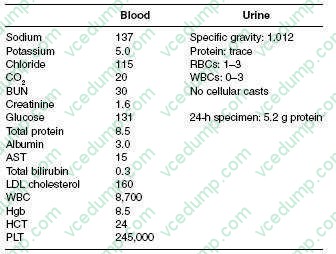
B. clonidine 0.2 mg orally twice daily
C. metoprolol 25 mg orally twice daily
D. amlodipine 5 mg orally once daily
E. hydralazine 25 mg orally three times daily -
Question 400:
A 49-year-old male postal worker presents to your office for the evaluation of a lesion on his left arm. The lesion started about a week ago as a red pustule but has grown and now has a thick black scab. The lesion is painless. A coworker showed the patient a similar appearing lesion that she developed on her arm for which her doctor prescribed an oral antibiotic. Examination reveals a 5 cm circular black eschar with some surrounding vesicles. A Gram stain of fluid drained from a vesicle reveals chains of gram-positive bacilli.
The patient asks how he contracted this infection.
Which of the following do you tell him?
A. from direct contact with the coworker who had the similar appearing lesion
B. ingestion of contaminated food in the postal facility cafeteria
C. a small skin cut or sore was directly contaminated with spores
D. inhalation of bacteria from a contaminated ventilation system
E. exposure to respiratory droplets from an infected person
Tips on How to Prepare for the Exams
Nowadays, the certification exams become more and more important and required by more and more enterprises when applying for a job. But how to prepare for the exam effectively? How to prepare for the exam in a short time with less efforts? How to get a ideal result and how to find the most reliable resources? Here on Vcedump.com, you will find all the answers. Vcedump.com provide not only USMLE exam questions, answers and explanations but also complete assistance on your exam preparation and certification application. If you are confused on your USMLE-STEP-3 exam preparations and USMLE certification application, do not hesitate to visit our Vcedump.com to find your solutions here.