USMLE-STEP-3 Exam Details
-
Exam Code
:USMLE-STEP-3 -
Exam Name
:United States Medical Licensing Step 3 -
Certification
:USMLE Certifications -
Vendor
:USMLE -
Total Questions
:804 Q&As -
Last Updated
:Jul 29, 2026
USMLE USMLE-STEP-3 Online Questions & Answers
-
Question 411:
A severely traumatized patient who has been receiving prolonged parenteral alimentation develops diarrhea, mental status changes, alopecia, and perioral and periorbital dermatitis. Administration of which of the following trace element is most likely to reverse these complications?
A. iodine
B. zinc
C. selenium
D. silicon
E. tin -
Question 412:
A30-year-old female presents to your office for the evaluation of a rash on her back. It has been present and growing for about a week. Along with this rash, she has had a fever, headache, myalgias, and fatigue. Her symptoms started about a week after returning from a camping trip to New England. She denies having any bites from ticks or other insects and exposure to poison ivy and has had no wounds to her skin. On examination, her temperature is 99.5 and her v ital signs are otherwise normal. Her rash is shown in Figure. Her examination is otherwise unremarkable.

You order IgM and IgG ELISA testing for Borrelia burgdorferi and the results return as negative. Which of the following management options would be most appropriate?
A. Treat the patient with a topical steroid for presumed contact dermatitis.
B. Treat the patient with oral steroids for a presumed systemic allergic reaction.
C. Treat the patient with oral cephalexin for streptococcal cellulitis.
D. Treat the patient with doxycycline for Lyme disease.
E. No medication at present, but have the patient return in 68 weeks for repeat serologic testing and treat for Lyme disease if positive at that time. -
Question 413:
A 31/2-year-old female presented with a left upper quadrant abdominal mass. The child had no previous history of medical illnesses. An ultrasound examination revealed a markedly deformed left kidney with 12 cm nonhomogenous soft tissue mass arising from the upper pole. Medial displacement of the bowel loops was also noted.
What would be the most likely diagnosis in this case?
A. hydronephrotic kidney
B. Wilms tumor
C. tuberculosis
D. congenital malformation
E. papillary transitional cell carcinoma of the renal pelvis -
Question 414:
A 40-year-old male is returning to the office for a follow-up visit. He is told about his blood work results, which are consistent with leukemia. He is informed that he should receive a bone marrow biopsy for further clarification. While being presented with this information, he remains silent, peering, and staring intensely. When finished, he comments, "Doctors think they are so smart!" He then explains that he has been mistreated by physicians in the past and, in fact, has several malpractice suits pending. He feels that the biopsy was recommended only "because you want to use me in order to publish and further your career."
When interacting with this patient, which of the following approaches would be most effective?
A. defend the recommendation by citing professional credentials
B. encourage him to speak with a psychiatrist to provide added support
C. interpret his anger as a defense against his fears of having leukemia
D. provide detailed information regarding his differential diagnosis
E. refer him to a colleague to avoid litigation -
Question 415:
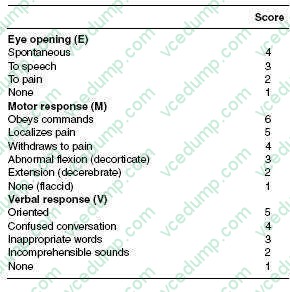
A 30-year-old male is brought to the ED after being hit in the head by a baseball. He is making incomprehensible sounds, but no words. He opens his eyes and withdraws to painful stimuli. His Glasgow Coma Scale score is:
A. 10
B. 9
C. 8
D. 7
E. 6 -
Question 416:
In your role as a physician in a community health center, you agree to perform sports preparticipation examinations on students from the local high school. You have several scheduled for today. Your first appointment is with a 16-year-old male who is planning to run on the cross-country team in the Fall and play baseball in the Spring. He reports that one time he "blacked out" while running, but he has never had chest pain while exercising and he is one of the top runners on the team. He has no known medical history, denies alcohol, tobacco, recreational drug, or performance-enhancing drug use. He has a cousin who died at the age of 21 of "some kind of heart disease," although your patient is not sure of any details. On examination, he is healthy appearing and has normal vital signs, with a pulse rate of 72 and a blood pressure of 100/65. Auscultation of his heart reveals no cardiac murmur while he is lying down, a soft systolic murmur when he stands which increases on having the patient perform a Valsalva maneuver. The remainder of his examination is normal.
At this point, what is your most appropriate management option?
A. allow unrestricted participation in sports
B. allow participation in noncontact sports
C. allow him to play baseball but not run cross-country
D. restrict him from all athletic participation until he is evaluated by a cardiologist
E. restrict him from competitive athletics but allow him to participate in gym class -
Question 417:
A 30-year-old (G2P0101) female presents to the clinic for a new obstetric visit. She has an unknown LMP. She reports that she discovered she was pregnant when she took a urine pregnancy test at home a month ago. She vaguely recalls having a period about 2 months ago, but is not sure exactly when that occurred. She reports that she is generally healthy. She had a previous delivery at 36 weeks EGA, though she reports her doctor was not really sure about her due date in that pregnancy. She reports that she had a normal spontaneous vaginal delivery in her previous pregnancy, and the child is healthy. Her postpartum course was complicated by depression, which has since resolved and not recurred. She denies history of sexually transmitted diseases or abnormal pap smears. She has no surgical history. She does not smoke, drink alcohol, or use illicit drugs. She does not have any family history of hypertension, diabetes, twins, or congenital anomalies. She does report that her mother has a history of depression
Given the patient's history of postpartum depression as well as her family history of depression, her risk of postpartum depression after this pregnancy is approximately what percentage?
A. 50% or greater
B. 5%
C. 10%
D. 20%
E. less than 1% -
Question 418:
A 72-year-old diabetic is transferred to your hospital for fever and altered mental status in the late summer. Symptoms started in this patient 1 week prior to admission. On physical examination, the patient was disoriented. There were no focal neurologic findings. There was a fine rash on the patient's trunk. On oral examination, there were tongue fasciculations. A lumbar puncture was performed which showed a glucose of 71 and a protein of 94; microscopy of the cerebrospinal fluid (CSF) revealed 9 RBC and 14 WBC (21 P, 68 L, 11 H). The creatinine phosphokinase was 506. An electroencephalogram and MRI of the brain were normal. What is the best interpretation of these findings?
A. The patient may have cryptococcal meningitis.
B. The patient may have disseminated candidiasis.
C. The patient may have West Nile virus.
D. The patient may have Coccidioides immitis infection.
E. The patient may have rhinocerebral mucormycosis. -
Question 419:
A 67-year-old female was admitted to the hospital because of chronic fatigue and low back pain. An x- ray of the vertebral column showed diffuse osteoporosis and compression fractures of L1 and L2 vertebral bodies. The complete blood count (CBC) was within normal limits. The peripheral blood smear showed rouleaux formation. The immunoelectrophoresis showed a monoclonal spike of more than 3 g. A bone marrow biopsy was performed and showed an increase of more than 20% in plasma cells see Figure below

Radiographs of the bone and skeletal system in multiple myeloma will more characteristically show which of the following?
A. fractures
B. osteoblastic lesions
C. destructive bone lesions throughout the skeletal system
D. the skeletal system will remain intact
E. changes that resemble Paget disease -
Question 420:
A 40-year-old woman presents with nausea, vomiting, and weakness. She has been amenorrheic since the birth of her last child 1 year ago and has not felt well since that time. On examination, she appears chronically ill, her thyroid is not palpable, and there is no galactorrhea. Laboratory studies on admission include:
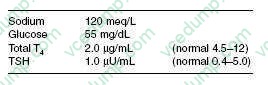
The most appropriate next step is to start treatment with which of the following?
A. hydrocortisone
B. fluid restriction
C. desmopressin
D. glucagon
E. fludrocortisone
Tips on How to Prepare for the Exams
Nowadays, the certification exams become more and more important and required by more and more enterprises when applying for a job. But how to prepare for the exam effectively? How to prepare for the exam in a short time with less efforts? How to get a ideal result and how to find the most reliable resources? Here on Vcedump.com, you will find all the answers. Vcedump.com provide not only USMLE exam questions, answers and explanations but also complete assistance on your exam preparation and certification application. If you are confused on your USMLE-STEP-3 exam preparations and USMLE certification application, do not hesitate to visit our Vcedump.com to find your solutions here.