USMLE-STEP-3 Exam Details
-
Exam Code
:USMLE-STEP-3 -
Exam Name
:United States Medical Licensing Step 3 -
Certification
:USMLE Certifications -
Vendor
:USMLE -
Total Questions
:804 Q&As -
Last Updated
:Jul 29, 2026
USMLE USMLE-STEP-3 Online Questions & Answers
-
Question 381:
A 42 year old male admitted for pulmonary embolus was placed on heparin, dosed by a weight based protocol. However, later in the day, you receive a call from the floor nurse stating that the patient had spontaneous epistaxis and a very high aPTT. Use of which of the following would be best at this time?
A. cimetidine
B. heparinase
C. clofibrate
D. protamine sulfate
E. vitamin K -
Question 382:
A 52-year-old male construction worker is seen in the emergency department (ED) at a local hospital with complaints of persistent cough for the past 4 months. He has been relatively healthy until a few months ago, when he lost his mother and developed severe depression which left him socially and professionally paralyzed. He has stopped doing any exercise or outdoor activity and spends most of his time at home eating, sleeping, and watching TV. In addition, he has noticed a 20-lb weight gain over this period but attributes it to his lack of exercise and increased food intake. His cough is worse at night, or any time when he lies down to sleep, and he notices a burning sensation in his throat associated with it. It is not associated with fever or chills, and his wife complains that he is constantly clearing his throat after meals. He smoked a few cigarettes per day as a young man in the Navy but quit more than 30 years ago. He denies recent travel or incarceration and has no recollection of any sick contacts. On examination, he is afebrile and appears mildly obese. His lung examination is clear. His oropharynx is red and mucosal membranes are dry and not inflamed. Which of the following therapies would be most beneficial in alleviating this patient's symptoms?
A. an inhaled, short-acting beta-2 agonist
B. a proton pump inhibitor (PPI)
C. an antitussive-expectorant syrup
D. weight loss and exercise
E. prolonged course of antibiotics -
Question 383:
Avascular necrosis is most likely to occur in fracture dislocations involving which of the following?
A. the femoral head
B. the shaft of the femur
C. the shaft of the humerus
D. the scapula
E. the clavicle -
Question 384:
A 60-year-old woman arrives at your office for a routine physical examination. During the course of her examination she asks you about osteoporosis. She is concerned about her risk for osteoporosis, as her mother suffered from multiple vertebral compression fractures at the age of 60. Your patient reports that she still smokes cigarettes ("although I know they are bad for me") and has one alcoholic beverage a week. She reports having had menopause 5 years ago and experiencing a deep venous thrombosis approximately 20 years ago. She is proud of the fact that she regularly exercises at the local fitness center. She has been taking 1500 mg of calcium with 800 IU of vitamin D every day. You suspect that she is at risk for osteoporosis. After performing the appropriate imaging study, you determine that your patient has osteoporosis. Of the following choices, which is risk factor most likely contributing to her osteoporosis?
A. active lifestyle
B. late menopause
C. cigarette smoking
D. frequency of alcohol intake
E. her intake of calcium and vitamin D -
Question 385:
A 23-year-old African-American presents with acute-onset pain in the abdomen, back, and legs. On physical examination, his pulse is 115 bpm, respiratory rate is 20, blood pressure is 100/70 mmHg, and temperature is 101. There is scleral icterus, a s ystolic ejection murmur at the right upper sternal border, bilateral rhonchi, a right upper quadrant abdominal scar from a cholecystectomy, and a diffusely tender abdomen without rebound. A neurologic examination is normal. A peripheral blood smear is shown in Figure
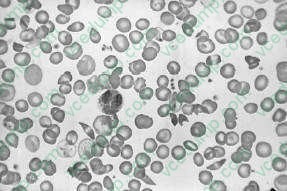
.
Among the initial orders for this patient should be which of the following?
A. broad-spectrum antibiotics for community-acquired pneumonia
B. type and hold for 2 units packed RBCs
C. an arterial blood gas
D. a CT scan of the abdomen
E. analgesics -
Question 386:
A 72-year-old male with type II diabetes, hypertension, and a history of recurrent pneumonia is admitted to the Medical intensive care unit (ICU) with a diagnosis of septic shock. His vital signs are:
BP 80/60 mmHg, RR 24 breaths per minute, pulse 120 beats per minute (bpm), temp. 102.4, O2 saturation 99% on room air. Of the choices listed below, what would be your initial management?
A. start IV dopamine
B. start empiric IV broad-spectrum antibiotics
C. bolus IV fluids
D. intubate and start ventilator support
E. start IV norepinephrine -
Question 387:
A 39-year-old woman presents to the office for the evaluation of a mole on her left arm. It has been present and enlarging over the past 6 months. It itches and occasionally bleeds. Which of the following statements regarding skin cancer is true?
A. Skin types III and IV are more prone to developing melanoma.
B. Squamous cell carcinoma only occurs in sun-exposed areas.
C. Basal cell carcinomas do not occur in persons of African descent.
D. Squamous cell carcinomas of the skin have a higher metastatic potential than basal cell carcinomas.
E. A shave biopsy is recommended for the evaluation of suspicious pigmented lesions. -
Question 388:
During laparoscopic abdominal procedures, the abdominal cavity is usually insufflated with carbon dioxide to a pressure of 15 mmHg. Increasing the intra-abdominal pressure to these levels produces which of the following1 physiologic responses?
A. decreased afterload
B. depressed cardiac output
C. hypercarbia
D. depressed diaphragm
E. alkalosis -
Question 389:
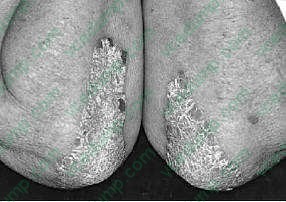
An 18-year-old female presents for follow-up of a rash. She states that she has been using OTC antifungal preparations without success. She used OTC cortisone cream with mild improvement, but the lesions never disappeared. Her condition also recurred with full severity once the cortisone cream was discontinued. Her family history reveals a first degree relative with similar rash. The rash is over the elbows, trunk, and scalp .
Which other physical finding would be consistent with your presumptive diagnosis?
A. velvety, hyperpigmented patches over the axilla and neck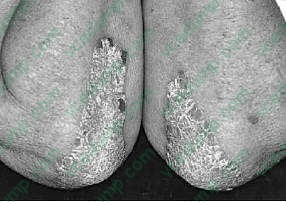
B. pitting of the nails
C. oily scalp
D. subcutaneous nodules
E. multiple tender and tense vesicles and bullae -
Question 390:
Asmall area of abnormality is noted on the lateral wall of the urinary bladder during a cystoscopy on a patient being evaluated for asymptomatic microscopic hematuria. Biopsy of the lesion is most likely to reveal which of the following?
A. adenocarcinoma
B. neuroendocrine carcinoma
C. rhabdomyosarcoma
D. squamous cell carcinoma
E. papillary transitional cell carcinoma
Tips on How to Prepare for the Exams
Nowadays, the certification exams become more and more important and required by more and more enterprises when applying for a job. But how to prepare for the exam effectively? How to prepare for the exam in a short time with less efforts? How to get a ideal result and how to find the most reliable resources? Here on Vcedump.com, you will find all the answers. Vcedump.com provide not only USMLE exam questions, answers and explanations but also complete assistance on your exam preparation and certification application. If you are confused on your USMLE-STEP-3 exam preparations and USMLE certification application, do not hesitate to visit our Vcedump.com to find your solutions here.