USMLE-STEP-3 Exam Details
-
Exam Code
:USMLE-STEP-3 -
Exam Name
:United States Medical Licensing Step 3 -
Certification
:USMLE Certifications -
Vendor
:USMLE -
Total Questions
:804 Q&As -
Last Updated
:Jul 29, 2026
USMLE USMLE-STEP-3 Online Questions & Answers
-
Question 401:
A38-year-old woman presents to the ER with heavy vaginal bleeding. A pelvic examination using a speculum to visualize the cervix reveals a large, friable, fungating cervical mass. On bimanual examination, the mass extends to the right pelvic sidewall. A biopsy from a recent gynecologic visit reveals invasive squamous cell carcinoma of the cervix. An abdominal/pelvic CT scan shows enlarged pelvic lymph nodes and right hydronephrosis. Her hematocrit (HCT) in the ER is 24%, but she is hemodynamically stable with a BP of 124/70 and a pulse of 73. The cervical mass is actively bleeding.
Which of the following is the most appropriate immediate management of the vaginal bleeding in the ER?
A. vaginal packing soaked with Monsel solution
B. vitamin K
C. transfusion of fresh frozen plasma (FFP)
D. uterine massage
E. supportive care with transfusion of packed red blood cells -
Question 402:
A 53-year-old Black male, with a history of hypertension, hepatitis C, and newly diagnosed nonsmall cell lung cancer, undergoes his first round of chemotherapy, which includes cisplatin. You are called to see this patient 5 days into his hospitalization for oliguria and laboratory abnormalities. Other than the chemotherapy, he is receiving lansoprazole, acetaminophen, and an infusion of D5-- 0.9% normal saline at 50 mL/h. On examination, his BP is 98/60 and heart rate is irregular, between 40 and 50 bpm. His physical examination shows a middle-aged male in no acute distress. His cardiac examination is unremarkable, his lungs show bibasilar crackles, and the abdominal examination is positive for a palpable spleen tip without any hepatomegaly or abdominal tenderness. He has trace bilateral ankle edema. His distal pulses are irregular. The neurologic examination was unremarkable. His laboratory (serum sample) results are as follows
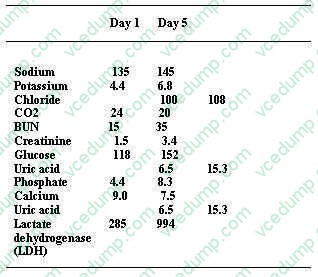
What is the most likely etiology of this patient's acute renal failure?
A. renal tubular deposition of uric acid
B. calcium oxalate kidney stones causing partial urinary tract obstruction
C. renal tubular injury due to cisplatin
D. ischemic acute tubular necrosis from a decreased cardiac output
E. type II cryoglobulinemia due to hepatitis C -
Question 403:
A 70-year-old male is seen in the office for chest pain. He reports that he is getting substernal chest pain, without radiation, when he mows his lawn. The pain resolves with 1015 minutes of rest. He has never had pain at rest. He has no other cardiac complaints and his review of systems is otherwise negative. He has an unremarkable medical history and takes only a baby aspirin a day. On examination, his blood pressure is 160/70, pulse 85, and respiratory rate 16. His cardiac examination is notable for a harsh, 3/6 systolic ejection murmur along the sternal border that radiates to the carotid arteries. His carotid pulsation is noted to rise slowly and is small and sustained. His lungs are clear. The remainder of his examination is normal.
Which of the following would be the most appropriate test to order next?
A. echocardiogram
B. exercise stress test
C. cardiac catheterization
D. 24-hour Holter monitor
E. electrophysiologic studies -
Question 404:
A 40-year-old male comes to your office as a new patient to get established for care, as he recently moved into your city from another state. He has been on medical therapy for type 2 diabetes mellitus for 3 years and has had good glycemic control. He takes metformin 500 mg bid and reports having fasting glucose levels of less than 100 on home monitoring. He has records from his previous physician that show that he had a dilated eye examination 6 months ago that was normal and a hemoglobin A1C (HgbA1C) level of 6.2 that was taken 3 months ago. He has no known history of coronary artery disease. His last fasting lipid measurement was 14 months ago. You order a fasting lipid panel today and get the following results:
Total cholesterol: 235 mg/dL Triglycerides: 210 mg/dL HDL cholesterol: 45mg/dL LDL cholesterol: 162 mg/dL
He states that he has not had any immunizations in "longer than I can remember." Which of the following would be recommended for him?
A. hepatitis A and hepatitis B vaccines
B. herpes zoster vaccine (Zostavax)
C. tetanus, diphtheria, and acellular pertussis (Tdap) vaccine
D. tetanus and diphtheria (Td) vaccine
E. Tdap and PPV-23 -
Question 405:
Of the following conditions, which results in the most deaths each year in the United States?
A. acquired immunodeficiency syndrome (AIDS)
B. breast cancer
C. motor vehicle accidents
D. occupational injuries
E. medical errors -
Question 406:
A 23-year-old female graduate student with acne and asthma presents to you with a chief complaint of headaches. She has noted a gradual increase in the intensity and frequency of the headaches to the point where they are interfering with her daily activities and studies. Your examination shows an obese young lady with papilledema. The remainder of your physical examination is normal Which of the following is most commonly associated with this condition?
A. obesity
B. steroid use during asthma attacks
C. tetracycline treatment for acne
D. oral contraceptives
E. pregnancy -
Question 407:
A 55-year-old male is brought to the ED, by ambulance, because of crushing chest pain radiating to his left shoulder and arm that started 1 hour ago. He has a history of hypertension, high cholesterol, and has smoked a pack of cigarettes a day for 30 years. He has never had symptoms like this before. The patient's rhythm converts to asystole. What is the most appropriate first action to take?
A. IV epinephrine
B. IV atropine
C. discontinuation of resuscitation
D. direct current (DC) cardioversion
E. check a second monitor lead -
Question 408:
An amenorrheic 17-year-old female is diagnosed with Kallmann syndrome. Blood testing of this patient would indicate which of the following results?
A. FSH, LH, normal estradiol
B. high FSH, high LH, low estradiol
C. normal FSH, normal LH, normal estradiol
D. low FSH, low LH, normal estradiol
E. low FSH, low LH, low estradiol -
Question 409:
A man who underwent total thyroidectomy 24 hours ago now complains of a generalized "tingling" sensation and muscle cramps. Appropriate treatment would include which of the following?
A. intravenous infusion of calcium gluconate
B. administration of oxygen by mask
C. administration of an anticonvulsant
D. administration of a tranquilizer
E. neurologic consultation -
Question 410:
Which of the following maternal cardiac conditions is associated with the highest mortality rate during pregnancy?
A. mitral stenosis, New York Heart Association class 12
B. corrected tetralogy of Fallot
C. porcine prosthetic heart valve
D. mechanical prosthetic heart valve
E. pulmonary hypertension
Tips on How to Prepare for the Exams
Nowadays, the certification exams become more and more important and required by more and more enterprises when applying for a job. But how to prepare for the exam effectively? How to prepare for the exam in a short time with less efforts? How to get a ideal result and how to find the most reliable resources? Here on Vcedump.com, you will find all the answers. Vcedump.com provide not only USMLE exam questions, answers and explanations but also complete assistance on your exam preparation and certification application. If you are confused on your USMLE-STEP-3 exam preparations and USMLE certification application, do not hesitate to visit our Vcedump.com to find your solutions here.