USMLE-STEP-3 Exam Details
-
Exam Code
:USMLE-STEP-3 -
Exam Name
:United States Medical Licensing Step 3 -
Certification
:USMLE Certifications -
Vendor
:USMLE -
Total Questions
:804 Q&As -
Last Updated
:Jul 29, 2026
USMLE USMLE-STEP-3 Online Questions & Answers
-
Question 361:
A54-year-old Asian female with no significant medical history presents with frontal headache, eye pain, nausea, and vomiting. Her abdominal examination shows mild diffuse tenderness but no rebound or guarding. Her mucous membranes are dry. Her vision is blurry in both eyes, her eyes are injected but her extraocular muscles are intact. Her pupils are mid-dilated and fixed Which of the following is appropriate initial management of this patient?
A. urgent consultation of a general surgeon
B. urgent consultation of an ophthalmologist
C. prescription of an antiemetic with follow-up the next day in the office
D. bed rest with head of bed elevated to45 degrees
E. performance of a dilated eye examination prior with referral if abnormalities seen -
Question 362:
A 14-year-old girl is admitted to the medical unit due to dehydration. She is found to be severely underweight, at 75% of expected weight. She has no significant medical problems, but she stopped menstruating 9 months ago after having regular periods since age 12. She has no prior psychiatric history and is a very successful student and athlete at school. She denies feeling depressed but does admit to feeling tired. When confronted about her weight loss, she does not appear concerned, stating, "I was very fat and still have more weight to lose." Which of the following treatment modalities is the most effective for her gaining weight?
A. amitriptyline (Elavil)
B. behavioral therapy
C. fluoxetine (Prozac)
D. growth hormone
E. lithium -
Question 363:
A 12-month-old male child is brought to your office for a well-child examination and immunizations. You have been following the child since delivery and are aware that he has acquired immune deficiency syndrome (AIDS) and a markedly reduced T-cell count. Which of the following vaccinations should he not receive?
A. diphtheria, tetanus, and acellular pertussis (DTaP)
B. diphtheria tetanus (dT)
C. hepatitis B
D. injectable polio vaccine (IPV)
E. varicella -
Question 364:
A25-year-old African American female develops a large lesion on her ear lobe after having it pierced (see Figure). How would you advise this patient?
A. Surgical excision is curative.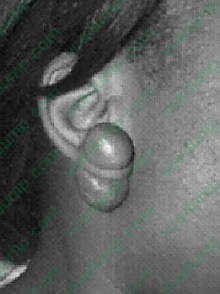
B. This resulted from an infection that occurred when she had her ear pierced.
C. Recurrences of this problem are common.
D. She is likely to have reduced fertility.
E. Oral corticosteroids have been effective. -
Question 365:
A husband and wife, both aged 30, come to the community health center for advice and evaluation prior to a month-long mission trip to central Africa. Both are in good health. She takes oral contraceptive pills and he is on no prescription medication. Review of their records shows that they have had all of the appropriate vaccinations for their ages, have completed a three dose hepatitis B series and had dT boosters 2 years ago. Their mission will involve building a school and health clinic in a rural area of Cameroon. Which of the following immunizations would be recommended prior to the trip?
A. MMR booster
B. dT booster
C. hepatitis B booster
D. injectable polio vaccine
E. smallpox vaccine -
Question 366:
A 45-year-old woman undergoes an uncomplicated thyroidectomy for a goiter. Later that night, she becomes agitated and complains of difficulty breathing. The surgeon notices some neck swelling at the incision site, but the dressing is clean.
What should the next step be?
A. start oxygen by nasal cannula
B. check STAT serum calcium level
C. endotracheal intubation to protect her airway
D. open the incision
E. administer propranolol and morphine -
Question 367:
The patient is a 7-year-old boy brought in for evaluation by his father. He has been concerned with his son's behavior. At school conferences, he has been told that his son will not stay in place and moves around the room despite being informed about the rules. He neither listens at home nor at school when given feedback. For example, he continues to have difficulty waiting in line, completing his homework, and cleaning up his toys, regardless of numerous consequences. In department stores, he will run around and grab at items, and this has resulted in his breaking merchandise on many occasions. The father states that his son has been this way "since he could walk" and is worried about his son's future.
After further history is obtained and consultation with the school is initiated, a definitive diagnosis is made. The recommendation to begin a stimulant is presented to the father, but he has concerns regarding that treatment choice. How should he be counseled regarding the use of this medication?
A. It may cause paradoxical sedation.
B. It only improves behavior and not school performance.
C. It requires regular BP monitoring.
D. It should be taken daily, throughout the year.
E. It will increase the risk of future addiction. -
Question 368:
A 74-year-old male with gout, osteoporosis, and type II diabetes presents for routine followup. As you review his medication list you note that he is on insulin, vitamin D, glypizide, quinidine, and allopurinol. You now diagnose him with hypertension that requires pharmacologic management. Which of the following medications would be contraindicated in this patient?
A. enalapril
B. hydrochlorothiazide
C. diltiazem
D. losartan
E. atenolol -
Question 369:
You are called to see a 12-hour-old male infant who was born to a 19-year-old G1 woman with no prenatal care. She presented to the emergency room completely dilated and crowning. The baby was born minutes later. On examination, the baby is febrile and tachypneic. A CXR confirms the presence of pneumonia.
What is the most likely infectious agent?
A. group B Streptococcus (GBS)
B. HSV
D. respiratory syncytial virus (RSV)
E. Streptococcus pneumoniae -
Question 370:
A 48-year-old woman presents for evaluation of progressively worsening dyspnea. She relates the onset of symptoms to a "walking pneumonia" that she had a year ago. Her breathing has worsened progressively since that time. She has a "smoker's cough" productive of some clear or white phlegm, for which she frequently sucks on cough drops. She started smoking regularly at the age of 18. She currently smokes about a pack of cigarettes a day, down from as much as two packs per day. She is not on
any medications regularly. She has no history of heart disease and has always had normal blood pressure
Which of the following is most likely to be found on a CXR?
A. cardiomegaly
B. residual infiltrate from inadequately treated pneumonia
C. a pulmonary mass with hilar adenopathy
D. hyperinflation of the lungs
E. Kerley B lines
Tips on How to Prepare for the Exams
Nowadays, the certification exams become more and more important and required by more and more enterprises when applying for a job. But how to prepare for the exam effectively? How to prepare for the exam in a short time with less efforts? How to get a ideal result and how to find the most reliable resources? Here on Vcedump.com, you will find all the answers. Vcedump.com provide not only USMLE exam questions, answers and explanations but also complete assistance on your exam preparation and certification application. If you are confused on your USMLE-STEP-3 exam preparations and USMLE certification application, do not hesitate to visit our Vcedump.com to find your solutions here.