USMLE-STEP-3 Exam Details
-
Exam Code
:USMLE-STEP-3 -
Exam Name
:United States Medical Licensing Step 3 -
Certification
:USMLE Certifications -
Vendor
:USMLE -
Total Questions
:804 Q&As -
Last Updated
:Jul 29, 2026
USMLE USMLE-STEP-3 Online Questions & Answers
-
Question 281:
Which of the following is a contraindication to sentinel lymph node biopsy in breast cancer?
A. clinically negative axillary examination
B. multicentric disease
C. lesion under the nipple
D. history of previous breast biopsy
E. patient preference for breast conservation -
Question 282:
A 45-year-old male comes to your office for his first annual checkup in the last 10 years. On first impression, he appears overweight but is otherwise healthy and has no specific complaints. He has a brother with diabetes and a sister with high blood pressure. Both of his parents are deceased and his father died of a stroke at age 73. He is a long-standing heavy smoker and only drinks alcohol on special occasions. On physical examination, his blood pressure is 166/90 in the left arm and 164/88 in the right arm. The rest of the examination is unremarkable. He is concerned about his health and does not want to end up on medication, like his siblings
In the initial evaluation of a patient such as this, which of the following should be routinely recommended?
A. a urine microalbumin/creatinine ratio
B. an echocardiogram
C. thyroid function tests
D. renal function tests (serum creatinine and blood urea nitrogen [BUN])
E. an exercise stress test -
Question 283:
A 29-year-old woman presents to the primary care clinic complaining of frequent headaches for several months. During the interview she appears tearful and withdrawn, with minimal eye contact and reluctance to answer questions. With further encouragement and support, she is able to describe intense feelings of sadness, along with significant insomnia, poor concentration, fatigue, anhedonia, and little appetite with a 20-lb weight loss.
Before she leaves the office, what is the most important question to ask her?
A. "Have you been drinking alcohol or using illicit drugs recently?"
B. "Have you been taking any over-thecounter medications?"
C. "Have you been treated for any medical conditions?"
D. "Have you ever felt like this before?"
E. "Have you had thoughts of hurting yourself?" -
Question 284:
The patient is a 70-year-old man brought to the primary care clinic by his family over concerns that he has Alzheimer's disease. They have noticed a worsening of his memory over the past 6 months. He does not seem to want to get out of bed, and he appears to have difficulty providing for his basic needs such as cleaning, dressing, and cooking for himself. He is hesitant when talking, but it is unclear whether he is unable or unmotivated to speak. His family has also noticed that he appears depressed and is often seen crying. A MSE of the patient is performed to help determine whether he is suffering from a dementing illness or a depressive illness (pseudodementia).
Which of the following characteristics on MSE is most consistent with pseudodementia?
A. appears unconcerned during examination
B. attends poorly to questions on MSE
C. displays poor insight into symptoms
D. gives "don't know" answers to questions
E. consistently performs poorly to tasks -
Question 285:
Ayoung college student is brought to your office by his fianc?for evaluation of weight loss. He tells you that, over the past few months, he seems to be unable to gain any weight despite having a ferocious appetite and that he is steadily losing weight. He has also noticed increased thirst and urination. Over the past few nights, he has awakened several times to go to the bathroom. You suspect that he may have developed diabetes.
Which of the following is a diagnostic criterion for diabetes mellitus (DM)?
A. a single fasting plasma glucose level of140 mg/dL in an asymptomatic person
B. a plasma glucose level of >175 mg/dL measured at least 8 hours after a meal
C. a plasma glucose level of >124 mg/dL measured at least 4 hours after a meal
D. a blood glucose level of 200 mg/dL, 2 hours after completing a glucose tolerance test with a 75-g oral glucose load
E. a serum glycosylated HgbA1C level higher than 7% -
Question 286:
A 26-year-old G2P1 female comes to your office for her initial obstetric visit. The first day of her last menstrual period was 6 weeks ago. Other than some mild morning sickness, she is feeling fine. Her first pregnancy was 40 weeks in gestation and uncomplicated. She has no significant medical history. The result of the test that you ordered is positive. What would be appropriate management for the neonate to reduce the risk of perinatal transmission of the hepatitis B virus?
A. hepatitis B vaccine within 2 days of birth
B. hepatitis B immune globulin within 2 days of birth
C. hepatitis B immune globulin and hepatitisB vaccine within 12 hours of birth
D. deliver the baby by scheduled caesarian section
E. advise the mother not to breast feed -
Question 287:
A 4-week-old, previously healthy male presents with projectile emesis after feeds. His mother states that he has had 2 weeks of postprandial emesis, which became projectile in the past 2 days. She states that it looks like formula and has never been bilious.
Which of the following statements is true?
A. Physical examination is almost always normal in patients with this condition.
B. Upper gastrointestinal (GI) contrast study is the best diagnostic option.
C. This patient should be taken emergently to the operating room (OR) once the diagnosis is made.
D. If uncorrected, these infants will progress to complete obstruction.
E. Surgical therapy involves bypassing the site of obstruction. -
Question 288:
A 53-year-old Black male, with a history of hypertension, hepatitis C, and newly diagnosed nonsmall cell lung cancer, undergoes his first round of chemotherapy, which includes cisplatin. You are called to see this patient 5 days into his hospitalization for oliguria and laboratory abnormalities. Other than the chemotherapy, he is receiving lansoprazole, acetaminophen, and an infusion of D5-- 0.9% normal saline at 50 mL/h. On examination, his BP is 98/60 and heart rate is irregular, between 40 and 50 bpm. His physical examination shows a middle-aged male in no acute distress. His cardiac examination is unremarkable, his lungs show bibasilar crackles, and the abdominal examination is positive for a palpable spleen tip without any hepatomegaly or abdominal tenderness. He has trace bilateral ankle edema. His distal pulses are irregular. The neurologic examination was unremarkable. His laboratory (serum sample) results are as follows
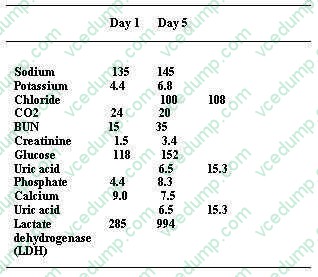
Which electrolyte/acid-base abnormality is most likely responsible for the findings on physical examination?
A. hypernatremia
B. hyperkalemia
C. metabolic acidosis
D. hyperphosphatemia
E. hyperuricemia -
Question 289:
A61-year-old man comes to your office for a checkup. He currently feels well and has no focal complaints. He has a past medical history significant for wellcontrolled hypertension, and his gallbladder was removed 3 years ago in the setting of acute cholecystitis. He does not smoke and drinks one to two alcoholic beverages per day. Family history is remarkable for colon cancer in his mother at age 45 and a brother at age 49. He has a sister who developed endometrial cancer at age 53. He has never undergone colon cancer screening and is interested in pursuing this. The patient's family history is strongly suggestive of which of the following?
A. familial adenomatous polyposis (FAP) syndrome
B. hereditary nonpolyposis colorectal cancer (HNPCC) syndrome
C. Peutz-Jeghers syndrome
D. Cronkhite-Canada syndrome
E. Turcot syndrome -
Question 290:
A husband and wife, both aged 30, come to the community health center for advice and evaluation prior to a month-long mission trip to central Africa. Both are in good health. She takes oral contraceptive pills and he is on no prescription medication. Review of their records shows that they have had all of the appropriate vaccinations for their ages, have completed a three dose hepatitis B series and had dT boosters 2 years ago. Their mission will involve building a school and health clinic in a rural area of Cameroon.
How would you advise them regarding food safety?
A. Carbonated soft drinks served with ice cubes are considered safe to drink.
B. Locally grown oranges and bananas are safe to eat.
C. Water is safe to drink after filtering through an absolute 1 m filter.
D. Brushing teeth with untreated water is safe as long as it is not swallowed.
E. Salads are generally safer to eat than cooked meats.
Tips on How to Prepare for the Exams
Nowadays, the certification exams become more and more important and required by more and more enterprises when applying for a job. But how to prepare for the exam effectively? How to prepare for the exam in a short time with less efforts? How to get a ideal result and how to find the most reliable resources? Here on Vcedump.com, you will find all the answers. Vcedump.com provide not only USMLE exam questions, answers and explanations but also complete assistance on your exam preparation and certification application. If you are confused on your USMLE-STEP-3 exam preparations and USMLE certification application, do not hesitate to visit our Vcedump.com to find your solutions here.