USMLE USMLE-STEP-3 Online Practice
Questions and Exam Preparation
USMLE-STEP-3 Exam Details
Exam Code
:USMLE-STEP-3
Exam Name
:United States Medical Licensing Step 3
Certification
:USMLE Certifications
Vendor
:USMLE
Total Questions
:804 Q&As
Last Updated
:Jul 29, 2026
USMLE USMLE-STEP-3 Online Questions &
Answers
Question 251:
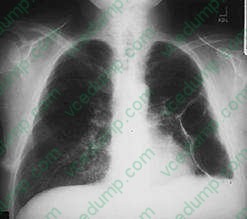
A 53-year-old insulin-dependent diabetic, who underwent a cadaveric renal transplant 1 year prior to admission, presents with fever and cough of 3 weeks duration. He works as a long-haul trucker, carting fruit from McAllen, Texas (on the Texas- Mexico border) to Fresno, California. He does not smoke. His PPD skin test prior to admission was positive. On physical examination, his respiratory rate is 25, his oral temperature is 101, his lungs have rhonchi and de creased breath sounds on the left. His CXR is shown in Figure.
What organism besides Mycobacterium tuberculosis leads your differential as a cause of pneumonia in this case?
A. Haemophilus influenzae B. CMV C. immitis E. Histoplasma capsulatum
D
Explanation
The clinical picture is most consistent with disease caused by C. immitis. This is due both to the nature of the cavitary lesion on CXR and the endemic area. Figure 1-4 shows a peripheral, thinwalled cavitary lesion on CXR as well as a right lower lobe infiltrate. As a renal transplant recipient 1 year out, this patient is likely to have infections with tuberculosis and disseminated fungal infections. It is interesting that the route that he travels is through the lower Sonoran life zone where coccidiomycosis is endemic.
CMV produces a diffuse interstitial infiltrate pattern on CXR, as does Pneumocystis and H. capsulatum. Fiberoptic bronchoscopy with bronchial alveolar lavage should be performed in any patient with this clinical presentation who is immunocompromised because of the lack of ability to produce a good sputum specimen. We know that the patient is PPD positive, so skin testing is not useful. The patient is not mentioned to be in the endemic area for histoplasmosis. Serum cryptococcal antigen testing is a remote possibility. While Cryptococcus can produce a pulmonary disease with cavitary lesions, in immunocompromised hosts such as this, the patient more likely would present with meningitis.
Question 252:
Which of the following patients is most likely to progress to develop cirrhosis?
A. a man with chronic liver disease due to cytomegalovirus infection B. a man with chronic liver disease due to hepatitis B C. a man with chronic liver disease due to hepatitis C D. a man chronic with liver disease due to hepatitis D E. a man with chronic liver disease due to human immunodeficiency virus
C. a man with chronic liver disease due to hepatitis C
Explanation
Hepatitis C which is caused by a singlestranded RNA virus is responsible for over 90% of the cases of hepatitis associated with transfusion of blood and blood products in the United States. The disease also occurs in drug abusers and transplant recipients, as well as renal dialysis patients. It is associated with a higher incidence of chronic hepatitis, which occurs in 50% of those affected and cirrhosis complicates 20% of the cases.
Question 253:
The practice of confidentiality has roots in the Hippocratic Oath. However, the increasing use of health information technology has increased the efficiency of acquisition, manipulation, and dissemination of this potentially sensitive data. Federal laws have been adopted to safeguard health information privacy. Under the Health Insurance Portability and Accountability Act (HIPAA), which of the following is allowed?
A. conducting teaching rounds at a table in the hospital cafeteria, as long as patient names are not used B. sharing a patient's diagnosis with any family member who requests the information C. discussing patient information with a consulting physician D. leaving an electronic medical record page with patient information open on a computer in the hallway of the ICU, to allow the nurse to have more rapid access to information E. sharing health information about a patient with his or her employer if the employer is paying for the patient's health insurance
C. discussing patient information with a consulting physician
Explanation
In 1996, the U.S. Congress recognized the need for comprehensive national health information privacy standards, which required full compliance by April 14, 2004. This rule provided the first systematic privacy protection for health information and is grounded in the principle of protecting the confidentiality of information about patients while protecting the legitimate interests of third parties (e.g., proxy and surrogate decision makers, health care providers, health care institutions, teaching situations). This legislation provides mechanisms to release information for payment of health care services, and consumer access to medical records.
HIPAA does not restrict the normal exchange of clinical information between consulting physicians or nurses on the patient's case. However, this normal exchange of information must occur in a medical context, not in elevators, public hallways, or the cafeteria. Health care providers must obtain the individual's written consent prior to disclosure of health information except in the management of emergencies or if the consent can be inferred from a patient with impaired communication. Procedures must be developed to prevent open access to patient information via computers or documents which can be easily accessed, including paper medical records. The privacy legislation also protects the release of medical information to an employer without the patient's consent.
Question 254:
1. A22-year-old male presents to the emergency department (ED) with complaints of right-sided chest pain and dyspnea. He has no other significant medical history. There is no history of trauma. On examination, he has a pulse of 95, BP of 110/70, and SpO2 of 95% on 2 L. A chest x-ray reveals a large right pneumothorax.
Which of the following statements is true?
A. Since the patient is hemodynamically stable, he can be observed with oxygen supplementation, pain control, and serial chest x-rays. B. The patient is likely to have a tall, thin habitus. C. This condition is probably due to small lacerations in the apex of the right lung. D. His risk of recurrence is 10%. E. Recurrences are usually on the contralateral side since adhesions prevent recurrence on the ipsilateral side.
B. The patient is likely to have a tall, thin habitus.
Explanation
Spontaneous pneumothorax is usually found in young males. A tall, thin habitus is common. Eighty- five percent of patients are found to have pulmonary blebs on the affected side. The correct management is placement of a chest tube, pain control, oxygen supplementation, and serial chest x-rays to monitor resolution. Thoracotomy is required if the pneumothorax does not resolve with a chest tube or if there is a persistent air leak. Bleb resection and pleurodesis is usually performed at the time of operation to prevent future bleb rupture and to promote adhesion of the lung to the chest wall. Thoracotomy is also offered to patients after a recurrence to prevent future episodes. Fifty percent of patients will have a recurrence on the ipsilateral side after a spontaneous pneumothorax.
Question 255:
Which of the following agents is considered the first-line therapy for prevention of eclamptic seizures?
A. diazepam B. phenytoin C. magnesium sulfate D. phenobarbital E. carbamazepine
C. magnesium sulfate
Explanation
Magnesium sulfate has been demonstrated in randomized-controlled trials to be superior to any other anticonvulsant agent in prevention of initial eclamptic seizures and prevention of recurrence of eclampsia. Phenytoin would be considered the best alternative in patients who had an absolute contraindication to magnesium sulfate therapy (such as women with myasthenia gravis).
Question 256:
C1 deficiency has three subcomponents, of which the most common is deficiency of C1q. Most of those patients will have clinical and serologic findings typical of which of these?
A. polymyositis B. RA C. SLE D. recurrent Streptococcus pneumoniae infections E. recurrent H. influenzae type B infections.
C. SLE
Explanation
Deficiency of C1q, along with other C1, C2, and C4 deficiencies, results in immune complex syndromes that are clinically similar to lupus. Deficiencies of C5, C6, C7, and C8 often result in recurrent, invasive Neisseria Infection.
Question 257:
A70-year-old White woman has been faithful about taking 1200 mg of calcium, 400 IU of vitamin D supplements, and performing weight-bearing exercise on a daily basis. Her hip T score from her current DEXA scan has changed from -2.0 SDs to -2.55 SDs compared with last year's test.
At this time, which of the following do you recommend?
A. an oral bisphosphonate B. weekly GnRH injections C. discontinuation of her vitamin D D. glucocorticoid therapy E. IM testosterone
A. an oral bisphosphonate
Explanation
This patient meets criteria for the diagnosis of osteoporosis, with a T score falling below -2.5 standard SD. AT score indicates the number of standard deviations below or above the average peak bone mass in young, healthy adults of the same gender. Bisphosphonate therapy has been shown to reduce vertebral and hip fracture risk in up to 50% of women with documented osteoporosis. GnRH therapy and discontinuation of her vitamin D therapy would worsen, not improve, this patient's bone density.
Although testosterone may arrest further bone loss, the side effects of the medication are too great compared to any potential benefit.
For women who have osteoporosis the serum calcium level is generally normal. In premenopausal osteoporosis, or more severe cases of bone loss/fractures, the presence of metabolic bone disease should be considered. In hyperparathyroidism the serum calcium is elevated. With renal failure, as with osteomalacia, serum calcium is low. The serum calcium level is normal, and the alkaline phosphatase level is elevated in patients with Paget disease. The use of tobacco, a family history of mother or maternal grandmother with hip fractures, postmenopausal state without estrogen replacement, vision problems, and a body mass index of less than 23 are all increased risks for fractures. Abody mass index of greater than 23 does not represent an increased risk for fracture.
Question 258:
A 16-year-old sexually active woman is being seen in the emergency department. She is complaining of vaginal discharge. She has a temperature of 99.5, but is otherwise well. On pelvic examination, you see a mucopurulent cervical discharge with scant blood. Samples of the discharge are sent to the laboratory for culture. There are no cervical ulcers noted. She does not have any medical allergies.
Which of the following is the most common sexually transmitted infection in adolescents?
A. herpes simplex virus (HSV) B. chlamydia C. gonorrhea D. human immunodeficiency virus (HIV) E. syphilis
B. chlamydia
Explanation
This young woman has cervicitis, but without evidence of pelvic inflammatory disease (PID). Chlamydia is the most common bacterial cause of sexually transmitted diseases in the United States and the most likely etiology of this patient's infection. Gonorrhea would be the next most likely cause and, frequently, there will be coinfection with the two pathogens. The simplest outpatient treatment for these two would be a single 1- g oral dose of azithromycin and a 125-mg IM dose of ceftriaxone. This regimen will ensure complete compliance, which is crucial. Treatment of her sexual partners would also be recommended. Another cause of cervicitis is trichomoniasis, for which metronidazole, either for 1 week of 500 mg bid or a single 2- g oral dose, would be recommended therapy. Of the suggested answers, option Ais the only one which would cover the two most common infectious agents.
Question 259:
A 48-year-old woman with metastatic breast cancer presents to the Emergency Center complaining of a 4- day history of nausea, anorexia, and generalized weakness. Her husband reports that she has been more somnolent, sleeping 1214 hours per day, and at times she seems confused. CT scan of the brain reveals no abnormalities. Initial laboratory evaluation reveals a normal CBC, but her BUN is elevated at 32 mg/dL with a slight elevation of serum creatinine above her baseline. Her serum calcium is elevated at 15 mg/dL.
What is the most appropriate initial therapy for the patient's hypercalcemia?
A. volume resuscitation with normal saline B. administration of furosemide every 6 hours C. subcutaneous calcitonin D. intravenous zoledronate E. treatment of the patient's underlying malignancy with chemotherapy
A. volume resuscitation with normal saline
Explanation
The patient is hypercalcemic and has laboratory features suggesting dehydration, as do most patients with symptomatic hypercalcemia. Initial management would include saline rehydration, which replaces volume deficits, dilutes the elevated serum calcium, and promotes urinary calcium excretion. The addition of loop diuretics such as furosemide can also increase calciuresis, but should only be added after the patient has had adequate volume repletion. Administration of bisphosphanates, such as pamidronate or zoledronate, provide more powerful reduction of serum calcium by inhibiting bone resorption and liberation of calcium. Their effects may last for several weeks, but their onset of action does not occur for 12 days. Subcutaneous calcitonin can provide a faster onset of action to inhibit bone resorption within a few hours, but patients develop tachyphylaxis and become unresponsive to the drug effect within 2448 hours. Most cancer patients with hypercalcemia develop this problem as a paraneoplastic phenomenon, due to the production of a parathyroid hormone-related protein (PTHrP).
This problem, called humoral hypercalcemia of malignancy (HHM), is very common, affecting 510% of all cancer patients. The diagnosis is usually straightforward, as there is a readilyavailable laboratory assay for PTHrP. Other cancer patients develop HHM due to the production of an enzyme that converts 25- hydroxyvitamin D to the more active 1,25- hydroxyvitamin D, similar to the hypercalcemia seen in patients with granulomatous diseases. Severe hypercalcemia solely due to the presence of osteolytic metastases is much less common. Hyperparathyroidism and medications such as thiazide diuretics can also cause elevations of serum calcium, but usually not to the severe levels seen in HHM.
Question 260:
A 25-year-old male presents to his psychiatrist for follow-up after a lengthy psychiatric hospitalization. He was diagnosed with schizophrenia and discharged on risperidone 6 mg daily. He has no known medical problems and is without physical complaints. He continues to have some paranoia and ideas of reference regarding CNN, but he is not overtly delusional. He denies hallucinations as well. Although he feels "depressed" regarding his illness, he denies suicidal or homicidal ideation.
The above patient continues to be compliant with his medication and remains asymptomatic. He returns 6 months later with complaints of urinary frequency and weight gain. Afasting glucose is 200. Consideration is given to switching to another antipsychotic. Which of the following medications would be the most appropriate?
A. aripiprazole (Abilify) B. clozapine (Clozaril) C. olanzapine (Zyprexa) D. quetiapine (Seroquel) E. thioridazine (Mellaril)
A. aripiprazole (Abilify)
Explanation
Routine vital signs, ECG, and blood work such as CBC or LFTs are not required for ongoing use of second-generation (atypical) antipsychotics in healthy patients. Due to the risk of weight gain, hyperlipidemia, and diabetes ("metabolic syndrome"), regular monitoring for these is recommended. Due to variations in height, calculating a BMI is preferred when monitoring for weight gain in these patients. This patient has developed new-onset diabetes, presumably from the risperidone. Although all of the second- generation antipsychotics have Food and Drug Administration (FDA) warnings about causing metabolic syndrome, studies have demonstrated that they have varying rates of causing or exacerbating this:
Therefore, assuming there is no contraindication to using one of the listed agents, aripiprazole would be the most appropriate choice based on its likely minimal risk of causing or exacerbating diabetes.
Nowadays, the certification exams become more and more important and required by more and more
enterprises when applying for a job. But how to prepare for the exam effectively? How to prepare
for the exam in a short time with less efforts? How to get a ideal result and how to find the
most reliable resources? Here on Vcedump.com, you will find all the answers.
Vcedump.com provide not only USMLE exam questions,
answers and explanations but also complete assistance on your exam preparation and certification
application. If you are confused on your USMLE-STEP-3 exam preparations
and USMLE certification application, do not hesitate to visit our
Vcedump.com to find your solutions here.