USMLE-STEP-3 Exam Details
-
Exam Code
:USMLE-STEP-3 -
Exam Name
:United States Medical Licensing Step 3 -
Certification
:USMLE Certifications -
Vendor
:USMLE -
Total Questions
:804 Q&As -
Last Updated
:Jul 29, 2026
USMLE USMLE-STEP-3 Online Questions & Answers
-
Question 171:
A 49-year-old male postal worker presents to your office for the evaluation of a lesion on his left arm. The lesion started about a week ago as a red pustule but has grown and now has a thick black scab. The lesion is painless. A coworker showed the patient a similar appearing lesion that she developed on her arm for which her doctor prescribed an oral antibiotic. Examination reveals a 5 cm circular black eschar with some surrounding vesicles. A Gram stain of fluid drained from a vesicle reveals chains of gram-positive bacilli.
What organism is most likely responsible for this lesion?
A. methicillin-resistant Staphylococcus aureus
B. smallpox virus
C. Clostridium tetani
D. Bacillus anthracis
E. group A beta-hemolytic Streptococcus -
Question 172:
A 45-year-old woman presents with a slowly growing mass near the right jaw. You palpate a firm nodule in the parotid gland but find no adenopathy and no other abnormality on examination. A biopsy reveals both epithelial and stromal elements.
What is the appropriate treatment for this lesion?
A. observation, as this is a benign lesion
B. external beam radiation therapy
C. excision with narrow margins
D. excision with a wide margin of normal tissue
E. chemotherapy -
Question 173:
A 56-year-old man comes to the hospital. For the past 5 days he has had colicky abdominal pain, vomiting, abdominal distention, and constipation
During definitive surgical treatment of the lesion shown on the barium enema, the left ureter is accidentally transected at the level of the pelvic brim. What is the most appropriate management of this complication?
A. ureteroneocystostomy
B. left to right ureteroureterostomy
C. anastomosis of the two cut ends over a "double J" stent
D. nephrectomy
E. ligation of the transected ends -
Question 174:
A23-year-old female presents to her obstetrician gynecologist (OB/GYN) complaining of inability to conceive. She has regular menstrual cycles, and her husband's semen analysis is normal. She undergoes a hysterosalpingogram that shows evidence of bilateral distal tubal obstruction. Which of the following is the most likely cause of acquired tubal damage?
A. appendicitis
B. pelvic inflammatory disease (PID)
C. salpingitis isthmica nodosa (SIN)
D. Asherman's syndrome
E. ruptured ovarian cyst -
Question 175:
An autopsy was performed following the death of a 72-year-old man. The kidney is shown in Figure below. Which of the following clinical scenarios is most likely to explain the changes seen in this kidney?
A. complete urinary outflow obstruction from an enlarged prostate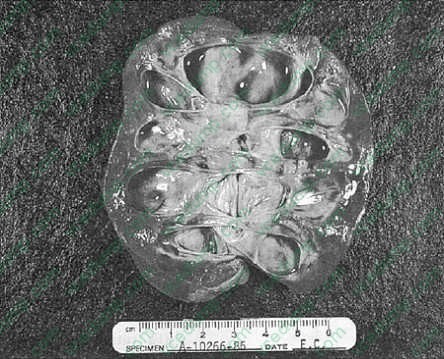
B. renal infarct from an embolism originating in the atrium of the heart due to atrial fibrillation
C. long-standing hypertension
D. renal cell carcinoma
E. chronic abuse of analgesics and nonsteroidal anti-inflammatory drugs -
Question 176:
A 39-year-old HIV-positive male presents for routine follow-up. He is on highly active antiretroviral therapy. A CD4 count is 250/L. His vital signs are within normal limits and his examination is normal. He has a PPD placed and follows up in 48 hours. At the site of the injection you find 6 mm of induration. A CXR is normal. He has never been treated for tuberculosis or a positive PPD before.
Which management option is most appropriate?
A. Collect sputum samples for 3 days to send for AFB (acid fast bacilli) staining.
B. Empirically start four-drug therapy for active tuberculosis.
C. Empirically start isoniazid daily for 9 months.
D. Have the patient return in 1 week for a second PPD to assess for the presence of a "booster" phenomenon; treat with isoniazid if 10 mm induration.
E. No intervention at this time but repeat the test in 6 months. -
Question 177:
Which of these statements is true in regard to GI hormones?
A. Vagal activation, antral distension, and antral protein are all stimuli for gastrin release.
B. Secretin stimulates gastrin.
C. Secretin is released from the antrum of the stomach.
D. Cholecystokinin (CCK) release is stimulated by fat in the duodenum and results in release of insulin by the pancreas.
E. CCK is released by the pancreas and relaxes the sphincter of Oddi. -
Question 178:
A50-year old male presents to the office for prostate cancer screening because he saw a TV show recommending that men get tested. He has no significant medical history, takes no medications, and has no genitourinary symptoms. There is no family history of prostate cancer. What can you tell him about prostate cancer and the PSA test?
A. PSA testing has been proven to reduce all-cause mortality in men over 50.
B. In spite of PSA testing, the diseasespecific mortality from prostate cancer has not changed in the past 30 years.
C. Prostate cancer is the only condition that causes an elevated PSA level.
D. PSA testing can prevent the development of prostate cancer.
E. PSA testing can increase the chances of detecting prostate cancer. -
Question 179:
A26-year-old female with recurrent pregnancy loss undergoes a laparoscopy and hysteroscopy. She is found to have a Mlerian anomaly with a heart-shaped uterus that has two uterine horns but one common cervix.
What is the name of the uterine anomaly?
A. didelphic
B. septate
C. unicornuate
D. bicornuate
E. Mlerian agenesis (Mayer-Rokitansky- Kter-Hauser syndrome) -
Question 180:
A 17-year-old male presents for evaluation of shortness of breath. He has episodes where he will audibly wheeze and have chest tightness. His symptoms worsen if he tries to exercise, especially when it is cold. He has used an OTC inhaler with good relief of his symptoms, but he finds that his symptoms are worsening. He now has episodes of wheezing on a daily basis and will have nighttime wheezing and coughing, on average, five or six times a month. You suspect a diagnosis of asthma. Which of the following would confirm your suspicion of the diagnosis of asthma?
A. presence of expiratory wheezing on examination
B. increase in FEV1 of 15% after giving inhaled albuterol
C. a decreased serum IgE level
D. presence of eosinophils on a sputum sample
E. a peak expiratory flow measurement 30% below the predicted normal value for the patient
Tips on How to Prepare for the Exams
Nowadays, the certification exams become more and more important and required by more and more enterprises when applying for a job. But how to prepare for the exam effectively? How to prepare for the exam in a short time with less efforts? How to get a ideal result and how to find the most reliable resources? Here on Vcedump.com, you will find all the answers. Vcedump.com provide not only USMLE exam questions, answers and explanations but also complete assistance on your exam preparation and certification application. If you are confused on your USMLE-STEP-3 exam preparations and USMLE certification application, do not hesitate to visit our Vcedump.com to find your solutions here.