USMLE USMLE-STEP-3 Online Practice
Questions and Exam Preparation
USMLE-STEP-3 Exam Details
Exam Code
:USMLE-STEP-3
Exam Name
:United States Medical Licensing Step 3
Certification
:USMLE Certifications
Vendor
:USMLE
Total Questions
:804 Q&As
Last Updated
:Jul 29, 2026
USMLE USMLE-STEP-3 Online Questions &
Answers
Question 151:
A40-year-old woman presents with headaches and visual disturbances for the past 6 months. She suddenly developed amenorrhea 2 years ago. One year ago, she noticed milky discharge from her left breast. The most likely diagnosis is which of the following?
A. prolactinoma B. premature ovarian failure C. Kallman syndrome D. Sheehan syndrome E. polycystic ovarian syndrome (PCOS)
A. prolactinoma
Explanation
Galactorrhea with amenorrhea is consistent with hyperprolactinemia. The additional history of headache and possible visual field changes or cranial nerve abnormalities is strongly suggestive of a pituitary tumor. In this setting, the most likely diagnosis is prolactinoma. Ovarian failure, Kallman syndrome, and Sheehan syndrome would not present with galactorrhea. Kallman syndrome is associated with primary amenorrhea and anosmia. PCOS presents with a long history of irregular cycles and hyperandrogenism
Question 152:
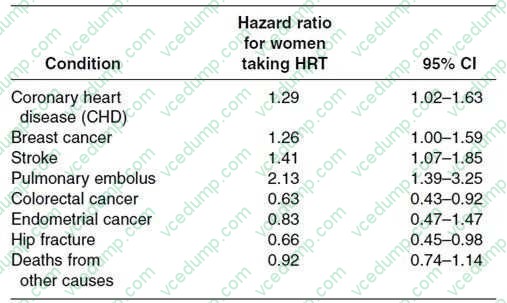
A 60-year-old woman presents to your office to discuss her ongoing treatment with HRT that she takes for menopausal symptoms. She was started on estrogen and progesterone replacement at the age of 51 and has been on them since that time. She has read several articles in newspapers and on the Internet stating that hormone therapy is dangerous. You briefly review the results of the Women's Health Initiative study, a randomized-controlled trial comparing health outcomes in women taking combined estrogen-progestin therapy (HRT) versus a placebo. The results are as follows:
Based on the results listed, what can you tell your patient about women taking HRT?
A. They have no difference in endometrial cancer risk. B. They have no difference in CHD risk. C. They have no difference in pulmonary embolus risk. D. They have no difference in stroke risk. E. They have no difference in hip fracture risk.
A. They have no difference in endometrial cancer risk.
Explanation
The hazard ratio statistic as presented is a comparison of the rate of development of an outcome in the treatment group divided by the rate of development of the same outcome in the control group. It is a "hazard" ratio because all of the outcomes measured are adverse. Ahazard ratio of 1.00 means that there is no difference in the rate of development of the outcome between the two groups. Further, if the 95% CI crosses 1.00 then there is no statistically significant difference between the two groups. From the data presented, the hazard ratio for the development of endometrial cancer is 0.83, suggesting that there may be a reduction in the risk of endometrial cancer for women on HRT. However, the 95% CI crosses 1, therefore we cannot consider this result to be statistically significant. For the other outcomes listed, the 95% CIs do not cross 1.00, thus representing statistically significant increases in the risk of CHD, pulmonary embolism, and stroke and a statistically significant reduction in the risk of hip fracture. The data reveal statistically significant rates of combined cardiovascular disease and fracture risk between the two groups. The risk of cardiovascular disease is increased but the combined fracture risk is reduced in women on HRT. The combined cancer risk and total mortality do not reach the level of statistical significance. There are no data presented on quality of life in the chart, so we cannot state that option E is true.
Question 153:
While you are working in the community health center, a 40-year-old male presents to you as a referral from the dental clinic. The patient reported on the intake history form at the dental office that he had rheumatic fever at the age of 7. The dentist refused to allow him to have a dental examination and cleaning until he was cleared by a medical doctor. Other than rheumatic fever, the patient has no medical history and does not take any medications. He denies chest pain, palpitations, dyspnea, or any other symptoms. On examination, he has normal vital signs and a normal general examination. On auscultation of his heart, you hear a 2/6 systolic ejection murmur at the left upper sternal border without radiation. Review of his chart shows that he had an echocardiogram approximately 9 months ago that revealed mild mitral valve prolapse without evidence of mitral regurgitation, but otherwise normal valves and cardiac function
In patients in whom it is required, for which of the following dental procedures is bacterial endocarditis prophylaxis recommended?
A. fluoride treatments B. taking of oral impressions C. taking of dental x-rays D. dental extractions E. adjustment of orthodontic appliances
D. dental extractions
Explanation
Explanations:
Bacterial endocarditis is a rare, but life-threatening, disease. It occurs primarily in persons with underlying structural heart defects who develop bacteremia with organisms that are likely to cause endocarditis. Most cases of endocarditis are not a complication of invasive medical or dental procedures. Because of the risks associated with the disease, efforts should be made to prevent bacterial endocarditis when appropriate. The American Heart Association has published updated, evidence- based recommendations on the prevention of bacterial endocarditis. These guidelines are available at the American Heart Association web site (www.americanheart.org). These guidelines outline conditions for which endocarditis prophylaxis is appropriate, procedures for which endocarditis prophylaxis is necessary, and antibiotic regimens that are recommended.
Cardiac conditions are stratified into high-risk, moderate-risk, and negligible risk. Negligible risk conditions are those in which, although endocarditis may develop, the risk is no greater than in the general population. This patient has a history of rheumatic fever, which can potentially result in high- risk valvular damage. However, his echocardiogram did not reveal any such condition. Mitral valve prolapse without a regurgitant jet (which is not a complication of rheumatic fever) is considered a negligible risk condition, so the proposed dental work can proceed without delay. Of the conditions listed, only bicuspid aortic valve would require antibiotic prophylaxis, as it is a moderate-risk congenital cardiac malformation. All of the other conditions listed are considered to be of negligible risk. Procedures which require antibiotic prophylaxis are those which produce a significant bacteremia with organisms commonly causing endocarditis. For dental procedures, those that tend to cause significant bleeding from hard or soft tissues would necessitate prophylaxis. Of the procedures listed, only dental extraction is likely to do this. During the course of other procedures, if unexpected significant bleeding occurs, antibiotics within 2 hours following the procedure would be recommended
Question 154:
A meta-analysis of randomized-controlled trials was published comparing two methods of managing postterm pregnancies. The question studied was whether the routine induction of labor at 41 weeks' gestation would result in improved maternal or fetal outcomes compared with expectant management. The authors reported that the odds ratio for caesarian delivery rate in the induction group compared to the expectant management group was 0.88 with a 95% confidence interval (CI) of 0.780.99. A second outcome studied was perinatal mortality. For this outcome, the odds ratio for the induction group compared to the expectant management group was 0.41 with a 95% CI of 0.141.18.
The authors assessed the study as being underpowered for the outcome of perinatal mortality. Possible ways to increase the statistical power of a study include which of the following?
A. using P-value to determine statistical significance in place of 95% CI B. performing a "case-control" study in place of a meta-analysis of randomizedcontrolled trials C. reporting the results as a relative risk in place of an odds ratio D. performing a subgroup analysis E. increasing the number of subjects enrolled in a study
E. increasing the number of subjects enrolled in a study
Explanation
Explanations:
The odds ratio is a frequently published statistic. The odds of an event occurring are the number of times an event occurred divided by the number of times that it did not. In medical studies, it is calculated by dividing the number of subjects who achieved a certain outcome by the number of subjects who did not. An odds ratio is calculated by dividing the odds of an event in one group by the odds of the same event in another group. This is frequently an experimental group and a control group. In the study presented in this question, the "experimental" group is the induction of labor group and the control is the expectant management group. An odds ratio of less than one means that the outcome in question occurred less often in the experimental group than in the control group. Conversely, an odds ratio of greater than one reveals that the outcome occurred more often in the experimental group than the control group. In the study presented, the odds ratios for both the outcomes of caesarian delivery and perinatal mortality are less than one, suggesting that these outcomes occurred less often in the group of women treated with induction of labor at 41 weeks' gestation compared to those treated with expectant management. A CI is a range within which the "true" result is likely to be found. A95% CI states that there is a 95% probability that the true answer exists within these bounds.
For statistics, such as odds ratios or relative risks, a 95% CI that includes the number 1 within its bounds is considered not statistically significant. This is because an odds ratio of 1 means that there is no difference in the odds of an event occurring in either group. For the outcome of caesarian delivery, the odds ratio is 0.88 with a 95% CI that does not include 1. Therefore, one can say that there is a statistically significant reduction in the number of caesarian deliveries in the induction group compared to the expectant management group. For the outcome of perinatal mortality, the odds ratio is 0.41 but the 95% CI extends up to 1.18. This result cannot be considered statistically significant.
Question 155:
On a Monday morning you see a 12-year-old otherwise healthy boy in the emergency department. The parents brought the boy in because they noticed that he started to have an abnormal gait in the past few days. He seems to be shuffling his feet. The boy complains that his legs feel heavy and are tingling. He relates that his arms feel fine. His past history is significant for attention deficit/hyperactivity disorder (ADHD) for which he is taking methylphenidate. He denies trauma or taking any other medicines or drugs. On examination, he is afebrile with normal vital signs. His entire physical examination is normal with the exception of the examination of is lower extremities. He has 3/5 strength throughout both of his lower extremities with a normal muscle mass. His all joints have a full range of motion, without any pain or swelling. His reflexes are absent and he describes some paresthesias of his feet and ankles
Which of the following is the most appropriate initial management plan?
A. hospitalization and close observation for progression of his weakness B. high-dose corticosteroids C. gastric lavage and activated charcoal D. outpatient family counseling E. plasmaphoresis
A. hospitalization and close observation for progression of his weakness
Explanation
Acute inflammatory demyelinating polyneuropathy, commonly called Guillain-Barr?syndrome, is an ascending paralysis with a hallmark of absent reflexes. There may also be some nominal sensory deficits as well, but they are not as striking as the paresis. Methylphenidate toxicity usually results in seizures and tachycardia. In children with malingering, reflexes are usually present, as they are not under cognitive control. Reflexes are also present in children with polymyositis. Children with polymyositis will usually have fever and muscle pain with weakness, as well. With the use of the polio vaccines (OPV or IPV), poliomyelitis is no longer present in wild type in the United States. Guillain- Barr?is usually a self-limited disease.
The most common complication is respiratory failure. The paresis usually advances for 4872 hours and then will slowly recede. The use of corticosteroids is not recommended. Plasmaphoresis is used in the following situations: progressive paresis, nonambulatory patients, or bulbar or respiratory involvement. As this child's disease has plateaued at the time of evaluation, plasmaphoresis would be of little benefit.
Question 156:
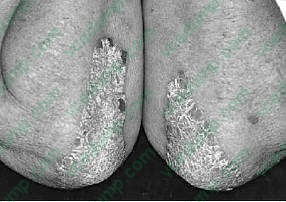
An 18-year-old female presents for follow-up of a rash. She states that she has been using OTC antifungal preparations without success. She used OTC cortisone cream with mild improvement, but the lesions never disappeared. Her condition also recurred with full severity once the cortisone cream was discontinued. Her family history reveals a first degree relative with similar rash. The rash is over the elbows, trunk, and scalp.
Which of the following would be the appropriate initial treatment?
A. methotrexate B. systemic steroids C. phototherapy D. topical steroids E. systemic biologicals
D. topical steroids
Explanation
Psoriasis is a benign chronic, inflammatory skin disorder with a genetic basis that affects approximately 2% of the population in the United States. The condition varies in its presentation from person to person, with some having only local involvement and others having a severe generalized involvement. The incidence occurs in a bimodal distribution, with peaks persons in their 20s and 50s. Those with earlier onset generally will have a more severe disease over the course of their lifetime. Psoriasis has several variants, or subtypes, including plaque type (most common), eruptive (guttate), generalized pustular, and erythrodermic psoriasis. Some patients may be asymptomatic or may have only minor itching. Others may have involvement of most of their body, with severe disfigurement and poor quality of life. Psoriasis may involve any skin area; however, areas such as the scalp, extensor surfaces, palms, soles, and nails should always be examined. The typical lesions are described as erythematous, well- demarcated plaques with overlying scales. Fine stippling (pitting) of the nails is highly suggestive of psoriasis. In addition to the skin findings, patients may also have arthritis. The lesions can be reactivated with local injury or irritation of normal skin (Koebner phenomenon). The diagnosis is predominantly clinical, based on the history and examination. There are no laboratory measures that will diagnose psoriasis. Skin biopsy, although not pathognomonic, would show features consistent with psoriasis and would help to rule out other similar appearing conditions.
Question 157:
Parents bring their 6-year-old son to the emergency room following an acute onset of vomiting and combative behavior. The parents state that the child has recently had chickenpox. They have been giving him medication to reduce his fever, which has been as high as 102 F. Which medication is the likely cause of his current condition?
A. acetaminophen B. aspirin C. amoxicillin D. ibuprofen E. diphenhydramine
B. aspirin
Explanation
Historically, Reye's syndrome was a cause of hepatitis and encephalitis. It was seen in children with influenza or varicella who were given aspirin. Widespread knowledge of this issue, resulting in an almost complete cessation of the use of aspirin in children, has made Reye's syndrome a very rare occurrence.
Question 158:
While working in the emergency room you see a 14-month-old boy brought in with apparent leg pain. His parents tell you that he has recently been learning to walk and that this injury is the result of a fall.
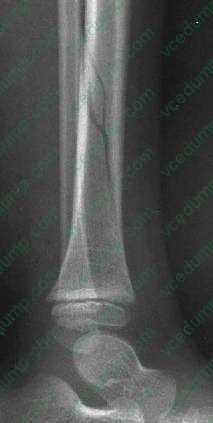
You obtain the following x-ray
What is your interpretation of the x-ray?
A. dislocation of the ankle B. a "chip" fracture of the proximal tibia C. a spiral fracture of the distal tibia D. a buckle fracture involving the distal tibia and fibula E. a transverse fracture of the distal tibia
C. a spiral fracture of the distal tibia
Explanation
The x-ray provided shows a nondisplaced spiral fracture of the distal tibia. This is also known as a toddler's fracture. This fracture can occur when the toddler begins to walk and twists on a planted leg. This torque can result in a spiral fracture of the planted tibia. There usually is no dislocation of the ankle joint and minimal displacement of the fracture. A chip fracture of the metaphysis is a common fracture seen in abused infants and is commonly termed as a "bucket-handle" or "corner" fracture. A buckle fracture is a common accidental fracture seen in falls from a height.
Question 159:
A 55-year-old female presents to your office after a lung mass was found on a chest x-ray. She has undergone a series of imaging studies and has been referred to your office to determine if she is a candidate for surgery. With which of the following findings would she still be a candidate for potentially curative surgical resection?
A. malignant pleural effusion B. contralateral mediastinal node involvement C. chest wall invasion D. liver metastases E. superior vena cava syndrome
C. chest wall invasion
Explanation
Tumor resectability in lung cancer is generally determined by (1) whether or not the resection is technically feasible and (2) whether or not the resection will result in improved survival. In general, invasion of the tumor into structures that are vital to life would classify the tumor as unresectable. For example, the presence of superior vena cava syndrome in the setting of lung cancer is generally the result of tumor growing into the superior vena cava, which cannot be surgically removed. Those patients should be treated with chemotherapy and radiation. For lung cancer, the presence of distant metastatic disease is a contraindication to surgical resection. Distant metastasis is defined by the presence of tumor in distant organs, such as brain, bone, or liver, as well as distant nodal involvement. In the treatment of lung cancer, this can be confusing when evaluating patients with lymph node metastases because the presence of positive ipsilateral medastinal nodes is not a contraindication to surgery, while positive contralateral mediastinal nodes indicates disseminated disease. With regards effusions, the presence of a pleural effusion in and of itself does not dictate the method of treatment, but identification of malignant cells within the effusion indicates noncurability and those patients should be treated medically. On the other hand, patients who present with local invasion of the tumor into the chest wall can potentially be cured of the disease with en bloc resection. Finally, involvement of more than one lobe has no bearing on prognosis as long as the patient's preoperative ventilation parameters will allow for safe resection.
Question 160:
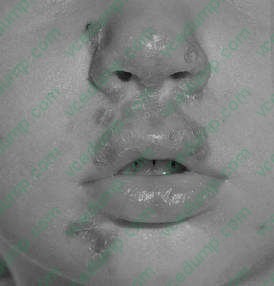
A 4-year-old girl is brought in to the office by her mother. She developed chicken pox about 6 days ago. She appeared to be recovering well but mother became concerned because she was persistently scratching at several of the lesions and they were not healing. On examination, the child is afebrile and generally well appearing. On examination of her skin you see the following image
What is the most likely current diagnosis?
A. tinea corporis B. impetigo C. warts D. contact dermatitis E. reactivated chicken pox
B. impetigo
Explanation
The image provided shows a classic case of impetigo. This is a common skin infection of childhood. It frequently occurs following a case of chickenpox and is due to the child picking or scratching at the varicella lesions, resulting in a secondary bacterial infection. GAS infection is the most common cause of impetigo associated with varicella infections. It is markedly more prevalent than the next most common infectious agent, S. aureus. Tinea corporis, often due to T. rubrum, is also known as ringworm. It classically is a circular lesion with a red, raised border, and central clearing. Contact dermatitis, from exposure to an irritant such as poison ivy, often causes plaques of erythema and edema with superimposed vesicles. This is also frequently secondarily infected with GAS from scratching. Warts, caused by the human papilloma virus, do not typically appear as the lesions in the image. Of the options listed, oral cephalexin would be the most appropriate initial therapy. Most GAS isolates are sensitive to first- generation cephalosporins, such as cephalexin. Topical steroids are useful for inflammatory or allergic conditions, topical nystatin for a fungal infection (such as tinea corporis) and oral acyclovir can be used early in the course of a varicella infection.
Nowadays, the certification exams become more and more important and required by more and more
enterprises when applying for a job. But how to prepare for the exam effectively? How to prepare
for the exam in a short time with less efforts? How to get a ideal result and how to find the
most reliable resources? Here on Vcedump.com, you will find all the answers.
Vcedump.com provide not only USMLE exam questions,
answers and explanations but also complete assistance on your exam preparation and certification
application. If you are confused on your USMLE-STEP-3 exam preparations
and USMLE certification application, do not hesitate to visit our
Vcedump.com to find your solutions here.