PMI PMI-SP Online Practice
Questions and Exam Preparation
PMI-SP Exam Details
Exam Code
:PMI-SP
Exam Name
:PMI Scheduling Professional (PMI-SP)
Certification
:PMI Certifications
Vendor
:PMI
Total Questions
:323 Q&As
Last Updated
:Aug 07, 2026
PMI PMI-SP Online Questions &
Answers
Question 211:
You are the project manager of the QAQ Project. The QAQ Project has a BAC of $2,786,121. You are currently 20 percent complete with this project, though you should be 25 percent complete with the project work. The project has consumed $595,000 of the project budget to date. Management has asked you, based on the current project performance, what the project's estimate to complete will be considering the current project schedule variance. What is the ETC for this project?
A. $2,975,000 B. 1.02 C. $139,306 D. $2,380,000
D. $2,380,000
The estimate to complete wants to know how much more money the project will need to complete its objectives. The estimate to complete (ETC) is the expected cost needed to complete all the remaining work for a scheduled activity, a group
of activities, or the project. ETC helps project managers predict what the final cost of the project will be upon completion. The formula for the ETC is EAC- AC. The EAC is BAC/ CPI.
Answer option A is incorrect. This is the estimate at completion based on the current project performance. Answer option C is incorrect. This is the current schedule variance. Answer option B is incorrect. 1.02 is the to-complete performance
index based on the BAC.
Question 212:
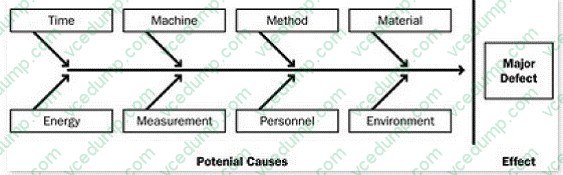
You work as a project manager for BlueWell Inc. Which of the following tools/techniques will you use to demonstrate how a process behaves over time, and when a process is subject to special cause variation, resulting in an out-of-control condition?
A. Pareto Chart B. Ishikawa Diagram C. Scatter Chart D. Control Chart
D. Control Chart
You should use the control charts to demonstrate how a process behaves over time, and when a process is subject to special cause variation, resulting in an out-of-control condition. Control charts are graphical representations of different processes. These charts contain the maximum and minimum values allowed. Control charts are used to determine whether or not a process is stable or has predictable performance. A process is considered out of control when a data point exceeds a control limit or if seven consecutive points are above or below the mean. Answer option B is incorrect. The Ishikawa diagram (or fishbone diagram or also cause-and-effect diagram) are diagrams, that shows the causes of a certain event. A common use of the Ishikawa diagram is to identify potential factors causing an overall effect. It helps identify causal factors and contributing causes.
It is known as a fishbone diagram because of its shape, similar to the side view of a fish skeleton. It is considered as a basic tool of quality management. Answer option A is incorrect. A Pareto chart is a special type of bar chart where the values being plotted are arranged in descending order. The graph is accompanied by a line graph, which shows the cumulative totals of each category, left to right. The chart is named after Vilfredo Pareto, and its use in quality assurance was popularized by Joseph M. Juran and Kaoru Ishikawa. Answer option C is incorrect. A scatter chart is a type of display using Cartesian coordinates to display values for two variables for a set of data. The data is displayed as a collection of points, each having the value of one variable determining the position on the horizontal axis and the value of the other variable determining the position on the vertical axis. A scatter diagram shows the pattern of relationship between two variables. This tool allows the quality team to study and identify the possible relationship between changes observed in two variables. Dependent variables versus independent variables are plotted. The closer the points are to a diagonal line, the more closely they are related.
Question 213:
You work as a project manager for BlueWell Inc. Some of the activities in your project are not being completed on time. You reviewed these activities with your project team and discovered that the time estimates for the project are much more aggressive than what they are actually experiencing in the completion of the activities. You elect to create a new schedule for the project. What project Management process are you working with when you create a new target schedule?
A. Develop schedule B. Estimate activity durations C. Control schedule D. Estimate activity resources
C. Control schedule
In severe cases, new schedule duration estimates with new forecasted start and finish dates are needed. In these instances, it is an example of using the control schedule process. Control schedule process is a method of monitoring the status of the project to update project progress and deal with the changes to the schedule baseline. It is concerned with: Determining the current status of the project Influencing the factors that create schedule changes Determining that the project schedule has changed Managing the actual changes as they occur Control schedule is a component of the Perform Integration Change Control process. Answer option D is incorrect. The activity resources would only address the addition or replacement of resources needed to complete the project work. Answer option B is incorrect. This is a tempting choice, but new schedules are a part of the control schedule process. Answer option A is incorrect. Develop schedule is not the best choice for this question.
Question 214:
Which of the following individuals performs various management roles within an administrative or functional area of the business, such as human resources, finance, accounting, or procurement?
A. Seller B. Operations manager C. Functional manager D. Project manager
C. Functional manager
The role of a functional manager is to perform various management roles within an administrative or functional area of the business, such as human resources, finance, accounting, or procurement. He is assigned his own permanent staff to carry out the ongoing work. He should have a clear directive to manage all tasks within his functional area of responsibility. Answer option D is incorrect. A project manager is an expert in the field of project management. He is responsible for the entire project from inception to completion. The project manager leads the team and helps negotiate the multiple relationships within any project whether with clients, team members, firm principals or any variety of partners and functions as the hub of a project. Answer option A is incorrect. Seller is also known as a vendor, supplier or contractor. They are external company's elements that enter into a contractual agreement to provide components or services necessary for the project. Answer option B is incorrect. The role of operations manager is to perform various management roles in a core business area, such as research and development, design, manufacturing, provisioning, testing, or maintenance. The operations manager directly deals with constructing and maintaining the saleable products or services of the enterprise.
Question 215:
You are the project manager for your organization. You have worked with the project team to create the project scope statement. The key stakeholders have signed off on the project scope and they are eager for you and the project team to begin creating the deliverables identified within the project scope. What process must you and the project team complete next in this scenario?
A. Create the activity list. B. Create the WBS. C. Create the risk assessment. D. Determine the project budget.
B. Create the WBS.
Once the project scope statement has been approved, the project manager and the project team should decompose the project scope statement into the WBS.
Answer option A is incorrect. Before the activity list may be created, the WBS is needed. The activity list is based on the work packages identified in the WBS. Answer option C is incorrect. Creating the risk assessment for the project is part of
project planning, but it is not the most appropriate process to complete at this time. Answer option D is incorrect. Determining the project budget is the process of aggregating the estimated costs of individual activities or work packages to
establish an authorized cost baseline. Determining the project budget is a part of project cost management.
Question 216:
You are the project manager of the NHQ project. Your project has a budget of $1,258,456 and is scheduled to last for three years. Your project is currently forty percent complete though it should be forty- five percent complete. In order to reach this point of the project, you have spent $525,000. Management needs a performance report regarding the NHQ project. What is the planned value for this project?
A. $566,305 B. $1,258,456 C. -$54,044 D. $503, 382
A. $566,305
The planned value is the percent complete that the project should have done. In this instance, it is:
Planned value = 45% of $1,258,456 =$566,305
Answer option B is incorrect. This is the project budget. Answer option D is incorrect. $503,382 is the earned value for this project. Answer option C is incorrect. -$54,044 is the variance at completion for your project.
Question 217:
Complete this sentence:
_________________________ is the process of collecting and distributing performance information including status reports, progress measurements, and forecasts.
A. Corrective action B. Report performance C. Earned value management D. Monitor and control project performance
B. Report performance
Report performance is a project process that collects and distributes information on the project work. Answer option C is incorrect. Earned value management may be used as the tool and technique for determining project performance.
Answer option D is incorrect. Monitor and control project performance is not a project process so this choice is not valid.
Answer option A is incorrect. Corrective action is a response to project performance to bring the project back into alignment with expectations.
Question 218:
You are the project manager of the NHQ Project. This project has a Budget at Completion of $750,000 and is expected to take 18 months to complete. The project is supposed to be 75 percent complete, but due to some errors the project is only 60 percent complete. At this time the project has spent $465,500. Management has asked you to review the project work and report the project's SPI. What is the SPI for this project?
A. 0.97 B. 0.80 C. $562,500 D. -$112,500
B. 0.80
The project's schedule performance index (SPI) can be found by using the formula; earned value/planned value. The earned value is the percent of the project completed times the BAC. The planned value is the percentage of where the project should be times the budget at completion. In this instance, the formula reads: $450,000/562500 = 0.80. Schedule performance index (SPI) is the measure of schedule efficiency on a project. It is used in trend analysis to predict future performance. SPI is the ratio of earned value to planned value. The SPI is calculated based on the following formula: SPI = Earned Value (EV) / Planned Value (PV) If the SPI value is greater than 1, it indicates better than expected performance, whereas if the value is less than 1, it shows poor performance. The SPI value of 1 indicates that the project is right on target. Answer option A is incorrect. This value is the project's Cost Performance Index (CPI). Answer option D is incorrect. This value is the schedule variance for the project. Answer option C is incorrect. $562,500 is the planned value for the project.
Question 219:
You are the project manager of the NHA Project. This project is expected to last one year with quarterly milestones throughout the year. Your project is supposed to be at the third milestone today, but you are likely to be only 60 percent complete. Your project has a BAC of $745,000 and you have spent $440,000 of the budget-to-date. What is your schedule variance for this project?
A. $11,667 B. 1.02 C. $7,000 D. $-111,750
D. $-111,750
The schedule variance is found by subtracting the planned value from the earned value. In this instance, it is $447,000 minus $558,750. Schedule variance (SV) is a measure of schedule performance on a project. The variance notifies that
the schedule is ahead or behind what was planned for this period in time. The schedule variance is calculated based on the following formula: SV = Earned Value (EV) - Planned Value (PV) If the resulting schedule is negative, it indicates that
the project is behind schedule. A value greater than 0 shows that the project is ahead of the planned schedule. A value of 0 indicates that the project is right on target.
Answer option C is incorrect. $7,000 is the cost variance for this project. Answer option A is incorrect. $11,667 is the variance at completion for this project. Answer option B is incorrect. 1.02 is the cost performance index for this project.
Question 220:
You are the project manager of the GHY Project. This project is scheduled to last for one year and has a BAC of $4,500,000. You are currently 45 percent complete with this project, though you are supposed to be at your second milestone, which accounts for half of the project completion. There have been some errors in the project, which has caused you to spend $2,073,654. Based on the budget at completion, what is this project's to-complete performance index?
A. -$108,120 B. 0.98 C. $2,500.000 D. 1.02
D. 1.02
The to-complete performance index shows the likelihood of reaching the project objectives based on the current performance. The formula is (BAC-EV)/(BAC-AC) for a result of 1.02. The higher the value over 1 the less likely the project is to reach its objectives based on the current performance.To- complete Performance Index (TCPI) is the measured projection of the anticipated performance required to achieve either the BAC or the EA
C. TCPI indicates the future required cost efficiency needed to achieve a target EAC (Estimate At Complete).Once approved, the EAC supersedes the BAC as the cost performance goal. Any significant difference between TCPI and the CPI needed to meet the EAC should be accounted for by management in their forecast of the final cost. The formula for TCPI is as follows: TCPI = {(BAC-EV)/(BAC-AC)} Answer option B is incorrect. This is the cost performance index for this project. Answer option A is incorrect. This is the expected variance at completion. Answer option C is incorrect. This is not a valid answer for this question.
Nowadays, the certification exams become more and more important and required by more and more
enterprises when applying for a job. But how to prepare for the exam effectively? How to prepare
for the exam in a short time with less efforts? How to get a ideal result and how to find the
most reliable resources? Here on Vcedump.com, you will find all the answers.
Vcedump.com provide not only PMI exam questions,
answers and explanations but also complete assistance on your exam preparation and certification
application. If you are confused on your PMI-SP exam preparations
and PMI certification application, do not hesitate to visit our
Vcedump.com to find your solutions here.