NSE4_FGT-7.2 Exam Details
-
Exam Code
:NSE4_FGT-7.2 -
Exam Name
:Fortinet NSE 4 - FortiOS 7.2 -
Certification
:Fortinet Certifications -
Vendor
:Fortinet -
Total Questions
:185 Q&As -
Last Updated
:May 24, 2026
Fortinet NSE4_FGT-7.2 Online Questions & Answers
-
Question 101:
Refer to the exhibit.
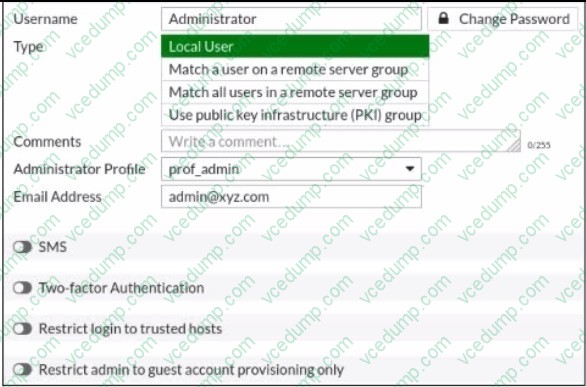
The global settings on a FortiGate device must be changed to align with company security policies. What does the Administrator account need to access the FortiGate global settings?
A. Change password
B. Enable restrict access to trusted hosts
C. Change Administrator profile
D. Enable two-factor authentication -
Question 102:
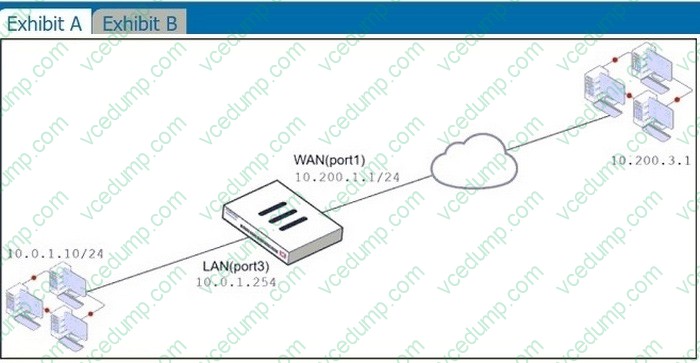
Refer to the exhibits.
Exhibit A shows a network diagram. Exhibit B shows the firewall policy configuration and a VIP object configuration.
The WAN (port1) interface has the IP address 10.200.1.1/24.
The LAN (port3) interface has the IP address 10.0.1.254/24.
The administrator disabled the WebServer firewall policy.
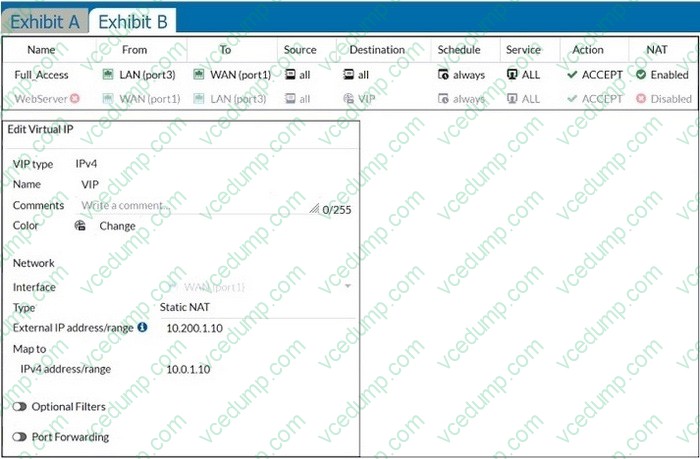
Which IP address will be used to source NAT the traffic, if a user with address 10.0.1.10 connects over SSH to the host with address 10.200.3.1?
A. 10.200.1.10
B. 10.0.1.254
C. 10.200.1.1
D. 10.200.3.1 -
Question 103:
Refer to the exhibit.
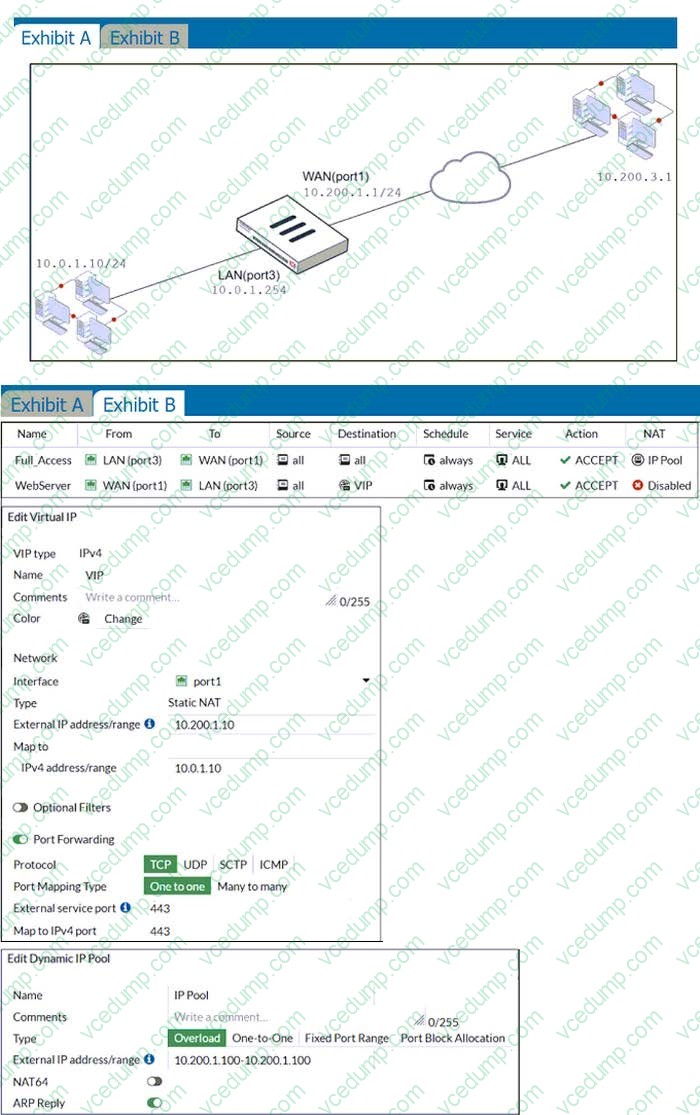
The exhibit contains a network diagram, virtual IP, IP pool, and firewall policies configuration.
1.
The WAN (port1) interface has the IP address 10.200. 1. 1/24.
2.
The LAN (port3) interface has the IP address 10 .0.1.254. /24.
3.
The first firewall policy has NAT enabled using IP Pool.
4.
The second firewall policy is configured with a VIP as the destination address.
Which IP address will be used to source NAT (SNAT) the internet traffic coming from a workstation with the IP address 10.0.1.10?
A. 10.200.1.1
B. 10.200.3.1
C. 10.200.1.100
D. 10.200.1.10 -
Question 104:
An administrator wants to simplify remote access without asking users to provide user credentials. Which access control method provides this solution?
A. ZTNA IP/MAC filtering mode
B. ZTNA access proxy
C. SSL VPN
D. L2TP -
Question 105:
Which two features of IPsec IKEv1 authentication are supported by FortiGate? (Choose two.)
A. Extended authentication (XAuth) for faster authentication because fewer packets are exchanged
B. Extended authentication (XAuth) to request the remote peer to provide a username and password
C. No certificate is required on the remote peer when you set the certificate signature as the authentication method
D. Pre-shared key and certificate signature as authentication methods -
Question 106:
An administrator is running the following sniffer command:
Which three pieces of Information will be Included in me sniffer output? {Choose three.)
A. Interface name
B. Packet payload
C. Ethernet header
D. IP header
E. Application header -
Question 107:
Refer to the exhibit.
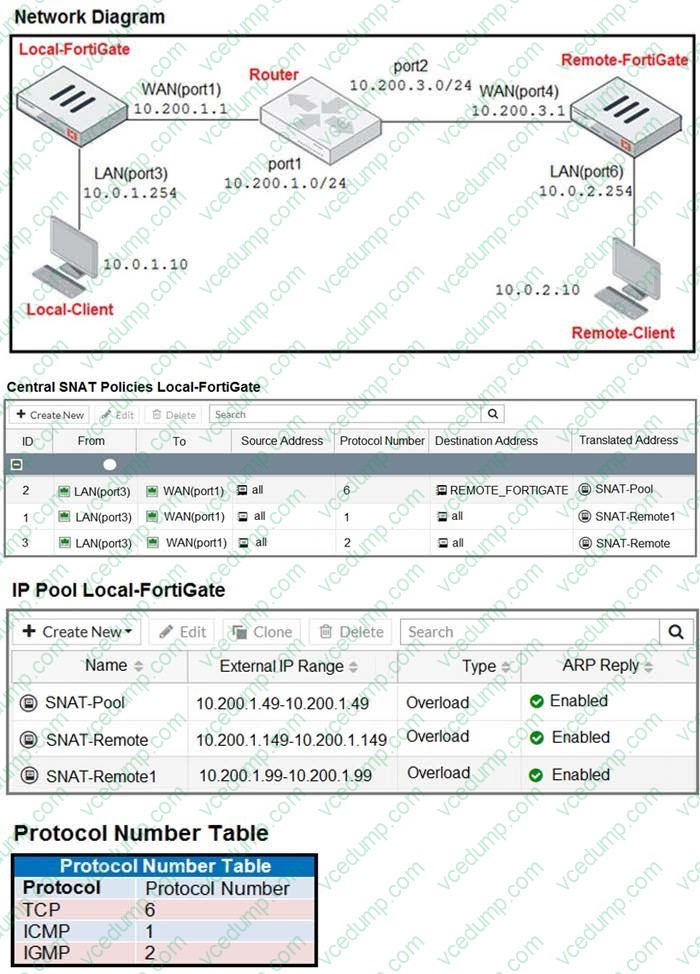
The exhibit contains a network diagram, central SNAT policy, and IP pool configuration.
The WAN (port1) interface has the IP address 10.200. 1. 1/24.
The LAN (port3) interface has the IP address 10.0. 1.254/24.
A firewall policy is configured to allow to destinations from LAN (port3) to WAN (port1).
Central NAT is enabled, so NAT settings from matching Central SNAT policies will be applied.
Which IP address will be used to source NAT the traffic, if the user on Local-Client (10.0. 1.10) pings the IP address of Remote-FortiGate (10.200.3.1)?
A. 10.200. 1. 149
B. 10.200. 1. 1
C. 10.200. 1.49
D. 10.200. 1.99 -
Question 108:
A team manager has decided that, while some members of the team need access to a particular website, the majority of the team does not Which configuration option is the most effective way to support this request?
A. Implement a web filter category override for the specified website
B. Implement a DNS filter for the specified website.
C. Implement web filter quotas for the specified website
D. Implement web filter authentication for the specified website. -
Question 109:
An administrator is configuring an IPsec VPN between site A and site B. The Remote Gateway setting in both sites has been configured as Static IP Address. For site A, the local quick mode selector is 192. 168. 1.0/24 and the remote quick
mode selector is 192.
168.2.0/24.
Which subnet must the administrator configure for the local quick mode selector for site B?
A. 192. 168. 1.0/24
B. 192. 168.0.0/24
C. 192. 168.2.0/24
D. 192. 168.3.0/24 -
Question 110:
Refer to the exhibits.
Exhibit A shows a network diagram. Exhibit B shows the firewall policy configuration and a VIP object configuration.
The WAN (port1) interface has the IP address 10.200.1.1/24.
The LAN (port3) interface has the IP address 10.0.1.254/24.
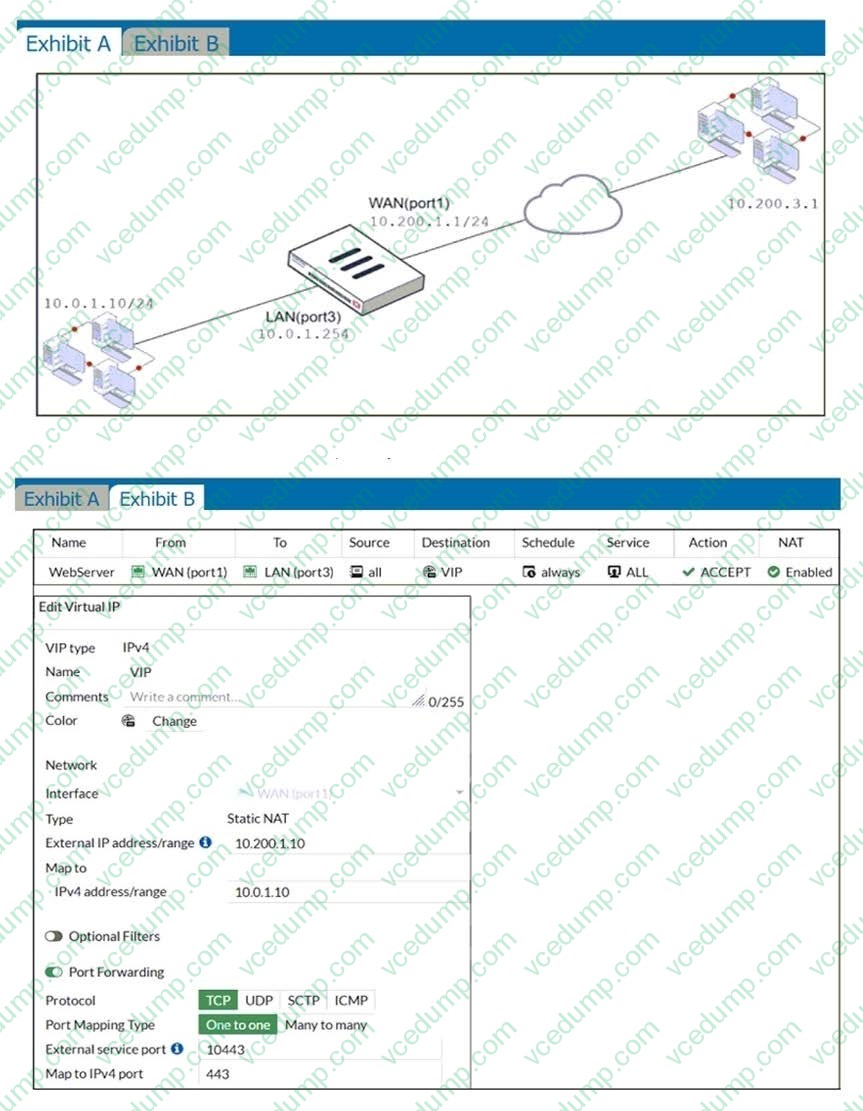
If the host 10.200.3.1 sends a TCP SYN packet on port 10443 to 10.200.1.10, what will the source address, destination address, and destination port of the packet be, after FortiGate forwards the packet to the destination?
A. 10.0.1.254, 10.0.1.10, and 443, respectively
B. 10.0.1.254, 10.200.1.10, and 443, respectively
C. 10.200.3.1, 10.0.1.10, and 443, respectively
D. 10.0.1.254, 10.0.1.10, and 10443, respectively
Related Exams:
-
EMEA-ADVANCED-SUPPORT
Fortinet EMEA Advanced Support -
FCP_FAC_AD-6.5
FCP - FortiAuthenticator 6.5 Administrator -
FCP_FAZ_AD-7.4
FCP - FortiAnalyzer 7.4 Administrator -
FCP_FAZ_AN-7.4
FCP - FortiAnalyzer 7.4 Analyst -
FCP_FAZ_AN-7.6
Fortinet NSE 5 - FortiAnalyzer 7.6 Analyst -
FCP_FCT_AD-7.2
FCP - Forti Client EMS 7.2 Administrator -
FCP_FCT_AD-7.4
Fortinet NSE 6 - FortiClient EMS 7.4 Administrator -
FCP_FGT_AD-7.4
FCP - FortiGate 7.4 Administrator -
FCP_FGT_AD-7.6
FortiGate 7.6 Administrator FCP_FGT_AD-7.6 -
FCP_FMG_AD-7.4
FCP - FortiManager 7.4 Administrator
Tips on How to Prepare for the Exams
Nowadays, the certification exams become more and more important and required by more and more enterprises when applying for a job. But how to prepare for the exam effectively? How to prepare for the exam in a short time with less efforts? How to get a ideal result and how to find the most reliable resources? Here on Vcedump.com, you will find all the answers. Vcedump.com provide not only Fortinet exam questions, answers and explanations but also complete assistance on your exam preparation and certification application. If you are confused on your NSE4_FGT-7.2 exam preparations and Fortinet certification application, do not hesitate to visit our Vcedump.com to find your solutions here.