NSE4_FGT-7.2 Exam Details
-
Exam Code
:NSE4_FGT-7.2 -
Exam Name
:Fortinet NSE 4 - FortiOS 7.2 -
Certification
:Fortinet Certifications -
Vendor
:Fortinet -
Total Questions
:185 Q&As -
Last Updated
:May 24, 2026
Fortinet NSE4_FGT-7.2 Online Questions & Answers
-
Question 91:
Which statement is correct regarding the use of application control for inspecting web applications?
A. Application control can identity child and parent applications, and perform different actions on them.
B. Application control signatures are organized in a nonhierarchical structure.
C. Application control does not require SSL inspection to identity web applications.
D. Application control does not display a replacement message for a blocked web application. -
Question 92:
Refer to the exhibits.
The exhibits show the firewall policies and the objects used in the firewall policies.
The administrator is using the Policy Lookup feature and has entered the search criteria shown in the exhibit.
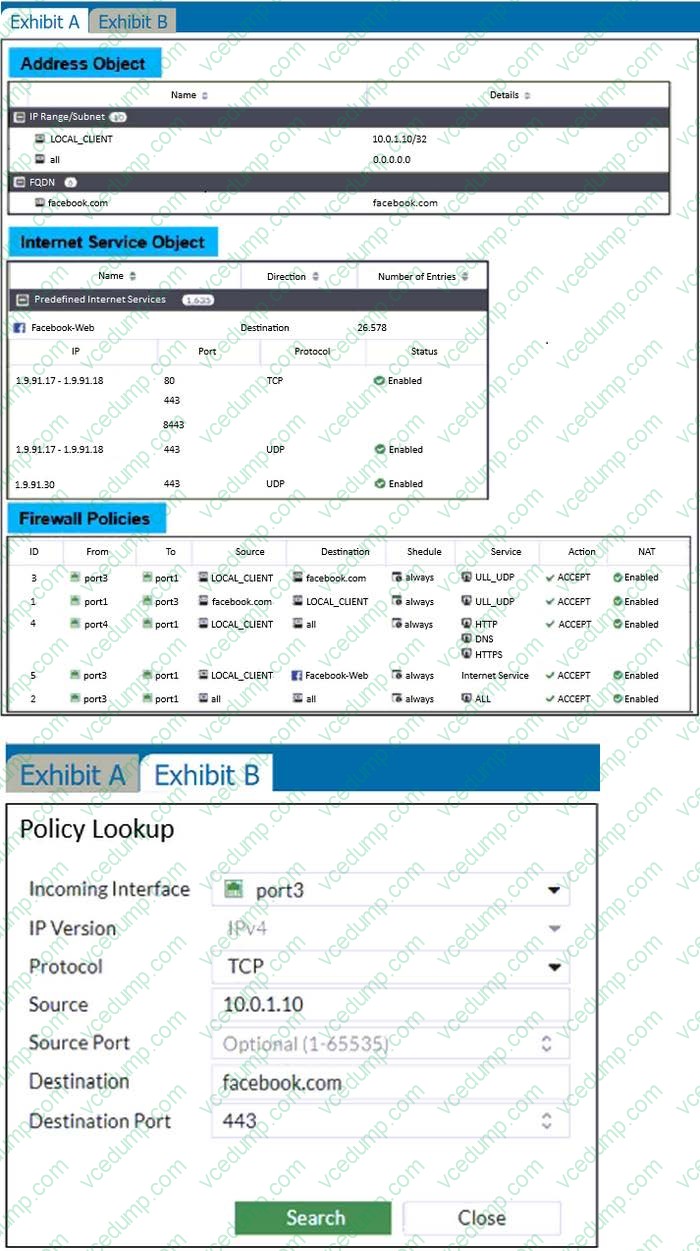
Which policy will be highlighted, based on the input criteria?
A. Policy with ID 4.
B. Policy with ID 5.
C. Policies with ID 2 and 3.
D. Policy with ID 4. -
Question 93:
Which statement about the deployment of the Security Fabric in a multi-VDOM environment is true?
A. VDOMs without ports with connected devices are not displayed in the topology.
B. Downstream devices can connect to the upstream device from any of their VDOMs.
C. Security rating reports can be run individually for each configured VDOM.
D. Each VDOM in the environment can be part of a different Security Fabric. -
Question 94:
Which statement correctly describes the use of reliable logging on FortiGate?
A. Reliable logging is enabled by default in all configuration scenarios.
B. Reliable logging is required to encrypt the transmission of logs.
C. Reliable logging can be configured only using the CLI.
D. Reliable logging prevents the loss of logs when the local disk is full. -
Question 95:
Refer to the exhibits.
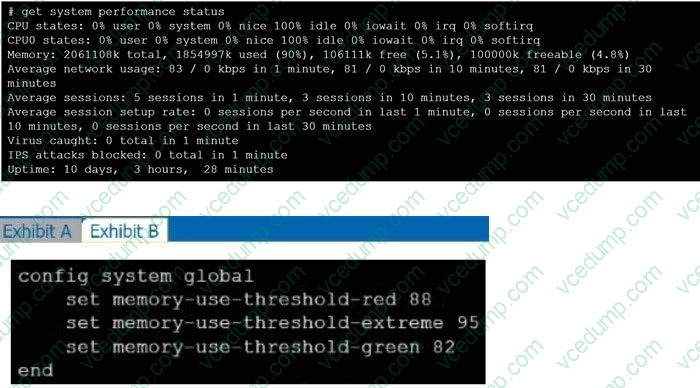
Exhibit A shows system performance output. Exhibit B shows a FortiGate configured with the default configuration of high memory usage thresholds. Based on the system performance output, which two statements are correct? (Choose two.)
A. Administrators can access FortiGate only through the console port.
B. FortiGate has entered conserve mode.
C. FortiGate will start sending all files to FortiSandbox for inspection.
D. Administrators cannot change the configuration. -
Question 96:
Which feature in the Security Fabric takes one or more actions based on event triggers?
A. Fabric Connectors
B. Automation Stitches
C. Security Rating
D. Logical Topology -
Question 97:
Refer to the exhibit.
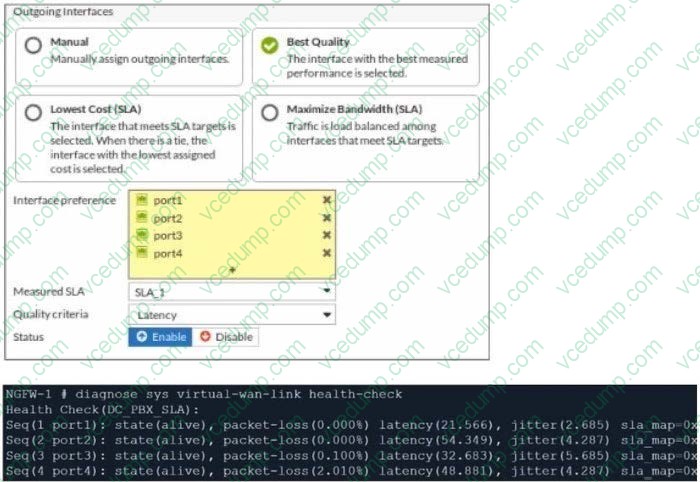
The exhibit contains the configuration for an SD-WAN Performance SLA, as well as the output of diagnose sys virtual-wan-link health-check . Which interface will be selected as an outgoing interface?
A. port2
B. port4
C. port3
D. port1 -
Question 98:
An employee needs to connect to the office through a high-latency internet connection.
Which SSL VPN setting should the administrator adjust to prevent SSL VPN negotiation failure?
A. idle-timeout
B. login-timeout
C. udp-idle-timer
D. session-ttl -
Question 99:
Examine this output from a debug flow:
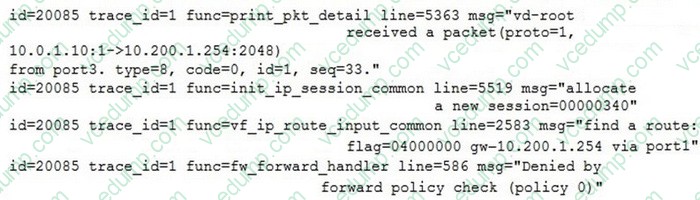
Why did the FortiGate drop the packet?
A. The next-hop IP address is unreachable.
B. It failed the RPF check .
C. It matched an explicitly configured firewall policy with the action DENY.
D. It matched the default implicit firewall policy. -
Question 100:
Consider the topology:
Application on a Windows machine <--{SSL VPN} -->FGT--> Telnet to Linux server.
An administrator is investigating a problem where an application establishes a Telnet session to a Linux server over the SSL VPN through FortiGate and the idle session times out after about 90 minutes. The administrator would like to
increase or disable this timeout.
The administrator has already verified that the issue is not caused by the application or Linux server. This issue does not happen when the application establishes a Telnet connection to the Linux server directly on the LAN.
What two changes can the administrator make to resolve the issue without affecting services running through FortiGate? (Choose two.)
A. Set the maximum session TTL value for the TELNET service object.
B. Set the session TTL on the SSLVPN policy to maximum, so the idle session timeout will not happen after 90 minutes.
C. Create a new service object for TELNET and set the maximum session TTL.
D. Create a new firewall policy and place it above the existing SSLVPN policy for the SSL VPN traffic, and set the new TELNET service object in the policy.
Related Exams:
-
EMEA-ADVANCED-SUPPORT
Fortinet EMEA Advanced Support -
FCP_FAC_AD-6.5
FCP - FortiAuthenticator 6.5 Administrator -
FCP_FAZ_AD-7.4
FCP - FortiAnalyzer 7.4 Administrator -
FCP_FAZ_AN-7.4
FCP - FortiAnalyzer 7.4 Analyst -
FCP_FAZ_AN-7.6
Fortinet NSE 5 - FortiAnalyzer 7.6 Analyst -
FCP_FCT_AD-7.2
FCP - Forti Client EMS 7.2 Administrator -
FCP_FCT_AD-7.4
Fortinet NSE 6 - FortiClient EMS 7.4 Administrator -
FCP_FGT_AD-7.4
FCP - FortiGate 7.4 Administrator -
FCP_FGT_AD-7.6
FortiGate 7.6 Administrator FCP_FGT_AD-7.6 -
FCP_FMG_AD-7.4
FCP - FortiManager 7.4 Administrator
Tips on How to Prepare for the Exams
Nowadays, the certification exams become more and more important and required by more and more enterprises when applying for a job. But how to prepare for the exam effectively? How to prepare for the exam in a short time with less efforts? How to get a ideal result and how to find the most reliable resources? Here on Vcedump.com, you will find all the answers. Vcedump.com provide not only Fortinet exam questions, answers and explanations but also complete assistance on your exam preparation and certification application. If you are confused on your NSE4_FGT-7.2 exam preparations and Fortinet certification application, do not hesitate to visit our Vcedump.com to find your solutions here.