NSE4_FGT-7.2 Exam Details
-
Exam Code
:NSE4_FGT-7.2 -
Exam Name
:Fortinet NSE 4 - FortiOS 7.2 -
Certification
:Fortinet Certifications -
Vendor
:Fortinet -
Total Questions
:185 Q&As -
Last Updated
:May 24, 2026
Fortinet NSE4_FGT-7.2 Online Questions & Answers
-
Question 171:
Which three authentication timeout types are availability for selection on FortiGate? (Choose three.)
A. hard-timeout
B. auth-on-demand
C. soft-timeout
D. new-session
E. Idle-timeout -
Question 172:
An administrator needs to increase network bandwidth and provide redundancy.
What interface type must the administrator select to bind multiple FortiGate interfaces?
A. VLAN interface
B. Software Switch interface
C. Aggregate interface
D. Redundant interface -
Question 173:
An administrator does not want to report the logon events of service accounts to FortiGate. What setting on the collector agent is required to achieve this?
A. Add the support of NTLM authentication.
B. Add user accounts to Active Directory (AD).
C. Add user accounts to the FortiGate group fitter.
D. Add user accounts to the Ignore User List. -
Question 174:
How does FortiGate act when using SSL VPN in web mode?
A. FortiGate acts as an FDS server.
B. FortiGate acts as an HTTP reverse proxy.
C. FortiGate acts as DNS server.
D. FortiGate acts as router. -
Question 175:
An administrator configures FortiGuard servers as DNS servers on FortiGate using default settings.
What is true about the DNS connection to a FortiGuard server?
A. It uses UDP 8888.
B. It uses UDP 53.
C. It uses DNS over HTTPS.
D. It uses DNS overTLS. -
Question 176:
Refer to the exhibit to view the firewall policy.
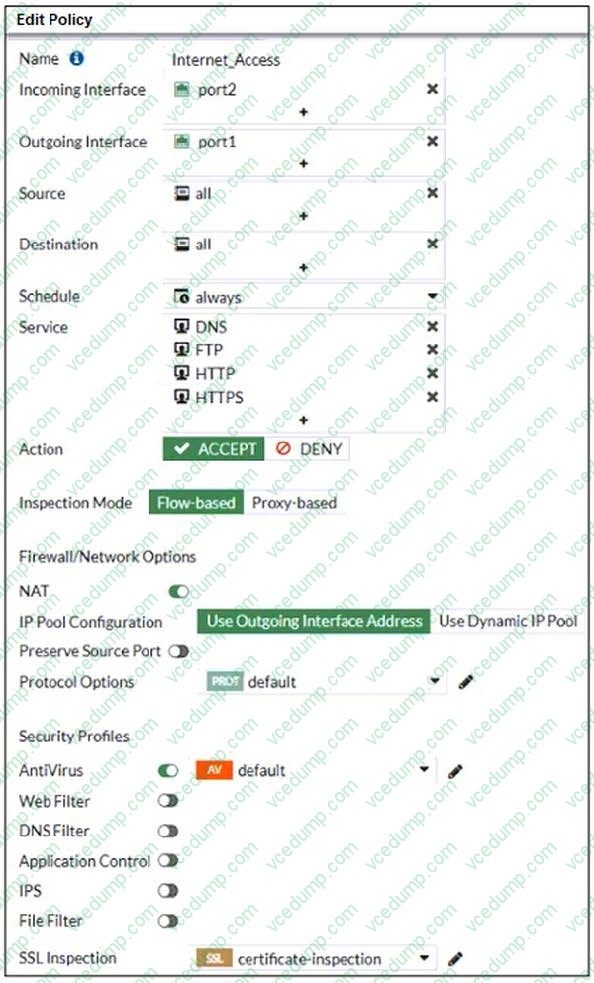
Why would the firewall policy not block a well-known virus, for example eicar?
A. Web filter is not enabled on the firewall policy to complement the antivirus profile.
B. The firewall policy is not configured in proxy-based inspection mode.
C. The firewall policy does not apply deep content inspection.
D. The action on the firewall policy is not set to deny. -
Question 177:
Why does FortiGate Keep TCP sessions in the session table for several seconds, even after both sides (client and server) have terminated the session?
A. To allow for out-of-order packets that could arrive after the FIN/ACK packets
B. To finish any inspection operations
C. To remove the NAT operation
D. To generate logs -
Question 178:
On FortiGate, which type of logs record information about traffic directly to and from the FortiGate management IP addresses?
A. System event logs
B. Forward traffic logs
C. Local traffic logs
D. Security logs -
Question 179:
Which statement describes a characteristic of automation stitches?
A. They can have one or more triggers.
B. They can be run only on devices in the Security Fabric.
C. They can run multiple actions simultaneously.
D. They can be created on any device in the fabric. -
Question 180:
Which of the following conditions must be met in order for a web browser to trust a web server certificate signed by a third-party CA?
A. The public key of the web server certificate must be installed on the browser.
B. The web-server certificate must be installed on the browser.
C. The CA certificate that signed the web-server certificate must be installed on the browser.
D. The private key of the CA certificate that signed the browser certificate must be installed on the browser.
Related Exams:
-
EMEA-ADVANCED-SUPPORT
Fortinet EMEA Advanced Support -
FCP_FAC_AD-6.5
FCP - FortiAuthenticator 6.5 Administrator -
FCP_FAZ_AD-7.4
FCP - FortiAnalyzer 7.4 Administrator -
FCP_FAZ_AN-7.4
FCP - FortiAnalyzer 7.4 Analyst -
FCP_FAZ_AN-7.6
Fortinet NSE 5 - FortiAnalyzer 7.6 Analyst -
FCP_FCT_AD-7.2
FCP - Forti Client EMS 7.2 Administrator -
FCP_FCT_AD-7.4
Fortinet NSE 6 - FortiClient EMS 7.4 Administrator -
FCP_FGT_AD-7.4
FCP - FortiGate 7.4 Administrator -
FCP_FGT_AD-7.6
FortiGate 7.6 Administrator FCP_FGT_AD-7.6 -
FCP_FMG_AD-7.4
FCP - FortiManager 7.4 Administrator
Tips on How to Prepare for the Exams
Nowadays, the certification exams become more and more important and required by more and more enterprises when applying for a job. But how to prepare for the exam effectively? How to prepare for the exam in a short time with less efforts? How to get a ideal result and how to find the most reliable resources? Here on Vcedump.com, you will find all the answers. Vcedump.com provide not only Fortinet exam questions, answers and explanations but also complete assistance on your exam preparation and certification application. If you are confused on your NSE4_FGT-7.2 exam preparations and Fortinet certification application, do not hesitate to visit our Vcedump.com to find your solutions here.