MCAT-TEST Exam Details
-
Exam Code
:MCAT-TEST -
Exam Name
:Medical College Admission Test: Verbal Reasoning, Biological Sciences, Physical Sciences, Writing Sample -
Certification
:Medical Tests Certifications -
Vendor
:Medical Tests -
Total Questions
:812 Q&As -
Last Updated
:Jul 08, 2026
Medical Tests MCAT-TEST Online Questions & Answers
-
Question 771:
When softball players take batting practice, they often use a machine called an "automatic pitcher," which is essentially a cannon that uses air pressure to launch a projectile. In a prototype automatic pitcher, a softball is loaded into the barrel of the cannon and rests against a flat disk. That disk is locked into place, and a high air pressure is built up behind it. When the disk is released, the softball is pushed along the barrel of the cannon and ejected at a speed of V0. Figure 1 shows the batter and automatic pitcher. The angle of the barrel to the horizontal is . The unit vectors I and j point in the horizontal and vertical directions respectively.

Figure 1
The height above the ground y of the softball as a function of time t is shown in Figure 2, where t = 0 at Point A, t = tB at Point B, and t = tC at Point C. The softball is ejected from the barrel of the cannon at Point A; it reaches its maximum height at Point B; and the batter hits the softball at Point C. (Note: Assume that the effects of air resistance are negligible unless otherwise stated.)
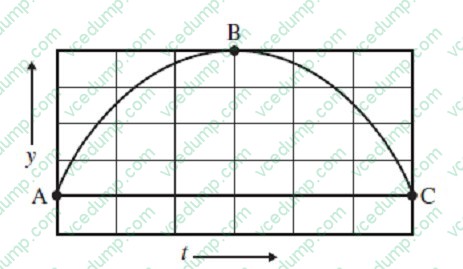
Figure 2
How will V0 change if the impulse on the softball remains the same but its mass is doubled?
A. It will decrease by a factor of 4.
B. It will decrease by a factor of 2.
C. It will not change.
D. It will increase by a factor of 2. -
Question 772:
Which of the following neurotransmitters could be imbalanced if someone woke up and realized they could not move any muscle?
A. Catecholamine
B. Acetylcholine
C. Frataxin
D. Cortisol -
Question 773:
The equation of state of an ideal gas is given by the ideal gas law:
PV = nRT
where P is the pressure, V is the volume, n is the number of moles of gas, R is the ideal gas constant, and T is the temperature of the gas. The gas particles in a container are constantly moving at various speeds. These speeds are
characterized by the Maxwell shown in the figure below.
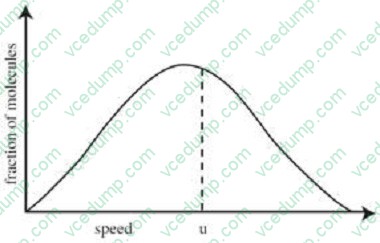
If two particles collide, their velocities change. However, if the gas is in thermal equilibrium, the velocity distribution of the gas as a whole will remain unchanged by the collision.
The average kinetic energy (E) of a gas particle is given by:
Equation 1
where m is the mass of one particle and u is the root mean square speed (rms speed) of the gas particles:

where N is the number of gas particles; this is different from the average speed). For an ideal gas, the kinetic energy of all the particles is:

Equation 2
where n is the number of moles of gas. Combining these equations gives:
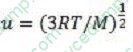
Equation 3
where M is the molar mass of the gas particles.
The average distance a particle travels between collisions is known as the mean free path l. Intuitively, the mean free path (mfp) could be expected to be larger for gases at low pressure, since there is a lot of space between particles.
Similarly, the mfp should be larger when the gas particles are small. The following expression for the mfp shows this to be correct.
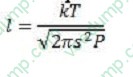
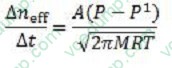
Equation 4 In this equation, s is the atomic diameter (typically on the order of 10?), k is the Boltzmann constant, and P is the pressure. In addition to colliding with one another, gas particles also collide with the walls of their container. If the container wall has a pinhole that is small compared to the mfp of the gas, and a pressure differential exists across the wall, the particles will effuse (or escape) through this pinhole without disturbing the Maxwellian distribution of the particles. The rate of effusion can be described by:
Equation 5
Where neff is the number of moles of effusing particles, A is the area of the pinhole, p and p1 are the pressures on the inside and outside of the container wall respectively, and p>p1.
What is the relative rate of effusion for a mixture of two noble gases, GA and GB, which escape through the same pinhole?
A. Option A
B. Option B
C. Option C
D. Option D -
Question 774:
The time has come to acknowledge the ascendancy of the humanistic psychology movement. The so- called "Third Stream" emerged at mid-century, asserting itself against the opposition of a pair of mighty, long-established currents, psychoanalysis and behaviorism. The hostility between these two older schools, as well as divisiveness within each of them, probably helped enable humanistic psychology to survive its early years. But the movement flourished because of its wealth of insights into the nature of this most inexact science.
Of the three major movements in the course of 20th century psychology, psychoanalysis is the oldest and most introspective. Conceived by Sigmund Freud as a means of treating mental and emotional disorders, psychoanalysis is based on the theory that people experience unresolved emotional conflicts in infancy and early childhood. Years later, although these experiences have largely disappeared from conscious awareness, they may continue to impair a person's ability to function in daily life. The patient experiences improvement when the psychoanalyst eventually unlocks these long-repressed memories of conflict and brings them to the patient's conscious awareness.
In the heyday of behaviorism, which occurred between the two world wars, the psychoanalytic movement was heavily criticized for being too concerned with inner subjective experience. Behavioral psychologists, dismissing ideas and feelings as unscientific, tried to deal only with observable and quantifiable facts. They perceived the human being merely as an organism which generated responses to stimuli produced by its body and the environment around it. Patients' neuroses no longer needed analysis; they could instead by modified by behavioral conditioning. Not even babies were safe: B.F. Skinner devised a container in which infants could be raised under "ideal" conditions -- if a sound-proof box can be considered the ideal environment for child-rearing.
By mid-century, a number of psychologists had grown dissatisfied with both the deterministic Freudian perspective and the mechanistic approach of behaviorism. They questioned the idea that human personality becomes permanently fixed in the first few years of life. They wondered if the purpose of psychology was really to reduce people to laboratory specimens. Was it not instead possible that human beings are greater than the sum of their parts? That psychology should speak to their search for fulfillment and meaning in life?
It is questions like these that members of the Third Stream have sought to address. While the movement cannot be simplified down to a single theoretical position, it does spring from certain fundamental propositions. Humanistic psychologists believe that conscious experience, rather than outward behavior, is the proper subject of psychology. We recognize that each human being is unique, capable of change and personal growth. We see maturity as a process dependent on the establishment of a set of values and the development of self. And we believe that the more aspects of self which are satisfactorily developed, the more positive the individual's self-image. Abraham Maslow, a pioneer of the Third Stream, articulated a hierarchy of basic human needs, starting with food, water and air, progressing upward through shelter and security, social acceptance and belonging, to love, esteem and self-expression. Progress toward the higher stages cannot occur until all of the more basic needs have been satisfied. Individuals atop the pyramid, having developed their potential to the highest possible extent, are said to be "self-actualized".
If this humanist theoretical perspective is aimed at empowering the individual, so too are the movement's efforts in the practical realm of clinical psychology. Believing that traditional psychotherapists tend to lead patients toward predetermined resolutions of their problems, Carl Rogers pressed for objective evaluations of both the process and outcome of psychotherapeutic treatment. Not content to function simply as a reformer, Rogers also pioneered the development of "client-centered" or nondirective therapy, which emphasizes the autonomy of the client (i.e., patient). In client-centered therapy, clients choose the subjects for discussion, and are encouraged to create their own solutions to their problems.
The author most probably believes that, in its early days, the humanistic psychology movement:
I. benefited from dissension among psychologists.
II. acknowledged Maslow and Rogers as its only leaders.
III.
was an offshoot of behaviorism.
A. I only
B. II only
C. I and II only
D. II and III only
I. benefited from dissension among psychologists. II. acknowledged Maslow and Rogers as its only leaders. III. was an offshoot of behaviorism. -
Question 775:
Every atomic orbital contains plus and minus regions, defined by the value of the quantum mechanical function for electron density. When orbitals from different atoms overlap to form bonds, an equal number of new molecular orbitals results. These are of two types: or bonding orbitals, formed by overlap between orbital regions with the same sign, and antibonding * or * orbitals, formed by overlap between regions with opposite signs. Bonding orbitals have lower energy than their component atomic orbitals, and antibonding orbitals have higher energy. The electron pairs reside in the lower-energy bonding orbitals; the higher-energy, less stable orbitals remain empty when the molecule is in its ground state. A benzene ring has six unhybridized pz orbitals (one from each carbon atom), which together from six molecular orbitals, each one delocalized over the entire ring. Of the possible orbital structures for benzene, the one with the lowest energy has the plus region of all six p orbital functions on one side of the ring. The six electrons occupying the orbitals fill the three most stable molecular orbitals, leaving the other three empty. Molecular orbitals are filled from the lowest to the highest energy level. The number of bonds between atoms is determined by the number of filled bonding orbitals minus the number of filled antibonding orbitals; each antibonding orbital cancels out a filled bonding orbital. For a diatomic molecule, orbitals in
the n = 2 energy level are filled as follows:

(equal in energy), and * (equal in energy), *2 . (The designation of the three p orbitals as , , and are interchangeable.) Absorption of a photon can raise an electron to a higher-energy molecular orbital. The excited electron does not immediately change its spin, which is opposite to that of the electron with which it was previously paired. This singlet state is relatively unstable: the molecule may interact with another molecule, or fluoresce and return to its ground state. Alternatively, there may be a change in spin direction somewhere in the system; the molecule then enters the so-called triplet state, which generally has lower energy. The molecule now cannot return quickly to its ground state, since the excited electron no longer has a partner of opposite spin with which to pair. It also cannot return to the singlet state, because the singlet has greater energy. Consequently, the triplet state, which has two unpaired electrons in separate orbitals, is long-lived by atomic standards, with a lifetime that may be ten seconds or more. During this period, the molecule is highly reactive.
Among conjugated polyenes (molecules with alternating carbon-carbon double and single bonds) why are those that are longer able to absorb longer wavelengths of light?
A. Larger molecular orbitals have a lower ground state.
B. A longer wavelength is better able to interact with a longer molecular orbital.
C. The larger number of molecular orbitals allows for smaller energy transitions.
D. Larger molecular orbitals can absorb more energy. -
Question 776:
The time has come to acknowledge the ascendancy of the humanistic psychology movement. The so- called "Third Stream" emerged at mid-century, asserting itself against the opposition of a pair of mighty, long-established currents, psychoanalysis and behaviorism. The hostility between these two older schools, as well as divisiveness within each of them, probably helped enable humanistic psychology to survive its early years. But the movement flourished because of its wealth of insights into the nature of this most inexact science.
Of the three major movements in the course of 20th century psychology, psychoanalysis is the oldest and most introspective. Conceived by Sigmund Freud as a means of treating mental and emotional disorders, psychoanalysis is based on the theory that people experience unresolved emotional conflicts in infancy and early childhood. Years later, although these experiences have largely disappeared from conscious awareness, they may continue to impair a person's ability to function in daily life. The patient experiences improvement when the psychoanalyst eventually unlocks these long-repressed memories of conflict and brings them to the patient's conscious awareness. In the heyday of behaviorism, which occurred between the two world wars, the psychoanalytic movement was heavily criticized for being too concerned with inner subjective experience. Behavioral psychologists, dismissing ideas and feelings as unscientific, tried to deal only with observable and quantifiable facts. They perceived the human being merely as an organism which generated responses to stimuli produced by its body and the environment around it. Patients' neuroses no longer needed analysis; they could instead by modified by behavioral conditioning. Not even babies were safe: B.F. Skinner devised a container in which infants could be raised under "ideal" conditions -- if a sound-proof box can be considered the ideal environment for child-rearing.
By mid-century, a number of psychologists had grown dissatisfied with both the deterministic Freudian perspective and the mechanistic approach of behaviorism. They questioned the idea that human personality becomes permanently fixed in the first few years of life. They wondered if the purpose of psychology was really to reduce people to laboratory specimens. Was it not instead possible that human beings are greater than the sum of their parts? That psychology should speak to their search for fulfillment and meaning in life?
It is questions like these that members of the Third Stream have sought to address. While the movement cannot be simplified down to a single theoretical position, it does spring from certain fundamental propositions. Humanistic psychologists believe that conscious experience, rather than outward behavior, is the proper subject of psychology. We recognize that each human being is unique, capable of change and personal growth. We see maturity as a process dependent on the establishment of a set of values and the development of self. And we believe that the more aspects of self which are satisfactorily developed, the more positive the individual's self-image.
Abraham Maslow, a pioneer of the Third Stream, articulated a hierarchy of basic human needs, starting with food, water and air, progressing upward through shelter and security, social acceptance and belonging, to love, esteem and self-expression. Progress toward the higher stages cannot occur until all of the more basic needs have been satisfied. Individuals atop the pyramid, having developed their potential to the highest possible extent, are said to be "self-actualized".
If this humanist theoretical perspective is aimed at empowering the individual, so too are the movement's efforts in the practical realm of clinical psychology. Believing that traditional psychotherapists tend to lead patients toward predetermined resolutions of their problems, Carl Rogers pressed for objective evaluations of both the process and outcome of psychotherapeutic treatment. Not content to function simply as a reformer, Rogers also pioneered the development of "client-centered" or nondirective therapy, which emphasizes the autonomy of the client (i.e., patient). In client-centered therapy, clients choose the subjects for discussion, and are encouraged to create their own solutions to their problems.
If the author of this passage met a Freudian psychoanalyst who felt that it was important for patients to consider themselves capable of fundamental change, he would most likely conclude that the psychoanalyst was:
A. opposed to the Third Stream.
B. concerned only with conscious experience.
C. influenced by humanist theory.
D. rejecting Maslow's hierarchy of human needs. -
Question 777:
It is critical for the human body blood to maintain its pH at approximately 7.4. Decreased or increased blood pH are called acidosis and alkalosis respectively; both are serious metabolic problems that can cause death. The table below lists the major buffers found in the blood and/or kidneys. Table 1 Buffer pKa of a typical conjugate acid:*

+ Histidine side chains

Organic phosphates N-terminal amino groups

6.1
6.3
6.8
7.0
8.0
9.2

*For buffers in many of these categories, there is a range of actual values.
The relationship between blood pH and the of any buffer can be described by the Henderson-Hasselbalch equation:
pH = + log([conjugate base]/[conjugate acid]) Equation 1

Bicarbonate, the most important buffer in the plasma, enters the blood in the form of carbon dioxide, a byproduct of metabolism, and leaves in two forms: exhaled and excreted bicarbonate. Blood pH can be adjusted rapidly by changes
in the rate of exhalation. The reaction given below, which is catalyzed by carbonic anhydrase in the erythrocytes, describes how bicarbonate and interact in the blood.
+ + Reaction 1
How does the titration of a weak monoprotic acid with a strong base differ from the titration of a strong monoprotic acid with a strong base?
A. The equivalence point will occur at a higher pH.
B. The equivalence point will occur at a lower pH.
C. The equivalence point will occur at the same pH.
D. Whether the equivalence point is higher or lower depends on the particular monoprotic acids used. -
Question 778:
Hemophilia is a genetically inherited disease that causes the synthesis of an abnormal clotting factor. As a result, hemophiliacs bleed excessively from the slightest injury. The figure below is a partial pedigree for the hemophilia trait in Queen Victoria's descendants. The pedigree indicates no history of hemophilia for either parent prior to the F1 generation.
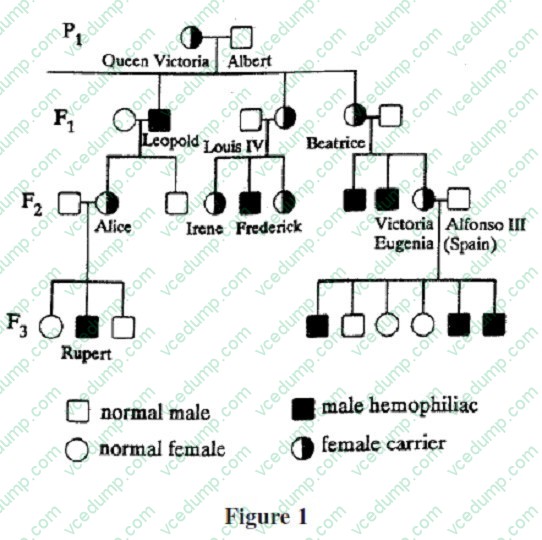
If Beatrice had married a hemophiliac and had a son, what is the probability that the son would have been a hemophiliac?
A. 0%
B. 25%
C. 50%
D. 100% -
Question 779:
The anthropomorphic bias of those who would relegate marsupials to an inferior evolutionary status is most apparent in their recourse to data on brain structure and behavior. Unlike humans and other placentals, marsupials lack the corpus callosum, which facilitates inter-hemisphere transfer of data acquired through the senses. Yet it cannot be inferred that marsupials are thus deprived of such function. Didelphis Virginiana, one of the opossums, makes use of the anterior commissure, an adaptation that is also found in reptiles and monotremes. Diprodontons, including kangaroos and koalas, supplement the anterior commissure with the fasciculus aberrans. While the modes of neocortical interconnection may be diverse, the work of Johnson, Heath and Jones points to the conclusion that, functionally speaking the cortices and neocortices of both groups of mammals exhibit parallel connections. Parker also notes "a similar range of brain size to body weight ratios and of neocortical expansion". Another stigma borne by marsupials is the consensus that they are less intelligent than placentals. Yet Williams argues that, all else being equal, natural selection will favor instinctive over learned behavior as being more biologically efficient and that it is the accidental death of the young that is the prime selective pressure for the evolution of intelligence. Seen in this light, marsupials have a competitive edge; their gestation period is brief and the young remain in the pouch for an extended period exposed only to those dangers which also affect the mother. There they are directly exposed to the mother's food supply and can observe her behavior at leisure. Placentals, on the other hand, not only have a longer gestation period but, once their young are born, must often leave while foraging. Such absences increase the risk of mortality and decrease the opportunity to learn. Thus, among placentals, selection would favor the apparent intelligence in the young and protective behavior in the mother. Marsupials are not known to exhibit maternal protective behavior. In fact, Serventy has reported that frightened female kangaroos will drop their pouch-young as they flee, drawing a predator's attention to the less able offspring while the adult escapes. This behavior, whether purposeful or accidental, instantaneously relieves the female marsupial of the mechanical difficulties of pregnancy with which her placental counterpart would be burdened, while marsupials can replace any lost young quickly. Thus, in the absence of any need for close maternal supervision, sacrificing their offspring in this manner may well have been favored in selection. Pointing to the absence of the "virtue" of maternal protectiveness in marsupials is an instance of how mistaken are those theorists who see similarities with humans as marks of evolutionary sophistication.
According to the passage, which of the following favor(s) the development of intelligence as a trait of placental mammals?
I. The need to leave their young while foraging
II. The comparatively great risk of accidental death of the young
III.
The opportunity for the young to observe the mother at leisure
B. I only
C. III only
D. I and II only
E. II and III only
I. The need to leave their young while foraging II. The comparatively great risk of accidental death of the young III. The opportunity for the young to observe the mother at leisure -
Question 780:
Family violence, such as domestic violence, child abuse, and elder abuse, are serious and pervasive problems in the United States. On an annual basis, the National Crime Survey has found domestic violence results in 21000 hospitalizations, 99800 days of hospitalization, 28700 emergency department visits, and 39900 visits to physicians.
Currently there is little consensus about the definitions of intimate violence. Even the terms employed are varied; for example, domestic violence, conjugal violence, intimate abuse, and partner abuse. Similarly, there are a range of causal explanations, and these are contingent upon the theoretical perspective employed. There is also controversy whether the term "violence," "abuse," or "aggression" should be used. Finally, within the terms adopted, there is no consensus about the victim-perpetrator relationship. For example, do the terms refer to a married co-habiting couple? Two heterosexual individuals who do not reside together but are dating? All this has implications for research, practice, and policy.
The National Violence Against Women Survey was one of the largest studies sponsored by the National Institute of Justice and the Centers for Disease Control and Prevention. It systematically analyzed crime against women in the United States. A total of 8000 men and 8000 women in the United States were interviewed on the phone using a closed-ended survey. Table 1 displays the breakdown of figures when examining life time victimization by racial groups.
Table 1 Percentage of people victimized by an intimate partner in lifetime, by victim gender, type of victimization, and victim race

Source: Adapted from P Tjaden and N. Thoennes, "Consequences of Intimate Partner Violence: Findings from the National Violence Against Women Survey."
Counselors who experience the cumulative effects of strain and exhaustion from hearing the stories of violence of victims of domestic violence over time are suffering from a phenomenon named:
A. learned helplessness.
B. acute stress.
C. compassion fatigue.
D. post-traumatic stress syndrome.


Related Exams:
Tips on How to Prepare for the Exams
Nowadays, the certification exams become more and more important and required by more and more enterprises when applying for a job. But how to prepare for the exam effectively? How to prepare for the exam in a short time with less efforts? How to get a ideal result and how to find the most reliable resources? Here on Vcedump.com, you will find all the answers. Vcedump.com provide not only Medical Tests exam questions, answers and explanations but also complete assistance on your exam preparation and certification application. If you are confused on your MCAT-TEST exam preparations and Medical Tests certification application, do not hesitate to visit our Vcedump.com to find your solutions here.