MCAT-TEST Exam Details
-
Exam Code
:MCAT-TEST -
Exam Name
:Medical College Admission Test: Verbal Reasoning, Biological Sciences, Physical Sciences, Writing Sample -
Certification
:Medical Tests Certifications -
Vendor
:Medical Tests -
Total Questions
:812 Q&As -
Last Updated
:Jul 08, 2026
Medical Tests MCAT-TEST Online Questions & Answers
-
Question 761:
Aerobic respiration is the major process used by oxygen- requiring organisms to generate energy. During respiration, glucose is metabolized to generate chemical energy in the form of ATP:

The biochemical machinery necessary for cellular respiration is found in the mitochondria, small organelles scattered throughout the cytoplasm of most eukaryotic cells. The number of mitochondria per cell varies by tissue type and cell function.
Mitochondria are unusual in that they have their own genetic systems that are entirely separate from the cell's genetic material. However, mitochondrial replication is still dependent upon the cell's nuclear DNA to encode essential proteins required for replication. Despite this fact, mitochondria seem to replicate randomly, out of phase with both the cell cycle and other mitochondria.
The nature of the mitochondrial genome and protein synthesizing machinery has led many researchers to postulate that mitochondria may have arisen as the result of the ingestion of a bacterium by a primitive cell millions of years ago. It is postulated that the two may have entered into a symbiotic relationship and eventually became dependent on each another; the cell sustained the bacterium, while the bacterium provided energy for the cell. Gradually, the two evolved into the present-day eukaryotic cell, with the mitochondrion retaining some of its own DNA. This is known as the endosymbiotic hypothesis. Because mitochondrial DNA is inherited in a non-Mendelian fashion (mitochondria are inherited from the maternal parent, who supplies most of the cytoplasm to the fertilized egg), it has been used to look at evolutionary relationships among different organisms.
Scientists have demonstrated that human mitochondrial DNA mutates at a fairly slow rate. Because mitochondria play such an important role in the cell, these mutations are most likely to be:
A. point mutations.
B. frameshift mutations.
C. lethal mutations.
D. nondisjunctions. -
Question 762:
A 2-stage rocket is launched vertically upwards at velocity v. At height h it discards its first stage in four fragments and travels faster without changing direction. Which of the following views from above could be the velocity vectors of the first stage fragments?
A. Option A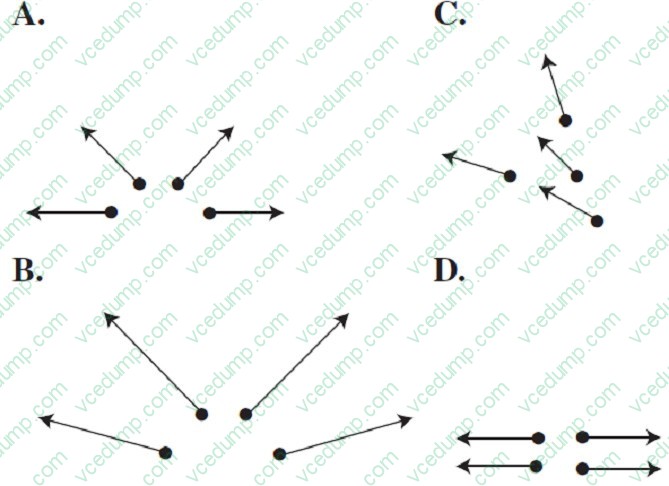
B. Option B
C. Option C
D. Option D -
Question 763:
When Gwendolyn Brooks published her first collection of poetry A Street In Bronzeville in 1945 most reviewers recognized Brooks' versatility and craft as a poet. Yet, while noting her stylistic successes few of her contemporaries discussed the critical question of Brooks' relationship to the Harlem Renaissance. How had she addressed herself, as a poet, to the literary movement's assertion of the folk and African culture, and its promotion of the arts as the agent to define racial integrity? The New Negro poets of the Harlem Renaissance expressed a deep pride in being Black; they found reasons for this pride in ethnic identity and heritage; and they shared a common faith in the fine arts as a means of defining and reinforcing racial pride. But in the literal expression of this impulse, the poets were either romantics, or realists and, quite often within the same poem, both. The realistic impulse, as defined best in the poems of McKay's Harlem Shadows (1922), was a sober reflection upon Blacks as second class citizens, segregated from the mainstream of American socio-economic life, and largely unable to realize the wealth and opportunity that America promised. The romantic impulse, on the other hand, as defined in the poems of Sterling Brown's Southern Road (1932), often found these unrealized dreams in the collective strength and will of the folk masses. In comparing the poems in A Street in Bronzeville with various poems from the Renaissance, it becomes apparent that Brooks brings many unique contributions to bear on this tradition. The first clue that A Street In Bronzeville was, at its time of publication, unlike any other book of poems by a Black American is its insistent emphasis on demystifying romantic love between Black men and women. During the Renaissance, ethnic or racial pride was often focused with romantic idealization upon the Black woman. A casual streetwalker in Hughes' poem, "When Sue Wears Red," for example, is magically transformed into an Egyptian Queen. In A Street In Bronzeville, this romantic impulse runs headlong into the biting ironies of racial discrimination. There are poems in which Hughes, McKay and Brown recognize the realistic underside of urban life for Black women. But for Brooks, unlike the Renaissance poets, the victimization of poor Black women becomes not simply a minor chord but a predominant theme. ...Brooks' relationship with the Harlem Renaissance poets, as A Street in Bronzeville ably demonstrates, was hardly imitative. As one of the important links with the Black poetic tradition of the 1920s and 1930s, she enlarged the element of realism that was an important part of the Renaissance world-view. Although her poetry is often conditioned by the optimism that was also a legacy of the period, Brooks rejects outright their romantic prescriptions for the lives of Black women. And in this regard, she serves as a vital link with the Black Arts Movement of the 1960s that, while it witnessed the flowering of Black women as poets and social activists as well as the rise of Black feminist aesthetics in the 1970s, brought about a curious revival of romanticism in the Renaissance mode.
According to the passage, critics praised the quality of Brooks' first collection of poetry but:
A. rejected her description of the plight of poor Black women in urban America.
B. failed to consider the links between her work and the work of earlier Black poets.
C. assumed incorrectly that she had borrowed many ideas from the poems of Sterling Brown.
D. argued that she had neglected to demystify romantic love between Black men and women. -
Question 764:
Arsenic is widely distributed in sulfide ores of many metals and is obtained as a byproduct of copper smelting. The element, as well as many compounds of arsenic -- for example arsine, AsH3 -- are extremely poisonous. Arsenic compounds, as might be expected, have found use in herbicides and pesticides, but have also been successful in some pharmacological agents. The first useful antisyphilitic agent, Salvarsan, or 3,3'-diamino-4,4'-dihydroxyarsenobenzene dihydrochloride, is an arsenic compound. The element sublimes at 600°C, forming tetrahedral molecules, As4. Arsenic is a metalloid, possessing properties characteristic of both metals and non-metals. Arsenic is a gray-colored, metalliclooking solid, but arsenic vapor is yellow in color, has a garlic-like odor, and is very poisonous. If the arsenic vapor is cooled rapidly, an unstable, yellow crystalline allotrope consisting of As4 molecules is produced. The Marsh test, based on the instability of arsine, is a very sensitive test for the presence of arsenic. This test is commonly employed in the detection of arsenic poisoning -- either before or after death. The apparatus for the Marsh test is shown in Figure 1.

Figure 1
Typically, a sample, usually hair, is taken from a person suspected of being the victim of arsenic poisoning. This sample is then treated in such a way so as to produce arsenic oxide, As4O6. The oxide is then placed into the apparatus shown
in Figure 1 and reacted according to Reaction 1.
As4O6 + 12Zn(s) + 24H+(aq) AsH3(g) + 12Zn2 +(aq) + 6H2O
Reaction 1
When the evolved arsine is ignited it decomposes into its elements. The arsenic vapor is rapidly cooled when it encounters the porcelain evaporating dish and deposits a black mirror of arsenic on the bottom, indicating the presence of arsenic
in the original sample.
The Marsh test takes advantage of the fact that arsine is not very soluble in water. Since arsenic is below nitrogen on the periodic table, it would be expected that arsine, like ammonia, would be very soluble in water. What is the most likely
reason for this difference in solubility?
A. Arsine has a higher molecular weight than ammonia does.
B. Arsine has a smaller dipole moment than ammonia does.
C. Arsine is less basic than ammonia is.
D. Arsine is less stable than ammonia is. -
Question 765:
A neutral body is rubbed and its charge becomes positive. It must have:
A. gained protons.
B. gained neutrons.
C. gained electrons.
D. lost electrons. -
Question 766:
Millenialism is, generally speaking, the religious belief that salvation and material benefits will be conferred upon a society in the near future as the result of some apocalyptic event. The term derives from the Latin word for 1,000; in early Christian theology, believers held that Christ would return and establish his kingdom on earth for a period of a thousand years.
Millenialist movements, Christian and non-Christian, have arisen at various points throughout history, usually in times of great crisis or social upheaval. In "nativistic" millenialist movements, a people threatened with cultural disintegration attempts to earn its salvation by rejecting foreign customs and values and returning to the "old ways." One such movement involving the Ghost Dance cults, named after the ceremonial dance which cult members performed in hope of salvation, flourished in the late 19th century among Indians of the western United States.
By the middle of the 19th century, western expansion and settlement by whites was seriously threatening Native American cultures. Mining, agriculture and ranching encroached on and destroyed many Indian land and food sources. Indian resistance led to a series of wars and massacres, culminating in the U.S. Government's policy of resettlement of Indians onto reservations which constituted a fraction of their former territorial base. Under these dire circumstances, a series of millenialist movements began among western tribes.
The first Ghost Dance cult arose in western Nevada around 1870. A Native American prophet named Wodziwob, a member of a Northern Paiute tribe, received the revelation of an imminent apocalypse which would destroy the white man, restore all dead Indians to life, and return to the Indians their lands, food supplies (such as the vanishing buffalo), and old way of life. The apocalypse was to be brought about with the help of a ceremonial dance and songs, and by strict adherence to a moral code which, oddly enough, strongly resembled Christian teaching. In the early 1870s, Wodziwob's Ghost Dance cult spread to several tribes in California and Oregon, but soon died out or was absorbed into other cults.
A second Ghost Dance cult, founded in January 1889, evolved as the result of a similar revelation. This time Wovoka -- another Northern Paiute Indian, whose father had been a disciple of Wodziwob -- received a vision during a solar eclipse in which he died, spoke to God, and was assigned the task of teaching the dance and the millennial message. With white civilization having pushed western tribes ever closer to the brink of cultural disintegration during the previous twenty years, the Ghost Dance movement spread rapidly this time, catching on among tribes from the Canadian border to Texas, and from the Missouri River to the Sierra Nevadas -- an area approximately one-third the size of the continental United States.
Wovoka's Ghost Dance doctrine forbade Indian violence against whites or other Indians; it also involved the wearing of "ghost shirts," which supposedly rendered the wearers invulnerable to the white man's bullets. In 1890, when the Ghost Dance spread to the Sioux Indians, both the ghost shirts and the movement itself were put to the test. Violent resistance to white domination had all but ended among the Sioux by the late 1880s, when government- ordered reductions in the size of their reservations infuriated the Sioux, and made them particularly responsive to the millenialist message of the Ghost Dance. As the Sioux organized themselves in the cult of the dance, an alarmed federal government resorted to armed intervention which ultimately led to the massacre of some 200 Sioux men, women and children at Wounded Knee, South Dakota in December of 1890. The ghost shirts had been worn to no avail, and Wounded Knee marked the end of the second Ghost Dance cult.
All of the following characteristics are described in the passage as common to all millenialist movements EXCEPT:
A. the desire for salvation.
B. the belief in imminent apocalypse.
C. attempts to preserve cultural integrity.
D. adherence to Christian doctrines. -
Question 767:
(1) Fluorescent proteins are found in bioluminescent sea creatures, such as jellyfish. (2) In 1969, the green fluorescent protein was discovered and, since then, prolific research has resulted in the discovery and development of many new fluorescent proteins. (3) Fluorescent proteins can be expressed in cells, making them easily visible under a microscope. (4) In fact, the use of fluorescent proteins revolutionized bio- imaging because the inherently natural nature meant that they could be incorporated into living cells with no deadly toxic effects. (5) Numerous other scientific and medical applications also exploit the unique properties of fluorescent proteins, which is why they were the subject of the 2008 Nobel Prize for Chemistry. (6) However, the science behind fluorescent proteins is still not fully understood, and there are many more avenues for exploration.
If the author had intended to provide an overview of all the applications of fluorescent proteins, would this passage achieve that goal?
A. Yes, the passage describes multiple applications.
B. No, because the passage describes only one application in detail.
C. No, the passage describes no applications.
D. Yes, the passage describes one application. -
Question 768:
The Russian wheat aphid, Diuraphis noxia, is a small green insect discovered in southern Russia around the turn of the century. Agricultural researchers are not quite sure, but they believe the Russian aphid adapted itself to wheat about ten thousand years ago, when the crop was first domesticated by man. What is not in doubt is the insect's destructiveness. Spread by both wind and human transport, the Russian aphid has destroyed wheat fields throughout Asia, Africa, and Latin America. Until a few years ago, the United States had been free of this pest. But in the spring of 1986, a swarm of Russian aphids crossed the Mexican border and settled a few hundred miles north, in central Texas. From there, it quickly spread to other Western states, destroying wheat fields all along its path. In fact, the level of destruction has been so great over the past five years that entomologists are calling the Russian aphid the greatest threat to American agriculture since the Hessian fly, Phytophaga destructor, was inadvertently brought to the colonies on ships by German mercenary troops during the Revolutionary War. A combination of several factors have made it particularly difficult to deal with the threat posed by this aphid. First, Russian aphids reproduce asexually at a phenomenal rate. This process, known as parthenogenesis, often results in as many as twenty generations of insects in a single year. Although most generations remain in a limited geographic area because they have no wings, a few generations are born with wings, allowing the insect to spread to new areas. Second, because wheat is a crop with a very low profit margin, most American farmers do not spray it with pesticides; it simply is not economical to do so. And since the Russian aphid has only recently entered the United States, it has no natural enemies among North American insects or animals. As a result, there have been no man-made or natural obstacles to the spread of the Russian aphid in the United States.
Agricultural researchers seeking to control the Russian aphid have looked to its place of origin for answers. In the Soviet Union, the Russian aphid has been kept in check by predators which have evolved alongside it over many thousands of years. One species of wasp seems to be particularly efficient at destroying the aphid. The pregnant females of the species search the Russian aphid's home, the interior of a wheat stalk, sting the aphid into paralysis, and then inject an egg into its body. When the egg hatches the wasp larva feeds off of the aphid, killing it in the process.
The introduction of predators like the wasp, coupled with the breeding of new strains of insect-resistant wheat, may substantially curb the destructiveness of the Russian aphid in the future. For the time being, however, American farmers are left to their own devices when it comes to protecting their wheat crops
The passage supplies information for answering all of the following questions EXCEPT:
A. What measures were taken to combat the Hessian fly during the 18th century?
B. Why does the Russian wheat aphid cause less damage in the Soviet Union than in other countries?
C. Is it logical for American farmers to use pesticides in order to attempt to protect their wheat crops from the Russian aphid?
D. What sorts of solutions have agricultural researchers investigated in their efforts to curb the destructiveness of the Russian wheat aphid? -
Question 769:
The simple harmonic motion of a mass suspended from vertical springs is investigated in two experiments. The springs used in both experiments have a spring constant k and a natural length L0. The material used to make the springs has a
Young's modulus of 2 x 10¹¹ Pa.
In the first experiment a mass m is suspended from a spring. The mass stretches the spring to a new length L, called the equilibrium length.
In the second experiment the mass m is suspended from two identical springs as shown in Figure 2 below. When the mass m is in equilibrium, each spring is stretched from its natural length by the same amount xe.
In both experiments the masses of the springs are negligible, and the elastic limits of the springs are never exceeded.

In the first experiment the mass is pulled down and set into motion. The position of greatest speed is:
A. at the equilibrium position.
B. at the position where the spring's length is its natural length.
C. at the lowest point in its motion.
D. at the highest point in its motion. -
Question 770:
Today's new urban Asia is just as sophisticated and in many ways more exciting than Western cities. Urban Asian consumers are knowledgeable, modern, and keen to embrace the global lifestyle. Young, urban Asians have grown up accustomed to many things that originated in the West. They have, for example, completely embraced pizza, some even claiming that it is a part of their heritage. The story is told about a young Singaporean boy who was taken by his father to Rome. "Hey, look, Dad," the little boy exclaimed, "they have pizza here too!" On sampling the product, the boy decided that it was not as good as the original back home. Nury Vitachi, who writes for the South China Post and the Far Eastern Economic Review, describes the Asian middle-class phenomenon: "Executives in Asia have become rich at warp speed by taking full control of their own lives. They invest a great deal of time in their work, they use strategy to scramble up the corporate ladder, and they demand payment in cash -- so they can make their money work as hard as they do." Signs of affluence are everywhere, but don't get carried away. Traveling around Asia, no matter how rich the Asians become, signs of their frugal nature are still apparent. And they are very cost-conscious. Shopkeepers in many Asian cities, most notably in Hong Kong, demand payments for discounted merchandise in cash instead of plastic, and many Asians are accustomed to that. Most people save the increases in their income, and many prefer to put it into fixed or other income-generating assets. Stock, land, and property are their favorites. Many affluent Asians still regard financial security as the most important form of security, and they are confident that Asia is the place to be to achieve that. While many have begun to savor the good life, they are not letting go of their top priority of education for their children. Education is looked upon as the most important contributing factor to success in life. And in many of Asia's competitive urban centers, there is a rush to acquire a second degree and other forms of professional qualification to ensure personal competitiveness in the workplace. There are extraordinary opportunities in Asia for education and training programs from language to software programming. Despite the rise in their assertiveness, Asians still look to the United States and not so much to Europe for ideas and trends. In general, except for those in Hong Kong and Japan, they are not particularly concerned with being fashionable. For today's Asia, Japan and Hong Kong are the sources of Asian fashion ideas, but as Asia becomes more affluent, there is a great opportunity to develop an indigenous fashion industry. For example, a huge market potential exists in introducing new materials and simplified but fashionable designs for countries in tropical Asia with a hot humid climate throughout the year. The population density and lack of space in urban areas has prohibited Asians from exercising frequently and few indulge in outdoor activities. This is changing. Most Asians consider themselves in good health. Compared with Americans, few are overweight -- largely as a result of their Asian diet. But now health clubs are becoming popular among younger Asians. Potential for indoor exercise equipment holds great promise. It is also important to dress for the gym, and younger Asians are serious about looking good, complete with makeup, sunglasses, designer exercise shoes and outfits, and a gym bag. In trying to hit Asia's moving targets, regardless of what you are selling, it is a good idea to stick with market density -- not country by country, but, mostly, city by city. Asian markets can be a marketer's dream in that their densities are among the highest in the world. Java, Indonesia's main island, has 115 million people. On Nanjing Road, Shanghai's busiest street, businesses are open twelve hours a day almost every day of the year. More than 1.5 million people visit the shops there and spend more than $50 million every day. Someone said that you can only become rich if you sell to the rich. I would add that you can become rich faster if you sell to the new rich. For investors in the West, watch for Western companies that are preparing a big push in Asia. The world has not yet seen anything like it before, and you can reap handsome dividends if you back those stocks that are going eastward.
Which of the following is NOT directly supported by the passage?
A. Asians have already assimilated many Western customs and fashions.
B. Future investment in Asian markets will be the most lucrative action for Western manufacturers.
C. Urban professionals in Asia consider education as beneficial to their careers.
D. The affluence of many Asians is not always evident in their spending patterns.
Related Exams:
Tips on How to Prepare for the Exams
Nowadays, the certification exams become more and more important and required by more and more enterprises when applying for a job. But how to prepare for the exam effectively? How to prepare for the exam in a short time with less efforts? How to get a ideal result and how to find the most reliable resources? Here on Vcedump.com, you will find all the answers. Vcedump.com provide not only Medical Tests exam questions, answers and explanations but also complete assistance on your exam preparation and certification application. If you are confused on your MCAT-TEST exam preparations and Medical Tests certification application, do not hesitate to visit our Vcedump.com to find your solutions here.