MCAT-TEST Exam Details
-
Exam Code
:MCAT-TEST -
Exam Name
:Medical College Admission Test: Verbal Reasoning, Biological Sciences, Physical Sciences, Writing Sample -
Certification
:Medical Tests Certifications -
Vendor
:Medical Tests -
Total Questions
:812 Q&As -
Last Updated
:Jul 08, 2026
Medical Tests MCAT-TEST Online Questions & Answers
-
Question 751:
The lead-acid battery, also called a lead storage battery, is the battery of choice for starting automobiles. It contains 6 cells connected in series, each composed of a lead oxide cathode "sandwiched" between 2 lead anodes. Insulating separators are placed between the electrodes to prevent internal short-circuits. Aqueous sulfuric acid is the electrolyte.
When the battery is being discharged, the following reaction takes place:

Reaction 1
The electrode reactions, both written as reductions, are shown in Table 1.
Table 1
Half-reaction
E?V)
PbO2(s) + SO42-(aq) + 4H+(aq) + 2ePbSO4(s) + 2H2O
PbSO4(s) + 2e-Pb(s) + SO42-(aq)
1.69
?.36
As a car operates, the battery is recharged by electricity produced by the car's alternator, an AC generator whose ultimate power source is the car's internal combustion engine. In spite of this, batteries eventually lose their power. The battery is said to be "dead" when Reaction 1 has proceeded completely to the right.
Often in cold weather the battery goes "dead". Thermodynamic data confirms that the voltage of most electrochemical cells decreases with decreasing temperature. If the battery is warmed to room temperature, it often recovers its ability to deliver normal power. The battery appeared "dead" because:
I) the resistance of the electrolyte had decreased. II) the viscosity of the electrolyte had increased. III) the viscosity of the electrolyte had decreased.
A. I only
B. II only
C. I and II only
D. I and III only -
Question 752:
Breast milk is proven to be the best form of nutrition for infants and is recommended for at least 1 year after birth. Unfortunately, a recent survey of breastfeeding mothers revealed that only 20% continue breastfeeding or to provide breast milk through pumping after 4 months, after which they switch to formula. When asked about reasons for stopping breastfeeding, the top three reasons were: going back to work, lack of support, and difficulties pumping. A socioeconomic study of the mothers revealed that women who choose to breastfeed for longest tend to have a higher level of education and come from more affluent backgrounds. Conversely, those mothers who breastfeed for the least amount of time tend to belong to minority groups and are from poorer backgrounds. It has been proposed that cultural differences also have a significant impact on the duration of breastfeeding.
Based on the information in the passage, would a mother with a supportive family environment be more or less likely to continue breastfeeding for a full year?
A. She would be less likely because there are many more influential factors that stop mothers breastfeeding.
B. She would be more likely because family would be able to help with feeding.
C. It is impossible to say because the survey only looked at mothers who stopped breastfeeding after 4 months.
D. She would be more likely because lack of support was one of the top three reasons for mothers stopping breastfeeding. -
Question 753:
Which of the following glands is known as "master gland"?
A. Thyroid
B. Pituitary
C. Island of Langerhans
D. Adrenal -
Question 754:
The lead-acid battery, also called a lead storage battery, is the battery of choice for starting automobiles. It contains 6 cells connected in series, each composed of a lead oxide cathode "sandwiched" between 2 lead anodes. Insulating separators are placed between the electrodes to prevent internal short-circuits. Aqueous sulfuric acid is the electrolyte.
When the battery is being discharged, the following reaction takes place:
Reaction 1
The electrode reactions, both written as reductions, are shown in Table 1.
Table 1
Half-reaction
E?V)
PbO2(s) + SO42-(aq) + 4H+(aq) + 2ePbSO4(s) + 2H2O PbSO4(s) + 2e-Pb(s) + SO42-(aq)
?.36
As a car operates, the battery is recharged by electricity produced by the car's alternator, an AC generator whose ultimate power source is the car's internal combustion engine. In spite of this, batteries eventually lose their power. The battery is said to be "dead" when Reaction 1 has proceeded completely to the right.
Currents as small as 0.1 A can be fatal to humans. If the typical resistance of the human body is 10 k, what is the minimum voltage that could be fatal?
A. 0.1 V
B. 1 V
C. 100 V
D. 1,000 V -
Question 755:
Many nutrients required by plants exist in soil as basic cations:

A soil's cation-exchange capacity is a measure of its ability to adsorb these basic cations as well as exchangeable hydrogen and aluminum ions. The cation-exchange capacity of soil is derived from two sources: small clay particles called micelles consisting of alternating layers of alumina and silica crystals, and organic colloids.

Replacement of + and + by other cations of lower valence creates a net negative charge within the inner layers of the micelles. This is called the soil's permanent charge. For example, replacement of an atom of aluminum by calcium within a section where the net charge was previously zero, as shown below, produces a net charge of ?, to which other cations can become adsorbed.

Figure 1
A pH-dependent charge develops when hydrogen dissociates from hydroxyl moieties on the outer surfaces of the clay micelles. This leaves negatively-charged oxygen atoms to which basic cations may adsorb. Likewise, a large pH-
dependent charge develops when hydrogen dissociates from carboxylic acids and phenols in organic matter.
In most clays, permanent charges brought about by substitution account for anywhere from half to nearly all of the total cation-exchange capacity. Soils very high in organic matter contain primarily pH-dependent charges. In a research study,
three samples of soil were leached with a 1 N solution of neutral KCl, and the displaced A13+ and basic cations measured. The sample was then leached again with a buffered solution of BaCl2 and triethanolamine at pH 8.2, and the
displaced H+ measured. Table 1 gives results for three soils tested by this method.
Table 1
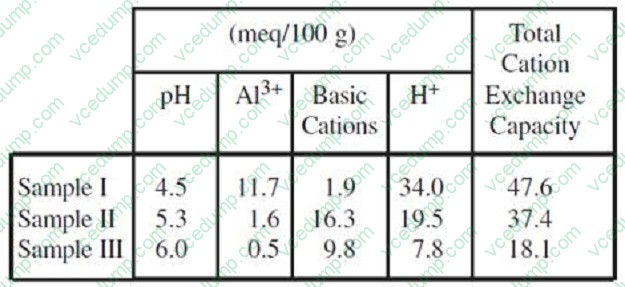
Due to the buffering effect of the soil's cation exchange capacity, just measuring the soil solution's pH will not indicate how much base is needed to change the soil pH. In another experiment, measured amounts of acid and base were added to 10-gram samples of well-mixed soil that had been collected from various locations in a field. The volumes of the samples were equalized by adding water. The results were recorded in Figure 2.
Figure 2.
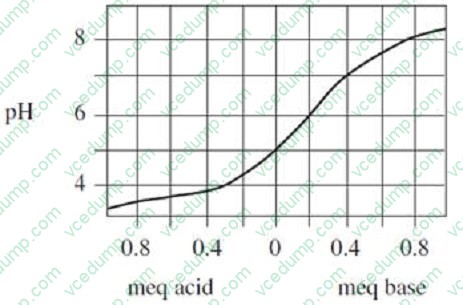
The amount of soil on a particular one-acre field down to a depth of one furrow slice weighs 9 ?105 kilograms. Based on Figure 2, how many kilograms of CaCO3 would have to be added to this field to raise the pH from 5 to 6?
A. Option A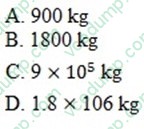
B. Option B
C. Option C
D. Option D -
Question 756:
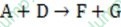
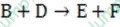
Several techniques have been developed to determine the order of a reaction. The rate of a reaction cannot be predicted on the basis of the overall equation, but can be predicted on the basis of the rate-determining step. For instance, the following reaction can be broken down into three steps.
Step 1

(Slow)
Step 2
(fast)
Step 3

(fast)
Reaction 1 In this case, the first step in the reaction pathway is the rate-determining step. Therefore, the overall rate of the reaction must equal the rate of the first step, k1 [A] where k1 is the rate constant for the first step. (Rate constants of the different steps are denoted by kx, where x is the step number.)
In some cases, it is desirable to measure the rate of a reaction in relation to only one species. In a second-order reaction, for instance, a large excess of one species is included in the reaction vessel. Since a relatively small amount of this large concentration is reacted, we assume that the concentration essentially remains unchanged. Such a reaction is called a pseudo first-order reaction. A new rate constant, k', is established, equal to the product of the rate constant of the original reaction, k, and the concentration of the species in excess. This approach is often used to analyze enzyme activity.
In some cases, the reaction rate may be dependent on the concentration of a short-lived intermediate. This can happen if the rate-determining step is not the first step. In this case, the concentration of the intermediate must be derived from the equilibrium constant of the preceding step. For redox reactions, the equilibrium can be correlated with the voltage produced by two half-cells by means of the Nernst equation. This equation states that at any given moment:
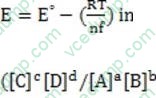
Equation 1 When

Reaction 2
Note: R = 8.314 J/K•mol; F = 9.6485 x 10⁴ /mol.)
What is the effect of increasing the concentration of reactants in a voltaic cell?
A. The voltage increases, while the spontaneity of the reaction remains the same.
B. The spontaneity of the reaction increases, but the voltage remains the same.
C. Both the voltage and the spontaneity of the reaction increase.
D. The reaction rate increases, but the voltage and spontaneity of the reaction are unchanged. -
Question 757:
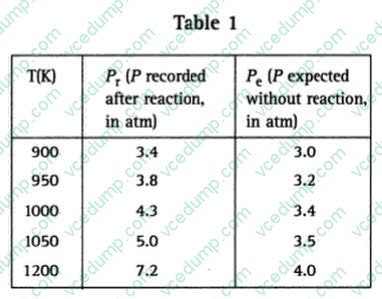
A researcher investigated the equilibrium between CO2, C, and CO as a function of temperature. The equation is given below: CO2(g) + C(s) 2 CO(g) Carbon dioxide, at 298 K and 1 atm, and an excess of powdered carbon were introduced into a furnace, which was then sealed so that pressure would increase as the temperature rose. The furnace was heated to, and held constant at, a predetermined temperature. The pressure within the furnace chamber was recorded after it had remained unchanged for one hour. The table below shows the pressures recorded for a series of temperatures together with the pressures expected if no reaction had taken place. Table 1

Which of the following is NOT necessarily true about the equilibrium reaction between CO2, C, and CO?
A. The standard entropy change is positive.
B. A decrease in pressure at constant temperature would shift the equilibrium to the right.
C. Addition of CO will shift the equilibrium to the left.
D. The standard Gibbs' free energy change is negative. -
Question 758:
Just as the ingestion of nutrients is mandatory for human life, so is the excretion of metabolic waste products. One of these nutrients, protein, is used for building muscle, nucleic acids, and countless compounds integral to homeostasis. However, the catabolism of the amino acids generated from protein digestion produces ammonia, which, if not further degraded, can become toxic. Similarly, if the same salts that provide energy and chemical balance to cells are in excess, fluid retention will occur, damaging the circulatory, cardiac, and pulmonary systems.
One of the most important homeostatic organs is the kidney, which closely regulates the excretion and reabsorption of many essential ions and molecules. One mechanism of renal function involves the secretion of antidiuretic hormone (ADH).
Diabetes insipidus (DI), is the condition that occurs when ADH is ineffective. As a result, the kidneys are unable to concentrate urine, leading to excessive water loss. There are two types of DI -- central and nephrogenic. Central DI occurs when there is a deficiency in the quantity or quality of ADH produced. Nephrogenic DI occurs when the kidney tubules are unresponsive to ADH. To differentiate between these two conditions, a patient's urine osmolarity is measured both prior to therapy and after a 24-hour restriction on fluid intake. Exogenous ADH is then administered and urine osmolarity is measured again. The table below gives the results of testing on four patients. Assume that a urine osmolarity of 285 mOsm/L of H2O is normal.
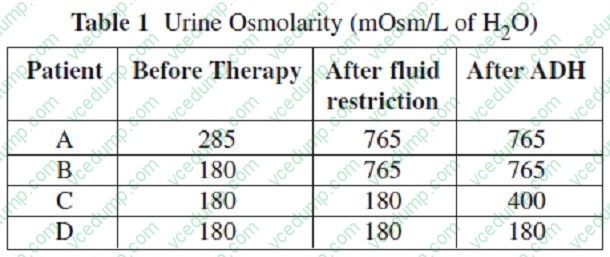
Based on the data in Table 1, which of the four patients most likely has central diabetes insipidus?
A. Patient A
B. Patient B
C. Patient C
D. Patient D -
Question 759:
Before birth, the rodent brain is sexually undifferentiated. It is only in the first few days following birth, during a period referred to as the critical period, that the rodent brain differentiates along male or female lines. The hormone testosterone plays a critical role in this development. Specifically, sexual differentiation is determined by the presence of estradiol, an estrogen derivative of testosterone, in certain areas of the brain. Testosterone is converted to estradiol in critical brain cells that contain the enzyme aromatase. To study the effects of testosterone on the neonatal rodent brain, the following experiments were conducted: The above research, combined with additional studies, concluded that testosterone has two "organizational" effects on the male rodent brain: Defeminization Moderate levels of testosterone-derived estradiol during the critical period are sufficient for defeminization of the brain. Defeminization of the rodent brain results in loss of estrogen positive feedback on LH and FSH secretion and the ensuing loss of cyclicity, as well as loss of female sex behavior. Masculinization High levels of estradiol due to high levels of testosterone during the critical period results in masculinization of the brain. Masculinization leads to the induction of male sex behavior including antagonism towards other males and the mounting of females.
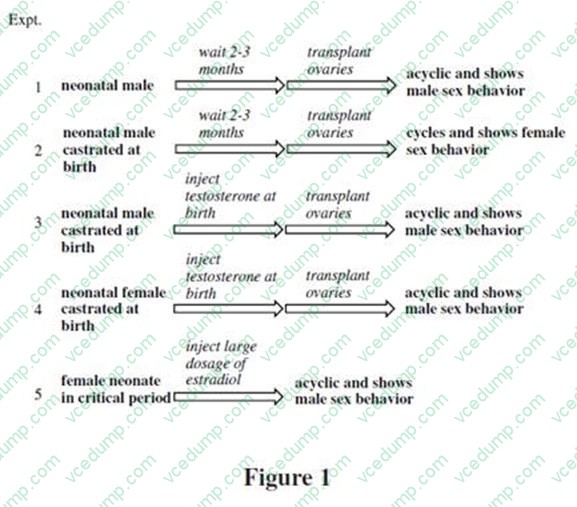
In Experiment 2, researchers most likely waited 2-3 months before implanting ovaries:
A. to allow the rat to recover from previous surgery.
B. to allow testosterone levels to rise to necessary concentrations.
C. to wait for the critical period to pass.
D. to promote the defeminization of the rat brain. -
Question 760:
A student conducts a chemical analysis of the components of a popular soft drink. The beverage label shows that the drink contains carbonated water, phosphoric acid, caffeine, and caramel color, but does not indicate the concentrations of these chemicals.
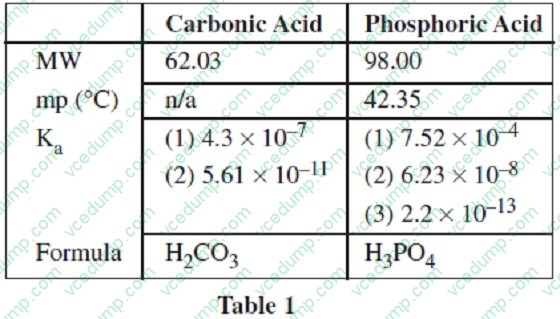
Dissolved carbon dioxide will react reversibly with water to form carbonic acid. In an attempt to analyze the beverage composition, the student conducts the following experiments on a one liter sample of the beverage.
Experiment 1
The sample is placed in a sealed beaker cooled to 10?C and a vacuum is created in the space above the beverage. The gas pumped from this space is passed through a solution of BaCl2, producing a white precipitate. The process
continues until no more precipitate forms. The precipitate is dried and found to have a mass of 9.5 grams.
Experiment 2
The remaining solution left in the sealed beaker is then titrated with 0.01 M NaOH to give the titration curve shown in Figure 1.
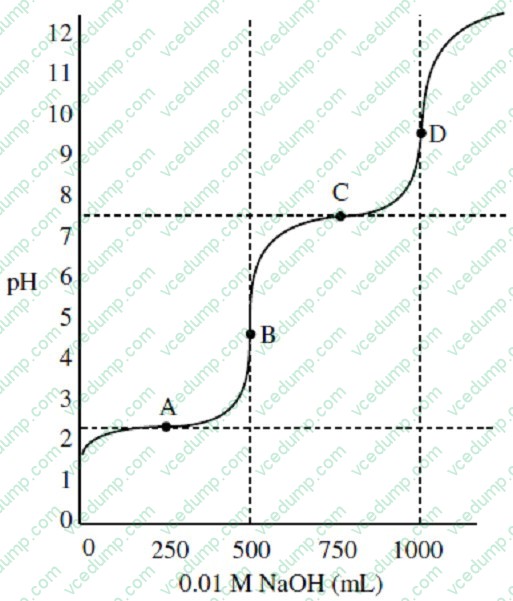
Figure 1
In the body, rapid breathing (hyperventilation) leads to a decrease in the concentration of carbon dioxide in the blood. This will tend to:
A. Option A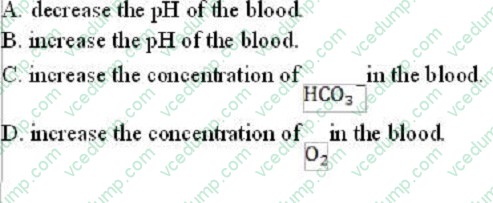
B. Option B
C. Option C
D. Option D

Related Exams:
Tips on How to Prepare for the Exams
Nowadays, the certification exams become more and more important and required by more and more enterprises when applying for a job. But how to prepare for the exam effectively? How to prepare for the exam in a short time with less efforts? How to get a ideal result and how to find the most reliable resources? Here on Vcedump.com, you will find all the answers. Vcedump.com provide not only Medical Tests exam questions, answers and explanations but also complete assistance on your exam preparation and certification application. If you are confused on your MCAT-TEST exam preparations and Medical Tests certification application, do not hesitate to visit our Vcedump.com to find your solutions here.