MCAT-TEST Exam Details
-
Exam Code
:MCAT-TEST -
Exam Name
:Medical College Admission Test: Verbal Reasoning, Biological Sciences, Physical Sciences, Writing Sample -
Certification
:Medical Tests Certifications -
Vendor
:Medical Tests -
Total Questions
:812 Q&As -
Last Updated
:Jul 08, 2026
Medical Tests MCAT-TEST Online Questions & Answers
-
Question 741:
At a recent meeting of the American Public Transit Association, the Environmental Protection Agency unveiled stringent new standards for pollution control. The transit authorities were particularly concerned about the implementation of a proposed "Clean Air Act." They believed the provisions of the Clean Air Act could severely affect basic services to their local communities. Many transit agencies were concerned that it would be difficult to comply with the pollution and emissions control standards while continuing to operate within realistic budgets. The aim of the Clean Air Act is to assure that by the year 2000, there will be a reduction of at least 10 million tons of sulfur dioxide from 1980 levels. The bill also calls for a reduction in pollutants that contribute to the depletion of ozone. Strict regulations of toxic air emissions would have to be established and enforced. Additionally, the Clean Air Act would establish specific acid-rain reduction quotas and enforce severe penalties for transgressors of any of the new clean air regulations. There is little doubt that mass-transit suppliers will be considerably affected by this new legislation, just as the chemical and petroleum industries have already been affected by similar legislation. Transit authorities are challenged to strike a difficult balance between complying with the government's new standards and developing an official concern for the environment, while continuing to fulfill the transportation needs of the general population. Among the areas addressed by the Clean Air Act, the topic of mobile resources is of particular interest to mass transit authorities. Provisions contained in the Act under this title are aimed at encouraging the development and practical use of alternative fuel sources, like solar energy and methane fuel. The goal of this section of the Act is to eradicate toxic fuel emissions in order to provide cleaner air and a more favorable environment. The Act even goes so far as to declare that in cities like New York, Los Angeles and Houston -- where air quality is particularly noxious and toxins exceed the limits of federal regulations -- forms of mass transit should run on so-called "clean-burning fuels" by the year 2000. Such fuels include reformulated gasoline, propane, electricity, natural gas, ethanol, methanol, or any similar type of low-emission fuel. In addition, the Act proposes that, by 1994, all new urban buses in cities with populations exceeding one million must operate solely on clean-burning fuels. The topics of alternative fuels and alternative fuel vehicles represent, by far, the most controversial issue in the Clean Air Act. President Bush has called alternative fuels "bold and innovative" means to control pollution, but according to many transportation experts, the Act's proposals on alternative fuel usage are unrealistic. The transit authorities recognize that concern for the environment and health hazards like pollution are global issues. However, most transit officials concur that inventing and developing new ways to fuel mass transit will take at least 50 years to realize. They point out that the Act does not mention the political and social ramifications of usurping the role of the petroleum industries. The Act does not mention if or how the thousands of people employed by the oil industry will get retrained to produce and implement the use of "clean" fuel. No one disputes the fact that people need some form of transportation to get from place to place. Preserving the environment should be a priority, yet we need to remember that even if toxic emissions are completely eliminated sometime in the future, the challenge of moving mass numbers of people where they want to go will still exist and must remain a priority. Transit authorities contend that unless the Clean Air Act also acknowledges this, and develops a way to encourage mass transit over personal transportation, the problems of pollution might not be significantly altered. They suggest that there are many areas in this country that have little or no mass transit and that, if the Clean Air Act's goal is to reduce pollution, perhaps the most practical and realistic means to achieve that goal is to encourage the development and maintenance of mass transit systems.
Which of the following statements about transit officials' reactions to the Clean Air Act is LEAST supported by the passage?
A. Transit officials feel that they will have a great deal of difficulty complying with the stringent pollution and emission standards while continuing to operate on a financially practical level.
B. Transit authorities believe that the Act's proposals on alternative fuel usage are unrealistic.
C. Transit officials argue that unless the Clean Air Act recognizes the importance of mass transit, pollution may not be fundamentally modified.
D. Mass transit authorities feel that it is impossible to meet the Clean Air Act's demand that all new buses in cities with populations exceeding one million must run solely on clean-burning fuel such as ethanol or propane. -
Question 742:
Triacylglycerides consist of:
I) a ribose backbone II) a glycerol backbone III) three phosphodiester linkages IV) three ester linkages
A. I and III
B. II only
C. II and III
D. II and IV -
Question 743:
The Earth's atmosphere reaches hundreds of kilometers above the surface of the planet. The lowest layer, the troposphere, extends from the ground to a height of approximately 12 km. Air pressure within the troposphere decreases with height above the ground, accompanied by a parallel trend in air density. The decrease in density has important consequences for the dissipation of air pollution from industrial smoke stacks. The gas from the stack is typically hotter and less dense than the surrounding air and rises. As a parcel of hot air rises, it expands approximately adiabatically doing work on the surrounding air. This results in a decrease in both its temperature and its density.
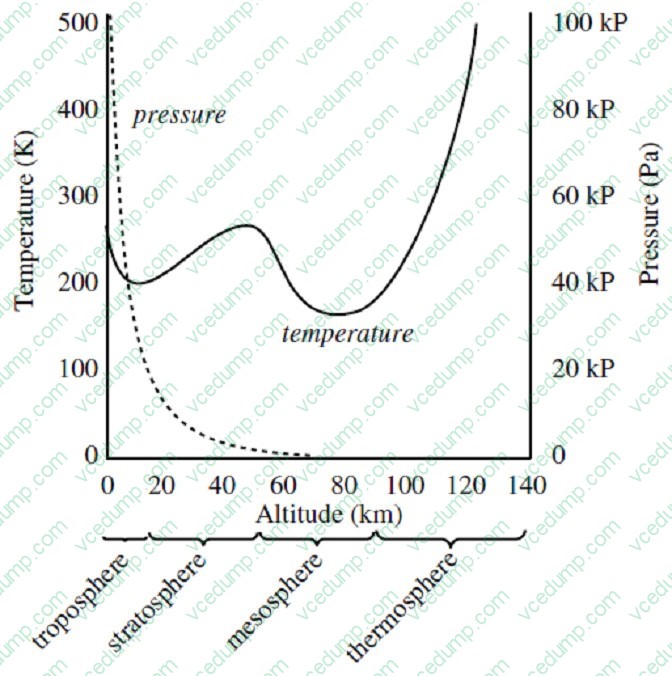
Figure 1 A smoke stack functions to expel gaseous waste products from a chemical process. It is also an important means of removing heat from a reaction mixture. The heat corresponding to a change in temperature of a gas at constant pressure is

given by , where is the heat added to the gas, n is the number of moles of gas, is the molar heat capacity of a particular gas at constant pressure, and T is the change in temperature. At atmospheric pressure, the

molar heat capacity for steam, O (g) is approximately four times that of air.
The decrease in temperature of a parcel of hot air rising from a smoke stack is a result of:
A. conductive heat losses to the surrounding cooler air.
B. convective heat losses to the surrounding cooler air.
C. an increase in kinetic energy.
D. the expansion of the parcel. -
Question 744:
For the last two decades many earth scientists have supported the notion that the Mediterranean was once a huge, dry desert, lying 3,000 meters below sea level. This "death valley" was thought to have existed at the end of Miocene time, about 6 to 5.5 million years ago.... ...From a geological point of view, the Mediterranean is a tectonically mobile land-enclosed depression -- small (about 3,000,000 square kilometers) in comparison to the major world oceans...Immediately obvious on all charts is the highly variable topography and relief of both the seafloor and adjacent borderland. The coastline is highly irregular and continental shelves, though generally narrow, are well developed off the major river deltas (Nile, Rhone, Po, and Ebro). Moreover, the deep-sea basins and trenches have distinctive relief, with basin plains ranging in depth from less than 1,000 meters to more than 4,000...Observation that rocks dredged offshore are similar to those on land raised a fundamental concept -- the key to understanding Mediterranean history lies in the adjacent emerged land masses, and vice- versa.... ...Early paleographic reconstructions showed that the once-open communication with the Atlantic deteriorated during the upper Miocene. Water-mass exchange continued for a while in the Rif Strait, but then ceased completely prior to the beginning of the Pliocene.... ...High relief near what is now the Strait of Gibraltar served as a barrier to the exchange of waters with the Atlantic. Exposed to a hot and dry climate, water evaporated and the then-dry basin elicited comparison with a gigantic Death Valley... Microfossil studies suggested that the depth of the Mediterranean basin at these times had been "deep." Estimates suggested a dry seafloor as far as 2,000 meters below ocean level... As a response to suddenly lowered sea level, rivers feeding the Mediterranean and canyons on the now-dry seafloor began a geologically dramatic phase of erosion. Deep, Grand Canyon-like gorges of the Nile and Rhone rivers, presently buried on land, were apparently cut during a great drawdown of water -- when the Mediterranean floor lay exposed 1,000 meters or more below its present level...The sudden flooding through a gigantic waterfall at Gibraltar drowned the exposed basin floor. These falls would have been 1,000 times bigger than Niagara Falls...This flooding event is recorded by the Miocene Pliocene boundary, a time when open marine faunal assemblages were suddenly reintroduced from the Atlantic.... ...Geological theories usually fall at a glacial pace into a sea of controversy, and this one is no exception. Today -- charging that proof for the theory is lacking -- many scientists believe that the Med always contained saltwater, with only the depth of the seafloor and the water being in question... Some of the tenets on which the theory was formulated are, if not defective, very seriously in question. To interpret their findings, a respectable number of geologists studying the surrounding emerged borderland as well as subsea sections indicate that alternative, more comprehensive concepts must be envisioned.... ...It is not realistic to envision the Mediterranean seafloor of about 5 million years ago as a desert at 3,000 meters below present ocean level. Several years ago...the Mediterranean [was compared] to a complex picture- puzzle that comprises numerous intricate pieces, many of which are already in place. A general image is emerging, although gaps in some areas of the picture remain fuzzy and indistinct.
All of the following are features of the "desert theory" EXCEPT:
A. Around 5.5 to 6 million years ago, the earth's climate was similar to that of modern day Earth.
B. The arid region compared to a "Death Valley" existed below sea level.
C. The start of the Pliocene period saw a waterfall at the Strait of Gibraltar that rivaled Niagara in its intensity.
D. During the Miocene, the Rif Strait served as a channel for the Atlantic waters to mix with the Mediterranean. -
Question 745:
The rich analyses of Fernand Braudel and his fellow Annales historians have made significant contributions to historical theory and research. In a departure from traditional historical approaches, the Annales historians, assume (as do Marxists) that history cannot be limited to a simple recounting of conscious human actions, but must be understood in the context of forces and material conditions that underlie human behavior. Braudel was the first Annales historian to gain widespread support of the idea that history should synthesize data from various social sciences, especially economics, in order to provide a broader view of human societies over time (although Febvre and Bloch, founders of the Annales school, had originated this approach). Braudel conceived of history as the dynamic interaction of three temporalities. The first of these, the evenementielle, involved short-lived dramatic "events," such as battles, revolutions and the actions of great men, which had preoccupied traditional historians like Carlyle. Conjonctures was Braudel's term for larger cyclical processes that might last up to half a century. The longue duree, a historical wave of great length, was for Braudel the most fascinating of the three temporalities. Here he focused on those aspects of everyday life that might remain relatively unchanged for centuries. What people ate, what they wore, their means and routes of travel -- for Braudel these things create "structures" which define the limits of potential social change for hundreds of years at a time. Braudel's concept of the longue duree extended the perspective of historical space as well as time. Until the Annales school, historians had taken the juridical political unit the nation-state, duchy, or whatever as their starting point. Yet, when such enormous timespans are considered, geographical features may well have more significance for human populations than national borders. In his doctoral thesis, a seminal work on the Mediterranean during the reign of Philip II, Braudel treated the geohistory of the entire region as a "structure" that had exerted myriad influences on human lifeways since the first settlements on the shores of the Mediterranean Sea. And so the reader is given such arcane information as the list of products that came to Spanish shores from North Africa, the seasonal routes followed by Mediterranean sheep and their shepherds, and the cities where the best ship timber could be bought. Braudel has been faulted for the imprecision of his approach. With his Rabelaisian delight in concrete detail, Braudel vastly extended the realm of relevant phenomena; but this very achievement made it difficult to delimit the boundaries of observation, a task necessary to beginning any social investigation. Further, Braudel and other Annales historians minimize the differences among the social sciences. Nevertheless, the many similarly-designed studies aimed at both professional and popular audiences indicate that Braudel asked significant questions which traditional historians had overlooked.
In the third paragraph, the author is primarily concerned with discussing:
A. Braudel's fascination with obscure facts.
B. Braudel's depiction of the role of geography in human history.
C. the geography of the Mediterranean region.
D. the irrelevance of national borders. -
Question 746:
At a recent meeting of the American Public Transit Association, the Environmental Protection Agency unveiled stringent new standards for pollution control. The transit authorities were particularly concerned about the implementation of a proposed "Clean Air Act." They believed the provisions of the Clean Air Act could severely affect basic services to their local communities. Many transit agencies were concerned that it would be difficult to comply with the pollution and emissions control standards while continuing to operate within realistic budgets. The aim of the Clean Air Act is to assure that by the year 2000, there will be a reduction of at least 10 million tons of sulfur dioxide from 1980 levels. The bill also calls for a reduction in pollutants that contribute to the depletion of ozone. Strict regulations of toxic air emissions would have to be established and enforced. Additionally, the Clean Air Act would establish specific acid-rain reduction quotas and enforce severe penalties for transgressors of any of the new clean air regulations. There is little doubt that mass-transit suppliers will be considerably affected by this new legislation, just as the chemical and petroleum industries have already been affected by similar legislation. Transit authorities are challenged to strike a difficult balance between complying with the government's new standards and developing an official concern for the environment, while continuing to fulfill the transportation needs of the general population. Among the areas addressed by the Clean Air Act, the topic of mobile resources is of particular interest to mass transit authorities. Provisions contained in the Act under this title are aimed at encouraging the development and practical use of alternative fuel sources, like solar energy and methane fuel. The goal of this section of the Act is to eradicate toxic fuel emissions in order to provide cleaner air and a more favorable environment. The Act even goes so far as to declare that in cities like New York, Los Angeles and Houston -- where air quality is particularly noxious and toxins exceed the limits of federal regulations -- forms of mass transit should run on so-called "clean-burning fuels" by the year 2000. Such fuels include reformulated gasoline, propane, electricity, natural gas, ethanol, methanol, or any similar type of low-emission fuel. In addition, the Act proposes that, by 1994, all new urban buses in cities with populations exceeding one million must operate solely on clean-burning fuels. The topics of alternative fuels and alternative fuel vehicles represent, by far, the most controversial issue in the Clean Air Act. President Bush has called alternative fuels "bold and innovative" means to control pollution, but according to many transportation experts, the Act's proposals on alternative fuel usage are unrealistic. The transit authorities recognize that concern for the environment and health hazards like pollution are global issues.
However, most transit officials concur that inventing and developing new ways to fuel mass transit will take at least 50 years to realize. They point out that the Act does not mention the political and social ramifications of usurping the role of the petroleum industries. The Act does not mention if or how the thousands of people employed by the oil industry will get retrained to produce and implement the use of "clean" fuel. No one disputes the fact that people need some form of transportation to get from place to place. Preserving the environment should be a priority, yet we need to remember that even if toxic emissions are completely eliminated sometime in the future, the challenge of moving mass numbers of people where they want to go will still exist and must remain a priority. Transit authorities contend that unless the Clean Air Act also acknowledges this, and develops a way to encourage mass transit over personal transportation, the problems of pollution might not be significantly altered. They suggest that there are many areas in this country that have little or no mass transit and that, if the Clean Air Act's goal is to reduce pollution, perhaps the most practical and realistic means to achieve that goal is to encourage the development and maintenance of mass transit systems.
According to the passage, the major fear that transportation officials have about the effects of the Clean Air Act is:
A. that it may discourage the use of mass transit.
B. the difficulty they will encounter in attempting to conform to the Clean Air Act's stringent pollution- control requirements.
C. the high cost of switching to new sources of energy.
D. the political and social ramifications of usurping the role of the petroleum industries. -
Question 747:
The mechanism for the acid-catalyzed esterification of a carboxylic acid, carried out with R'OH, is shown below. The tagged alcohol R'18OH is used to study the reaction mechanism. The resulting ester is separated from the reaction mixture; the water from the reaction mixture is then distilled off completely and collected as a separate fraction.

Another method for forming esters is:

Why does this reaction occur?
A. The halide is a poor leaving group.
B. The halide acts as a good nucleophile.
C. The halide is an electron-donating group.
D. The carboxylate anion is highly nucleophilic. -
Question 748:
Several techniques have been developed to determine the order of a reaction. The rate of a reaction cannot be predicted on the basis of the overall equation, but can be predicted on the basis of the rate-determining step. For instance, the following reaction can be broken down into three steps.
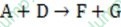
Step 1

(Slow)
Step 2
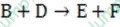
(fast)
Step 3

(fast)
Reaction 1 In this case, the first step in the reaction pathway is the rate-determining step. Therefore, the overall rate of the reaction must equal the rate of the first step, k1 [A] where k1 is the rate constant for the first step. (Rate constants of the different steps are denoted by kx , where x is the step number.)
In some cases, it is desirable to measure the rate of a reaction in relation to only one species. In a second-order reaction, for instance, a large excess of one species is included in the reaction vessel. Since a relatively small amount of this large concentration is reacted, we assume that the concentration essentially remains unchanged. Such a reaction is called a pseudo first-order reaction. A new rate constant, k', is established, equal to the product of the rate constant of the original reaction, k, and the concentration of the species in excess. This approach is often used to analyze enzyme activity.
In some cases, the reaction rate may be dependent on the concentration of a short-lived intermediate. This can happen if the rate-determining step is not the first step. In this case, the concentration of the intermediate must be derived from the equilibrium constant of the preceding step. For redox reactions, the equilibrium can be correlated with the voltage produced by two half-cells by means of the Nernst equation. This equation states that at any given moment:
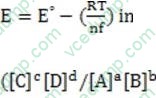
Equation 1 When

Reaction 2
Note: R = 8.314 J/K•mol; F = 9.6485 x 10⁴ C/mol.)
In a test of the rate of Step 3 of Reaction 1, a solution is prepared containing a 0.1 M concentration of E and a 50 M concentration of C. The rate is calculated after the reaction has gone 50% to completion. By what percent will the calculated
rate differ from the true rate if we treat the reaction as pseudo first-order?
A. 0.02%
B. 0.05%
C. 0.1%
D. 0.2% -
Question 749:
...[TV Guide's] immediate concern was the television quiz show scandal, which had reached its climax two weeks earlier when Charles Van Doren, the appealing young man who'd taught viewers the value of learning while winning big on MCA's Twenty-one, stood before a House committee and admitted he was a fraud. But the issue went well beyond rigged quiz shows. The charge was that through their stranglehold on talent, MCA and William Morris monopolized the medium to the detriment of their clients, the industry, and the public at large. This was why the Justice Department had launched a secret investigation of both agencies more than two years before. The Morris Agency had started the quiz show vogue in 1955, when it packaged The $64,000 Question for Revlon and sold it to CBS. While the show won praise for its "educational" nature, the real source of its appeal was in its crapshoot format -- the idea that once contestants' winnings hit the $32,000 mark, they had to decide whether to go double or nothing on the final, $64,000 question, or play it safe and go home. The response was tremendous. Within weeks, the show knocked I Love Lucy out of the number-one slot in the ratings. Casinos in Vegas emptied out when it went on the air. Bookies took odds on whether the first contestant to go for the big one -- a marine captain whose specialty was cooking -- would get the answer right. (He did.) Revlon sold so much Living Lipstick that its factory was unable to meet the demand. The $64,000 Question quickly inspired imitators, among them an MCA package called Twenty-one. Based on the card game, more or less, Twenty-one was a dismal failure at first. "Do whatever you have to do," the sponsor ordered angrily, so the producers put the fix in. In December 1956, when Charles Van Doren, a boyishly attractive English instructor at Columbia University, beat Herb Stempel, a short, squat, nerdy grad at City College, Van Doren became the first intellectual hero of the television age. Honors and acclaim poured in -- the covers of Time, letters by the hundreds, offers of movie roles and tenured professorships and a regular guest spot on The Today Show. But Herb Stempel didn't like being told to lose, especially to some Ivy League snot. He went to the press. The DA's office started to investigate. The walls began to close in. Meanwhile, the show's producers agreed to sell the rights to NBC for $2 million. One of them started to feel queasy about selling the show without letting the network know the score, so he went to Sonny Werblin, MCA's top man in New York, and asked his advice. Werblin, the man behind such hits as The Ed Sullivan Show and The Jackie Gleason Show, ran the television department as if it were a football team coached by Attila the Hun. "Dan," he asked the producer, "have I ever asked you whether the show was rigged?" No, he hadn't. "And has NBC ever asked you whether the show is rigged?" No, they hadn't either. "Well," Werblin concluded, "the reason that none of us has asked is because we don't want to know." And with good reason. Not only was Twenty-one an MCA package and Van Doren himself an MCA client; Werblin had a special relationship with NBC's president, Robert Kintner. Kintner had been president of ABC until...ABC's chairman forced him out in his determination to move the network out of third place. MCA used its influence to place him at NBC, where he proved an extremely pliant customer. In the spring of 1957, when the networks were putting together their schedules for the next season, Werblin went to a meeting of NBC programming executives led by Kintner and his boss, RCA chairman Robert Sarnoff. "Sonny, look at the schedule for next season," Kintner said when he walked in, "here are the empty slots, you fill them."
Based on the passage, which of the following must NOT be true?
A. Sonny Werblin was a difficult and exacting man to work with.
B. Herb Stempel refused to offer information to the media concerning his appearances on Twenty-one.
C. The $64,000 Question was rigged.
D. Sonny Werblin was unfamiliar with Robert Kintner before he was made president of NBC. -
Question 750:
Although we know more about so-called Neanderthal men than about any other early population, their exact relation to present-day human beings remains unclear. Long considered sub-human, Neanderthals are now known to have been fully human. They walked erect, used fire, and made a variety of tools. They lived partly in the open and partly in caves. The Neanderthals are even thought to have been the first humans to bury their dead, a practice which has been interpreted as demonstrating the capacity for religious and abstract thought. The first monograph on Neanderthal anatomy, published by Marcelling Boule in 1913, presented a somewhat misleading picture. Boule took the Neanderthals' lowvaulted cranium and prominent brow ridges, their heavy musculature, and the apparent overdevelopment of certain joints as evidence of a prehuman physical appearance. In postulating for the Neanderthal such "primitive" characteristics as a stooping, bent-kneed posture, a rolling gait, and a forward-hanging head, Boule was a victim of the rudimentary state of anatomical science. Modern anthropologists recognize the Neanderthal bone structure as that of a creature whose bodily orientation and capacities were very similar to those of present-day human beings. The differences in the size and shape of the limbs, shoulder blades, and other body parts are simply adaptations which were necessary to handle the Neanderthal's far more massive musculature. Current taxonomy considers the Neanderthals to have been fully human and thus designates them not as a separate species, Homo neanderthalensis, but as a subspecies of Homo sapiens: Homo sapiens neanderthalensis. The rise of the Neanderthals occurred over some 100,000 years -- a sufficient period to account for evolution of the specifically Neanderthal characteristics through free interbreeding over a broad geographical range. Fossil evidence suggests that the Neanderthals inhabited a vast area from Europe through the Middle East and into Central Asia from approximately 100,000 years ago until 35,000 years ago. Then, within a brief period of five to ten thousand years, they disappeared. Modern human, not found in Europe prior to about 33,000 years ago, thenceforth became the sole inhabitants of the region. Anthropologists do not believe that the Neanderthals evolved into modern human beings. Despite the similarities between Neanderthal and modern human anatomy, the differences are great enough that, among a population as broad-ranging as the Neanderthals, such an evolution could not have taken place in a period of only ten thousand years. Furthermore, no fossils of types intermediate between Neanderthals and moderns have been found. A major alternative hypothesis, advanced by E. Trinkaus and W.W. Howells, is that of localized evolution. Within a geographically concentrated population, free interbreeding could have produced far more pronounced genetic effects within a shorter time. Thus modern human could have evolved relatively quickly, either from Neanderthals or from some other ancestral type, in isolation from the main Neanderthal population. These humans may have migrated throughout the Neanderthal areas, where they displaced or absorbed the original inhabitants. One hypothesis suggests that these "modern" humans immigrated to Europe from the Middle East. No satisfactory explanation of why modern human beings replaced the Neanderthals has yet been found. Some have speculated that the modern humans wiped out the Neanderthals in warfare; however, there exists no archeological evidence of a hostile encounter. It has also been suggested that the Neanderthals failed to adapt to the onset of the last Ice Age; yet their thick bodies should have been heat-conserving and thus well-adapted to extreme cold. Finally, it is possible that the improved tools and hunting implements of the late Neanderthal period made the powerful Neanderthal physique less of an advantage than it had been previously. At the same time, the Neanderthals' need for a heavy diet to sustain this physique put them at a disadvantage compared to the less massive moderns. If this was the case, then it was improvements in human culture -- including some introduced by the Neanderthals themselves -- that made the Neanderthal obsolete.
According to the passage, the latest that any Neanderthal might have existed was:
A. 100,000 years ago.
B. 35,000 years ago.
C. 33,000 years ago.
D. 25,000 years ago.
Related Exams:
Tips on How to Prepare for the Exams
Nowadays, the certification exams become more and more important and required by more and more enterprises when applying for a job. But how to prepare for the exam effectively? How to prepare for the exam in a short time with less efforts? How to get a ideal result and how to find the most reliable resources? Here on Vcedump.com, you will find all the answers. Vcedump.com provide not only Medical Tests exam questions, answers and explanations but also complete assistance on your exam preparation and certification application. If you are confused on your MCAT-TEST exam preparations and Medical Tests certification application, do not hesitate to visit our Vcedump.com to find your solutions here.