MCAT-TEST Exam Details
-
Exam Code
:MCAT-TEST -
Exam Name
:Medical College Admission Test: Verbal Reasoning, Biological Sciences, Physical Sciences, Writing Sample -
Certification
:Medical Tests Certifications -
Vendor
:Medical Tests -
Total Questions
:812 Q&As -
Last Updated
:Jul 16, 2026
Medical Tests MCAT-TEST Online Questions & Answers
-
Question 661:
Every atomic orbital contains plus and minus regions, defined by the value of the quantum mechanical function for electron density. When orbitals from different atoms overlap to form bonds, an equal number of new molecular orbitals results. These are of two types: or bonding orbitals, formed by overlap between orbital regions with the same sign, and antibonding * or * orbitals, formed by overlap between regions with opposite signs. Bonding orbitals have lower energy than their component atomic orbitals, and antibonding orbitals have higher energy. The electron pairs reside in the lower-energy bonding orbitals; the higher-energy, less stable orbitals remain empty when the molecule is in its ground state. A benzene ring has six unhybridized pz orbitals (one from each carbon atom), which together from six molecular orbitals, each one delocalized over the entire ring. Of the possible orbital structures for benzene, the one with the lowest energy has the plus region of all six p orbital functions on one side of the ring. The six electrons occupying the orbitals fill the three most stable molecular orbitals, leaving the other three empty. Molecular orbitals are filled from the lowest to the highest energy level. The number of bonds between atoms is determined by the number of filled bonding orbitals minus the number of filled antibonding orbitals; each antibonding orbital cancels out a filled bonding orbital. For a diatomic molecule, orbitals in the n = 2 energy level are filled as follows:
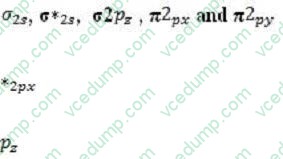
(equal in energy), and * (equal in energy), *2 . (The designation of the three p orbitals as , , and are interchangeable.) Absorption of a photon can raise an electron to a higher-energy molecular orbital. The excited electron does not immediately change its spin, which is opposite to that of the electron with which it was previously paired. This singlet state is relatively unstable: the molecule may interact with another molecule, or fluoresce and return to its ground state. Alternatively, there may be a change in spin direction somewhere in the system; the molecule then enters the so-called triplet state, which generally has lower energy. The molecule now cannot return quickly to its ground state, since the excited electron no longer has a partner of opposite spin with which to pair. It also cannot return to the singlet state, because the singlet has greater energy. Consequently, the triplet state, which has two unpaired electrons in separate orbitals, is long-lived by atomic standards, with a lifetime that may be ten seconds or more. During this period, the molecule is highly reactive.
Molecular orbitals in hydrocarbons are formed between the 1s atomic orbital of hydrogen and the sp, sp2, or sp3 hybrid atomic orbitals of carbon. Which choice correctly lists the energy level of the C-H bonds, from lowest to highest?
A. Option A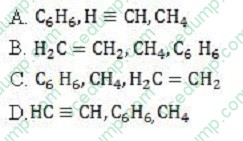
B. Option B
C. Option C
D. Option D -
Question 662:
Millenialism is, generally speaking, the religious belief that salvation and material benefits will be conferred upon a society in the near future as the result of some apocalyptic event. The term derives from the Latin word for 1,000; in early Christian theology, believers held that Christ would return and establish his kingdom on earth for a period of a thousand years.
Millenialist movements, Christian and non-Christian, have arisen at various points throughout history, usually in times of great crisis or social upheaval. In "nativistic" millenialist movements, a people threatened with cultural disintegration attempts to earn its salvation by rejecting foreign customs and values and returning to the "old ways." One such movement involving the Ghost Dance cults, named after the ceremonial dance which cult members performed in hope of salvation, flourished in the late 19th century among Indians of the western United States.
By the middle of the 19th century, western expansion and settlement by whites was seriously threatening Native American cultures. Mining, agriculture and ranching encroached on and destroyed many Indian land and food sources. Indian resistance led to a series of wars and massacres, culminating in the U.S. Government's policy of resettlement of Indians onto reservations which constituted a fraction of their former territorial base. Under these dire circumstances, a series of millenialist movements began among western tribes.
The first Ghost Dance cult arose in western Nevada around 1870. A Native American prophet named Wodziwob, a member of a Northern Paiute tribe, received the revelation of an imminent apocalypse which would destroy the white man, restore all dead Indians to life, and return to the Indians their lands, food supplies (such as the vanishing buffalo), and old way of life. The apocalypse was to be brought about with the help of a ceremonial dance and songs, and by strict adherence to a moral code which, oddly enough, strongly resembled Christian teaching. In the early 1870s, Wodziwob's Ghost Dance cult spread to several tribes in California and Oregon, but soon died out or was absorbed into other cults.
A second Ghost Dance cult, founded in January 1889, evolved as the result of a similar revelation. This time Wovoka -- another Northern Paiute Indian, whose father had been a disciple of Wodziwob -- received a vision during a solar eclipse in which he died, spoke to God, and was assigned the task of teaching the dance and the millennial message. With white civilization having pushed western tribes ever closer to the brink of cultural disintegration during the previous twenty years, the Ghost Dance movement spread rapidly this time, catching on among tribes from the Canadian border to Texas, and from the Missouri River to the Sierra Nevadas -- an area approximately one-third the size of the continental United States.
Wovoka's Ghost Dance doctrine forbade Indian violence against whites or other Indians; it also involved the wearing of "ghost shirts," which supposedly rendered the wearers invulnerable to the white man's bullets. In 1890, when the Ghost Dance spread to the Sioux Indians, both the ghost shirts and the movement itself were put to the test. Violent resistance to white domination had all but ended among the Sioux by the late 1880s, when government- ordered reductions in the size of their reservations infuriated the Sioux, and made them particularly responsive to the millenialist message of the Ghost Dance. As the Sioux organized themselves in the cult of the dance, an alarmed federal government resorted to armed intervention which ultimately led to the massacre of some 200 Sioux men, women and children at Wounded Knee, South Dakota in December of 1890. The ghost shirts had been worn to no avail, and Wounded Knee marked the end of the second Ghost Dance cult.
Which of the following tribes would probably NOT have taken part in the Ghost Dance cults?
A. The Potawatomi of Illinois
B. The Eastern Shoshoni of Wyoming
C. The Pawnee of Nebraska
D. The Southern Arapaho of Oklahoma -
Question 663:
The mechanism for the acid-catalyzed esterification of a carboxylic acid, carried out with R'OH, is shown below. The tagged alcohol R'18OH is used to study the reaction mechanism. The resulting ester is separated from the reaction mixture; the water from the reaction mixture is then distilled off completely and collected as a separate fraction.

The rate of the reaction is negligible without the acid catalyst. The catalyst:
A. attacks the carbonyl oxygen, permitting the nucleophilic group to attack the carbonyl carbon.
B. attacks the carbonyl carbon, permitting the nucleophilic group to attack the carbonyl oxygen.
C. attacks the carbonyl oxygen, permitting the electrophilic group to attack the carbonyl carbon.
D. attacks the carbonyl carbon, permitting the electrophilic group to attack the carbonyl oxygen -
Question 664:
When softball players take batting practice, they often use a machine called an "automatic pitcher," which is essentially a cannon that uses air pressure to launch a projectile. In a prototype automatic pitcher, a softball is loaded into the barrel of the cannon and rests against a flat disk. That disk is locked into place, and a high air pressure is built up behind it. When the disk is released, the softball is pushed along the barrel of the cannon and ejected at a speed of V0. Figure 1 shows the batter and automatic pitcher. The angle of the barrel to the horizontal is . The unit vectors I and j point in the horizontal and vertical directions respectively.
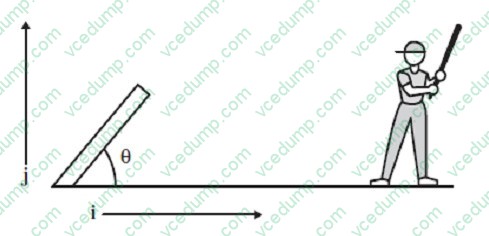
Figure 1
The height above the ground y of the softball as a function of time t is shown in Figure 2, where t = 0 at Point A, t = tB at Point B, and t = tC at Point C. The softball is ejected from the barrel of the cannon at Point A; it reaches its maximum height at Point B; and the batter hits the softball at Point C. (Note: Assume that the effects of air resistance are negligible unless otherwise stated.)
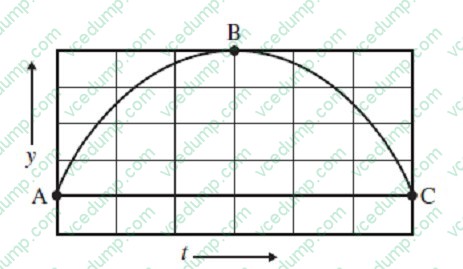
Figure 2
What is the ratio of the horizontal distance traveled by the softball at Point B to the horizontal distance traveled at Point C?
A. 5:1
B. 4:1
C. 3:3
D. 1:2 -
Question 665:
Every atomic orbital contains plus and minus regions, defined by the value of the quantum mechanical function for electron density. When orbitals from different atoms overlap to form bonds, an equal number of new molecular orbitals results. These are of two types: or bonding orbitals, formed by overlap between orbital regions with the same sign, and antibonding * or * orbitals, formed by overlap between regions with opposite signs. Bonding orbitals have lower energy than their component atomic orbitals, and antibonding orbitals have higher energy. The electron pairs reside in the lower-energy bonding orbitals; the higher-energy, less stable orbitals remain empty when the molecule is in its ground state. A benzene ring has six unhybridized pz orbitals (one from each carbon atom), which together from six molecular orbitals, each one delocalized over the entire ring. Of the possible orbital structures for benzene, the one with the lowest energy has the plus region of all six p orbital functions on one side of the ring. The six electrons occupying the orbitals fill the three most stable molecular orbitals, leaving the other three empty. Molecular orbitals are filled from the lowest to the highest energy level. The number of bonds between atoms is determined by the number of filled bonding orbitals minus the number of filled antibonding orbitals; each antibonding orbital cancels out a filled bonding orbital. For a diatomic molecule, orbitals in the n = 2 energy level are filled as follows:
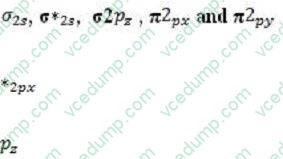
(equal in energy), and * (equal in energy), *2 . (The designation of the three p orbitals as , , and are interchangeable.) Absorption of a photon can raise an electron to a higher-energy molecular orbital. The excited electron does not immediately change its spin, which is opposite to that of the electron with which it was previously paired. This singlet state is relatively unstable: the molecule may interact with another molecule, or fluoresce and return to its ground state. Alternatively, there may be a change in spin direction somewhere in the system; the molecule then enters the so-called triplet state, which generally has lower energy. The molecule now cannot return quickly to its ground state, since the excited electron no longer has a partner of opposite spin with which to pair. It also cannot return to the singlet state, because the singlet has greater energy. Consequently, the triplet state, which has two unpaired electrons in separate orbitals, is long-lived by atomic standards, with a lifetime that may be ten seconds or more. During this period, the molecule is highly reactive.
The quantum number that distinguishes the px orbital from the py orbital is called the:
A. azimuthal quantum number.
B. magnetic quantum number.
C. principal quantum number.
D. spin quantum number. -
Question 666:
A researcher investigated the equilibrium between CO2, C, and CO as a function of temperature. The equation is given below:

CO2(g) + C(s) 2 CO(g) Carbon dioxide, at 298 K and 1 atm, and an excess of powdered carbon were introduced into a furnace, which was then sealed so that pressure would increase as the temperature rose. The furnace was heated to, and held constant at, a predetermined temperature. The pressure within the furnace chamber was recorded after it had remained unchanged for one hour. The table below shows the pressures recorded for a series of temperatures together with the pressures expected if no reaction had taken place. Table 1 When the system stabilized at 1,200 K, a sample of helium was injected into the furnace. What should happen to the amount of carbon dioxide in the system?
A. It should increase.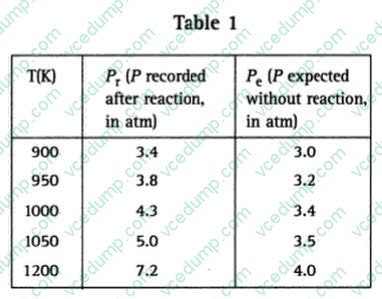
B. It should decrease.
C. It should be completely converted to carbon monoxide.
D. It should remain the same. -
Question 667:
Ink jet printers produce high resolution output, at a lower cost than laser printers, by generating charged ink droplets which are then deflected onto a sheet of paper by an electric field. Each droplet deflected by the field strikes the paper and forms a tiny dot of ink. While a typical printed letter requires about 100 drops, an ink jet printer is able to produce drops at a rate of 100,000 per second.

The essential elements of the ink jet printer head are shown in Figure 1. The drop generator produces the ink droplets, each with a mass of approximately 1.2 kg and a diameter of approximately 30 m. The drops then enter a

highly precise charging unit which controls the charge q on each droplet to within 2%, with typical charges for drops generated by various ink jet printers ranging from ?.0 C to ?.0 C. The charged droplets are

subsequently passed through the deflecting plates between which a variable electric field is generated. The electronically controlled electric field between the plates is typically varied over a range from 1.0 N/C to 5.4 N/C,
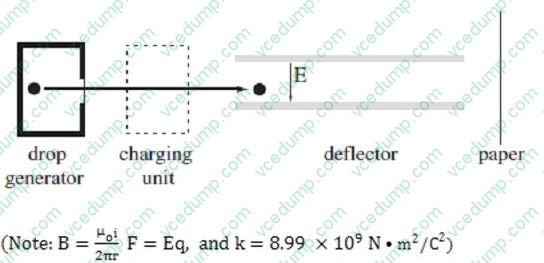
and is used to aim the ink droplet at the paper. .
Suppose that an ink-jet printer head is programmed to produce the letter shown below (note that cross hairs are not produced by the ink jet printer head).
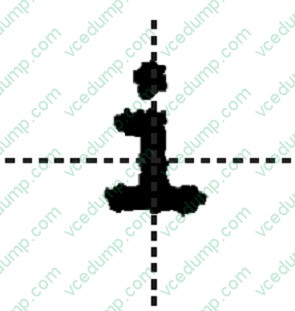
An uniform external electric field pointing upwards is superimposed on the printer head, and the letter is printed again. Which of the following diagrams best represents the new printer output?
A. Option A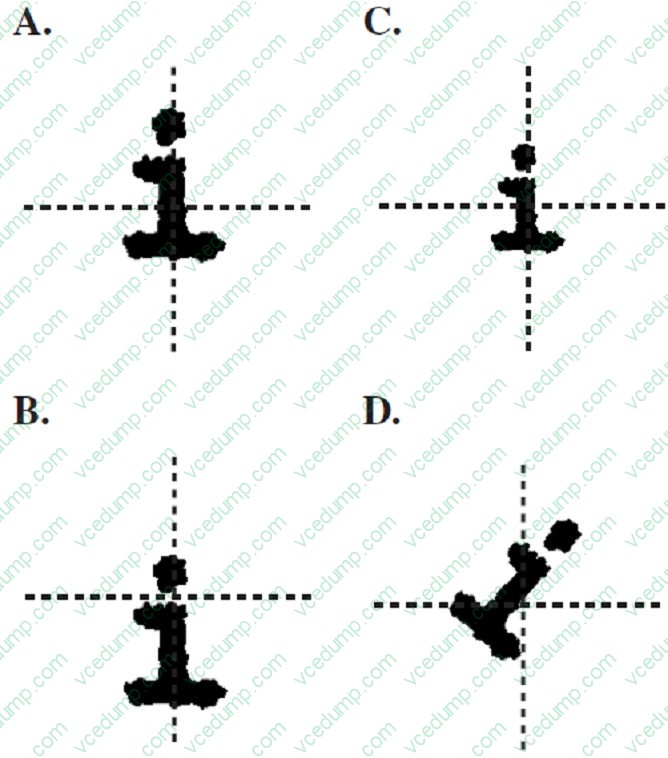
B. Option B
C. Option C
D. Option D -
Question 668:
It is critical for the human body blood to maintain its pH at approximately 7.4. Decreased or increased blood pH are called acidosis and alkalosis respectively; both are serious metabolic problems that can cause death. The table below lists the major buffers found in the blood and/or kidneys. Table 1 Buffer pKa of a typical conjugate acid:*
+ Histidine side chains

Organic phosphates N-terminal amino groups

6.1
6.3
6.8
7.0
8.0
9.2

*For buffers in many of these categories, there is a range of actual values.
The relationship between blood pH and the of any buffer can be described by the Henderson-Hasselbalch equation:
pH = + log([conjugate base]/[conjugate acid]) Equation 1

Bicarbonate, the most important buffer in the plasma, enters the blood in the form of carbon dioxide, a byproduct of metabolism, and leaves in two forms: exhaled and excreted bicarbonate. Blood pH can be adjusted rapidly by changes
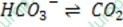
in the rate of exhalation. The reaction given below, which is catalyzed by carbonic anhydrase in the erythrocytes, describes how bicarbonate and interact in the blood.
+ + Reaction 1

The following graph shows the titration of 0.01 M with 10 M NaOH. Within which region of the titration curve will the concentration of become equal to that of ?
A. II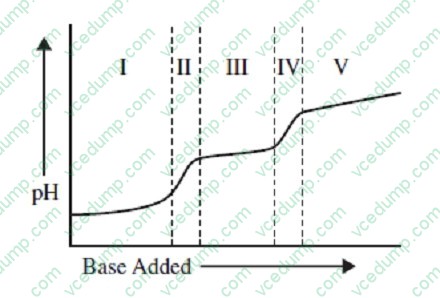
B. III
C. IV
D. V -
Question 669:
Flytraps in two pitcher plants ?Sundew and Venus ?are similar in that they both:
A. are saprophyte.
B. trap insects.
C. are symbiotic.
D. lack chlorophyll. -
Question 670:
Glycogen storage disease type V, also known as GSD-V or McArdle disease, is an autosomal recessive disease that results in the deficiency of myophosphorylase, an isoform of glycogen phosphorylase found in muscle cells. Patients with GSD-V experience severe muscle cramps after strenuous exercise and exercise intolerance.
Physicians may order two histology stains of the patient's muscle tissue in order to aid in the diagnosis (see Figure 1):
(A)
A Periodic acid-Schiff (PAS) stain uses periodic acid to detect carbohydrates in tissues. The reaction of the acid with sugar cleaves vicinal diols creating ketone and/or aldehyde fragments, the latter of which then reacts with the Schiff reagent to give a purple color;
(B)
A phosphorylase stain identifies the presence of the enzyme using a dark blue color indicator.
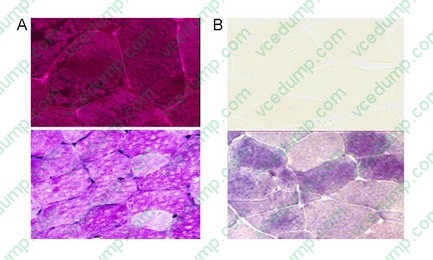
Figure 1A. Comparative histochemistry of GSD-V and healthy individual.
PAS stain of muscle tissue shows an accumulation of glycogen in the GSD-V individual (top) compared to the control (bottom). B) Phosphorylase stain of muscle tissue reveals an absence of phosphorylase in the GSD-V individual (top).
Despite initial pain during exercise, many patients with GSD-V have been able to increase their exercise tolerance by engaging in moderate periods of aerobic exercise. Muscle pain and fatigue subsides after a few minutes, a response that
researchers call the "second wind" phenomenon.
Patients who experienced "second wind" typically experienced lowered heart rate and a reported decrease in exercise effort after 7-10 minutes. A similar effect was seen in the same patients after an intravenous infusion of glucose.
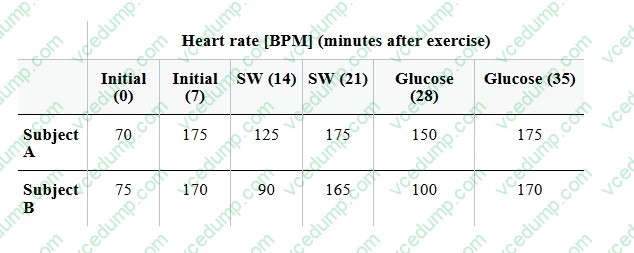
Figure 2. Measured heart rates in two GSD-V patients during sustained exercise.
Two subjects were asked to ride stationary bicycles at a steady rate over the course of 40 minutes. The subjects' heart rates were measured continuously, with high and low values coinciding with 7-minute intervals. Glucose was injected
intravenously after 21 minutes. SW = Second Wind.
Adapted from Bhavaraju-Sanka R, Howard J. Jr, Chahin N (2014). SOJ Neurol 1(1), 1-3. and Haller RG, Vissing J. Arch Neurol. 2002;59(9):1395-1402.
For a patient affected by GSD-V, which one of these scenarios describes the concentrations of metabolism products in muscle cells after exercise?
A. Increased concentrations of ADP, but decreased concentrations of Pi.
B. Increased concentrations of ATP, but decreased concentrations of Pi.
C. Decreased concentrations of ATP, and increased concentrations of Pi.
D. Decreased concentrations of ADP, and increased concentrations of Pi.
Related Exams:
Tips on How to Prepare for the Exams
Nowadays, the certification exams become more and more important and required by more and more enterprises when applying for a job. But how to prepare for the exam effectively? How to prepare for the exam in a short time with less efforts? How to get a ideal result and how to find the most reliable resources? Here on Vcedump.com, you will find all the answers. Vcedump.com provide not only Medical Tests exam questions, answers and explanations but also complete assistance on your exam preparation and certification application. If you are confused on your MCAT-TEST exam preparations and Medical Tests certification application, do not hesitate to visit our Vcedump.com to find your solutions here.