MCAT-TEST Exam Details
-
Exam Code
:MCAT-TEST -
Exam Name
:Medical College Admission Test: Verbal Reasoning, Biological Sciences, Physical Sciences, Writing Sample -
Certification
:Medical Tests Certifications -
Vendor
:Medical Tests -
Total Questions
:812 Q&As -
Last Updated
:Jul 16, 2026
Medical Tests MCAT-TEST Online Questions & Answers
-
Question 651:
When Gwendolyn Brooks published her first collection of poetry A Street In Bronzeville in 1945 most reviewers recognized Brooks' versatility and craft as a poet. Yet, while noting her stylistic successes few of her contemporaries discussed the critical question of Brooks' relationship to the Harlem Renaissance. How had she addressed herself, as a poet, to the literary movement's assertion of the folk and African culture, and its promotion of the arts as the agent to define racial integrity? The New Negro poets of the Harlem Renaissance expressed a deep pride in being Black; they found reasons for this pride in ethnic identity and heritage; and they shared a common faith in the fine arts as a means of defining and reinforcing racial pride. But in the literal expression of this impulse, the poets were either romantics, or realists and, quite often within the same poem, both. The realistic impulse, as defined best in the poems of McKay's Harlem Shadows (1922), was a sober reflection upon Blacks as second class citizens, segregated from the mainstream of American socio-economic life, and largely unable to realize the wealth and opportunity that America promised. The romantic impulse, on the other hand, as defined in the poems of Sterling Brown's Southern Road (1932), often found these unrealized dreams in the collective strength and will of the folk masses. In comparing the poems in A Street in Bronzeville with various poems from the Renaissance, it becomes apparent that Brooks brings many unique contributions to bear on this tradition. The first clue that A Street In Bronzeville was, at its time of publication, unlike any other book of poems by a Black American is its insistent emphasis on demystifying romantic love between Black men and women. During the Renaissance, ethnic or racial pride was often focused with romantic idealization upon the Black woman. A casual streetwalker in Hughes' poem, "When Sue Wears Red," for example, is magically transformed into an Egyptian Queen. In A Street In Bronzeville, this romantic impulse runs headlong into the biting ironies of racial discrimination. There are poems in which Hughes, McKay and Brown recognize the realistic underside of urban life for Black women. But for Brooks, unlike the Renaissance poets, the victimization of poor Black women becomes not simply a minor chord but a predominant theme. ...Brooks' relationship with the Harlem Renaissance poets, as A Street in Bronzeville ably demonstrates, was hardly imitative. As one of the important links with the Black poetic tradition of the 1920s and 1930s, she enlarged the element of realism that was an important part of the Renaissance world-view. Although her poetry is often conditioned by the optimism that was also a legacy of the period, Brooks rejects outright their romantic prescriptions for the lives of Black women. And in this regard, she serves as a vital link with the Black Arts Movement of the 1960s that, while it witnessed the flowering of Black women as poets and social activists as well as the rise of Black feminist aesthetics in the 1970s, brought about a curious revival of romanticism in the Renaissance mode.
The author most probably mentions Hughes' poem "When Sue Wears Red" (line 35?6) in order to:
A. prove that Brooks had not simply imitated the Harlem Renaissance poets.
B. highlight the critical role of the imagination in the creative process.
C. contrast the irony of Brooks' poetry with the naivet?of earlier poetry.
D. provide an example of the romanticized portrayal of Black women. -
Question 652:
Nitric oxide, NO, has recently been found to have widespread physiological effects, acting as a major regulator in the nervous, cardiovascular, and immune systems. The production of NO in the body is regulated by specific NOS enzymes which exist in at least three different isoforms -- bNOS, eNOS, and macNOS. Each of these isoforms differ in location and function and serve to mediate different physiological responses to NO. Some physiological roles of NO have been demonstrated as follows:
I. In the central nervous system, NO production is regulated by bNOS. Calcium ion concentrations of 200- 400 nM in the central nervous system activate bNOS to catalyze the formation of NO. NO exerts definite effects on brain function although its specific roles are not well established. bNOS inhibitors have been found to block the release of neurotransmitter from presynaptic neurons. Excess levels of NO are also thought to contribute to neurodegenerative disorders such as Alzheimer's disease.
II. In the blood vessels, NO is produced by eNOS which is activated by Ca2+ concentrations of 200-400 nM. NO acts as the major endogenous vasodilator in blood vessels. It diffuses into smooth muscle cells and leads to muscle relaxation by stimulating cGMP formation through activation of guanylyl cyclase. In addition, NO regulates the vascular system by inhibiting platelet aggregation and adhesion.
III. The role of NO in the immune system is regulated by macNOS through a pathway that is not Ca2+ dependent. Rather, exposure to cytokines, including interleukin-1 and interferon- , leads to synthesis of large amounts of NO by activation of macNOS in response to inflammatory stimuli. The NO produced plays a definitive role in the mediation of the activities of macrophages and neutrophils. NO also acts to inhibit the mechanism of viral replication.
According to the passage, NO may counter viral infection by all of the following mechanisms EXCEPT:
A. inducing white blood cells to engulf and destroy foreign agents.
B. inhibiting the synthesis of viral RNA.
C. denaturing viral protein coats in the interstitial fluid.
D. blocking viral release from infected cells.
I. In the central nervous system, NO production is regulated by bNOS. Calcium ion concentrations of 200- 400 nM in the central nervous system activate bNOS to catalyze the formation of NO. NO exerts definite effects on brain function although its specific roles are not well established. bNOS inhibitors have been found to block the release of neurotransmitter from presynaptic neurons. Excess levels of NO are also thought to contribute to neurodegenerative disorders such as Alzheimer's disease. II. In the blood vessels, NO is produced by eNOS which is activated by Ca2+ concentrations of 200-400 nM. NO acts as the major endogenous vasodilator in blood vessels. It diffuses into smooth muscle cells and leads to muscle relaxation by stimulating cGMP formation through activation of guanylyl cyclase. In addition, NO regulates the vascular system by inhibiting platelet aggregation and adhesion. III. The role of NO in the immune system is regulated by macNOS through a pathway that is not Ca2+ dependent. Rather, exposure to cytokines, including interleukin-1 and interferon- , leads to synthesis of large amounts of NO by activation of macNOS in response to inflammatory stimuli. The NO produced plays a definitive role in the mediation of the activities of macrophages and neutrophils. NO also acts to inhibit the mechanism of viral replication. According to the passage, NO may counter viral infection by all of the following mechanisms EXCEPT: -
Question 653:
If an object of mass 4 kg is suspended at a height of 5 m on Earth and acceleration due to gravity is 9.8 m/s2, what is its potential energy?
A. 150 J
B. 142 J
C. 196 J
D. 216 J -
Question 654:
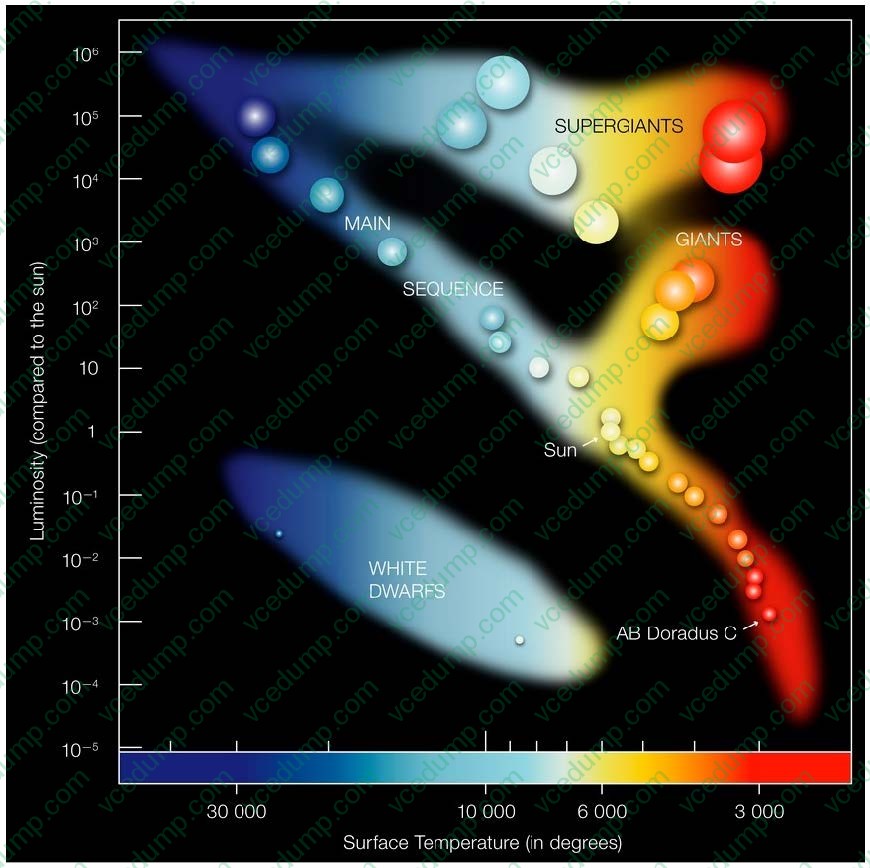
A Hertzsprung - Russel diagram illustrates the different stages in a star's life cycle. Stars evolve along the main sequence, increasing in surface temperature. After the main sequence stage, a star cools and expands. Using the diagram, which stage would you expect to come directly after the main sequence?
A. giant
B. supernova
C. white dwarf
D. none of these -
Question 655:
Gauguin's attitude toward art marked a break from the past and a beginning to modern art. Like all Post- Impressionist artists, he passed through an Impressionist phase but became quickly dissatisfied with the limitations of the style, and went on to discover a new style that had the directness and universality of a symbol and that concentrated on impressions, ideas and experiences. The beginning of his modern tradition lay in his rejection of Impressionism. He considered naturalism an error to be avoided. He was preoccupied with suggestion rather than description, seeking to portray not the exterior, but the essence of things in their purest, simplest, and most primitive form, which could only be achieved through simplification of the form. He firmly believed throughout his life that "art is an abstraction" and that "this abstraction [must be derived] from nature while dreaming before it." One must think of the creation that will result rather than the model, and not try to render the model exactly as one sees it. This was the birth of "Synthetism" or rather Synthetist-Symbolic, as Gauguin referred to it, using the term "symbolic" to indicate that the forms and patterns in his pictures were meant to suggest mental images or ideas and not simply to record visual experience.
Symbolism flourished around the period of 1885 to 1910 and can be defined as the rejection of direct, literal representation in favor of evocation and suggestion. Painters tried to give a visual expression to emotional experiences, and therefore the movement was a reaction against the naturalistic aims of Impressionism. Satisfying the need for a more spiritual or emotional approach in art, Symbolism is characterized by the desire to seek refuge in a dreamworld of beauty and the belief that color and line in themselves could express ideas. Stylistically, the tendency was towards flattened forms and broad areas of color, and features of the movement were an intense religious feeling and an interest in subjects of death, disease, and sin.
Similarly, "Synthetism" involved the simplification of forms into large-scale patterns and the expressive purification of colors. Form and color had to be simplified for the sake of expression. This style reacted against the "formlessness" of Impressionism and favored painting subjectively and expressing one's ideas rather than relying on external objects as subject matters. It was characterized by areas of pure colors, very defined contours, an emphasis on pattern and decorative qualities, and a relative absence of shadows.
Gauguin's new art form merged these two movements and succeeded in freeing color, form, and line, bringing it to express the artists' emotions, sensibilities, and personal experiences of the world around them. His style created a break with the old tradition of descriptive naturalism and favored the synthesis of observation and imagination. Gauguin sustained that forms are not discovered in nature but in one's wild imagination, and it was in himself that he searched rather than in his surroundings. For this reason, he scorned the Impressionists for their lack of imagination and their mere scientific reasoning. Furthermore, Gauguin used color unnaturalistically for its decorative or emotional effect and reintroduced emphatic outlines. "Synthetism" signified for him that the forms of his pictures were constructed from symbolic patterns of color and linear rhythms and were not mere scientific reproductions of what is seen by the eye.
Dempsey, A., and Dempsey, A. (2010). Styles, Schools and Movements: The Essential Encyclopaedic Guide to Modern Art. London: Thames and Hudson.
Which of these quotes from fellow painters would Gauguin be LEAST likely to agree with, based on passage information?
A. "Treat nature in terms of the cylinder, the sphere, and the cone." (Paul Cezanne)
B. "There is only one true thing: instantly paint what you see. When you've got it, you've got it. When you haven't, you begin again." (ouard Manet)
C. "Paintings have a life of their own that derives from the painter's soul." (Vincent van Gogh)
D. "Painting is a blind man's profession. He paints not what he sees, but what he feels, what he tells himself about what he has seen." (Pablo Picasso) -
Question 656:
Aerobic respiration is the major process used by oxygen- requiring organisms to generate energy. During respiration, glucose is metabolized to generate chemical energy in the form of ATP:

The biochemical machinery necessary for cellular respiration is found in the mitochondria, small organelles scattered throughout the cytoplasm of most eukaryotic cells. The number of mitochondria per cell varies by tissue type and cell function.
Mitochondria are unusual in that they have their own genetic systems that are entirely separate from the cell's genetic material. However, mitochondrial replication is still dependent upon the cell's nuclear DNA to encode essential proteins required for replication. Despite this fact, mitochondria seem to replicate randomly, out of phase with both the cell cycle and other mitochondria.
The nature of the mitochondrial genome and proteinsynthesizing machinery has led many researchers to postulate that mitochondria may have arisen as the result of the ingestion of a bacterium by a primitive cell millions of years ago. It is postulated that the two may have entered into a symbiotic relationship and eventually became dependent on each another; the cell sustained the bacterium, while the bacterium provided energy for the cell. Gradually, the two evolved into the present-day eukaryotic cell, with the mitochondrion retaining some of its own DNA. This is known as the endosymbiotic hypothesis. Because mitochondrial DNA is inherited in a non-Mendelian fashion (mitochondria are inherited from the maternal parent, who supplies most of the cytoplasm to the fertilized egg), it has been used to look at evolutionary relationships among different organisms.
Four different human cell cultures -- erythrocytes, epidermal cells, skeletal muscle cells, and intestinal cells -- were grown in a medium containing radioactive adenine. After 10 days, the mitochondria were isolated via centrifugation, and their level of radioactivity was measured using a liquid scintillation counter. Which of the following cells would be expected to have the greatest number of counts per minute of radioactive decay?
A. Erythrocytes
B. Epidermal cells
C. Skeletal muscle cells
D. Intestinal cells -
Question 657:
A segment of DNA from a lab mouse is determined to be 5’ – GGATCCTCATG – 3’.
Which of the following DNA segments would be the result of this original DNA sequence experiencing both a point mutation and a deletion?
A. 5’ – GCATCCTCATG – 3’
B. 5’ – TGATCCCAG – 3’
C. 5’ – GGTCCTCATC – 3’
D. 5’ – GGATCCATG – 3’ -
Question 658:
Due to ever-increasing paranoia about the transmission of hepatitis and AIDS via blood transfusions and the frequent difficulty of procuring matching blood donors for patients, researchers have been working at a feverish pace to produce disease-free and easy-to-use blood substitutes. The difficulty most synthetic blood researches have had is in formulating a substance that combines qualities of sterility, high capacity for carrying oxygen to body tissues, and versatility within the human body. Three major substitute technologies have been developed to date; each has certain advantages and shortcomings.
"Red blood," the first of the blood substitute technologies, is derived from hemoglobin which has been recycled from old, dead, or worn-out red blood cells and modified so that it can carry oxygen outside the red blood cell. Hemoglobin, a complex protein, is the blood's natural oxygen carrier and is attractive to scientists for use in synthetic blood because of its oxygen-carrying capacity. However, hemoglobin can sometimes constitute a two-fold threat to humans when it is extracted from the red blood cell and introduced to the body in its naked form. First, hemoglobin molecules are rarely sterile and often remain contaminated by viruses to which they were exposed in the cell. Second, naked hemoglobin is extremely dangerous to the kidneys, causing blood flow at these organs to shut down and leading, ultimately, to renal failure. Additional problems arise from the fact that hemoglobin is adapted to operate optimally within the intricate environment of the red blood cell. Stripped of the protection of the cell, the hemoglobin molecule tends to suffer breakdown within several hours. Although modification has produced more durable hemoglobin molecules which do not cause renal failure, undesired side effects continue to plague patients and hinder the development of hemoglobin-based blood substitutes.
Another synthetic blood alternative, "white blood," is dependent on laboratory synthesized chemicals called perfluorocarbons (PFCs). Unlike blood, PFCs are clear oil like liquids, yet they are capable of absorbing quantities of oxygen up to 50% of their volume, enough of an oxygen carrying potential for oxygen-dependent organisms to survive submerged in the liquid for hours by "breathing" it. Although PFCs imitate real blood by effectively absorbing oxygen, scientists are primarily interested in them as constituents of blood substitutes because they are inherently safer to use than hemoglobin-based substitutes. PFCs do not interact with any chemicals in the body and can be manufactured in near-perfect sterility. The primary pitfall of PFCs is in their tendency to form globules in plasma that can block circulation. Dissolving PFCs in solution can mitigate globulation; however, this procedure also seriously curtails the PFCs' oxygen capacity.
The final and perhaps most ambitious attempt to form a blood substitute involves the synthesis of a modified version of human hemoglobin by genetically-altered bacteria. Fortunately, this synthetic hemoglobin seems to closely mimic the qualities of sterility, and durability outside the cellular environment, and the oxygen-carrying efficiency of blood. Furthermore, researchers have found that if modified hemoglobin genes are added to bacterial DNA, the bacteria will produce the desired product in copious quantities. This procedure is extremely challenging, however, because it requires the isolation of the human gene for the production of hemoglobin, and the modification of the gene to express a molecule that works without support from a living cell.
While all the above technologies have serious drawbacks and difficulties, work to perfect an ideal blood substitute continues. Scientists hope that in the near future safe synthetic blood transfusions may ease blood shortages and resolve the unavailability of various blood types.
According to the passage, all of the following are reasons for research into the development of synthetic bloods EXCEPT:
A. dangerous diseases can be transmitted by conventional blood transfusions.
B. synthetic bloods have greater oxygen-carrying capacities than naturally-produced human blood.
C. donor blood is sometimes in short supply.
D. certain blood types are not readily available. -
Question 659:
At a recent meeting of the American Public Transit Association, the Environmental Protection Agency unveiled stringent new standards for pollution control. The transit authorities were particularly concerned about the implementation of a proposed "Clean Air Act." They believed the provisions of the Clean Air Act could severely affect basic services to their local communities. Many transit agencies were concerned that it would be difficult to comply with the pollution and emissions control standards while continuing to operate within realistic budgets. The aim of the Clean Air Act is to assure that by the year 2000, there will be a reduction of at least 10 million tons of sulfur dioxide from 1980 levels. The bill also calls for a reduction in pollutants that contribute to the depletion of ozone. Strict regulations of toxic air emissions would have to be established and enforced. Additionally, the Clean Air Act would establish specific acid-rain reduction quotas and enforce severe penalties for transgressors of any of the new clean air regulations. There is little doubt that mass-transit suppliers will be considerably affected by this new legislation, just as the chemical and petroleum industries have already been affected by similar legislation. Transit authorities are challenged to strike a difficult balance between complying with the government's new standards and developing an official concern for the environment, while continuing to fulfill the transportation needs of the general population. Among the areas addressed by the Clean Air Act, the topic of mobile resources is of particular interest to mass transit authorities. Provisions contained in the Act under this title are aimed at encouraging the development and practical use of alternative fuel sources, like solar energy and methane fuel. The goal of this section of the Act is to eradicate toxic fuel emissions in order to provide cleaner air and a more favorable environment. The Act even goes so far as to declare that in cities like New York, Los Angeles and Houston -- where air quality is particularly noxious and toxins exceed the limits of federal regulations -- forms of mass transit should run on so-called "clean-burning fuels" by the year 2000. Such fuels include reformulated gasoline, propane, electricity, natural gas, ethanol, methanol, or any similar type of low-emission fuel. In addition, the Act proposes that, by 1994, all new urban buses in cities with populations exceeding one million must operate solely on clean-burning fuels. The topics of alternative fuels and alternative fuel vehicles represent, by far, the most controversial issue in the Clean Air Act. President Bush has called alternative fuels "bold and innovative" means to control pollution, but according to many transportation experts, the Act's proposals on alternative fuel usage are unrealistic. The transit authorities recognize that concern for the environment and health hazards like pollution are global issues. However, most transit officials concur that inventing and developing new ways to fuel mass transit will take at least 50 years to realize. They point out that the Act does not mention the political and social ramifications of usurping the role of the petroleum industries. The Act does not mention if or how the thousands of people employed by the oil industry will get retrained to produce and implement the use of "clean" fuel. No one disputes the fact that people need some form of transportation to get from place to place. Preserving the environment should be a priority, yet we need to remember that even if toxic emissions are completely eliminated sometime in the future, the challenge of moving mass numbers of people where they want to go will still exist and must remain a priority. Transit authorities contend that unless the Clean Air Act also acknowledges this, and develops a way to encourage mass transit over personal transportation, the problems of pollution might not be significantly altered. They suggest that there are many areas in this country that have little or no mass transit and that, if the Clean Air Act's goal is to reduce pollution, perhaps the most practical and realistic means to achieve that goal is to encourage the development and maintenance of mass transit systems.
The main goal of the "Mobile Resources" section of the Clean Air Act is to:
A. reduce toxic vehicle emissions for cleaner air and a better environment.
B. encourage the development and practical use of different forms of mass transportation.
C. convince the general public of the environmental benefits of mass transit over private transportation.
D. force private oil industries to redevelop their methods of production so there is less pollution. -
Question 660:
Where in a virus is the genetic material contained?
A. tail
B. capsid
C. sheath
D. plug
Related Exams:
Tips on How to Prepare for the Exams
Nowadays, the certification exams become more and more important and required by more and more enterprises when applying for a job. But how to prepare for the exam effectively? How to prepare for the exam in a short time with less efforts? How to get a ideal result and how to find the most reliable resources? Here on Vcedump.com, you will find all the answers. Vcedump.com provide not only Medical Tests exam questions, answers and explanations but also complete assistance on your exam preparation and certification application. If you are confused on your MCAT-TEST exam preparations and Medical Tests certification application, do not hesitate to visit our Vcedump.com to find your solutions here.