MCAT-TEST Exam Details
-
Exam Code
:MCAT-TEST -
Exam Name
:Medical College Admission Test: Verbal Reasoning, Biological Sciences, Physical Sciences, Writing Sample -
Certification
:Medical Tests Certifications -
Vendor
:Medical Tests -
Total Questions
:812 Q&As -
Last Updated
:Jul 16, 2026
Medical Tests MCAT-TEST Online Questions & Answers
-
Question 681:
White light does not converge on a single point after passing through convex because of:
A. chromatic aberration.
B. spherical aberration.
C. distortion.
D. both spherical and chromatic aberration. -
Question 682:
Aqua regia is a mixture of HNO3 and HCl mixed in ratio of:
A. 3:1
B. 1:3
C. 2:3
D. 3:4 -
Question 683:
A student was given a sample of an unknown liquid and asked to determine as much as possible about its structure. He was told that the compound contained only carbon, hydrogen, and oxygen, and had only one type of functional group. The student found its boiling point to be 206癈. Using mass spectroscopy, he determined its molecular weight to be 138 g/mol. Finally, he took the infrared spectrum of the compound, which is shown below.
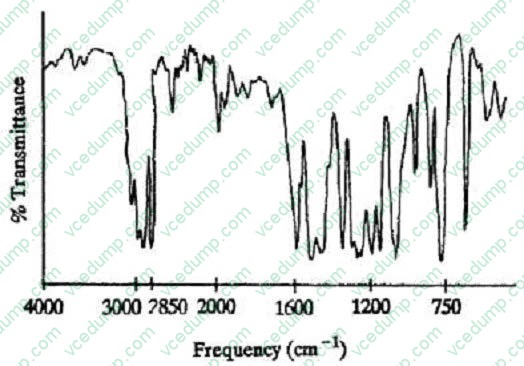
From this spectrum, the student quickly reached a conclusion about the functional group. He then turned his attention to the fingerprint region of the compound, which generally has a complicated pattern of peaks that are determined by the structure of the hydrocarbon portion of a molecule. The student decided that the large peak at 750 cm-1 must indicate that this was a disubstituted aromatic compound.
Assuming that all of the student's deductions were correct, which of the following could be the structure of the unknown compound?
A. Option A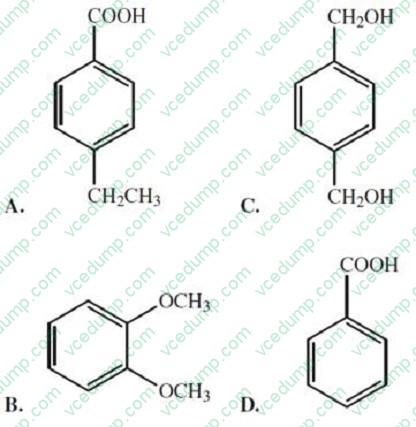
B. Option B
C. Option C
D. Option D -
Question 684:
Suppose an -particle starting from rest is accelerated through a 5 megavolt potential difference. What is the final kinetic energy of the -particle? (Note: Assume that e = 1.6x10⁻¹⁹ C.)
A. 1.6 x 10⁻¹² J
B. 8.0 x 10⁻¹³ J
C. 6.4 x 10⁻²⁶ J
D. 3.2 x 10⁻²⁶ J -
Question 685:
Which structure shows two amino acids linked by 1 peptide bond?
A. option A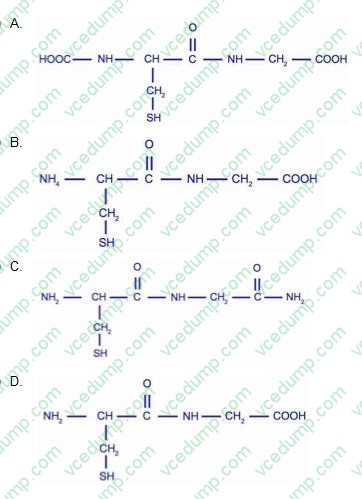
B. option B
C. option C
D. option D -
Question 686:
Sugars are carbohydrates, that is, molecules usually with the empirical formula C(H2O), and structural formulas made up of polyhydroxy aldehydes or ketones. Because of their polyfunctional nature, sugars can undergo a wide variety of
transformations upon treatment with acids, bases, or heat, and upon reaction with other simple reagents and enzymes. While many sugars occur in nature and are thus readily available, the synthesis and modification of simple sugars is a
necessary step in studies of enzymatic processes.
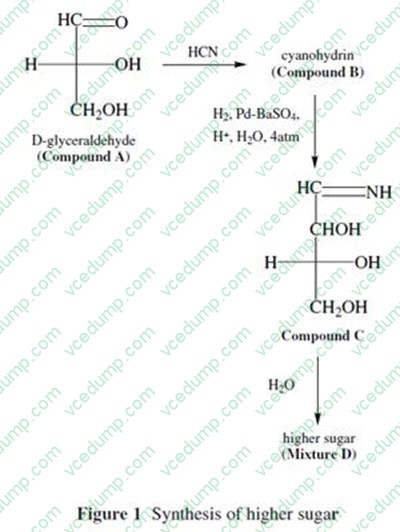
Higher sugars can be synthesized from the simple carbohydrate D-glyceraldehyde with the following procedure:
D-glyceraldehyde (Compound A) is reacted with HCN to produce a cyanohydrin (Compound B). Compound B is then treated with hydrogen gas and a modified palladium catalyst (similar to the Lindlar reagent) to give Compound C.
Compound C is hydrolyzed to give the higher sugars in Mixture D. This reaction is summarized in Figure 1. Mixture D contains two compounds, which can be separated by crystallization. Two doublets near 9.5 (, ppm) are observed in the 1H
NMR spectrum of mixture D, with each doublet corresponding to one of the two products present in the mixture. IR spectroscopy shows broad absorptions for both products around 3300 cm?.
The hydroxyl groups of carbohydrates can also participate in reactions. For example, D-glyceraldehyde can react with chloromethane under basic conditions to yield a completely methylated product. This SN2 reaction is shown in Figure 2.
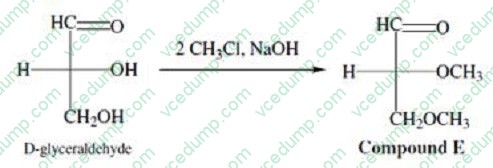
Figure 2 Methylation of D-glyceraldehyde
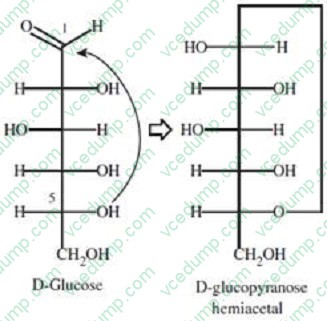
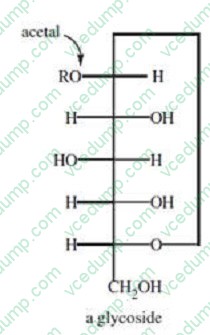
In glucose, the carbonyl carbon can be attacked, intramolecularly, by the hydroxyl oxygen of carbon-5 to form:
A. glucofuranose.
B. a hemiacetal.
C. a lactone.
D. a glycoside. -
Question 687:
Consider the following structure.
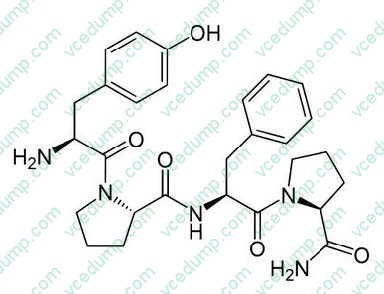
Which of the following is the most accurate description of the structure provided?
A. Dipeptide
B. Tripeptide
C. Tetrapeptide
D. Pentapeptide -
Question 688:
Bebop lives! cries the newest generation of jazz players. During the 1980s, musicians like Wynton Marsalis revived public interest in bebop, the speedy, angular music that first bubbled up out of Harlem in the early 1940s, changing the face of jazz. That Marsalis and others thought of themselves as celebrating and preserving a noble tradition is, in one sense, inevitable. After the excesses of experimental or "free" jazz in the 1960s and the electronic jazz-rock "fusion" of the 70s, it is hardly surprising that people should hearken back to a time when jazz was "purer", perhaps even at the apex of its development. But the recent enthusiasm for bebop is also ironic in light of the music's initial public reception.
In its infancy, during the first two decades of the 20th century, jazz was played by small groups of musicians improvising variations on blues tunes and popular songs. Most of the musicians were unable to read music, and their improvisations were fairly rudimentary. Nevertheless, jazz attained international recognition in the 1920s. Two of the people most responsible for its rise in popularity were Louis Armstrong, the first great jazz soloist, and Fletcher Henderson, leader of the first great jazz band. Armstrong, with his buoyant personality and virtuosic technical skills, greatly expanded the creative range and importance of the soloist in jazz. Henderson, a pianist with extensive training in music theory, foresaw the orchestral possibilities of jazz played by a larger band. He wrote out arrangements of songs for his band members that preserved the spirit of jazz, while at the same time giving soloists a more structured musical background upon which to shape their solo improvisations. In the 1930s, jazz moved further into the mainstream with the advent of the Swing Era. Big bands in the Henderson mold, led by musicians like Benny Goodman, Count Basie and Duke Ellington, achieved unprecedented popularity with jazz-oriented "swing" music that was eminently danceable.
Against this musical backdrop, bebop arrived on the scene. Like other modernist movements in art and literature, bebop music represented a departure from tradition in both form and content, and was met with initial hostility. Bebop tempos were unusually fast, with the soloist often playing at double time to the backing musicians. The rhythms were tricky and complex, the melodies intricate and frequently dissonant, involving chord changes and notes not previously heard in jazz. Before bebop, jazz players had improvised on popular songs such as those produced by Tin-Pan Alley, but bebop tunes were often originals with which jazz audiences were unfamiliar.
Played mainly by small combos rather than big bands, bebop was not danceable; it demanded intellectual concentration. Soon, jazz began to lose its hold on the popular audience, which found the new music disconcerting. Compounding public alienation was the fact that bebop seemed to have arrived on the scene in a completely mature state of development, without that early phase of experimentation that typifies so many movements in the course of Western music. This was as much the result of an accident of history as anything else. The early development of bebop occurred during a three-year ban on recording in this country made necessary by the petrol and vinyl shortages of World War II. By the time the ban was lifted, and the first bebop records were made, the new music seemed to have sprung fully-formed like Athena from the forehead of Zeus. And though a small core of enthusiasts would continue to worship bebop pioneers like Charlie Parker and Dizzy Gillespie, many bebop musicians were never able to gain acceptance with any audience and went on to lead lives of obscurity and deprivation.
It can be inferred from the passage that the innovations of Fletcher Henderson (lines 27-34) were inspired primarily by:
A. his admiration for Louis Armstrong.
B. a hunger for international recognition.
C. the realization that the public favored large bands over small combos.
D. a desire to go beyond the structural limitations of early jazz music. -
Question 689:
A source emits a sound from one medium with a certain velocity, intensity, frequency and wavelength. When the sound exits the first medium and enters a denser medium, all of the following changes EXCEPT:
A. velocity
B. intensity
C. frequency
D. wavelength -
Question 690:
Historically, two different methods have been used to estimate the fluid pressure in capillary beds.
Method 1 A glass pipette is inserted into the capillary. The level of blood rising in the pipette is measured and used to calculate the pressure. Alternatively, an inert fluid of density can be placed in the pipette and its height h can be measured. The pressure in the capillary is given by gh, where g is the acceleration due to gravity.

Figure 1 Method 2
The pressure can be measured indirectly in the following way. A section of gut tissue is removed from a specimen and placed on a beam balance. Blood is circulated through the tissue by a pump. The arterial pressure is then decreased. This leads to a decrease in the capillary hydrostatic pressure in the gut capillaries. The constant osmotic pressure of plasma proteins in the capillary causes absorption of fluid from the gut section which will decrease its weight. To prevent a change in the weight of the gut section, the venous pressure is increased. This tends to increase the capillary pressure, reducing the flow of fluid from the gut tissue into the capillaries. The capillary pressure is thus held constant (and the balance kept level) as the arterial pressure is decreased and the venous pressure increased. The arterial and venous pressures meet at the capillary pressure being measured.
( = MRT, where is the osmotic pressure, M the molarity of the solutes, R the universal gas constant, and T the temperature in Kelvin.)
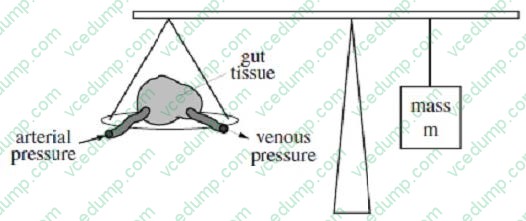
Figure 2
Method 2 relies on keeping the beam balance level. Which of the following must be true if the balance is level?
A. The arterial pressure equals the osmotic pressure.
B. The weight of the gut equals the weight of the mass (m).
C. The net force on the beam is zero.
D. The net torque on the beam is zero.
Related Exams:
Tips on How to Prepare for the Exams
Nowadays, the certification exams become more and more important and required by more and more enterprises when applying for a job. But how to prepare for the exam effectively? How to prepare for the exam in a short time with less efforts? How to get a ideal result and how to find the most reliable resources? Here on Vcedump.com, you will find all the answers. Vcedump.com provide not only Medical Tests exam questions, answers and explanations but also complete assistance on your exam preparation and certification application. If you are confused on your MCAT-TEST exam preparations and Medical Tests certification application, do not hesitate to visit our Vcedump.com to find your solutions here.