MCAT-TEST Exam Details
-
Exam Code
:MCAT-TEST -
Exam Name
:Medical College Admission Test: Verbal Reasoning, Biological Sciences, Physical Sciences, Writing Sample -
Certification
:Medical Tests Certifications -
Vendor
:Medical Tests -
Total Questions
:812 Q&As -
Last Updated
:Jul 16, 2026
Medical Tests MCAT-TEST Online Questions & Answers
-
Question 671:
The periodic beating of the heart is controlled by electrical impulses that originate within the cardiac muscle itself. These pulses travel to the sinoatrial node and from there to the atria and the ventricles, causing the cardiac muscles to contract. If a current of a few hundred milliamperes passes through the heart, it will interfere with this natural system, and may cause the heart to beat erratically. This condition is known as ventricular fibrillation, and is life-threatening. If, however, a larger current of about 5 to 6 amps is passed through the heart, a sustained ventricular contraction will occur. The cardiac muscle cannot relax, and the heart stops beating. If at this point the muscle is allowed to relax, a regular heartbeat will usually resume.
The large current required to stop the heart is supplied by a device known as a defibrillator. A schematic diagram of a defibrillator is shown below. This device is essentially a "heavy-duty" capacitor capable of storing large amounts of energy. To charge the capacitor quickly (in 1 to 3 seconds), a large DC voltage must be applied to the plates of the capacitor. This is achieved using a step-up transformer, which creates an output voltage that is much larger than the input voltage. The transformer used in this defibrillator has a step-up ratio of 1:50.
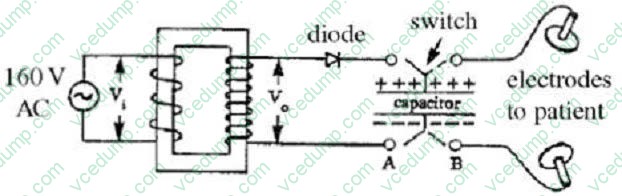
The AC voltage that is obtained from the transformer must then be converted to DC voltage in order to charge the capacitor. This is accomplished using a diode, which allows current flow in one direction only. Once the capacitor is fully charged, the charge remains stored until the switch is moved to position B and the plates are placed on the patient's chest. To cut down the resistance between the patient's body and the defibrillator, the electrodes are covered with a wetting gel before use. Care must be taken to insure that the patient is not in electrical contact with the ground while the defibrillator is in use.
Why is it important to insure that the patient is not in electrical contact with the ground while the defibrillator is in use?
A. Contact with the ground will decrease the resistance across the patient's body.
B. The doctor administering the treatment will be in greater danger of receiving an electric shock if the patient is in electrical contact with the ground.
C. Contact with the ground will cause a smaller current to pass through the patient's heart.
D. The patient receiving the treatment will be in greater danger of receiving burns due to the high current density if he is in electrical contact with the ground. -
Question 672:
The Earth's atmosphere reaches hundreds of kilometers above the surface of the planet. The lowest layer, the troposphere, extends from the ground to a height of approximately 12 km. Air pressure within the troposphere decreases with height above the ground, accompanied by a parallel trend in air density. The decrease in density has important consequences for the dissipation of air pollution from industrial smoke stacks. The gas from the stack is typically hotter and less dense than the surrounding air and rises. As a parcel of hot air rises, it expands approximately adiabatically doing work on the surrounding air. This results in a decrease in both its temperature and its density.
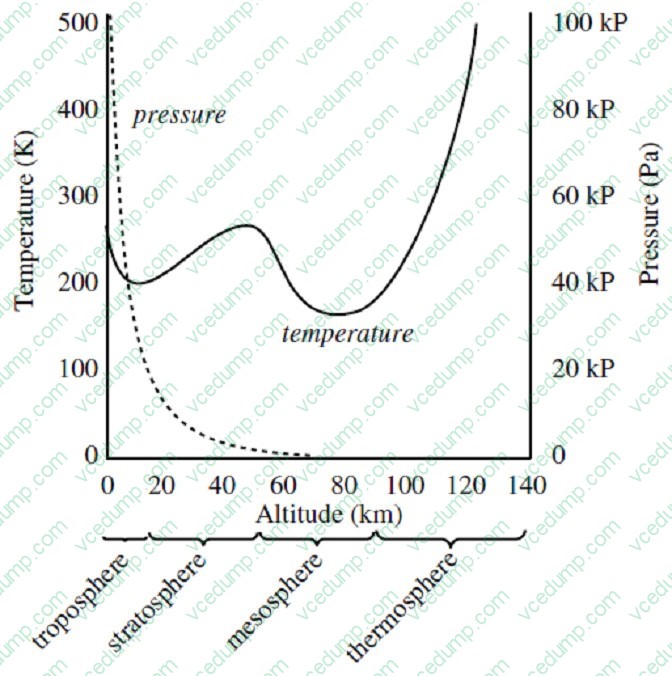
Figure 1 A smoke stack functions to expel gaseous waste products from a chemical process. It is also an important means of removing heat from a reaction mixture. The heat corresponding to a change in temperature of a gas at constant pressure is


given by , where is the heat added to the gas, n is the number of moles of gas, is the molar heat capacity of a particular gas at constant pressure, and T is the change in temperature. At atmospheric pressure, the

molar heat capacity for steam, O (g) is approximately four times that of air.

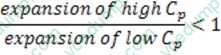
At constant pressure, the ratio between the volume expansion of a mole of gas with a high to that of a mole of gas with a low for a given heat input will be:
A. greater than 1.
B. less than 1.
C. equal to 1.
D. cannot be determined. -
Question 673:
Graphite is used in the nuclear reactors for specific purpose that is:
A. to absorb neutrons.
B. to slow down neutrons.
C. to absorb alpha particles.
D. to slow down high speed electron. -
Question 674:
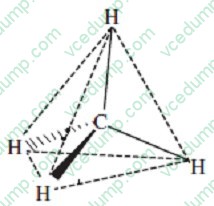
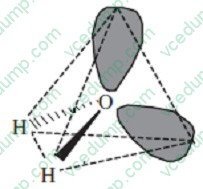
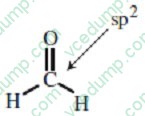
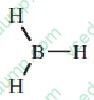
Which of the following molecules has the same geometric configuration of electron pairs about the central nucleus as CH4?
A. Option A
B. Option B
C. Option C
D. Option D -
Question 675:
In 1972, Georges Ungar reported the discovery of a peptide that appeared to transfer learning. Ungar's claim was based on experiments in which rats placed in a chamber with specially designed dark and light regions were trained to avoid
the dark regions of the chamber. Following their training, the rats were killed and brain extracts were prepared. These brain extracts were injected into naive rats which were then observed to acquire the fear of darkness without training. Two
hypotheses were proposed to explain these remarkable results:
Hypothesis 1
Ungar concluded that the extracts contained some chemical that transmitted the learned fear of darkness to the naive rats. A fifteen amino-acid polypeptide was isolated from the brain extracts and sequenced. Ungar claimed that this peptide,
called scotophobin, was a chemical transmitter of learning. The peptide had the primary structure shown below:
C-ser-asp-asn-arg-gln-gln-gly-lys-ser-ala-arg-gln-glygly-tyr-N scotophobin
Hypothesis 2
Other researchers, who tested scotophobin but could not reproduce Ungar's results, argued that scotophobin did not transfer the learned fear of darkness. Instead, they suggested that scotophobin, which is structurally similar to ACTH and
vasopressin, acted to increase stress in the rats. Since stress increases sympathetic nervous activity, rats injected with scotophobin would become hyperactive and tend to spend less time in the dark regions of the experimental chamber.
They argued that such stress responses in the rats could be misinterpreted as a fear of darkness. Ungar's claim was further weakened by chemical analysis in which both the scotophobin extracts which Ungar had injected into the naive rats
and a sample of synthesized scotophobin peptide were subjected to SDS polyacrylamide gel electrophoresis, as shown in Figure 1.
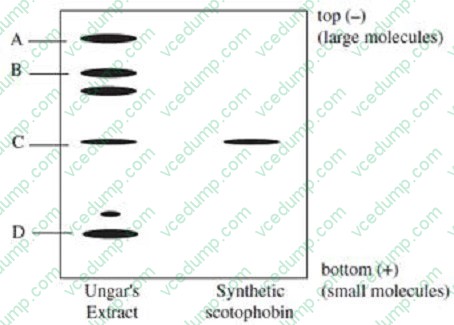
Figure 1
The chemical analysis of Ungar's extract most likely weakened his claim that scotophobin transferred the learned fear of darkness because it showed that:
A. the extract was not pure scotophobin.
B. the extract did not contain scotophobin.
C. scotophobin was not present in sufficient concentrations to illicit a response.
D. scotophobin was similar in structure to other proteins. -
Question 676:
Which of the following cell types does NOT contain the diploid number of chromosomes?
A. Spermatogonium
B. Spermatid
C. Zygote
D. Primary oocyte -
Question 677:
The mouthpiece of a telephone handset has a mass of 100 g, and the earpiece has a mass of 150 g. To balance the handset on one finger, that finger must be: (Note: Assume the bridge connecting the mouthpiece and the earpiece has a negligible mass.)
A. one and one half times farther from the earpiece than from the mouthpiece.
B. two times farther from the earpiece than from the mouthpiece
C. one and one half times farther from the mouthpiece than from the earpiece.
D. two times farther from the mouthpiece than from the earpiece -
Question 678:
Many nutrients required by plants exist in soil as basic cations:

A soil's cation-exchange capacity is a measure of its ability to adsorb these basic cations as well as exchangeable hydrogen and aluminum ions. The cation-exchange capacity of soil is derived from two sources: small clay particles called micelles consisting of alternating layers of alumina and silica crystals, and organic colloids.

Replacement of + and + by other cations of lower valence creates a net negative charge within the inner layers of the micelles. This is called the soil's permanent charge. For example, replacement of an atom of aluminum by calcium within a section where the net charge was previously zero, as shown below, produces a net charge of ?, to which other cations can become adsorbed.

Figure 1
A pH-dependent charge develops when hydrogen dissociates from hydroxyl moieties on the outer surfaces of the clay micelles. This leaves negatively-charged oxygen atoms to which basic cations may adsorb. Likewise, a large pH-
dependent charge develops when hydrogen dissociates from carboxylic acids and phenols in organic matter.
In most clays, permanent charges brought about by substitution account for anywhere from half to nearly all of the total cation-exchange capacity. Soils very high in organic matter contain primarily pH-dependent charges. In a research study,
three samples of soil were leached with a 1 N solution of neutral KCl, and the displaced A13+ and basic cations measured. The sample was then leached again with a buffered solution of BaCl2 and triethanolamine at pH 8.2, and the
displaced H+ measured. Table 1 gives results for three soils tested by this method.
Table 1

Due to the buffering effect of the soil's cationexchange capacity, just measuring the soil solution's pH will not indicate how much base is needed to change the soil pH. In another experiment, measured amounts of acid and base were added to 10-gram samples of well-mixed soil that had been collected from various locations in a field. The volumes of the samples were equalized by adding water. The results were recorded in Figure 2.
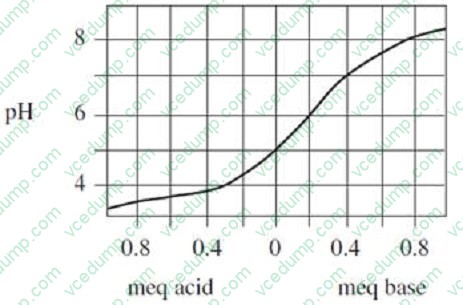
Figure 2.
An electron travels in the plane of the page from left to right, perpendicular to a magnetic field that points into the page. The direction of the resulting magnetic force on the electron will be in the plane of the page and:
A. upwards.
B. downwards.
C. to the left.
D. to the right. -
Question 679:
The anthropomorphic bias of those who would relegate marsupials to an inferior evolutionary status is most apparent in their recourse to data on brain structure and behavior. Unlike humans and other placentals, marsupials lack the corpus callosum, which facilitates inter-hemisphere transfer of data acquired through the senses. Yet it cannot be inferred that marsupials are thus deprived of such function. Didelphis Virginiana, one of the opossums, makes use of the anterior commissure, an adaptation that is also found in reptiles and monotremes. Diprodontons, including kangaroos and koalas, supplement the anterior commissure with the fasciculus aberrans. While the modes of neocortical interconnection may be diverse, the work of Johnson, Heath and Jones points to the conclusion that, functionally speaking the cortices and neocortices of both groups of mammals exhibit parallel connections. Parker also notes "a similar range of brain size to body weight ratios and of neocortical expansion". Another stigma borne by marsupials is the consensus that they are less intelligent than placentals. Yet Williams argues that, all else being equal, natural selection will favor instinctive over learned behavior as being more biologically efficient and that it is the accidental death of the young that is the prime selective pressure for the evolution of intelligence. Seen in this light, marsupials have a competitive edge; their gestation period is brief and the young remain in the pouch for an extended period exposed only to those dangers which also affect the mother. There they are directly exposed to the mother's food supply and can observe her behavior at leisure. Placentals, on the other hand, not only have a longer gestation period but, once their young are born, must often leave while foraging. Such absences increase the risk of mortality and decrease the opportunity to learn. Thus, among placentals, selection would favor the apparent intelligence in the young and protective behavior in the mother. Marsupials are not known to exhibit maternal protective behavior. In fact, Serventy has reported that frightened female kangaroos will drop their pouch-young as they flee, drawing a predator's attention to the less able offspring while the adult escapes. This behavior, whether purposeful or accidental, instantaneously relieves the female marsupial of the mechanical difficulties of pregnancy with which her placental counterpart would be burdened, while marsupials can replace any lost young quickly. Thus, in the absence of any need for close maternal supervision, sacrificing their offspring in this manner may well have been favored in selection. Pointing to the absence of the "virtue" of maternal protectiveness in marsupials is an instance of how mistaken are those theorists who see similarities with humans as marks of evolutionary sophistication.
With which of the following statements would the author be most likely to agree?
A. Maternal protectiveness is a trait common to all higher mammals.
B. Any physical or behavioral trait in animals should be evaluated primarily in terms of its contribution to species survival.
C. Current conceptions of evolution must be modified to account for new data.
D. Evolution is a progressive process culminating in the dominance of learned over instinctive behavior. -
Question 680:
Breast milk is proven to be the best form of nutrition for infants and is recommended for at least 1 year after birth. Unfortunately, a recent survey of breastfeeding mothers revealed that only 20% continue breastfeeding or to provide breast milk through pumping after 4 months, after which they switch to formula. When asked about reasons for stopping breastfeeding, the top three reasons were: going back to work, lack of support, and difficulties pumping. A socioeconomic study of the mothers revealed that women who choose to breastfeed for longest tend to have a higher level of education and come from more affluent backgrounds. Conversely, those mothers who breastfeed for the least amount of time tend to belong to minority groups and are from poorer backgrounds. It has been proposed that cultural differences also have a significant impact on the duration of breastfeeding.
Does the tone of the passage support breastfeeding?
A. Yes, the author states that breast milk is the only way to provide infants with sufficient nutrition.
B. No, the author states that formula is more nutritious.
C. No, the author implies that there are too many problems associated with breastfeeding.
D. Yes, the author talks positively about breastfeeding.


Related Exams:
Tips on How to Prepare for the Exams
Nowadays, the certification exams become more and more important and required by more and more enterprises when applying for a job. But how to prepare for the exam effectively? How to prepare for the exam in a short time with less efforts? How to get a ideal result and how to find the most reliable resources? Here on Vcedump.com, you will find all the answers. Vcedump.com provide not only Medical Tests exam questions, answers and explanations but also complete assistance on your exam preparation and certification application. If you are confused on your MCAT-TEST exam preparations and Medical Tests certification application, do not hesitate to visit our Vcedump.com to find your solutions here.