MCAT-TEST Exam Details
-
Exam Code
:MCAT-TEST -
Exam Name
:Medical College Admission Test: Verbal Reasoning, Biological Sciences, Physical Sciences, Writing Sample -
Certification
:Medical Tests Certifications -
Vendor
:Medical Tests -
Total Questions
:812 Q&As -
Last Updated
:Jul 16, 2026
Medical Tests MCAT-TEST Online Questions & Answers
-
Question 641:
The 'Synapse ' is a:
A. part of neuron.
B. part of axon.
C. chemical impulse.
D. gap between neurons. -
Question 642:
Arsenic is widely distributed in sulfide ores of many metals and is obtained as a byproduct of copper smelting. The element, as well as many compounds of arsenic -- for example arsine, AsH3 -- are extremely poisonous. Arsenic compounds, as might be expected, have found use in herbicides and pesticides, but have also been successful in some pharmacological agents. The first useful antisyphilitic agent, Salvarsan, or 3,3'-diamino-4,4'-dihydroxyarsenobenzene dihydrochloride, is an arsenic compound. The element sublimes at 600°C, forming tetrahedral molecules, As4. Arsenic is a metalloid, possessing properties characteristic of both metals and non-metals. Arsenic is a gray-colored, metalliclooking solid, but arsenic vapor is yellow in color, has a garlic-like odor, and is very poisonous. If the arsenic vapor is cooled rapidly, an unstable, yellow crystalline allotrope consisting of As4 molecules is produced. The Marsh test, based on the instability of arsine, is a very sensitive test for the presence of arsenic. This test is commonly employed in the detection of arsenic poisoning--either before or after death. The apparatus for the Marsh test is shown in Figure 1.
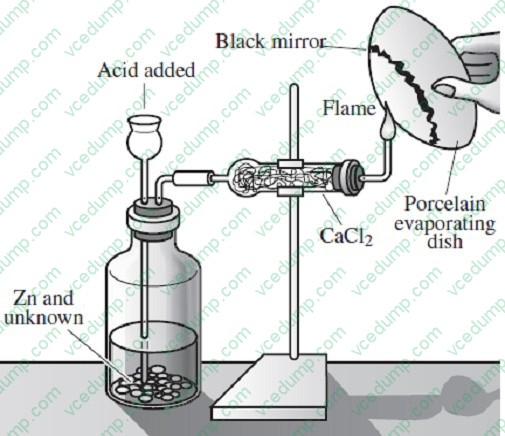
Figure 1
Typically, a sample, usually hair, is taken from a person suspected of being the victim of arsenic poisoning. This sample is then treated in such a way so as to produce arsenic oxide, As4O6. The oxide is then placed into the apparatus shown
in Figure 1 and reacted according to Reaction 1.
As4O6 + 12Zn(s) + 24H+(aq) AsH3(g) + 12Zn2 +(aq) + 6H2O
Reaction 1
When the evolved arsine is ignited it decomposes into its elements. The arsenic vapor is rapidly cooled when it encounters the porcelain evaporating dish and deposits a black mirror of arsenic on the bottom, indicating the presence of arsenic
in the original sample.
The phase diagram for arsenic is shown below. At what point does liquid arsenic exist?
A. 1.0 bar and 874 K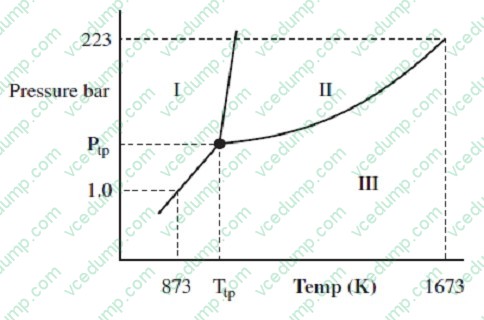
B. 1.0 bar and 1673 K
C. 223 bar and 1672 K
D. 223 bar and 873 K -
Question 643:
When a person faces an unexpected threat, which hormone is activated as a defensive response?
A. Cortisone
B. Androgens
C. Adrenaline
D. Nora-adrenaline -
Question 644:
If velocity of 11 x 103 m/s is needed to escape a rocket from gravitational pull, how much velocity will be needed to escape a cricket ball?
A. 11 x 106 m/s
B. 11 x 105 m/s
C. 11 x 104 m/s
D. 11 x 103 m/s -
Question 645:
X-rays are produced by a device which beams electrons with an energy between 103 and 106 eV at a metal plate. The electrons interact with the metal plate and are stopped by it. Much of the energy of the incoming electrons is released in the form of X-rays, which are high-energy photons of electromagnetic radiation. An example of such a device is shown below. Electrons are accelerated from the cathode towards the anode by an electric field.

There are two mechanisms by which the X-rays are produced within the metal. The first mechanism is called bremsstrahlung, which is German for "breaking radiation." X-rays are emitted by the electrons as they are brought to rest by
interactions with the positive nuclei of the anode.
The second mechanism occurs when an incoming electron knocks an inner electron out of one of the metal atoms of the anode. This electron is replaced by an electron from a higher energy level of the atom, and a photon making up the
energy difference is emitted.
X-rays are absorbed by a material when they pass through it. The amount of X-rays absorbed increases with the density of the material. In addition, lower energy X-rays are more likely to be absorbed than higher energy X-rays. (Note: 1 eV =
1.6 x 10¹⁹ J; Planck's constant h = 4.1 x 10⁻¹⁵ eV•s; speed of light c = 3 x 10⁸ m/s.)
An X-ray source produces X-rays with a maximum frequency of 6 x 10⁸ Hz. If the cathode current is doubled so that twice as many electrons are emitted per unit time, what is the new maximum frequency of the X-rays produced?
A. 3 x 10¹⁸ Hz
B. 6 x 10¹⁸ Hz
C. 12 x 1018 Hz
D. 24 x 1018 Hz -
Question 646:
Saul Hoffman's scientific journal paper published in 2015 in Societies explores the relationship between two topics that at the surface are very distant from each other. As he goes on to state, "It is relatively easy, at least for an economist, to see why economists would be attracted to issues like teen pregnancy and teen childbearing, despite their apparent distance from the core topics of economics. First, economics ?especially microeconomics ?is fundamentally the study of choices that individuals make, traditionally and most often in formal markets with monetary prices, but now more and more frequently outside that sphere. Viewed from that perspective, choices involving sexual and fertility behavior among teens are an incredibly challenging, but inviting, target. Is it possible to identify the role of economic incentives, including government policy, on these behaviors? Is it sensible to apply traditional models of rational choice decision-making to teens?
Second, the traditional concern about teen fertility was predicated on the notion that it was an economically catastrophic act. In a famous and oft-quoted 1968 article, Arthur Campbell wrote that 'The girl who has an illegitimate child at the age of 16 suddenly has 90 percent of her life's script written for her,' including reduced opportunities for schooling, the labor market, and marriage. But it doesn't take too much reflection to appreciate that more may be going on in leading to these poor outcomes than just a teen birth. Disentangling the causal effect of teen childbearing on subsequent socio-economic outcomes from its correlational effect is another deliciously inviting and challenging target, this time well-suited for the applied economist or econometrician.
Just to make all this yet more inviting, the two research strands are closely related. Suppose it could be demonstrated that for some teens the socio-economic impact of a teen birth was negligible. For example, maybe future prospects for some teens were equally poor with or without a birth or perhaps government programs provided substantial benefits, so that the net impact on socio-economic well-being was consequently small or even positive. Then, it might well be 'rational' in an economic sense to have a teen birth in the first place, thereby linking the research on the causal impact of a teen birth with the research on the choice determinants of a teen birth. So what came to be known as the teen birth `causes' literature and the teen birth `consequences' literature were clearly interrelated.
And then, to add yet another layer of challenge, the teen fertility rate in the U.S. has fallen at a rate that is totally unprecedented. Teen fertility was once widespread, with most of it occurring within early and sometimes not entirely voluntary marriage. In 1960, the teen fertility rate was approximately 90 births per 1000, which implied that more than 40% of women ever had a teen birth. When I published my first article on teen births 25 years ago, the teen fertility rate was 60 births per 1000, down one-third from 1960, but it had increased six years in a row in what turned out to be a deviation from the downward trend. Since then the rate has declined every single year, except for a short but puzzling uptick between 2005 and 2007. In 2014, the teen fertility rate was 24.2 births per 1000, the lowest teen fertility rate ever recorded in the U.S., though still shockingly high by European standards. Thus, the rate fell by more than 50% during my professional association with the topic and by 70% since 1960. Of course, at the same time teen marital births largely disappeared, falling from 85% of teen births to 12%.
This adds yet another focus for economic research. Why did the rate fall? Did it have anything to do with changes in the costs of teen childbearing or changes in policy? Is it a good thing or not?
In this article I try to make sense out of these various research strands by providing a personal narrative through the economics literature on teen childbearing, with a special emphasis on the three issues discussed above. My goal is to make the literature, including some reasonably technical content, accessible and valuable to a non-economist."
Hoffman, S. (2015). Teen Childbearing and Economics: A Short History of a 25-Year Research Love Affair. Societies, 5(3), 646-663. doi:10.3390/soc5030646
What is the author's main purpose in writing this passage?
A. To demonstrate that the current downturn in teen births is surprising because the socioeconomic consequences of teen birth have become less severe
B. To elucidate the possible reasons for and against bearing a child as a teenager
C. To present the question of teen birth as a challenging and fascinating question for the economist
D. To critique the existing literature that falsely assumes giving birth as a teen is always a harmful act -
Question 647:
Today's new urban Asia is just as sophisticated and in many ways more exciting than Western cities. Urban Asian consumers are knowledgeable, modern, and keen to embrace the global lifestyle. Young, urban Asians have grown up accustomed to many things that originated in the West. They have, for example, completely embraced pizza, some even claiming that it is a part of their heritage. The story is told about a young Singaporean boy who was taken by his father to Rome. "Hey, look, Dad," the little boy exclaimed, "they have pizza here too!" On sampling the product, the boy decided that it was not as good as the original back home. Nury Vitachi, who writes for the South China Post and the Far Eastern Economic Review, describes the Asian middle-class phenomenon: "Executives in Asia have become rich at warp speed by taking full control of their own lives. They invest a great deal of time in their work, they use strategy to scramble up the corporate ladder, and they demand payment in cash -- so they can make their money work as hard as they do." Signs of affluence are everywhere, but don't get carried away. Traveling around Asia, no matter how rich the Asians become, signs of their frugal nature are still apparent. And they are very cost-conscious. Shopkeepers in many Asian cities, most notably in Hong Kong, demand payments for discounted merchandise in cash instead of plastic, and many Asians are accustomed to that. Most people save the increases in their income, and many prefer to put it into fixed or other income-generating assets. Stock, land, and property are their favorites. Many affluent Asians still regard financial security as the most important form of security, and they are confident that Asia is the place to be to achieve that. While many have begun to savor the good life, they are not letting go of their top priority of education for their children. Education is looked upon as the most important contributing factor to success in life. And in many of Asia's competitive urban centers, there is a rush to acquire a second degree and other forms of professional qualification to ensure personal competitiveness in the workplace. There are extraordinary opportunities in Asia for education and training programs from language to software programming. Despite the rise in their assertiveness, Asians still look to the United States and not so much to Europe for ideas and trends. In general, except for those in Hong Kong and Japan, they are not particularly concerned with being fashionable. For today's Asia, Japan and Hong Kong are the sources of Asian fashion ideas, but as Asia becomes more affluent, there is a great opportunity to develop an indigenous fashion industry. For example, a huge market potential exists in introducing new materials and simplified but fashionable designs for countries in tropical Asia with a hot humid climate throughout the year. The population density and lack of space in urban areas has prohibited Asians from exercising frequently and few indulge in outdoor activities. This is changing. Most Asians consider themselves in good health. Compared with Americans, few are overweight -- largely as a result of their Asian diet. But now health clubs are becoming popular among younger Asians. Potential for indoor exercise equipment holds great promise. It is also important to dress for the gym, and younger Asians are serious about looking good, complete with makeup, sunglasses, designer exercise shoes and outfits, and a gym bag. In trying to hit Asia's moving targets, regardless of what you are selling, it is a good idea to stick with market density -- not country by country, but, mostly, city by city. Asian markets can be a marketer's dream in that their densities are among the highest in the world. Java, Indonesia's main island, has 115 million people. On Nanjing Road, Shanghai's busiest street, businesses are open twelve hours a day almost every day of the year. More than 1.5 million people visit the shops there and spend more than $50 million every day. Someone said that you can only become rich if you sell to the rich. I would add that you can become rich faster if you sell to the new rich. For investors in the West, watch for Western companies that are preparing a big push in Asia. The world has not yet seen anything like it before, and you can reap handsome dividends if you back those stocks that are going eastward.
Based on the information presented in the passage, with which of the following statements would the author most likely agree?
A. Every Asian nation shows some evidence of wealth.
B. Routine exercise keeps many Asians in prime physical condition.
C. Many Asian cities are large enough to be considered independent markets.
D. Asia's markets have recently been flooded with American goods. -
Question 648:
Synthetic dyes constitute a commercially significant area of organic chemistry. The color producing properties of these compounds are the result of highly delocalized electron systems giving rise to electronic transitions whose absorptions occur in the visible region. Most commercially useful dyes can be classified as one of three types -- anthraquinones, azo dyes, or triarylmethyl salts. Examples of each type are illustrated in Figure 1.

Figure 1
In order for a dye to be useful in the fabric industry, it must have sufficient affinity for the polymeric fibers of which the material is composed; the dye must not only impart a color to the fabric, but must also do so in a relatively permanent manner (color fastness). Proper design of synthetic polymers requires the placement of acidic or basic side chains along the polymer backbone such that binding sites are available for dying. Similarly, dyes must be produced not only with the appropriate color-producing structure, but also with an affinity for the fabric in question. The structural units of several common synthetic fibers are shown in Figure 2.

Figure 2
Azo dyes are synthesized via diazotization. The sequence of diazotization involves first treating an aromatic amine with NaNO2 in acidic solution, thereby converting it to the corresponding diazonium salt (with the general formula ArN2X-), then reacting with a second aromatic compound to form the azo dye. What is the structure of the azo dye produced by the reaction sequence below?
A. Option A
B. Option B
C. Option C
D. Option D -
Question 649:
The periodic beating of the heart is controlled by electrical impulses that originate within the cardiac muscle itself. These pulses travel to the sinoatrial node and from there to the atria and the ventricles, causing the cardiac muscles to contract. If a current of a few hundred milliamperes passes through the heart, it will interfere with this natural system, and may cause the heart to beat erratically. This condition is known as ventricular fibrillation, and is life-threatening. If, however, a larger current of about 5 to 6 amps is passed through the heart, a sustained ventricular contraction will occur. The cardiac muscle cannot relax, and the heart stops beating. If at this point the muscle is allowed to relax, a regular heartbeat will usually resume.
The large current required to stop the heart is supplied by a device known as a defibrillator. A schematic diagram of a defibrillator is shown below. This device is essentially a "heavy-duty" capacitor capable of storing large amounts of energy. To charge the capacitor quickly (in 1 to 3 seconds), a large DC voltage must be applied to the plates of the capacitor. This is achieved using a step-up transformer, which creates an output voltage that is much larger than the input voltage. The transformer used in this defibrillator has a step-up ratio of 1:50.

The AC voltage that is obtained from the transformer must then be converted to DC voltage in order to charge the capacitor. This is accomplished using a diode, which allows current flow in one direction only. Once the capacitor is fully charged, the charge remains stored until the switch is moved to position B and the plates are placed on the patient's chest. To cut down the resistance between the patient's body and the defibrillator, the electrodes are covered with a wetting gel before use. Care must be taken to insure that the patient is not in electrical contact with the ground while the defibrillator is in use.
If a dielectric was inserted between the plates of the capacitor in the defibrillator when the switch is in position A:
A. the energy stored in the capacitor would increase.
B. the energy stored in the capacitor would decrease.
C. the electric field between the plates would increase.
D. the electric field between the plates would decrease. -
Question 650:
Muzak, the intentionally unobtrusive music that most people associate with elevators and dentists' waiting rooms, represents the paradoxical success story of a product designed to be ignored. Although few people admit to enjoying its blandly melodic sounds, Muzak reaches over 100 million listeners in 14 countries and has played in the White House, the Apollo lunar spacecraft, and countless supermarkets, offices, and factories. This odd combination of criticism and widespread acceptance is not surprising, however, when one considers that Muzak is not created for the enjoyment of its listeners: rather, its purpose is to modify physiological and psychological aspects of an environment.
In the workplace, Muzak is credited with increasing both productivity and profitability. Research into the relationship between music and productivity can be traced to the earliest days of the Muzak Corporation. Developed by a military officer in 1922 as a way of transmitting music through electrical wires, Muzak blossomed in the 1930's following a study which reported that people work harder when they listen to certain kinds of music. Impressed by these findings, the BBC began to broadcast music in English munitions factories during World War II in an effort to combat fatigue. When workers assembling weapons increased their output by 6 percent, the U.S. War Production Board contracted the Muzak Corporation to provide uplifting music to American factories. Today, the corporation broadcasts its "Environmental Music" to countless businesses and institutions throughout the world. And while most people claim to dislike Muzak's discreet cadences, it seems to positively influence both productivity and job satisfaction.
Researchers speculate that listening to Muzak and other soft music improves morale and reduces stress by modifying our physiology. Physiological changes such as lowered heart rate and decreased blood pressure have been documented in hospital studies testing the effect of calming music on cardiac patients. In addition, certain kinds of music seem to effect one's sense of emotional, as well as physical, well being. It is just this sort of satisfaction which is thought to result in increased performance in the workplace. In a study of people performing repetitive clerical tasks, those who listened to music performed more accurately and quickly than those who worked in silence; those who listened to Muzak did better still. Moreover, while Muzak was conceived as a tool for productivity, it also seems to influence a business' profitability. In an experiment in which supermarket shoppers shopped to the mellow sounds of Muzak, sales were increased by as much as 12 percent. What makes Muzak unique is a formula by which familiar tunes are modified and programmed. Careful instrumentation adds to an overall sound that is neither monotonous nor rousing. But it is the precisely timed programming that separates Muzak from other "easy listening" formats. At the core of the programming is the concept of the "Stimulus Progression". Muzak programs are divided into quarter-hour groupings of songs, and are specifically planned for the time of day at which they will be heard. Each composition is assigned a mood rating between 1 and 6 called a stimulus value; a song with a rating of 2, for example, is slower and less invigorating than one with a value of 5. Approximately six compositions with ascending stimulus values play during any given quarter hour; each 15-minute segment ends in silence. Each segment of a 24-hour program is carefully planned. Segments that are considered more stimulating air at 11 a.m. and 3 p.m. (the times when workers typically tire), while more soothing segments play just after lunchtime and towards the end of the day, when workers are likely to be restless.
From the point of view of management, then, Muzak is a useful tool in the effort to maximize both productivity and profits. However, some people object to its presence, labeling it as a type of unregulated air pollution. Still others see it as an Orwellian nightmare, a manipulation of the subconscious. But Muzak's effectiveness seems to lie in the fact that most people never really listen to it. While it may be true that no one actually likes this carefully crafted aural atmosphere, many simply ignore it, allowing its forgettable sounds to soften the contours of the day.
According to the passage, Muzak may provide all of the following benefits EXCEPT:
A. increased work productivity.
B. decreased blood pressure.
C. increased business profitability.
D. decreased job absenteeism.
Related Exams:
Tips on How to Prepare for the Exams
Nowadays, the certification exams become more and more important and required by more and more enterprises when applying for a job. But how to prepare for the exam effectively? How to prepare for the exam in a short time with less efforts? How to get a ideal result and how to find the most reliable resources? Here on Vcedump.com, you will find all the answers. Vcedump.com provide not only Medical Tests exam questions, answers and explanations but also complete assistance on your exam preparation and certification application. If you are confused on your MCAT-TEST exam preparations and Medical Tests certification application, do not hesitate to visit our Vcedump.com to find your solutions here.