MCAT-TEST Exam Details
-
Exam Code
:MCAT-TEST -
Exam Name
:Medical College Admission Test: Verbal Reasoning, Biological Sciences, Physical Sciences, Writing Sample -
Certification
:Medical Tests Certifications -
Vendor
:Medical Tests -
Total Questions
:812 Q&As -
Last Updated
:Jul 16, 2026
Medical Tests MCAT-TEST Online Questions & Answers
-
Question 561:
...[TV Guide's] immediate concern was the television quiz show scandal, which had reached its climax two weeks earlier when Charles Van Doren, the appealing young man who'd taught viewers the value of learning while winning big on MCA's Twenty-one, stood before a House committee and admitted he was a fraud. But the issue went well beyond rigged quiz shows. The charge was that through their stranglehold on talent, MCA and William Morris monopolized the medium to the detriment of their clients, the industry, and the public at large. This was why the Justice Department had launched a secret investigation of both agencies more than two years before. The Morris Agency had started the quiz show vogue in 1955, when it packaged The $64,000 Question for Revlon and sold it to CBS. While the show won praise for its "educational" nature, the real source of its appeal was in its crapshoot format -- the idea that once contestants' winnings hit the $32,000 mark, they had to decide whether to go double or nothing on the final, $64,000 question, or play it safe and go home. The response was tremendous. Within weeks, the show knocked I Love Lucy out of the number-one slot in the ratings. Casinos in Vegas emptied out when it went on the air. Bookies took odds on whether the first contestant to go for the big one -- a marine captain whose specialty was cooking -- would get the answer right. (He did.) Revlon sold so much Living Lipstick that its factory was unable to meet the demand. The $64,000 Question quickly inspired imitators, among them an MCA package called Twenty-one. Based on the card game, more or less, Twenty-one was a dismal failure at first. "Do whatever you have to do," the sponsor ordered angrily, so the producers put the fix in. In December 1956, when Charles Van Doren, a boyishly attractive English instructor at Columbia University, beat Herb Stempel, a short, squat, nerdy grad at City College, Van Doren became the first intellectual hero of the television age. Honors and acclaim poured in -- the covers of Time, letters by the hundreds, offers of movie roles and tenured professorships and a regular guest spot on The Today Show. But Herb Stempel didn't like being told to lose, especially to some Ivy League snot. He went to the press. The DA's office started to investigate. The walls began to close in. Meanwhile, the show's producers agreed to sell the rights to NBC for $2 million. One of them started to feel queasy about selling the show without letting the network know the score, so he went to Sonny Werblin, MCA's top man in New York, and asked his advice. Werblin, the man behind such hits as The Ed Sullivan Show and The Jackie Gleason Show, ran the television department as if it were a football team coached by Attila the Hun. "Dan," he asked the producer, "have I ever asked you whether the show was rigged?" No, he hadn't. "And has NBC ever asked you whether the show is rigged?" No, they hadn't either. "Well," Werblin concluded, "the reason that none of us has asked is because we don't want to know." And with good reason. Not only was Twenty-one an MCA package and Van Doren himself an MCA client; Werblin had a special relationship with NBC's president, Robert Kintner. Kintner had been president of ABC until...ABC's chairman forced him out in his determination to move the network out of third place. MCA used its influence to place him at NBC, where he proved an extremely pliant customer. In the spring of 1957, when the networks were putting together their schedules for the next season, Werblin went to a meeting of NBC programming executives led by Kintner and his boss, RCA chairman Robert Sarnoff. "Sonny, look at the schedule for next season," Kintner said when he walked in, "here are the empty slots, you fill them."
The quote by Werblin (lines 55?6) is offered primarily as support of which of following contentions?
A. Werblin did not believe that quiz-show rigging was in the best interest of the public.
B. Werblin was an ambitious person who sought admiration for his successes.
C. Werblin was a ruthless executive who was influential with the William Morris Agency.
D. Werblin was a shrewd character who knew the consequences of knowingly promoting a rigged game show -
Question 562:
Besides calcium, the mammalian's skeleton also stores a huge amount of:
A. phosphorus.
B. sulfur.
C. iron.
D. nitrogen. -
Question 563:
Sugars are carbohydrates, that is, molecules usually with the empirical formula C(H2O), and structural formulas made up of polyhydroxy aldehydes or ketones. Because of their polyfunctional nature, sugars can undergo a wide variety of
transformations upon treatment with acids, bases, or heat, and upon reaction with other simple reagents and enzymes. While many sugars occur in nature and are thus readily available, the synthesis and modification of simple sugars is a
necessary step in studies of enzymatic processes.
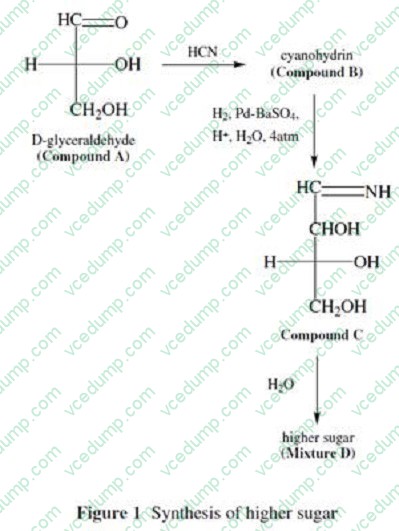
Higher sugars can be synthesized from the simple carbohydrate D-glyceraldehyde with the following procedure:
D-glyceraldehyde (Compound A) is reacted with HCN to produce a cyanohydrin (Compound B). Compound B is then treated with hydrogen gas and a modified palladium catalyst (similar to the Lindlar reagent) to give Compound C.
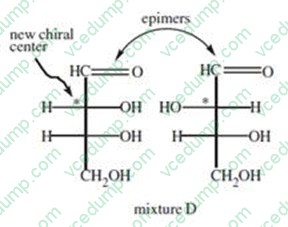
Compound C is hydrolyzed to give the higher sugars in Mixture D. This reaction is summarized in Figure 1. Mixture D contains two compounds, which can be separated by crystallization. Two doublets near 9.5 (, ppm) are observed in the 1H
NMR spectrum of mixture D, with each doublet corresponding to one of the two products present in the mixture. IR spectroscopy shows broad absorptions for both products around 3300 cm?.
The hydroxyl groups of carbohydrates can also participate in reactions. For example, D-glyceraldehyde can react with chloromethane under basic conditions to yield a completely methylated product. This SN2 reaction is shown in Figure 2.
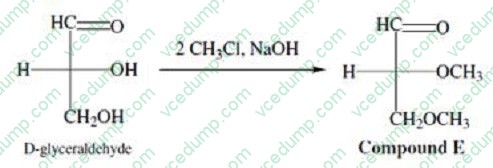
Figure 2 Methylation of D-glyceraldehyde The two sugars in Mixture D are:
A. enantiomers.
B. anomers.
C. epimers.
D. disaccharides. -
Question 564:
Historically, two different methods have been used to estimate the fluid pressure in capillary beds.
Method 1 A glass pipette is inserted into the capillary. The level of blood rising in the pipette is measured and used to calculate the pressure. Alternatively, an inert fluid of density can be placed in the pipette and its height h can be measured. The pressure in the capillary is given by gh, where g is the acceleration due to gravity.
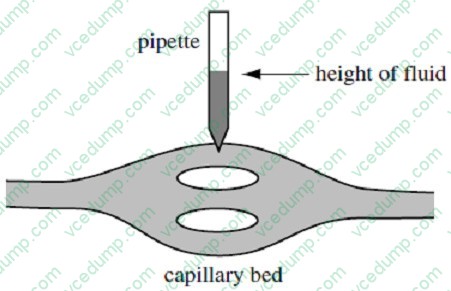
Figure 1 Method 2
The pressure can be measured indirectly in the following way. A section of gut tissue is removed from a specimen and placed on a beam balance. Blood is circulated through the tissue by a pump. The arterial pressure is then decreased. This leads to a decrease in the capillary hydrostatic pressure in the gut capillaries. The constant osmotic pressure of plasma proteins in the capillary causes absorption of fluid from the gut section which will decrease its weight. To prevent a change in the weight of the gut section, the venous pressure is increased. This tends to increase the capillary pressure, reducing the flow of fluid from the gut tissue into the capillaries. The capillary pressure is thus held constant (and the balance kept level) as the arterial pressure is decreased and the venous pressure increased. The arterial and venous pressures meet at the capillary pressure being measured.
( = MRT, where is the osmotic pressure, M the molarity of the solutes, R the universal gas constant, and T the temperature in Kelvin.)
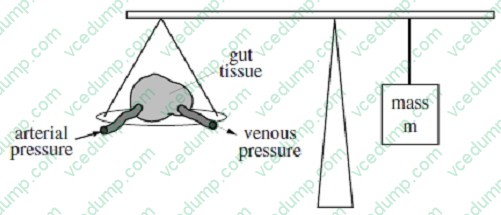
Figure 2
A researcher using Method 1 to determine the capillary pressure fills the pipette with an inert fluid less dense than blood. Compared to blood, the height of this fluid in the pipette will be:
A. higher because the fluid is less dense.
B. lower because the fluid is less dense.
C. the same because the pressure being measured is the same.
D. the same because the velocity of blood flow in the capillary bed is the same. -
Question 565:
...Until last year many people -- but not most economists -- thought that the economic data told a simple tale. On one side, productivity -- the average output of an average worker -- was rising. And although the rate of productivity increase was very slow during the 1970's and early 1980's, the official numbers said that it had accelerated significantly in the 1990's. By 1994 an average worker was producing about 20 percent more than his or her counterpart in 1978. On the other hand, other statistics said that real, inflation- adjusted wages had not been rising at anything like the same rate. In fact, some of the most commonly cited numbers showed real wages actually falling over the last 25 years. Those who did their homework knew that the gloomiest numbers overstated the case....Still, even the most optimistic measure, the total hourly compensation of the average worker, rose only 3 percent between 1978 and 1994.... ...But now the experts are telling us that the whole thing may have been a figment of our statistical imaginations.... a blue-ribbon panel of economists headed by Michael Boskin of Stanford declared that the Consumer Price Index [C.P.I.] had been systematically overstating inflation, probably by more than 1 percent per year for the last two decades, mainly failing to take account of changes in the patterns of consumption and improvements in product quality.... ...The Boskin report, in particular, is not an official document -- it will be quite a while before the Government actually issues a revised C.P.I., and the eventual revision may be smaller than Boskin and his colleagues propose. Still, the general outline of the resolution is pretty clear. When all the revisions are taken into account, productivity growth will probably look somewhat higher than it did before, because some of the revisions being proposed to the way we measure consumer prices will also affect the way we calculate growth. But the rate of growth of real wages will look much higher -- and so it will now be roughly in line with productivity, which will therefore reconcile numbers on productivity and wages with data that show a roughly unchanged distribution of income between capital and labor. In other words, the whole story about workers not sharing in productivity gains will turn out to have been based on a statistical illusion. It is important not to go overboard on this point. There are real problems in America, and our previous concerns were by no means pure hypochondria. For one thing, it remains true that the rate of economic progress over the past 25 years has been much slower than it was in the previous 25. Even if Boskin's numbers are right, the income of the median family -- which officially has experienced virtually no gain since 1973 -- has risen by only about 35 percent over the past 25 years, compared with 100 percent over the previous 25. Furthermore, it is quite likely that if we "Boskinized" the old data -- that is, if we tried to adjust the C.P.I. for the 50's and 60's to take account of changing consumption patterns and rising product quality -- we would find that official numbers understated the rate of progress just as much if not more than they did in recent decades.... ...Moreover, while workers as a group have shared fully in national productivity gains, they have not done so equally. The overwhelming evidence of a huge increase in income inequality in America has nothing to do with price indexes and is therefore unaffected by recent statistical revelations. It is still true that families in the bottom fifth, who had 5.4 percent of total income in 1970, had only 4.2 percent in 1994; and that over the same period the share of the top 5 percent went from 15.6 to 20.1. And it is still true that corporate C.E.O.'s, who used to make about 35 times as much as their employees, now make 120 times as much or more.... ...While these are real and serious problems, however, one thing is now clear: the truth about what is happening in America is more subtle than the simplistic morality play about greedy capitalists and oppressed workers that so many would- be sophisticates accepted only a few months ago. There was little excuse for buying into that simplistic view then; there is no excuse now.... According to the passage, "Boskinization" adjusts the C.P.I. by:
A. increasing wages and decreasing productivity to reconcile the present disparity.
B. taking into account technology's role in an improved efficiency.
C. reassessing consumption patterns and quality of product.
D. evaluating the inequalities in various levels of incomes. -
Question 566:
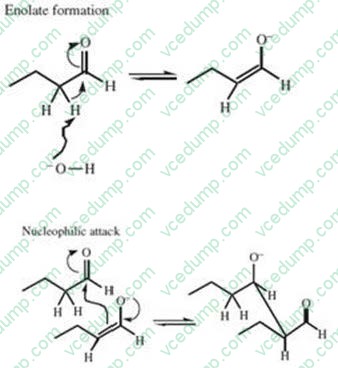
The hydrogens of alkanes have pKa values that are over 30 or 40. In contrast, the -hydrogens of aldehydes and ketones have pKa values that range from 19 to 21. These fairly acidic -hydrogens can be removed by strong bases to form anions called enolates. The enolate ions are strongly stabilized by resonance. Protonation of the enolate at oxygen produces an enol. Interconversion between the keto and enol forms is called tautomerization and is illustrated in Figure 1. The keto form is usually highly favored.
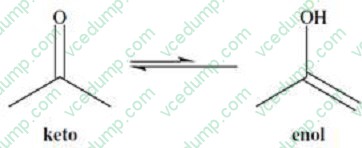
Figure 1
Keto-enol tautomerization has some interesting consequences. For example, if a ketone is treated with acid or base in a solvent of D2O (heavy water), all of the - hydrogens will be exchanged for deuterium. This reaction is shown in Figure 2.
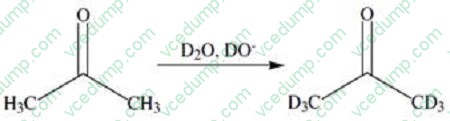
Figure 2
Another consequence of keto-enol tautomerization is the racemization of chiral -carbons. In the enol form, the -carbon adopts a planar configuration and is no longer chiral. Tautomerization back to the ketone produces a racemic mixture of products. This is shown in Figure 3.
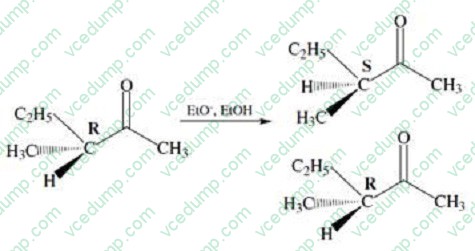
Figure 3
The aldol condensation proceeds through formation of an enolate anion. This is followed by nucleophilic attack by the enolate ion on the carbonyl carbon of the original aldehyde. Which of the following reactants would lead to the product indicated below?
A. Option A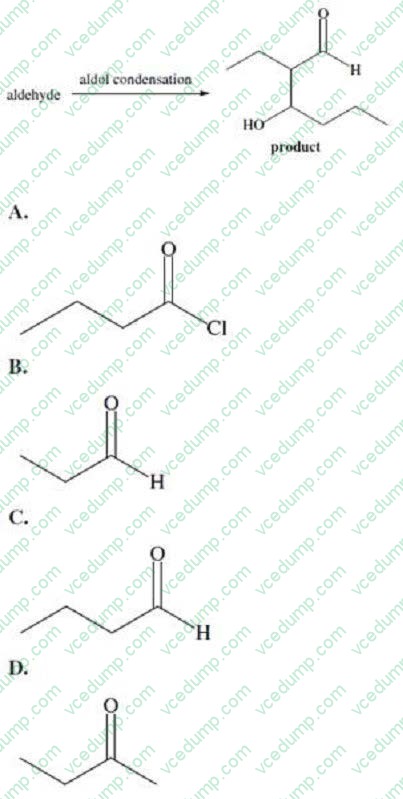
B. Option B
C. Option C
D. Option D -
Question 567:
The change in temperature of "20oC" is equivalent to change in temperature on Kelvin scale of:
A. 0.9 K
B. 20 K
C. 11 K
D. 6.7 K -
Question 568:
Many nutrients required by plants exist in soil as basic cations:

A soil's cation-exchange capacity is a measure of its ability to adsorb these basic cations as well as exchangeable hydrogen and aluminum ions. The cation-exchange capacity of soil is derived from two sources: small clay particles called micelles consisting of alternating layers of alumina and silica crystals, and organic colloids.

Replacement of + and + by other cations of lower valence creates a net negative charge within the inner layers of the micelles. This is called the soil's permanent charge. For example, replacement of an atom of aluminum by calcium within a section where the net charge was previously zero, as shown below, produces a net charge of ?, to which other cations can become adsorbed.

Figure 1
A pH-dependent charge develops when hydrogen dissociates from hydroxyl moieties on the outer surfaces of the clay micelles. This leaves negatively-charged oxygen atoms to which basic cations may adsorb. Likewise, a large pH-
dependent charge develops when hydrogen dissociates from carboxylic acids and phenols in organic matter.
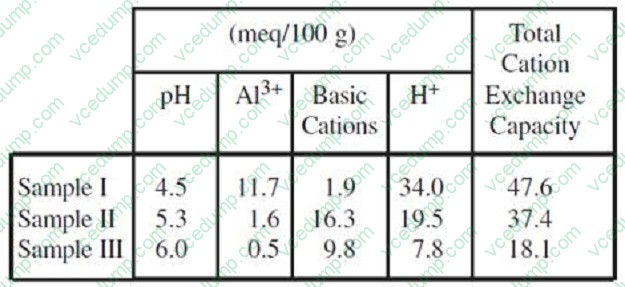
In most clays, permanent charges brought about by substitution account for anywhere from half to nearly all of the total cation-exchange capacity. Soils very high in organic matter contain primarily pH-dependent charges. In a research study,
three samples of soil were leached with a 1 N solution of neutral KCl, and the displaced A13+ and basic cations measured. The sample was then leached again with a buffered solution of BaCl2 and triethanolamine at pH 8.2, and the
displaced H+ measured. Table 1 gives results for three soils tested by this method.
Table 1
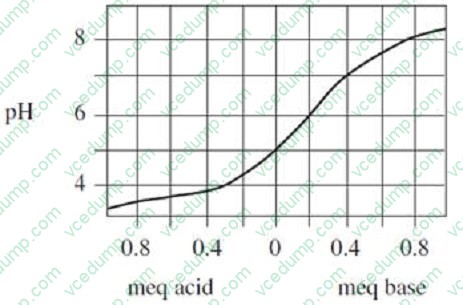
Due to the buffering effect of the soil's cation exchange capacity, just measuring the soil solution's pH will not indicate how much base is needed to change the soil pH. In another experiment, measured amounts of acid and base were added to 10-gram samples of well-mixed soil that had been collected from various locations in a field. The volumes of the samples were equalized by adding water. The results were recorded in Figure 2.
Figure 2.
A converging lens has a focal length of 8 cm. If the object is 10 cm to the left of the lens, what are the position of the image formed and the magnification of the lens?
A. 0.025 cm to the right of the lens and 0.0025X
B. 4.4 cm to the right of the lens and 0.4X
C. 40 cm to the right of the lens and 4X
D. 40 cm to the left of the lens and 4X -
Question 569:
A teacher sets up a reward system for her elementary school students. At the end of each day, she gives a sticker to each student who showed up on time that morning. At the end of each week, she gives a sticker to any student who got above a 90% on three quizzes in a row. After months of this regimen, she finds that performance on the quizzes has increased significantly but that tardiness has only decreased slightly.
Which of the following best explains the teacher's observation?
A. Variable ratio schedules create the strongest responses and behavior that is the least susceptible to extinction.
B. The students had more intrinsic motivation to do well on quizzes than to show up on time.
C. The students' behavior change was stronger in response to a fixed-ratio schedule than it was to a continuous reinforcement schedule.
D. The students' behavior change was stronger in response to a fixed-ratio schedule than it was to a variable-interval schedule. -
Question 570:
Musical instruments generate vibrations in the air that are perceived as musical tones. In many kinds of drums, these vibrations are created by a standing waves in a vibrating membrane. In a timpani drum, membrane vibration is coupled to the vibration of an enclosed volume of air. There may also be a second membrane whose vibration is coupled to that of the first by the enclosed air space, as in a snare drum. An idealized circular membrane will vibrate at normal mode frequencies given by Equation 1 where T is the membrane tension, r is the membrane radius, is the mass per unit area of the membrane, and frel is the relative frequency shown under each mode in Figure 1. The pitch of drums can be tuned by adjusting the membrane tension.
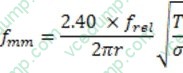
Equation 1
The modes are designated by two numbers, m and n. m indicates the number of diameter nodes, and n indicates the number of circular nodes. Several modes of vibration are shown in Figure 1.

Figure 1
Which of the following combinations of modal frequencies would generate the highest beat frequency?
A. (0,1) and (2,1)
B. (0,1) and (0,2)
C. (1,1) and (3,1)
D. (2,1) and (1,2)



Related Exams:
Tips on How to Prepare for the Exams
Nowadays, the certification exams become more and more important and required by more and more enterprises when applying for a job. But how to prepare for the exam effectively? How to prepare for the exam in a short time with less efforts? How to get a ideal result and how to find the most reliable resources? Here on Vcedump.com, you will find all the answers. Vcedump.com provide not only Medical Tests exam questions, answers and explanations but also complete assistance on your exam preparation and certification application. If you are confused on your MCAT-TEST exam preparations and Medical Tests certification application, do not hesitate to visit our Vcedump.com to find your solutions here.