MCAT-TEST Exam Details
-
Exam Code
:MCAT-TEST -
Exam Name
:Medical College Admission Test: Verbal Reasoning, Biological Sciences, Physical Sciences, Writing Sample -
Certification
:Medical Tests Certifications -
Vendor
:Medical Tests -
Total Questions
:812 Q&As -
Last Updated
:Jul 16, 2026
Medical Tests MCAT-TEST Online Questions & Answers
-
Question 581:
A deep-sea research module has a volume of 150 m3. If ocean water has an average density of 1,025 kg/m3, what will be the buoyant force on the module when it is completely submerged in the water? (Note: The acceleration due to gravity is 9.8 m/s2.)
A. Option A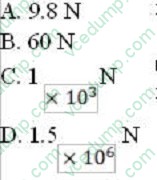
B. Option B
C. Option C
D. Option D -
Question 582:
The Earth's atmosphere reaches hundreds of kilometers above the surface of the planet. The lowest layer, the troposphere, extends from the ground to a height of approximately 12 km. Air pressure within the troposphere decreases with height above the ground, accompanied by a parallel trend in air density. The decrease in density has important consequences for the dissipation of air pollution from industrial smoke stacks. The gas from the stack is typically hotter and less dense than the surrounding air and rises. As a parcel of hot air rises, it expands approximately adiabatically doing work on the surrounding air. This results in a decrease in both its temperature and its density.
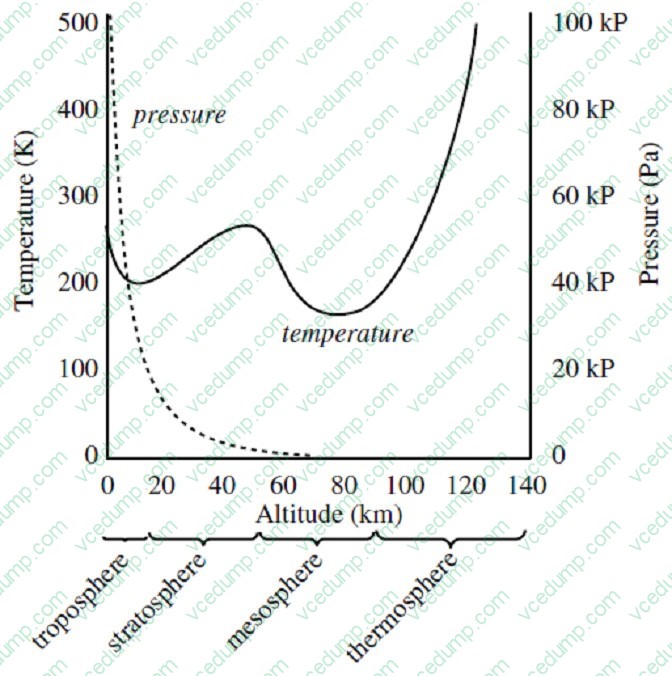
Figure 1 A smoke stack functions to expel gaseous waste products from a chemical process. It is also an important means of removing heat from a reaction mixture. The heat corresponding to a change in temperature of a gas at constant pressure is

given by , where is the heat added to the gas, n is the number of moles of gas, is the molar heat capacity of a particular gas at constant pressure, and T is the change in temperature. At atmospheric pressure, the

molar heat capacity for steam, O (g) is approximately four times that of air.
Ozone molecules in the stratosphere absorb ultraviolet radiation and photodissociate into an oxygen molecule (O2), and a free oxygen atom (O). Which of the following best describes this phenomenon?
A. The wavelength of the ultraviolet radiation is greater than the cutoff wavelength needed for photodissociation.
B. The frequency of the ultraviolet radiation is greater than the cutoff frequency needed for photodissociation.
C. The frequency of the ultraviolet radiation is less than the cutoff frequency needed for photodissociation.
D. The wavelength of the ultraviolet light is less than the cutoff frequency. -
Question 583:
When humans are submerged in water, the mammalian dive reflex acts to alter circulation. Heart rate decreases, blood flow to the extremities is reduced, and mean arterial blood pressure is increased. These accomodations lead to:
A. decreased oxygen demand by the tissues.
B. increased heat retention by the body.
C. decreased partial pressure of oxygen in the blood.
D. increased venous return. -
Question 584:
Which titration curve would be produced by titrating 25 mL of a 0.1 N weak base with a 0.1 N strong acid?
A. Option A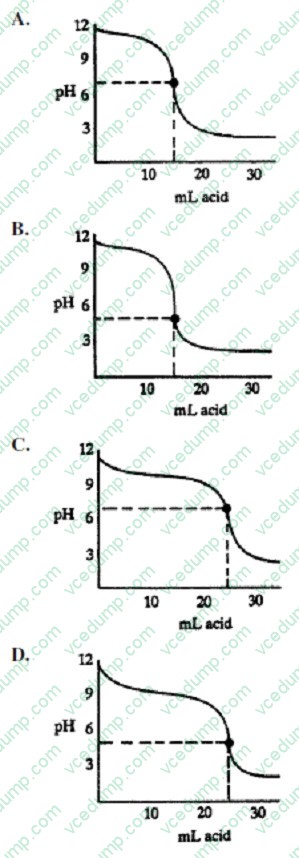
B. Option B
C. Option C
D. Option D -
Question 585:
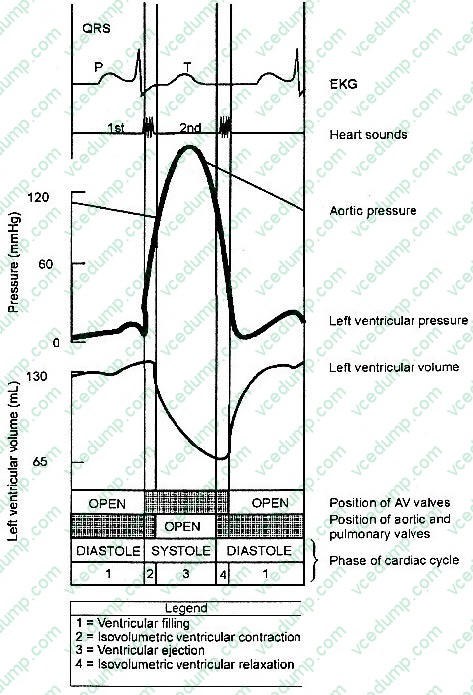
The process of depolarization triggers the cardiac cycle. The electronics of the cycle can be monitored by an electrocardiogram (EKG). The cycle is divided into two major phases, both named for events in the ventricle: the period of ventricular contraction and blood ejection, systole, followed by the period of ventricular relaxation and blood filling, diastole.
During the very first part of systole, the ventricles are contracting but all valves in the heart are closed thus no blood can be ejected. Once the rising pressure in the ventricles becomes great enough to open the aortic and pulmonary valves, the ventricular ejection or systole occurs. Blood is forced into the aorta and pulmonary trunk as the contracting ventricular muscle fibers shorten. The volume of blood ejected from a ventricle during systole is termed stroke volume.
During the very first part of diastole, the ventricles begin to relax, and the aortic and pulmonary valves close. No blood is entering or leaving the ventricles since once again all the valves are closed. Once ventricular pressure falls below atrial pressure, the atrioventricular (AV) valves open. Atrial contraction occurs towards the end of diastole, after most of the ventricular filling has taken place. The ventricle receives blood throughout most of diastole, not just when the atrium contracts.
Figure 1: Electronic and pressure changes in the heart and aorta during the cardiac cycle.
Would the walls of the atria or ventricles expected to be thicker?
A. Atria, because blood ejection due to atrial contraction is high.
B. Atria, because blood ejection due to atrial contraction is low.
C. Ventricles, because ventricular stroke volume is high.
D. Ventricles, because ventricular stroke volume is low. -
Question 586:
The rich analyses of Fernand Braudel and his fellow Annales historians have made significant contributions to historical theory and research. In a departure from traditional historical approaches, the Annales historians, assume (as do Marxists) that history cannot be limited to a simple recounting of conscious human actions, but must be understood in the context of forces and material conditions that underlie human behavior. Braudel was the first Annales historian to gain widespread support of the idea that history should synthesize data from various social sciences, especially economics, in order to provide a broader view of human societies over time (although Febvre and Bloch, founders of the Annales school, had originated this approach). Braudel conceived of history as the dynamic interaction of three temporalities. The first of these, the evenementielle, involved short-lived dramatic "events", such as battles, revolutions and the actions of great men, which had preoccupied traditional historians like Carlyle. Conjonctures was Braudel's term for larger cyclical processes that might last up to half a century. The longue duree, a historical wave of great length, was for Braudel the most fascinating of the three temporalities. Here he focused on those aspects of everyday life that might remain relatively unchanged for centuries. What people ate, what they wore, their means and routes of travel -- for Braudel these things create "structures" which define the limits of potential social change for hundreds of years at a time. Braudel's concept of the longue duree extended the perspective of historical space as well as time. Until the Annales school, historians had taken the juridical political unit the nation-state, duchy, or whatever as their starting point. Yet, when such enormous timespans are considered, geographical features may well have more significance for human populations than national borders. In his doctoral thesis, a seminal work on the Mediterranean during the reign of Philip II, Braudel treated the geohistory of the entire region as a "structure" that had exerted myriad influences on human lifeways since the first settlements on the shores of the Mediterranean Sea. And so the reader is given such arcane information as the list of products that came to Spanish shores from North Africa, the seasonal routes followed by Mediterranean sheep and their shepherds, and the cities where the best ship timber could be bought. Braudel has been faulted for the imprecision of his approach. With his Rabelaisian delight in concrete detail, Braudel vastly extended the realm of relevant phenomena; but this very achievement made it difficult to delimit the boundaries of observation, a task necessary to beginning any social investigation. Further, Braudel and other Annales historians minimize the differences among the social sciences. Nevertheless, the many similarly-designed studies aimed at both professional and popular audiences indicate that Braudel asked significant questions which traditional historians had overlooked.
Which of the following statements is most in keeping with the principles of Braudel's work as described in the passage?
A. All written history is the history of social elites.
B. The most important task of historians is to define the limits of potential social change.
C. Those who ignore history are doomed to repeat it.
D. People's historical actions are influenced by many factors that they may be unaware of. -
Question 587:
The resistance of a resistor is defined as the ratio of the voltage drop across it to the current passing through it. The resistance of a resistor can be measured using the circuit illustrated in Figure 1.
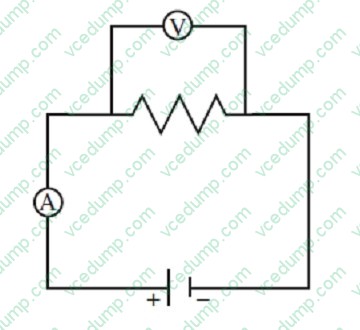
Figure 1
In the above circuit, a variable voltage source with negligible internal resistance is connected to a resistor. The voltage across the resistor is measured by a voltmeter and the current through the resistor is measured by an ammeter.

Additional resistors may be added to the circuit. The total resistance can be calculated as follows: If and are two resistances of two resistors, then the total resistance is given by = + when the resistors are connected in

series, and by 1/ = 1/ + 1/ when the resistors are connected in parallel.

Circuits similar to the one above are used in the common household appliance known as the toaster. The rate by which energy in the form of heat is dissipated by the resistor equals , where I is the current that passes through the resistor and R is the resistance of the resistor. Energy is dissipated in a resistor because moving electrons collide with atoms in the resistor, causing the atoms to vibrate.
In order for the ammeter to have a very small effect on the current flowing through the resistor, the ammeter should:
A. be connected to the resistor with insulated wire.
B. be connected as close as possible to the positive terminal of the voltage source.
C. have a very low resistance.
D. be sensitive to currents flowing in either direction around the circuit. -
Question 588:
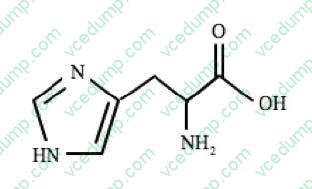
The amino acid histidine has a nitrogen-containing side chain. The pKa for the carboxylic acid group, imidazole side chain, and the primary amine has a value of 1.8, 6.0, and 9.0, respectively. Which of the following structures accurately reflects the predominate form of histidine at a normal physiological pH of 7.4?
A. Option A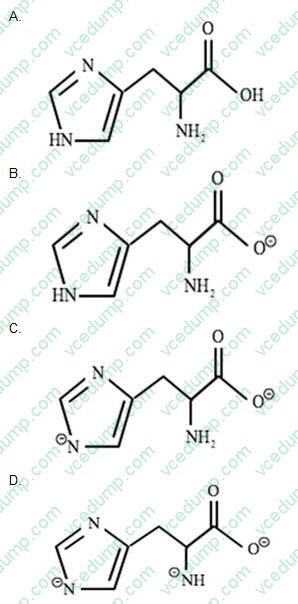
B. Option B
C. Option C
D. Option D -
Question 589:
In the small intestine, most amino acids are transported from the lumen of the gut into the epithelial cells against their concentration gradient. This movement of amino acids is coupled to the movement of sodium ions down their concentration gradient in a form of transmembrane movement called:
A. simple diffusion.
B. facilitated diffusion.
C. secondary active transport.
D. primary active transport. -
Question 590:
Myoclonic epilepsy and ragged-red fiber (MERRF) is an extremely rare disorder that affects neuromuscular systems. MERRF results from a mutation in mitochondrial DNA (mtDNA) that impairs protein synthesis, oxygen consumption, and energy production. When an affected male and a normal female reproduce, which of the following best predicts the expected phenotypic ratios of the offspring?
A. None of the offspring will be affected.
B. All males and no females will be affected.
C. Half of males and half of females will be affected.
D. One-fourth of the offspring will be affected.


Related Exams:
Tips on How to Prepare for the Exams
Nowadays, the certification exams become more and more important and required by more and more enterprises when applying for a job. But how to prepare for the exam effectively? How to prepare for the exam in a short time with less efforts? How to get a ideal result and how to find the most reliable resources? Here on Vcedump.com, you will find all the answers. Vcedump.com provide not only Medical Tests exam questions, answers and explanations but also complete assistance on your exam preparation and certification application. If you are confused on your MCAT-TEST exam preparations and Medical Tests certification application, do not hesitate to visit our Vcedump.com to find your solutions here.