MCAT-TEST Exam Details
-
Exam Code
:MCAT-TEST -
Exam Name
:Medical College Admission Test: Verbal Reasoning, Biological Sciences, Physical Sciences, Writing Sample -
Certification
:Medical Tests Certifications -
Vendor
:Medical Tests -
Total Questions
:812 Q&As -
Last Updated
:Jul 16, 2026
Medical Tests MCAT-TEST Online Questions & Answers
-
Question 551:
A researcher investigated the equilibrium between CO2, C, and CO as a function of temperature. The equation is given below:

CO2(g) + C(s) 2 CO(g) Carbon dioxide, at 298 K and 1 atm, and an excess of powdered carbon were introduced into a furnace, which was then sealed so that pressure would increase as the temperature rose. The furnace was heated to, and held constant at, a predetermined temperature. The pressure within the furnace chamber was recorded after it had remained unchanged for one hour. The table below shows the pressures recorded for a series of temperatures together with the pressures expected if no reaction had taken place. Table 1 How are the values of Pe calculated?
A. (T/273)(1 atm)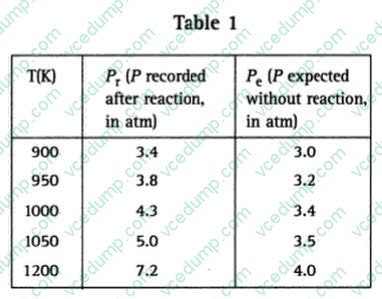
B. (T/298)(1 atm)
C. [(T ?273)/273](1 atm)
D. [(T ?298)/298](1 atm) -
Question 552:
Several models have been developed for relating changes in dissociation constants to changes in the tertiary and quaternary structures of oligomeric proteins. One model suggests that the protein's subunits can exist in either of two distinct conformations, R and T. At equilibrium, there are few R conformation molecules: 10 000 T to 1 R and it is an important feature of the enzyme that this ratio does not change. The substrate is assumed to bind more tightly to the R form than to the T form, which means that binding of the substrate favors the transition from the T conformation to R.
The conformational transitions of the individual subunits are assumed to be tightly linked, so that if one subunit flips from T to R the others must do the same. The binding of the first molecule of substrate thus promotes the binding of the second and if substrate is added continuously, all of the enzyme will be in the R form and act on the substrate. Because the concerted transition of all of the subunits from T to R or back, preserves the overall symmetry of the protein, this model is called the symmetry model. The model further predicts that allosteric activating enzymes make the R conformation even more reactive with the substrate while allosteric inhibitors react with the T conformation so that most of the enzyme is held back in the T shape.
Experiment Evaluating Non-Symmetry Model Enzymes
Experiments were performed with enzyme conformers that did not obey the symmetry model. The data is summarized in Figure 1.
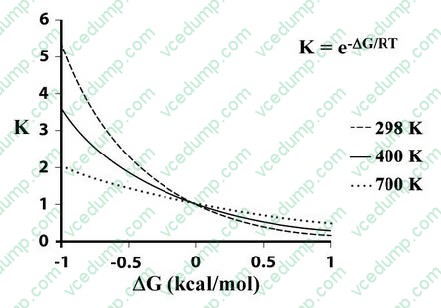
Figure 1: Equilibrium distribution of two conformers at different temperatures given the free energy of their interconversion. (modified from Mr.Holmium). What assumption is made about the T and R conformations and the substrate?
A. In the absence of any substrate, the T conformation predominates.
B. In the absence of any substrate, the R conformation predominates.
C. In the absence of any substrate, the T and R conformations are in equilibrium.
D. In the absence of any substrate, the enzyme exists in another conformation, S. -
Question 553:
Electromagnetic radiation from space constantly bombards the earth. Most wavelengths are absorbed by the atmosphere; however, there are two "windows" of nonabsorption through which significant amounts of radiation reach the ground.
The first transmits ultraviolet and visible light, as well as infrared light or heat; the second transmits radio waves. As a result, terrestrial organisms have evolved a number of pigments that interact with light in various ways: some capture light
energy, some provide protection from light- induced damage, and some serve camouflage or signaling purposes.
Among these compounds are many conjugated polyenes, which play important roles as photoreceptors. For every chemical compound, there are certain wavelengths of light whose quanta possess exactly the correct amount of energy to
raise electrons from their ground state to higher-energy orbitals. For most organic compounds, these wavelengths are in the UV range. However, conjugated double bond systems stabilize the electrons, so that they can be excited by lower-
frequency photons with wavelengths in the visible spectrum. Such a pigment, known as a chromophore, will then transmit the "subtraction color," a color complementary to the one absorbed. For instance, carotene, a hydrocarbon compound
with eleven conjugated double bonds, absorbs blue light and transmits orange. The wavelength that is absorbed generally increases with the number of conjugated bonds; rings and side-chains also affect wavelength.
Wavelength Color Subtraction Color
480 nm blue orange
580 nm yellow violet
680 nm red green
Among the many biological molecules that are affected by light is DNA, the genetic material of living organisms. DNA absorbs ultraviolet light, and may be damaged by UVC (< 280 nm) and UVB (280-315 nm). UVA (315-400 nm) and visible
light can actually repair light-induced damage to DNA by a process called photorepair. For this reason, UVA, which also stimulates tanning, was once considered beneficial. However, there is now increasing evidence that UVA can damage
skin.
Why is benzene colorless?
A. The absorption energy is of too high a frequency to be visible.
B. The absorption energy is of too low a frequency to be visible.
C. Benzene does not absorb light.
D. Benzene is not conjugated. -
Question 554:
Angular momentum is defined as:
A. the dot product of position vector and linear momentum.
B. the cross product of position vector and linear momentum.
C. the simple product of position vector and linear momentum.
D. the product of distance and linear momentum. -
Question 555:
The lead-acid battery, also called a lead storage battery, is the battery of choice for starting automobiles. It contains 6 cells connected in series, each composed of a lead oxide cathode “sandwiched” between 2 lead anodes. Insulating
separators are placed between the electrodes to prevent internal short-circuits. Aqueous sulfuric acid is the electrolyte.
When the battery is being discharged, the following reaction takes place:
Reaction 1
The electrode reactions, both written as reductions, are shown in Table 1.
Table 1
Half-reaction
E°(V)
PbO2(s) + SO42-(aq) + 4H+(aq) + 2e- →
PbSO4(s) + 2H2O
PbSO4(s) + 2e- → Pb(s) + SO42-(aq)
–0.36
As a car operates, the battery is recharged by electricity produced by the car's alternator, an AC generator whose ultimate power source is the car's internal combustion engine. In spite of this, batteries eventually lose their power. The battery
is said to be “dead” when Reaction 1 has proceeded completely to the right.
How many cells would be required to produce a 20-volt lead-acid battery of the type described in the passage?
A. 5
B. 10
C. 15
D. 20 -
Question 556:
When Gwendolyn Brooks published her first collection of poetry A Street In Bronzeville in 1945 most reviewers recognized Brooks' versatility and craft as a poet. Yet, while noting her stylistic successes few of her contemporaries discussed the critical question of Brooks' relationship to the Harlem Renaissance. How had she addressed herself, as a poet, to the literary movement's assertion of the folk and African culture, and its promotion of the arts as the agent to define racial integrity? The New Negro poets of the Harlem Renaissance expressed a deep pride in being Black; they found reasons for this pride in ethnic identity and heritage; and they shared a common faith in the fine arts as a means of defining and reinforcing racial pride. But in the literal expression of this impulse, the poets were either romantics, or realists and, quite often within the same poem, both. The realistic impulse, as defined best in the poems of McKay's Harlem Shadows (1922), was a sober reflection upon Blacks as second class citizens, segregated from the mainstream of American socio-economic life, and largely unable to realize the wealth and opportunity that America promised. The romantic impulse, on the other hand, as defined in the poems of Sterling Brown's Southern Road (1932), often found these unrealized dreams in the collective strength and will of the folk masses. In comparing the poems in A Street in Bronzeville with various poems from the Renaissance, it becomes apparent that Brooks brings many unique contributions to bear on this tradition. The first clue that A Street In Bronzeville was, at its time of publication, unlike any other book of poems by a Black American is its insistent emphasis on demystifying romantic love between Black men and women. During the Renaissance, ethnic or racial pride was often focused with romantic idealization upon the Black woman. A casual streetwalker in Hughes' poem, "When Sue Wears Red," for example, is magically transformed into an Egyptian Queen. In A Street In Bronzeville, this romantic impulse runs headlong into the biting ironies of racial discrimination. There are poems in which Hughes, McKay and Brown recognize the realistic underside of urban life for Black women. But for Brooks, unlike the Renaissance poets, the victimization of poor Black women becomes not simply a minor chord but a predominant theme. ...Brooks' relationship with the Harlem Renaissance poets, as A Street in Bronzeville ably demonstrates, was hardly imitative. As one of the important links with the Black poetic tradition of the 1920s and 1930s, she enlarged the element of realism that was an important part of the Renaissance world-view. Although her poetry is often conditioned by the optimism that was also a legacy of the period, Brooks rejects outright their romantic prescriptions for the lives of Black women. And in this regard, she serves as a vital link with the Black Arts Movement of the 1960s that, while it witnessed the flowering of Black women as poets and social activists as well as the rise of Black feminist aesthetics in the 1970s, brought about a curious revival of romanticism in the Renaissance mode.
According to the passage, the poems in A Street in Bronzeville are similar to the poems in Harlem Shadows because they each:
A. portray Black women in early twentieth-century America as resourceful individuals who were able to make successes of themselves.
B. influenced the poetry and social activism of Black women poets during the Black Arts Movement of the 1960s.
C. are based entirely on the romantic impulse of the New Negro poets of the Harlem Renaissance.
D. illustrate the grim realities of suffering and discrimination faced by Black Americans in early twentieth- century America. -
Question 557:
An object rests on a plane, with an angle of incline, , an acceleration due to gravity, g, and a coefficient of friction ?between the object and the plane. Which of the following gives the acceleration of the object?
A. a = g sin θ
B. a = g (sin θ – cos θ)
C. a = g (cos θ – µ sin θ)
D. a = g (sin θ – µ cos θ) -
Question 558:
The center that controls breathing, constriction and dilation of blood vessels, and heart beating is located in:
A. Cerebellum.
B. Pons.
C. Medulla oblongata.
D. Hypothalamus. -
Question 559:
The anthropomorphic bias of those who would relegate marsupials to an inferior evolutionary status is most apparent in their recourse to data on brain structure and behavior. Unlike humans and other placentals, marsupials lack the corpus callosum, which facilitates inter-hemisphere transfer of data acquired through the senses. Yet it cannot be inferred that marsupials are thus deprived of such function. Didelphis Virginiana, one of the opossums, makes use of the anterior commissure, an adaptation that is also found in reptiles and monotremes. Diprodontons, including kangaroos and koalas, supplement the anterior commissure with the fasciculus aberrans. While the modes of neocortical interconnection may be diverse, the work of Johnson, Heath and Jones points to the conclusion that, functionally speaking the cortices and neocortices of both groups of mammals exhibit parallel connections. Parker also notes "a similar range of brain size to body weight ratios and of neocortical expansion". Another stigma borne by marsupials is the consensus that they are less intelligent than placentals. Yet Williams argues that, all else being equal, natural selection will favor instinctive over learned behavior as being more biologically efficient and that it is the accidental death of the young that is the prime selective pressure for the evolution of intelligence. Seen in this light, marsupials have a competitive edge; their gestation period is brief and the young remain in the pouch for an extended period exposed only to those dangers which also affect the mother. There they are directly exposed to the mother's food supply and can observe her behavior at leisure. Placentals, on the other hand, not only have a longer gestation period but, once their young are born, must often leave while foraging. Such absences increase the risk of mortality and decrease the opportunity to learn. Thus, among placentals, selection would favor the apparent intelligence in the young and protective behavior in the mother. Marsupials are not known to exhibit maternal protective behavior. In fact, Serventy has reported that frightened female kangaroos will drop their pouch-young as they flee, drawing a predator's attention to the less able offspring while the adult escapes. This behavior, whether purposeful or accidental, instantaneously relieves the female marsupial of the mechanical difficulties of pregnancy with which her placental counterpart would be burdened, while marsupials can replace any lost young quickly. Thus, in the absence of any need for close maternal supervision, sacrificing their offspring in this manner may well have been favored in selection. Pointing to the absence of the "virtue" of maternal protectiveness in marsupials is an instance of how mistaken are those theorists who see similarities with humans as marks of evolutionary sophistication.
According to the passage, similarities between marsupials and placentals will most likely be found in:
A. brain function.
B. brain anatomy.
C. maternal behavior.
D. selection for intelligence. -
Question 560:
Red lead commonly known as 'Sandur' is represented by formula:
A. PbO
B. Pb3O4
C. PbCrO4
D. PbCO3

Related Exams:
Tips on How to Prepare for the Exams
Nowadays, the certification exams become more and more important and required by more and more enterprises when applying for a job. But how to prepare for the exam effectively? How to prepare for the exam in a short time with less efforts? How to get a ideal result and how to find the most reliable resources? Here on Vcedump.com, you will find all the answers. Vcedump.com provide not only Medical Tests exam questions, answers and explanations but also complete assistance on your exam preparation and certification application. If you are confused on your MCAT-TEST exam preparations and Medical Tests certification application, do not hesitate to visit our Vcedump.com to find your solutions here.