MCAT-TEST Exam Details
-
Exam Code
:MCAT-TEST -
Exam Name
:Medical College Admission Test: Verbal Reasoning, Biological Sciences, Physical Sciences, Writing Sample -
Certification
:Medical Tests Certifications -
Vendor
:Medical Tests -
Total Questions
:812 Q&As -
Last Updated
:Jul 16, 2026
Medical Tests MCAT-TEST Online Questions & Answers
-
Question 571:
By now the image of California in decline looms as large in the conventional media wisdom as the Golden State -- triumphant clich閟 of a generation ago -- "this El Dorado," as Time magazine had put it in 1969, that was to be "the mirror of America as it will become." Hardly anyone mentions the sunshine these days, or the beaches, or the beautiful young families around the pool, or the new lifestyles that all Americans will soon emulate, or how the University of California is wall-to-wall with cyclotrons and Nobel laureates, or how the state's higher-education system is accommodating absolutely all comers at little or no cost.
Today, California classrooms are among the most crowded in the country; many schools operate without libraries, without counselors, without nurses, without art or music, with greatly diminished curricular offerings. And what's true for the schools is true for the other services that have no powerful constituencies: children's protective services, probation, public health. Many cities have shut down swimming and wading pools because they cannot be safely maintained, and fenced playgrounds have been shut because of the danger presented by cracked and splintered structures. The list could be extended indefinitely. As thousands of professors receive golden handshakes from the University of California and California State University, among them some of the stars recruited in the go- go Fifties, the crowding in the lecture halls has increased and the lines at the classroom door have gotten longer and longer ("Don't panic," says the T-shirt on a student waiting to enroll at a Sacramento junior college, but many have been in line since four in the morning). U.C. tuition, which was roughly $800 a year in the early 1980s, is now over $4,000, a figure not out of line with tuitions at public colleges in other states but a far cry from the cost of a California state education in the golden days -- and it is almost certain to increase again next year. More than 200,000 students -- roughly 10 percent -- have vanished from the rolls of the state's colleges and universities in the past two years. While per capita tax revenues have been effectively frozen, and while they have declined relative to other states, client rolls for state services -- schools, prisons, Medicaid, welfare -- have been rising faster than population, leaving a structural gap that no one has yet confronted, much less closed. Again this year, the governor and legislature borrowed $7 billion from the banks and rolled over a $5 billion budget deficit, for which few politicians have proposed any remedies. Thanks to the deficit, California, which a decade ago, had one of the highest bond ratings in the country, has one of the lowest. "Were California a corporation," said John Vasconcellos, the chairman of the State Assembly Ways and Means Committee, "it would have little option but to initiate some sort of bankruptcy proceeding." The new image of California is familiar enough: a state suffering from earthquakes, fires, drought, floods, urban riots, dirty air, schools as overcrowded as the freeways; a legislature -- once said to be the nation's most professional and progressive -- oozing with corruption and stuck in the budgetary gridlock; and of course, recession, unemployment, chronic budget deficits, and financial calamity. For those who know their Nathaniel West, their Raymond Chandler, and their Joan Didion, the California apocalypse imagery is hardly new; it was always there on the dark side of the dream. This was the place, as Didion wrote back in the 1960s, "in which a boom mentality and a sense of Chekhovian loss meet in uneasy suspension; in which the mind is troubled by some buried but ineradicable suspicion that things better work here, because here, beneath that immense bleached sky, is where we run out of continent." os Angeles has burnt before. If you believe people like Governor Wilson, most of the state's problems were created somewhere else, usually in Washington, where the Clinton Administration has, on the one hand, cost California hundreds of thousands of jobs through excessive defense cuts and, on the other, allowed a horde of illegal immigrants to overrun the state's schools and health facilities without paying them for the immense costs that come with them...much has been changed in California since the days of West and Chandler, but the capacity for denial and self-deception is undiminished. In fact, California's trouble is at once more prosaic and more complex than the political rhetoric claims or the apocalyptic imagery suggests. It began before the recent recession, the big 1991 fire in the Oakland hills or the San Francisco earthquake of 1989 (itself a rerun of a classic), before those L.A. cops beat up Rodney King or the riot and the fire that followed their acquittal in the first trial, before the eight-year drought that still may not be over. And contrary to what a lot of Californians believe, a lot of the damage didn't just happen to us: we inflicted it on ourselves.
This passage argues that California has amassed overwhelming fiscal and social problems since the 1960s. The author uses which of the following to support this assertion?
I. California has repeatedly borrowed funds to cover its budget shortfalls.
II. Washington has played a major role in the decline of the California state economy.
III. Californian's demands for state services have far outstripped the state's ability to provide them.
A. I only
B. II only
C. II and III only
D. I and III only
I. California has repeatedly borrowed funds to cover its budget shortfalls. II. Washington has played a major role in the decline of the California state economy. III. Californian's demands for state services have far outstripped the state's ability to provide them. -
Question 572:
Musical instruments generate vibrations in the air that are perceived as musical tones. In many kinds of drums, these vibrations are created by a standing waves in a vibrating membrane. In a timpani drum, membrane vibration is coupled to the vibration of an enclosed volume of air. There may also be a second membrane whose vibration is coupled to that of the first by the enclosed air space, as in a snare drum. An idealized circular membrane will vibrate at normal mode frequencies given by Equation 1 where T is the membrane tension, r is the membrane radius, is the mass per unit area of the membrane, and frel is the relative frequency shown under each mode in Figure 1. The pitch of drums can be tuned by adjusting the membrane tension.
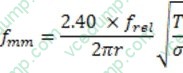
Equation 1
The modes are designated by two numbers, m and n. m indicates the number of diameter nodes, and n indicates the number of circular nodes. Several modes of vibration are shown in Figure 1.

Figure 1
Chladni patterns are formed when fine sand is placed on a vibrating membrane. The regions of localized sand indicate the:
A. circular nodes only.
B. antinodes.
C. circular nodes and diameter nodes.
D. region equidistant between nodes and antinodes. -
Question 573:
Although nihilism is commonly defined as a form of extremist political thought, the term has a broader meaning. Nihilism is in fact a complex intellectual stance with venerable roots in the history of ideas, which forms the theoretical basis for many positive assertions of modern thought. Its essence is the systematic negation of all perceptual orders and assumptions. A complete view must account for the influence of two historical crosscurrents: philosophical skepticism about the ultimacy of any truth, and the mystical quest for that same pure truth. These are united by their categorical rejection of the "known". The outstanding representative of the former current, David Hume (1711?776), maintained that external reality is unknowable, since sense impressions are actually part of the contents of the mind. Their presumed correspondence to external "things" cannot be verified, since it can be checked only by other sense impressions. Hume further asserts that all abstract conceptions turn out, on examination, to be generalizations from sense impressions. He concludes that even such an apparently objective phenomenon as a cause-and-effect relationship between events may be no more than a subjective fabrication of the observer. Stanley Rosen notes: "Hume terminates in skepticism because he finds nothing within the subject but individual impressions and ideas". For mystics of every faith, the "experience of nothingness" is the goal of spiritual practice. Buddhist meditation techniques involve the systematic negation of all spiritual and intellectual constructs to make way for the apprehension of pure truth. St. John of the Cross similarly rejected every physical and mental symbolization of God as illusory. St. John's spiritual legacy is, as Michael Novak puts it, "the constant return to inner solitude, an unbroken awareness of the emptiness at the heart of consciousness. It is a harsh refusal to allow idols to be placed in the sanctuary. It requires also a scorching gaze upon all the bureaucracies, institutions, manipulators, and hucksters who employ technology and its supposed realities to bewitch and bedazzle the psyche". Novak's interpretation points to the way these philosophical and mystical traditions prepared the ground for the political nihilism of the nineteenth and twentieth centuries. The rejection of existing social institutions and their claims to authority is in the most basic sense made possible by Humean skepticism. The political nihilism of the Russian intelligentsia combined this radical skepticism with a near mystical faith in the power of a new beginning. Hence, their desire to destroy becomes a revolutionary affirmation; in the words of Stanley Rosen, "Nihilism is an attempt to overcome or repudiate the past on behalf of an unknown and unknowable, yet hoped-for, future." This fusion of skepticism and mystical re-creation can be traced in contemporary thought, for example as an element in the counterculture of the 1960s.
Novak's interpretation of St. John's spiritual legacy (lines 31?8) is important to the author's argument primarily because it:
A. characterizes the essence of St. John's mystical doctrine.
B. gives insight into the historical antecedents of political nihilism.
C. draws a parallel between Christian mysticism and the Humean tradition of philosophical skepticism.
D. suggests that St. John's teachings are influential mainly because of their sociopolitical implications. -
Question 574:
Arsenic is widely distributed in sulfide ores of many metals and is obtained as a byproduct of copper smelting. The element, as well as many compounds of arsenic -- for example arsine, AsH3 -- are extremely poisonous. Arsenic compounds, as might be expected, have found use in herbicides and pesticides, but have also been successful in some pharmacological agents. The first useful antisyphilitic agent, Salvarsan, or 3,3'-diamino-4,4'-dihydroxyarsenobenzene dihydrochloride, is an arsenic compound. The element sublimes at 600°C, forming tetrahedral molecules, As4. Arsenic is a metalloid, possessing properties characteristic of both metals and non-metals. Arsenic is a gray-colored, metalliclooking solid, but arsenic vapor is yellow in color, has a garlic-like odor, and is very poisonous. If the arsenic vapor is cooled rapidly, an unstable, yellow crystalline allotrope consisting of As4 molecules is produced. The Marsh test, based on the instability of arsine, is a very sensitive test for the presence of arsenic. This test is commonly employed in the detection of arsenic poisoning -- either before or after death. The apparatus for the Marsh test is shown in Figure 1.

Figure 1
Typically, a sample, usually hair, is taken from a person suspected of being the victim of arsenic poisoning. This sample is then treated in such a way so as to produce arsenic oxide, As4O6. The oxide is then placed into the apparatus shown in Figure 1 and reacted according to Reaction 1. As4O6 + 12Zn(s) + 24H+(aq) AsH3(g) + 12Zn2 +(aq) + 6H2O Reaction 1 When the evolved arsine is ignited it decomposes into its elements. The arsenic vapor is rapidly cooled when it encounters the porcelain evaporating dish and deposits a black mirror of arsenic on the bottom, indicating the presence of arsenic in the original sample.
If equal masses of gray arsenic and yellow arsenic are allowed to completely react with oxygen at 298 K and constant pressure to form As4O6, which would produce more heat and why?
A. The yellow, because it is less stable than the gray.
B. The gray, because it is more stable than the yellow.
C. Both would produce the same amount of heat because they form the same product.
D. Both would produce the same amount of heat because they are the same element. -
Question 575:
A student observes that mercury forms a convex meniscus in the graduated cylinder but that water forms a concave one. This behavior is best explained by the fact that:
A. the two liquids are being kept in graduated cylinders made of different materials.
B. the adhesive forces between water and the walls of the graduated cylinder are greater than the adhesive forces between the mercury and the walls of the graduated cylinder.
C. the cohesive forces between two mercury atoms are stronger than the cohesive forces between two water molecules.
D. the mercury has strong cohesive than adhesive forces, whereas water has strong adhesive than cohesive ones. -
Question 576:
Aerobic respiration is the major process used by oxygen- requiring organisms to generate energy. During respiration, glucose is metabolized to generate chemical energy in the form of ATP:

The biochemical machinery necessary for cellular respiration is found in the mitochondria, small organelles scattered throughout the cytoplasm of most eukaryotic cells. The number of mitochondria per cell varies by tissue type and cell function.
Mitochondria are unusual in that they have their own genetic systems that are entirely separate from the cell's genetic material. However, mitochondrial replication is still dependent upon the cell's nuclear DNA to encode essential proteins required for replication. Despite this fact, mitochondria seem to replicate randomly, out of phase with both the cell cycle and other mitochondria.
The nature of the mitochondrial genome and protein synthesizing machinery has led many researchers to postulate that mitochondria may have arisen as the result of the ingestion of a bacterium by a primitive cell millions of years ago. It is postulated that the two may have entered into a symbiotic relationship and eventually became dependent on each another; the cell sustained the bacterium, while the bacterium provided energy for the cell. Gradually, the two evolved into the present-day eukaryotic cell, with the mitochondrion retaining some of its own DNA. This is known as the endosymbiotic hypothesis. Because mitochondrial DNA is inherited in a non-Mendelian fashion (mitochondria are inherited from the maternal parent, who supplies most of the cytoplasm to the fertilized egg), it has been used to look at evolutionary relationships among different organisms.
Which of the following pieces of evidence would NOT support the hypothesis that mitochondria were once independent bacteria that eventually formed a symbiotic relationship with eukaryotic cells?
A. Mitochondrial DNA is circular and not enclosed by a nuclear membrane.
B. Mitochondrial ribosomes more closely resemble eukaryotic ribosomes than prokaryotic ribosomes.
C. Many present-day bacteria live within eukaryotic cells, digesting nutrients that their hosts cannot and sharing the energy thus derived.
D. Mitochondrial DNA codes for its own ribosomal RNA. -
Question 577:
Agonistic behavior, or aggression, is exhibited by most of the more than three million species of animals on this planet. Animal behaviorists still disagree on a comprehensive definition of the term, but aggressive behavior can be loosely described as any action that harms an adversary or compels it to retreat. Aggression may serve many purposes, such as food gathering, establishing territory, and enforcing social hierarchy. In a general Darwinian sense, however, the purpose of aggressive behavior is to increase the individual animal's -- and thus, the species' -- chance of survival. Aggressive behavior may be directed at animals of other species, or it may be conspecific -- that is, directed at members of an animal's own species. One of the most common examples of conspecific aggression occurs in the establishment and maintenance of social hierarchies. In a hierarchy, social dominance is usually established according to physical superiority; the classic example is that of a pecking order among domestic fowl. The dominance hierarchy may be viewed as a means of social control that reduces the incidence of attack within a group. Once established, the hierarchy is rarely threatened by disputes because the inferior animal immediately submits when confronted by a superior. Two basic types of aggressive behavior are common to most species: attack and defensive threat. Each type involves a particular pattern of physiological and behavioral responses, which tends not to vary regardless of the stimulus that provokes it. For example, the pattern of attack behavior in cats involves a series of movements, such as stalking, biting, seizing with the forepaws and scratching with the hind legs, that changes very little regardless of the stimulus -- that is, regardless of who or what the cat is attacking. The cat's defensive threat response offers another set of closely linked physiological and behavioral patterns. The cardiovascular system begins to pump blood at a faster rate, in preparation for sudden physical activity. The eyes narrow and the ears flatten against the side of the cat's head for protection, and other vulnerable areas of the body such as the stomach and throat are similarly contracted. Growling or hissing noises and erect fur also signal defensive threat. As with the attack response, this pattern of responses is generated with little variation regardless of the nature of the stimulus. Are these aggressive patterns of attack and defensive threat innate, genetically programmed, or are they learned? The answer seems to be a combination of both. A mouse is helpless at birth, but by its 12th day of life can assume a defensive threat position by backing up on its hind legs. By the time it is one month old, the mouse begins to exhibit the attack response. Nonetheless, copious evidence suggests that animals learn and practice aggressive behavior; one need look no further than the sight of a kitten playing with a ball of string. All the elements of attack -- stalking, pouncing, biting and shaking -- are part of the game which prepares the kitten for more serious situations later in life.
Which of the following would be most in accord with the information presented in the passage?
A. The aggressive behavior of sharks is closely linked to their need to remain in constant motion.
B. The inability of newborn mice to exhibit the attack response proves that aggressive behavior must be learned.
C. Most animal species that do not exhibit aggressive behavior are prevented from doing so by environmental factors.
D. Members of a certain species of hawk use the same method to prey on both squirrels and gophers. -
Question 578:
Today's new urban Asia is just as sophisticated and in many ways more exciting than Western cities. Urban Asian consumers are knowledgeable, modern, and keen to embrace the global lifestyle. Young, urban Asians have grown up accustomed to many things that originated in the West. They have, for example, completely embraced pizza, some even claiming that it is a part of their heritage. The story is told about a young Singaporean boy who was taken by his father to Rome. "Hey, look, Dad," the little boy exclaimed, "they have pizza here too!" On sampling the product, the boy decided that it was not as good as the original back home. Nury Vitachi, who writes for the South China Post and the Far Eastern Economic Review, describes the Asian middle-class phenomenon: "Executives in Asia have become rich at warp speed by taking full control of their own lives. They invest a great deal of time in their work, they use strategy to scramble up the corporate ladder, and they demand payment in cash -- so they can make their money work as hard as they do." Signs of affluence are everywhere, but don't get carried away. Traveling around Asia, no matter how rich the Asians become, signs of their frugal nature are still apparent. And they are very cost-conscious. Shopkeepers in many Asian cities, most notably in Hong Kong, demand payments for discounted merchandise in cash instead of plastic, and many Asians are accustomed to that. Most people save the increases in their income, and many prefer to put it into fixed or other income-generating assets. Stock, land, and property are their favorites. Many affluent Asians still regard financial security as the most important form of security, and they are confident that Asia is the place to be to achieve that. While many have begun to savor the good life, they are not letting go of their top priority of education for their children. Education is looked upon as the most important contributing factor to success in life. And in many of Asia's competitive urban centers, there is a rush to acquire a second degree and other forms of professional qualification to ensure personal competitiveness in the workplace. There are extraordinary opportunities in Asia for education and training programs from language to software programming. Despite the rise in their assertiveness, Asians still look to the United States and not so much to Europe for ideas and trends. In general, except for those in Hong Kong and Japan, they are not particularly concerned with being fashionable. For today's Asia, Japan and Hong Kong are the sources of Asian fashion ideas, but as Asia becomes more affluent, there is a great opportunity to develop an indigenous fashion industry. For example, a huge market potential exists in introducing new materials and simplified but fashionable designs for countries in tropical Asia with a hot humid climate throughout the year. The population density and lack of space in urban areas has prohibited Asians from exercising frequently and few indulge in outdoor activities. This is changing. Most Asians consider themselves in good health. Compared with Americans, few are overweight -- largely as a result of their Asian diet. But now health clubs are becoming popular among younger Asians. Potential for indoor exercise equipment holds great promise. It is also important to dress for the gym, and younger Asians are serious about looking good, complete with makeup, sunglasses, designer exercise shoes and outfits, and a gym bag. In trying to hit Asia's moving targets, regardless of what you are selling, it is a good idea to stick with market density -- not country by country, but, mostly, city by city. Asian markets can be a marketer's dream in that their densities are among the highest in the world. Java, Indonesia's main island, has 115 million people. On Nanjing Road, Shanghai's busiest street, businesses are open twelve hours a day almost every day of the year. More than 1.5 million people visit the shops there and spend more than $50 million every day. Someone said that you can only become rich if you sell to the rich. I would add that you can become rich faster if you sell to the new rich. For investors in the West, watch for Western companies that are preparing a big push in Asia. The world has not yet seen anything like it before, and you can reap handsome dividends if you back those stocks that are going eastward.
In the passage, the author does all of the following EXCEPT:
A. resolve a seeming economic paradox.
B. offer an interpretation of an observed trend.
C. project consequences of current developments.
D. make the information presented relevant to the reader. -
Question 579:
The rich analyses of Fernand Braudel and his fellow Annales historians have made significant contributions to historical theory and research. In a departure from traditional historical approaches, the Annales historians, assume (as do Marxists) that history cannot be limited to a simple recounting of conscious human actions, but must be understood in the context of forces and material conditions that underlie human behavior. Braudel was the first Annales historian to gain widespread support of the idea that history should synthesize data from various social sciences, especially economics, in order to provide a broader view of human societies over time (although Febvre and Bloch, founders of the Annales school, had originated this approach). Braudel conceived of history as the dynamic interaction of three temporalities. The first of these, the evenementielle, involved short-lived dramatic "events," such as battles, revolutions and the actions of great men, which had preoccupied traditional historians like Carlyle. Conjonctures was Braudel's term for larger cyclical processes that might last up to half a century. The longue duree, a historical wave of great length, was for Braudel the most fascinating of the three temporalities. Here he focused on those aspects of everyday life that might remain relatively unchanged for centuries. What people ate, what they wore, their means and routes of travel -- for Braudel these things create "structures" which define the limits of potential social change for hundreds of years at a time. Braudel's concept of the longue duree extended the perspective of historical space as well as time. Until the Annales school, historians had taken the juridical political unit the nation-state, duchy, or whatever as their starting point. Yet, when such enormous timespans are considered, geographical features may well have more significance for human populations than national borders. In his doctoral thesis, a seminal work on the Mediterranean during the reign of Philip II, Braudel treated the geohistory of the entire region as a "structure" that had exerted myriad influences on human lifeways since the first settlements on the shores of the Mediterranean Sea. And so the reader is given such arcane information as the list of products that came to Spanish shores from North Africa, the seasonal routes followed by Mediterranean sheep and their shepherds, and the cities where the best ship timber could be bought. Braudel has been faulted for the imprecision of his approach. With his Rabelaisian delight in concrete detail, Braudel vastly extended the realm of relevant phenomena; but this very achievement made it difficult to delimit the boundaries of observation, a task necessary to beginning any social investigation. Further, Braudel and other Annales historians minimize the differences among the social sciences. Nevertheless, the many similarly-designed studies aimed at both professional and popular audiences indicate that Braudel asked significant questions which traditional historians had overlooked.
The passage implies that Braudel would consider which of the following as exemplifying the longue duree?
I. The prominence of certain crops in the diet of a region
II. The annexation of a province by the victor in a war
III.
A reduction in the population of an area following a disease epidemic
A. I only
B. III only
C. I and II only
D. II and III only
I. The prominence of certain crops in the diet of a region II. The annexation of a province by the victor in a war III. A reduction in the population of an area following a disease epidemic -
Question 580:
Morphine alkaloids derived from the opium poppy have long been used as analgesics. Codeine, the methyl ether of morphine, is a naturally occurring alkaloid with medicinal properties very similar to those of morphine. Thousands of derivatives of morphine have been synthesized and tested for their biological effects. For example, the diacylated derivative of morphine, heroin, is a highly addictive drug. Much effort has gone into understanding how morphine and its derivatives function.
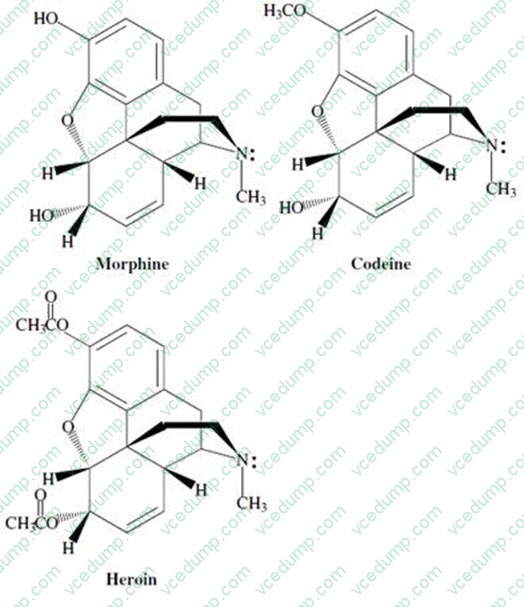
Studies have shown that certain common structural features of alkaloids are required for the compound to exhibit biological activity. These structural requirements are summarized by the so called "morphine rule":
Demerol and methadone, shown in Figure 2, are two synthetic alkaloids designed to satisfy the "morphine rule." Synthetic alkaloids such as these have been found to mimic certain physiological properties of morphine and its derivatives, and
have found pharmacological application due to other, more desirable biological effects. Methadone has been used widely in the United States and Great Britain as a treatment for heroin addiction; it reduces the physical symptoms
accompanying withdrawal without producing many of the other effects of heroin.
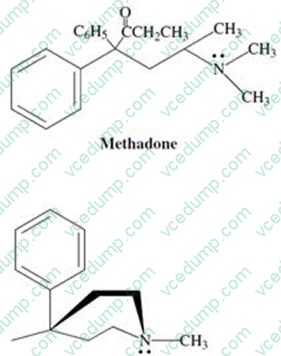
Meperidine (demerol) Figure 2
Researchers have discovered that the stereochemistry of the alkaloids is critical to their physiological effects. For example, (?-methadone produces powerful analgesic effects while (+)-methadone produces no effect. Which of the following is the most likely explanation for this difference in activity?
A. (+)-Methadone does not follow the "morphine rules."
B. Alkaloids bind to stereospecific receptors.
C. Analgesic effects require the rotation of plane polarized light.
D. (?-Methadone is the naturally occurring enantiomer
Related Exams:
Tips on How to Prepare for the Exams
Nowadays, the certification exams become more and more important and required by more and more enterprises when applying for a job. But how to prepare for the exam effectively? How to prepare for the exam in a short time with less efforts? How to get a ideal result and how to find the most reliable resources? Here on Vcedump.com, you will find all the answers. Vcedump.com provide not only Medical Tests exam questions, answers and explanations but also complete assistance on your exam preparation and certification application. If you are confused on your MCAT-TEST exam preparations and Medical Tests certification application, do not hesitate to visit our Vcedump.com to find your solutions here.