MCAT-TEST Exam Details
-
Exam Code
:MCAT-TEST -
Exam Name
:Medical College Admission Test: Verbal Reasoning, Biological Sciences, Physical Sciences, Writing Sample -
Certification
:Medical Tests Certifications -
Vendor
:Medical Tests -
Total Questions
:812 Q&As -
Last Updated
:Jul 16, 2026
Medical Tests MCAT-TEST Online Questions & Answers
-
Question 541:
Several techniques have been developed to determine the order of a reaction. The rate of a reaction cannot be predicted on the basis of the overall equation, but can be predicted on the basis of the rate-determining step. For instance, the following reaction can be broken down into three steps.
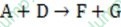
Step 1

(Slow)
Step 2
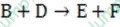
(fast)
Step 3

(fast)
Reaction 1 In this case, the first step in the reaction pathway is the rate-determining step. Therefore, the overall rate of the reaction must equal the rate of the first step, k1 [A] where k1 is the rate constant for the first step. (Rate constants of the different steps are denoted by kx , where x is the step number.)
In some cases, it is desirable to measure the rate of a reaction in relation to only one species. In a second-order reaction, for instance, a large excess of one species is included in the reaction vessel. Since a relatively small amount of this large concentration is reacted, we assume that the concentration essentially remains unchanged. Such a reaction is called a pseudo first-order reaction. A new rate constant, k', is established, equal to the product of the rate constant of the original reaction, k, and the concentration of the species in excess. This approach is often used to analyze enzyme activity.
In some cases, the reaction rate may be dependent on the concentration of a short-lived intermediate. This can happen if the rate-determining step is not the first step. In this case, the concentration of the intermediate must be derived from the equilibrium constant of the preceding step. For redox reactions, the equilibrium can be correlated with the voltage produced by two half-cells by means of the Nernst equation. This equation states that at any given moment:
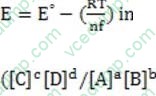
Equation 1 When

Reaction 2
Note: R = 8.314 J/K•mol; F = 9.6485 x 10⁴ C/mol.)
Which of the following is true of a reaction at equilibrium?
I) k1/k-1 = 1
II) E = E°
III) ln([C]c [D]d /[A]a [B]b ) = nFE°/RT
A. I only
B. III only
C. I and II only
D. I, II, and III -
Question 542:
Fireworks have been used for centuries in celebrations around the world. One of the primary components of these devices, black powder, was developed by the Chinese over a thousand years ago and is still used today as a propellant and explosive. Black powder is composed of potassium nitrate (KNO3), charcoal (primarily C) and sulfur (S8) in a 75:15:10 ratio by weight. It is very stable if kept dry but can easily be ignited by a spark or burning fuse to undergo the following reaction:

Reaction 1 The basic firework is shown in Figure 1. Fireworks rely on a particular kind of combustion in which oxygen is supplied by oxidizing agents included in the pyrotechnic mixture. When ignited, the solid propellant begins to liquefy and vaporize allowing the fuel and oxidizing agents to interact more intimately leading to rapid expansion of gases. Delay fuses time the ignition of the other compartments to occur when the shell is high above ground.

Figure 1
The light generating units of the firework are called stars and are dispersed and ignited by the bursting charge in each compartment. The intense colors of modern fireworks are generated by molecular emitters. For example, barium chloride emits green light (510?30 nm) and strontium chloride emits vibrant red light (605?50 nm). Many of the molecular emitters are unstable at room temperature and so cannot be placed directly into the firework. Instead, they are synthesized in the flame of the pyrotechnic reaction and exist for a short time before decomposing. The flame temperature must be carefully adjusted so that these emitters do not decompose too rapidly.

What is the energy of a photon of light emitted by a barium chloride emitter?
A. Option A
B. Option B
C. Option C
D. Option D -
Question 543:
Tetrodotoxin, the extremely potent poison produced by the puffer (fugu) fish, binds tightly to Na+ channels and blocks the flow of Na+ ions but does not affect K+ or Cl- channels. Tetrodotoxin directly blocks which phase of action potential propagation?
A. Depolarization
B. Repolarization
C. Hyperpolarization
D. Saltatory conduction -
Question 544:
For a very weak base, the pKb of a solution would likely be:
A. Equal to the pOH
B. Higher than the pOH
C. Lower than the pOH
D. Near 7 at 25篊 -
Question 545:
Aski jump is an inclined track from which a ski jumper takes off through the air. After traveling down the track, the skier takes off from a ramp at the bottom of the track. The skier lands farther down on the slope.
Figure 1 shows a ski jump, in which the ramp at the lower end of the track makes an angle of 30° to the horizontal. The track is inclined at an angle of to the horizontal and the slope is inclined at an angle of 45° to the horizontal. A ski jumper is stationary at the top of the track. Once the skier pushes off, she accelerates down the track, and then takes off from the ramp. The vertical height difference between the top of the track and its lowest point is 50 m, and the vertical height difference between the top of the ramp and its lowest point is 10 m.
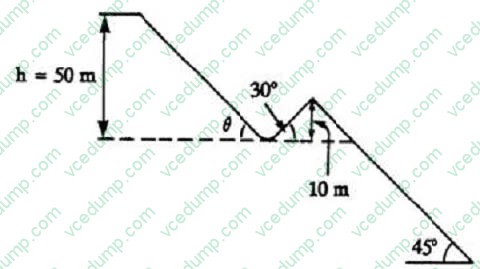
Figure 1
The distance traveled by the skier between leaving the ski jump ramp and making contact with the slope is called the jump distance. In some cases, in order to increase the jump distance a skier will jump slightly upon leaving the ramp,
thereby increasing the vertical velocity. Unless otherwise stated, assume that friction between the skis and the slope is negligible, and ignore the effects of air resistance.
What is the acceleration of an 80-kg skier going down the track if = 45?
A. Option A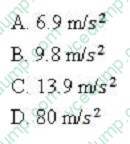
B. Option B
C. Option C
D. Option D -
Question 546:
The nuclei of certain unstable isotopes will spontaneously decay, producing a more stable nucleus and releasing a particle or quantity of energy. Alpha decay releases a helium nucleus, beta decay emits an electron, while gamma decay is the emission of a high energy photon. Each type of radioactive decay is characterized, in part, by the half-life of the radioactive material--the time required for half of the nuclei in a sample to undergo decay. Examples of such decays are shown in Figure 1.
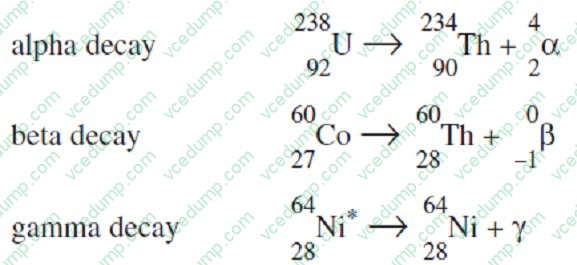
Figure 1
A Geiger counter can be used to detect the decay of radioactive materials. A simple Geiger counter consists of a hollow metal cylinder with a wire along its axis. The cylinder is filled with low pressure argon gas and a high voltage difference is
applied between the wire and the cylinder. When alpha, beta, or gamma radiation passes through the cylinder, it interacts with the gas particles and leads to the formation of ions which cause a discharge between the wire and the cylinder.
The consequent current may be used to drive a speaker, producing the characteristic clicking sound of the Geiger counter each time a pulse of current occurs. The Geiger counter circuitry is shown in Figure 2.

Figure 2
Assume that the values for V and R are known. What other information is needed to calculate the voltage drop across the speaker?
A. The resistance of the speaker's internal circuitry.
B. The duration of the discharge between the wire and the cylinder.
C. The current flowing through the resistor.
D. No other information is required. -
Question 547:
The polymerase chain reaction (PCR) is a powerful biological tool that allows the rapid amplification of any fragment of DNA without purification. In PCR, DNA primers are made to flank the specific DNA sequence to be amplified. These primers are then extended to the end of the DNA molecule with the use of a heat- resistant DNA polymerase. The newly synthesized DNA strand is then used as the template to undergo another round of replication. The 1st step in PCR is the melting of the target DNA into 2 single strands by heating the reaction mixture to approximately 94 oC, and then rapidly cooling the mixture to allow annealing of the DNA primers to their specific locations. Once the primer has annealed, the temperature is elevated to 72 oC to allow optimal activity of the DNA polymerase. The polymerase will continue to add nucleotides until the entire complimentary strand of the template is completed at which point the cycle is repeated (Figure 1) Figure 1

One of the uses of PCR is sex determination, which requires amplification of intron 1 of the amelogenin gene. This gene found on the X-Y homologous chromosomes has a 184 base pair deletion on the Y homologue. Therefore, by amplifying intron 1 females can be distinguished from males by the fact that males will have 2 different sizes of the amplified DNA while females will only have 1 unique fragment size.
What would PCR amplification of an individual's intron 1 of the amelogenin gene reveal if the individual were male?
A. One type of intron 1 since the individual has one X chromosome and one Y chromosome.
B. Two types of intron 1 since the individual has only one X chromosome.
C. One type of intron 1 since the individual has only one X chromosome.
D. Two types of intron 1 since the individual has one X chromosome and one Y chromosome. -
Question 548:
In an SDS-PAGE procedure, the SDS serves as a detergent.
Why are the proteins treated with a detergent before being run through the electrophoresis gel?
A. To coat the proteins with a large positive charge, since amino acid side chains may have positive, negative, or neutral charges, and a large uniform charge is necessary to get good separation in the gel.
B. To allow the electrophoresis to separate the proteins solely on the basis of the length of the primary sequence.
C. To prevent the protein from denaturing so that the electrophoresis can accurately resolve the proteins on the basis of tertiary structure.
D. To break the intramolecular bonds holding the tertiary and primary structure of the protein together, thereby generating linear fragments that may be sorted on size. -
Question 549:
...Squeaking sand produces sounds with very high frequencies -- between 500 and 2,500 hertz, lasting less than a quarter of a second. The peals are musically pure, often containing four or five harmonic overtones. Booming sand makes louder, low-frequency sounds of 50 to 300 hertz, which may last as long as 15 minutes in larger dunes (although typically they last for seconds or less). In addition, they are rather noisy, containing a multitude of nearby frequencies. Booms have never been observed to contain more than one harmonic of the fundamental tone. These dramatic differences once led to a consensus that although both types of sand produce acoustic emissions, the ways in which they do so must be substantially different.... In the late 1970s, however, Peter K. Haff, then at the California Institute of Technology, produced squeaks in booming sand, suggesting a closer connection between the two. Both kinds of sand must be displaced to make sounds. Walking on some sand, for example, forces the sand underfoot to move down and out, producing squeaks. In the case of booming sand, displacement occurs during avalanches. It is within the avalanche that sound begins and where the answers must be hiding. Before an avalanche can occur, winds must build a dune up to a certain angle, usually about 35 degrees for dry desert sand. Once an angle is achieved, the sand on the leeward side of the dune begins to slump. Intact layers of sand slip over the layers below, like a sheared deck of cards. At the same time, the individual grains in the upper layers tumble over the grains underneath, momentarily falling into the spaces between them and bouncing out again to continue their downward journey. Their concerted up-and-down motion is believed to be the secret source of sound. Fully developed avalanches, in which sliding plates of sand remain intact for most of their motion, have the greatest acoustic output. In some places, where large amounts of sand are involved, booming can be heard up to 10 kilometers away. Because it is caused by large volumes of shearing sand, the roaring is also loud. In fact, sounds made by booming sand can be nearly deafening, and the vibrations causing them can be so intense that standing in their midst is nearly impossible. A good place to start in exploring the vibrational properties of sand is with the grains themselves. The mean diameter of most sand grains, whether acoustically active or not, is about 300 microns. Usually the grains in a booming dune are very similar in size, especially near the leeward crest, where the sound most often originates; such uniformity allows for more efficient shearing. Otherwise, the smaller grains impede the smooth motion of the larger ones. Similar sizes do not alone allow sand to boom. On the contrary, the booming sands of Korizo and Gelf Kebib, also in Libya, feature an uncharacteristically broad range of particle sizes. Moreover, silent dune sand often contains grains somewhat similar to nearby booming sand. Grains of booming sand also tend to have uncommonly smooth surfaces, with protrusions on the scale of mere microns. Booming dunes are often found at the downwind end of large sand sources; having bounced and rolled across the desert for long distances, the sand grains in these dunes are usually highly polished. Over time a grain can also be polished by repeated shifts within a moving dune. And squeaking sand as well tends to be exceptionally smooth.... ...Another important factor is humidity, because moisture can modify the friction between grains or cause sand to clump together, thus precluding shearing. Sounds occur in those parts of the dune that dry the fastest. Precipitation may be rare in the desert, but dunes retain water with remarkable efficiency. Sand near the surface dries quickly, however, and sand around a dune's crest tends to dry the fastest.
A dune is found to be comprised of smooth grains and produces sounds that last less than a second. What further information, if any, would enable one to unambiguously characterize the sand as squeaking sand?
A. The grains are not uniform in size.
B. The sound is generated by walking upon it rather than through avalanches.
C. The information given is already sufficient to conclude that the sand is squeaking sand.
D. The sand cannot possibly be squeaking sand from the information given. -
Question 550:
In the early nineteenth century a large number of communal experiments, both secular and religious, sprang up in the northeastern United States. Perhaps the most famous secular commune was Brook Farm, founded by transcendentalists George Ripley and William H. Channing to promote the pursuit of leisure and culture through the proper application of time and labor. Its members (among the more notable were Nathaniel Hawthorne and Margaret Fuller) pursued field labor by day, art and philosophy by night. For a time the system worked so well that two afternoons a week were set aside for leisure and Brook Farm began outcompeting local farmers at the produce market. But by nature the Farm's members were thinkers, not workers; despite their success they remained mainly interested in the theoretical and philosophical implications of the experiment. Thus, when a devastating fire brought the community considerable financial burdens in its fifth year, the members felt little compunction about closing shop and returning to their comfortable Boston homes.
One of the most notable religious utopias was the Oneida community. Its founder, John Humphrey Noyes, believed that Christ's second coming had already occurred and that everyone alive was favored by Divine grace, which Noyes saw as an imperative to live a better life. Perhaps surprisingly, the Oneidans embraced industry and commerce, achieving success in fruit packing, trap making, and silk thread winding. They owned everything communally, and this principle extended to each other. The Oneidans saw monogamy as a selfish act and asserted that the men and women of the community were united in one "complex" marriage; sex between any two consenting members was perfectly acceptable. The Oneidans maintained order solely through "criticism"--anyone acting out of line was made to stand before the other members and hear his or her faults recounted. Oneida remained viable for some thirty years, until the leadership devolved on Noyes' son, an agnostic. The old religious fervor died out, and the dream degenerated into a joint stock company. Doubtless the most successful communalists were the Shakers, so called for the early propensity to tremble ecstatically during religious worship. Their guiding light, Mother Ann, espoused four key principles: Virgin Purity, Christian Communism, Confession, and Separation from the World. Though the Shakers were less adamant on the last point--maintaining social relations and some commerce with heir neighbors--they insisted on the other three, and renounced both personal property and sex. Men and women lived in a single large "Unitary Dwelling" and were considered complete equals, but they occupied separate wings and could speak together only if a third person were present. Despite their religious strictness, Shakers were known as simple, sincere, intelligent people, healthy and long-lived, producers of lovely books and hymns, and of furniture still prized for its quality and durability. In their eyday, six thousand Shakers lived in fifty-eight separate "families" throughout the Northeast. Later their celibacy, combined with their strict discipline, led to a decline in numbers, but even today a small number of elderly Shakers in two communities in Maine and New Hampshire continue to keep the faith.
It can be inferred from the passage that the cohesion of a secular workers' cooperative, based on the principles of collective ownership and the sharing of profits, would probably be weakened by:
I. diminished contact with the outside world.
II. increasing agnosticism.
III.
considerable economic losses.
A. I only
B. II only
C. III only
D. I and II only
I. diminished contact with the outside world. II. increasing agnosticism. III. considerable economic losses.



Related Exams:
Tips on How to Prepare for the Exams
Nowadays, the certification exams become more and more important and required by more and more enterprises when applying for a job. But how to prepare for the exam effectively? How to prepare for the exam in a short time with less efforts? How to get a ideal result and how to find the most reliable resources? Here on Vcedump.com, you will find all the answers. Vcedump.com provide not only Medical Tests exam questions, answers and explanations but also complete assistance on your exam preparation and certification application. If you are confused on your MCAT-TEST exam preparations and Medical Tests certification application, do not hesitate to visit our Vcedump.com to find your solutions here.