MCAT-TEST Exam Details
-
Exam Code
:MCAT-TEST -
Exam Name
:Medical College Admission Test: Verbal Reasoning, Biological Sciences, Physical Sciences, Writing Sample -
Certification
:Medical Tests Certifications -
Vendor
:Medical Tests -
Total Questions
:812 Q&As -
Last Updated
:Jul 16, 2026
Medical Tests MCAT-TEST Online Questions & Answers
-
Question 521:
An example of discontinuous variation is reflected by:
A. height.
B. intelligence.
C. blood group.
D. weight. -
Question 522:
Growth hormone decreases the sensitivity of cellular receptors to insulin. Therefore, a patient with acromegaly, which is caused by the oversecretion of growth hormone, would be expected to have:
A. a low blood glucose concentration.
B. a high blood glucose concentration.
C. a decreased urine volume.
D. a decreased cardiac output. -
Question 523:
The Russian wheat aphid, Diuraphis noxia, is a small green insect discovered in southern Russia around the turn of the century. Agricultural researchers are not quite sure, but they believe the Russian aphid adapted itself to wheat about ten thousand years ago, when the crop was first domesticated by man. What is not in doubt is the insect's destructiveness. Spread by both wind and human transport, the Russian aphid has destroyed wheat fields throughout Asia, Africa, and Latin America. Until a few years ago, the United States had been free of this pest. But in the spring of 1986, a swarm of Russian aphids crossed the Mexican border and settled a few hundred miles north, in central Texas. From there, it quickly spread to other Western states, destroying wheat fields all along its path. In fact, the level of destruction has been so great over the past five years that entomologists are calling the Russian aphid the greatest threat to American agriculture since the Hessian fly, Phytophaga destructor, was inadvertently brought to the colonies on ships by German mercenary troops during the Revolutionary War. A combination of several factors have made it particularly difficult to deal with the threat posed by this aphid. First, Russian aphids reproduce asexually at a phenomenal rate. This process, known as parthenogenesis, often results in as many as twenty generations of insects in a single year. Although most generations remain in a limited geographic area because they have no wings, a few generations are born with wings, allowing the insect to spread to new areas. Second, because wheat is a crop with a very low profit margin, most American farmers do not spray it with pesticides; it simply is not economical to do so. And since the Russian aphid has only recently entered the United States, it has no natural enemies among North American insects or animals. As a result, there have been no man-made or natural obstacles to the spread of the Russian aphid in the United States.
Agricultural researchers seeking to control the Russian aphid have looked to its place of origin for answers. In the Soviet Union, the Russian aphid has been kept in check by predators which have evolved alongside it over many thousands of years. One species of wasp seems to be particularly efficient at destroying the aphid. The pregnant females of the species search the Russian aphid's home, the interior of a wheat stalk, sting the aphid into paralysis, and then inject an egg into its body. When the egg hatches the wasp larva feeds off of the aphid, killing it in the process.
The introduction of predators like the wasp, coupled with the breeding of new strains of insect-resistant wheat, may substantially curb the destructiveness of the Russian aphid in the future. For the time being, however, American farmers are left to their own devices when it comes to protecting their wheat crops
It can reasonably be inferred that the author of the passage is:
A. a botanist with an interest in wheat production.
B. an agriculturist with an interest in pest control.
C. a pest exterminator with an interest in agriculture.
D. an entomologist with an interest in asexual reproduction. -
Question 524:
Before birth, the rodent brain is sexually undifferentiated. It is only in the first few days following birth, during a period referred to as the critical period, that the rodent brain differentiates along male or female lines. The hormone testosterone plays a critical role in this development. Specifically, sexual differentiation is determined by the presence of estradiol, an estrogen derivative of testosterone, in certain areas of the brain. Testosterone is converted to estradiol in critical brain cells that contain the enzyme aromatase. To study the effects of testosterone on the neonatal rodent brain, the following experiments were conducted:
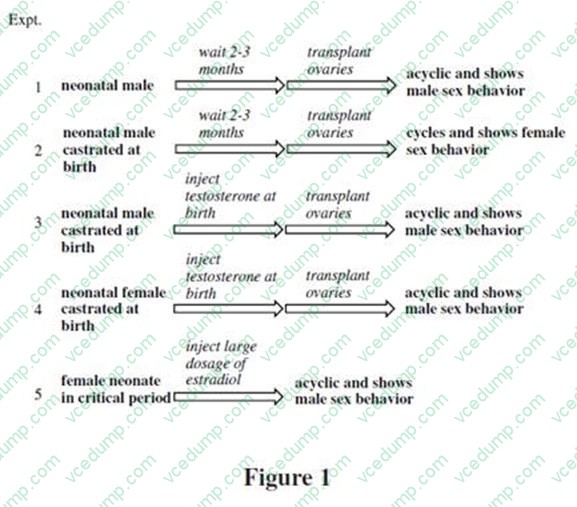
The above research, combined with additional studies, concluded that testosterone has two "organizational" effects on the male rodent brain: Defeminization Moderate levels of testosterone-derived estradiol during the critical period are sufficient for defeminization of the brain. Defeminization of the rodent brain results in loss of estrogen positive feedback on LH and FSH secretion and the ensuing loss of cyclicity, as well as loss of female sex behavior. Masculinization High levels of estradiol due to high levels of testosterone during the critical period results in masculinization of the brain. Masculinization leads to the induction of male sex behavior including antagonism towards other males and the mounting of females.
The conversion of testosterone to estradiol is what type of reaction?
A. Reduction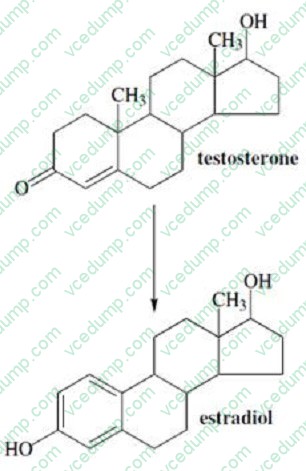
B. Aromatization
C. Electrophilic aromatic substitution
D. Methylation -
Question 525:
The polymerase chain reaction (PCR) is a powerful biological tool that allows the rapid amplification of any fragment of DNA without purification. In PCR, DNA primers are made to flank the specific DNA sequence to be amplified. These primers are then extended to the end of the DNA molecule with the use of a heat- resistant DNA polymerase. The newly synthesized DNA strand is then used as the template to undergo another round of replication.
The 1st step in PCR is the melting of the target DNA into 2 single strands by heating the reaction mixture to approximately 94 oC, and then rapidly cooling the mixture to allow annealing of the DNA primers to their specific locations. Once the primer has annealed, the temperature is elevated to 72 oC to allow optimal activity of the DNA polymerase. The polymerase will continue to add nucleotides until the entire complimentary strand of the template is completed at which point the cycle is repeated (Figure 1)

Figure 1
One of the uses of PCR is sex determination, which requires amplification of intron 1 of the amelogenin gene. This gene found on the X-Y homologous chromosomes has a 184 base pair deletion on the Y homologue. Therefore, by amplifying intron 1 females can be distinguished from males by the fact that males will have 2 different sizes of the amplified DNA while females will only have 1 unique fragment size.
The use of PCR for sex determination relies on the fact that:
A. the amelogenin gene is responsible for an autosomal recessive trait.
B. the X and Y homologous chromosomes have different sizes of intron 1 of the amelogenin gene.
C. females have an X and Y chromosome and males have two X chromosomes.
D. intron 1 has a different nucleotide length than intron 2. -
Question 526:
Early experimentation on the single-celled organism Acetabularia led to important discoveries about the role of the nucleus in regulating cell function. Acetabularia is an enormous single cell with three distinct regions: a cap, a root-like rhizoid,
and a stalk which connects the two. The following experiments were conducted to study the development of the cell:
Experiment 1
The stalk of an Acetabularia was cut, fragmenting the cell. The fragment which included the cap died shortly afterwards while the fragment containing the rhizoid regenerated to form a complete Acetabularia.
Experiment 2
The nucleus from Acetabularia mediterranea, which has a flat cap, was transplanted into Acetabularia crenulata, which has a tufted cap, following removal of the Acetabularia crenulata nucleus. The Acetabularia crenulata cap eventually
assumed the flat shape.
Experiment 3
The nucleus of Acetabularia mediterranea was removed from the young cell before it first formed a cap. A normal cap formed several weeks later. The cell proved to be inviable and died shortly thereafter.
Experiment 4
A young Acetabularia was fractioned into a number of portions before it first formed a cap. Several weeks later, both the portion containing the nucleus and the portion containing the apical tip of the stalk formed caps. The other portions did
not form caps.
It can be inferred from the experiments in the passage that development of the cap in Acetabularia is regulated by which of the following mechanisms?
A. Transcriptional regulation because mRNA in the cytoplasm lies dormant for several weeks before cap formation occurs.
B. Translational regulation because mRNA is not produced by the nucleus until it is required for cap production.
C. Translational regulation because mRNA in the cytoplasm lies dormant for several weeks before cap formation occurs.
D. Neither transcriptional regulation nor translational regulation. -
Question 527:
The mind, just like the body, has its needs. The needs of the body are the foundations of society; those of the mind are its amenities. While government and laws provide for the safety and well-being of men when they gather together, the sciences and the arts, which are less despotic but perhaps more powerful, spread garlands of flowers over the iron chains that bind them, stifle in them the sense for that original liberty for which they seem to have been born, cause them to love their own enslavement, and turn them into so-called "civilized people." Necessity raised thrones; the sciences and the arts have strengthened them. O earthly powers: cherish talents and protect those who cultivate them. O civilized people, cultivate them: you happy slaves owe to them that delicate and refined taste of which you are so proud, that gentleness of character and urbanity of manner which make relations among you so amiable and easy -- in other words, that semblance of all the virtues, none of which you actually possess... ...How pleasant it would be to live among us, if our external appearance were always a reflection of what is in our hearts, if decency were virtue, if our maxims served as our rules, and if true philosophy were inseparable from the title of philosopher! But so many qualities are seldom found together, and virtue hardly ever walks in such great pomp. Richness of adornment may be the mark of a man of taste, but a healthy, robust man is known by other signs: it is beneath the rustic clothes of a farmer, and not the gilt of a courtier, that strength and vigor of the body will be found. Ornamentation is just as foreign to virtue, which is the strength and vigor of the soul. The good man is an athlete who prefers to compete in the nude: he disdains all those vile ornaments which would hinder the use of his strength, ornaments which were for the most part invented only to hide some deformity. Before art had molded our manners and taught our passions to speak an affected language, our customs were rustic but natural, and differences in conduct revealed clearly differences in character. Human nature, basically, was no better, but men found security in being able to see through each other easily, and this advantage, which we no longer appreciate, spared them many vices. Now that more subtle refinements and more delicate taste have reduced the art of pleasing to set rules, a base and deceptive uniformity prevails in our behavior, and all minds seem to have been cast in the same mold. Incessantly politeness and propriety make demands on us, and incessantly we follow usage but never our own inclinations. We no longer dare to appear as we are, and under this perpetual constraint, the men who form this herd called society, when placed in the same circumstances, will all act similarly unless stronger motives direct them to do otherwise. Therefore we will never know well those with whom we deal, for to know our friends we will have to wait for some crises to arise -- which is to say that we will have to wait until it is too late, as it is for these very crises that it is essential to know one's friends well. What vice would not accompany this uncertainty? No more sincere friendships, no more genuine esteem, no more well-based confidence. Suspicion, offenses, fears, coldness, reserve, hatred and betrayal will constantly hide under the same false veil of politeness, under that much touted urbanity which we owe to the enlightenment of our times. The name of the Master of the Universe will no longer be profaned by swearing, but insulted by blasphemies that will not offend our scrupulous ears. Men will not boast of their own merits, but belittle those of others. An enemy will not be crudely insulted, but adroitly slandered. National hatreds will die, but so will patriotism. A dangerous skepticism will take the place of the scorning of ignorance. Some excesses will be forbidden, some vices dishonored, but others will be dignified with the name of virtues, and one must either have them or feign them. Let those who want to praise the sobriety of the sages of our time do so; as for me, I see in it only a refinement of intemperance that is as unworthy of my praise as their hypocritical simplicity.
According to the author, an "urbane" person is most likely to put the highest value on which of the following characteristics?
A. simple, unadorned clothing.
B. reflection on one's individual character.
C. polite relations in public discourse.
D. natural behavior and action. -
Question 528:
The automobile airbag was designed to inflate upon impact and decrease the risk of injury to drivers and passengers. Among the challenges to its development was the need to find a reliable inflation mechanism that was sufficiently rapid, controllable, and nontoxic. Prototypes employing compressed gases failed to meet these criteria. Researchers thus turned their attention to chemical alternatives.
The ideal inflatant requires a chemical reaction in which the reactants are stable and relatively dense in the condensed phase while the products are mostly or completely gaseous at ambient temperature and pressure. Additionally, the ideal chemical reaction would require a low activation energy and have a high kinetic rate constant, without the large exothermicity characteristic of most such reactions. Traditional explosives such as nitroglycerin, C3H5N3O9(l), were rejected almost immediately because of the extremely exothermic nature of their conversion. Benign solids such as calcium carbonate, CaCO3 , were similarly rejected, because of their large activation requirements. The desired attributes were finally found in sodium azide, NaN3, a stable, dense, ionic solid which rapidly decomposes into elemental sodium and nitrogen gas when ignited by an electrical impulse.

Reaction 1
The gas generating mixture includes excess KNO3 which reacts with the sodium metal from Reaction 1 to produce additional N2 and potassium and sodium oxides (Reactions 2 and 3). These oxides react with SiO2 to produce a non-toxic and stable alkaline silica (glass).

Reaction 2

Reaction 3
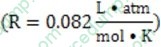
A sodium azide air bag inflates to a volume of 45 Liters at STP. According to the information contained in the passage, what is the mass of NaN3 (Mol. Wt. = 65) that is required to inflate the bag?
A. 76 grams
B. 81 grams
C. 87 grams
D. 130 grams -
Question 529:
There are two opposing theories of light: the particle theory and the wave theory. According to the particle theory, light is composed of a stream of tiny particles that are subject to the same physical laws as other types of elementary particles.
One consequence of this is that light particles should travel in a straight line unless an external force acts on them. According to the wave theory, light is a wave that shares the characteristics of other waves. Among other things, this means
that light waves should interfere with each other under certain conditions.
In support of the wave theory of light, Thomas Young's double slit experiment proves that light does indeed exhibit interference. Figure 1 shows the essential features of the experiment. Parallel rays of monochromatic light pass through two
narrow slits and are projected onto a screen. Constructive interference occurs at certain points on the screen, producing bright areas of maximum light intensity. Between these maxima, destructive interference produces light intensity minima.
The positions of the maxima are given by the equation dsin = n, where d is the distance between the slits, is the angle shown in Figure 1, the integer n specifies the particular maxima, and is the wavelength of the incident light. (Note: sin tan
for small angles.)
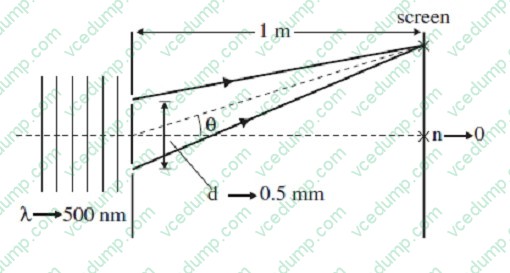
Figure 1
Light waves can be described in terms of frequency f and wavelength or in terms of wave number k and angular frequency . These quantities are related by the following equations:
k = 2/ and = 2f
Which equation below accurately describes the speed of the wave v in terms of k and ?
A. v = f
B. v = + k
C. v = /k
D. v = k -
Question 530:
The hydrogens of alkanes have pKa values that are over 30 or 40. In contrast, the -hydrogens of aldehydes and ketones have pKa values that range from 19 to 21. These fairly acidic -hydrogens can be removed by strong bases to form anions called enolates. The enolate ions are strongly stabilized by resonance. Protonation of the enolate at oxygen produces an enol. Interconversion between the keto and enol forms is called tautomerization and is illustrated in Figure 1. The keto form is usually highly favored.
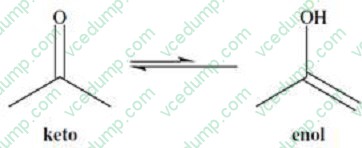
Figure 1
Keto-enol tautomerization has some interesting consequences. For example, if a ketone is treated with acid or base in a solvent of D2O (heavy water), all of the - hydrogens will be exchanged for deuterium. This reaction is shown in Figure 2.
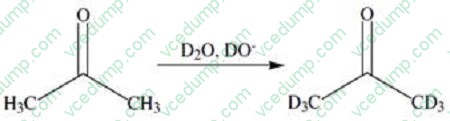
Figure 2
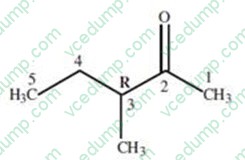
Another consequence of keto-enol tautomerization is the racemization of chiral -carbons. In the enol form, the -carbon adopts a planar configuration and is no longer chiral. Tautomerization back to the ketone produces a racemic mixture of products. This is shown in Figure 3.
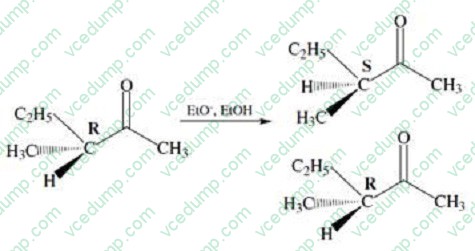
Figure 3
The IUPAC name for the reactant in Figure 3 is:
A. (R)-3-methyl-2-pentanone
B. (R)-3-ethyl-2-butanone
C. (R)-3-ethyl-3-methyl-propanal
D. (R)-2,2-diethyl-propanone

Related Exams:
Tips on How to Prepare for the Exams
Nowadays, the certification exams become more and more important and required by more and more enterprises when applying for a job. But how to prepare for the exam effectively? How to prepare for the exam in a short time with less efforts? How to get a ideal result and how to find the most reliable resources? Here on Vcedump.com, you will find all the answers. Vcedump.com provide not only Medical Tests exam questions, answers and explanations but also complete assistance on your exam preparation and certification application. If you are confused on your MCAT-TEST exam preparations and Medical Tests certification application, do not hesitate to visit our Vcedump.com to find your solutions here.