MCAT-TEST Exam Details
-
Exam Code
:MCAT-TEST -
Exam Name
:Medical College Admission Test: Verbal Reasoning, Biological Sciences, Physical Sciences, Writing Sample -
Certification
:Medical Tests Certifications -
Vendor
:Medical Tests -
Total Questions
:812 Q&As -
Last Updated
:Jul 16, 2026
Medical Tests MCAT-TEST Online Questions & Answers
-
Question 501:
The rich analyses of Fernand Braudel and his fellow Annales historians have made significant contributions to historical theory and research. In a departure from traditional historical approaches, the Annales historians, assume (as do Marxists) that history cannot be limited to a simple recounting of conscious human actions, but must be understood in the context of forces and material conditions that underlie human behavior. Braudel was the first Annales historian to gain widespread support of the idea that history should synthesize data from various social sciences, especially economics, in order to provide a broader view of human societies over time (although Febvre and Bloch, founders of the Annales school, had originated this approach). Braudel conceived of history as the dynamic interaction of three temporalities. The first of these, the evenementielle, involved short-lived dramatic "events," such as battles, revolutions and the actions of great men, which had preoccupied traditional historians like Carlyle. Conjonctures was Braudel's term for larger cyclical processes that might last up to half a century. The longue duree, a historical wave of great length, was for Braudel the most fascinating of the three temporalities. Here he focused on those aspects of everyday life that might remain relatively unchanged for centuries. What people ate, what they wore, their means and routes of travel -- for Braudel these things create "structures" which define the limits of potential social change for hundreds of years at a time. Braudel's concept of the longue duree extended the perspective of historical space as well as time. Until the Annales school, historians had taken the juridical political unit the nation-state, duchy, or whatever as their starting point. Yet, when such enormous timespans are considered, geographical features may well have more significance for human populations than national borders. In his doctoral thesis, a seminal work on the Mediterranean during the reign of Philip II, Braudel treated the geohistory of the entire region as a "structure" that had exerted myriad influences on human lifeways since the first settlements on the shores of the Mediterranean Sea. And so the reader is given such arcane information as the list of products that came to Spanish shores from North Africa, the seasonal routes followed by Mediterranean sheep and their shepherds, and the cities where the best ship timber could be bought. Braudel has been faulted for the imprecision of his approach. With his Rabelaisian delight in concrete detail, Braudel vastly extended the realm of relevant phenomena; but this very achievement made it difficult to delimit the boundaries of observation, a task necessary to beginning any social investigation. Further, Braudel and other Annales historians minimize the differences among the social sciences. Nevertheless, the many similarly-designed studies aimed at both professional and popular audiences indicate that Braudel asked significant questions which traditional historians had overlooked. The passage suggests that, compared with traditional historians, Annales historians are:
A. more interested in other social sciences than in history.
B. critical of the achievements of famous historical figures.
C. skeptical of the validity of most economic research.
D. more interested in the underlying context of human behavior. -
Question 502:
Our sense of smell is arguably the most powerful of our five senses, but it also the most elusive. It plays a vital yet mysterious role in our lives. Olfaction is rooted in the same part of the brain that regulates such essential functions as body metabolism, reaction to stress, and appetite. But smell relates to more than physiological function: its sensations are intimately tied to memory, emotion, and sexual desire. Smell seems to lie somewhere beyond the realm of conscious thought, where, intertwined with emotion and experience, it shapes both our conscious and unconscious lives.
The peculiar intimacy of this sense may be related to certain anatomical features. Smell reaches the brain more directly than do sensations of touch, sight, or sound. When we inhale a particular odor, air containing volatile odiferous molecules is warmed and humidified as it flows over specialized bones in the nose called turbinates. As odor molecules land on the olfactory nerves, these nerves fire a message to the brain. Thus olfactory neurons render a direct path between the stimulus provided by the outside environment and the brain, allowing us to rapidly perceive odors ranging from alluring fragrances to noisome fumes.
Certain scents, such as jasmine, are almost universally appealing, while others, like hydrogen sulfide (which emits a stench reminiscent of rotten eggs), are usually considered repellent, but most odors evoke different reactions from person to person, sometimes triggering strong emotional states or resurrecting seemingly forgotten memories. Scientists surmise that the reason why we have highly personal associations with smells is related to the proximity of the olfactory and emotional centers of our brain. Although the precise connection between emotion and olfaction remains a mystery, it is clear that emotion, memory, and smell are all rooted in a part of the brain called the limbic lobe.
Even though we are not always conscious of the presence of odors, and are often unable to either articulate or remember their unique characteristics, our brains always register their existence. In fact, such a large amount of human brain tissue is devoted to smell that scientists surmise the role of this sense must be profound. Moreover, neurobiological research suggests that smell must have an important function because olfactory neurons can regenerate themselves, unlike most other nerve cells. The importance of this sense is further supported by the fact that animals experimentally denied the olfactory sense do not develop full and normal brain function.
The significance of olfaction is much clearer in animals than in human beings. Animal behavior is strongly influenced by pheromones, which are odors that induce psychological or behavioral changes and often provide a means of communicating within a species. These chemical messages, often a complex blend of compounds, are of vital importance to the insect world. Honeybees, for example, organize their societies through odor: the queen bee exudes an odor that both inhibits worker bees from laying eggs and draws drones to her when she is ready to mate. Mammals are also guided by their sense of smell. Through odors emitted by urine and scent glands, many animals maintain their territories, identify one another, signal alarm, and attract mates.
Although our olfactory acuity can't rival that of other animal species, human beings are also guided by smell. Before the advent of sophisticated laboratory techniques, physicians depended on their noses to help diagnose illness. A century ago, it was common medical knowledge that certain bacterial infections carry the musty odor of wine, that typhoid smells like baking bread, and that yellow fever smells like meat. While medical science has moved away from such subjective diagnostic methods, in everyday life we continue to rely on our sense of small, knowingly or not, to guide us.
The author describes the sense of smell as elusive because:
A. odiferous molecules are extremely volatile.
B. the functions of smell are emotional rather than physiological.
C. the function and effects of smell are not fully understood.
D. olfactory sensations are more fleeting than those of other senses. -
Question 503:
There are two opposing theories of light: the particle theory and the wave theory. According to the particle theory, light is composed of a stream of tiny particles that are subject to the same physical laws as other types of elementary particles.
One consequence of this is that light particles should travel in a straight line unless an external force acts on them. According to the wave theory, light is a wave that shares the characteristics of other waves. Among other things, this means
that light waves should interfere with each other under certain conditions.
In support of the wave theory of light, Thomas Young's double slit experiment proves that light does indeed exhibit interference. Figure 1 shows the essential features of the experiment. Parallel rays of monochromatic light pass through two
narrow slits and are projected onto a screen. Constructive interference occurs at certain points on the screen, producing bright areas of maximum light intensity. Between these maxima, destructive interference produces light intensity minima.
The positions of the maxima are given by the equation dsin = n, where d is the distance between the slits, is the angle shown in Figure 1, the integer n specifies the particular maxima, and is the wavelength of the incident light. (Note:
sin tan for small angles.)

Figure 1

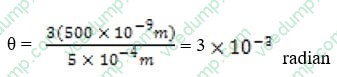
What is the angle for the third maximum (n = 3)?
A. Option A
B. Option B
C. Option C
D. Option D -
Question 504:
Before birth, the rodent brain is sexually undifferentiated. It is only in the first few days following birth, during a period referred to as the critical period, that the rodent brain differentiates along male or female lines. The hormone testosterone plays a critical role in this development. Specifically, sexual differentiation is determined by the presence of estradiol, an estrogen derivative of testosterone, in certain areas of the brain. Testosterone is converted to estradiol in critical brain cells that contain the enzyme aromatase. To study the effects of testosterone on the neonatal rodent brain, the following experiments were conducted:
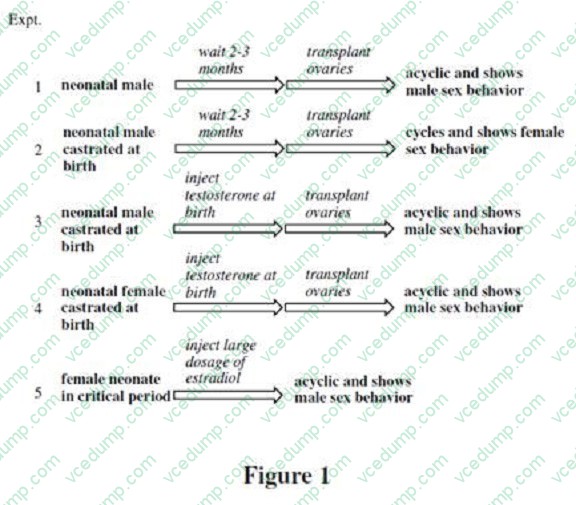
The above research, combined with additional studies, concluded that testosterone has two "organizational" effects on the male rodent brain: Defeminization Moderate levels of testosterone-derived estradiol during the critical period are sufficient for defeminization of the brain. Defeminization of the rodent brain results in loss of estrogen positive feedback on LH and FSH secretion and the ensuing loss of cyclicity, as well as loss of female sex behavior. Masculinization High levels of estradiol due to high levels of testosterone during the critical period results in masculinization of the brain. Masculinization leads to the induction of male sex behavior including antagonism towards other males and the mounting of females.
A normal female rat injected with estradiol will respond by:
A. decreasing secretion of LH from the anterior pituitary.
B. increasing secretion of LH from the anterior pituitary.
C. decreasing secretion of GnRH from the hypothalamus.
D. increasing secretion of progesterone from the follicle. -
Question 505:
Many nutrients required by plants exist in soil as basic cations:

A soil's cation-exchange capacity is a measure of its ability to adsorb these basic cations as well as exchangeable hydrogen and aluminum ions. The cation-exchange capacity of soil is derived from two sources: small clay particles called micelles consisting of alternating layers of alumina and silica crystals, and organic colloids.

Replacement of + and + by other cations of lower valence creates a net negative charge within the inner layers of the micelles. This is called the soil's permanent charge. For example, replacement of an atom of aluminum by calcium within a section where the net charge was previously zero, as shown below, produces a net charge of ?, to which other cations can become adsorbed.

Figure 1
A pH-dependent charge develops when hydrogen dissociates from hydroxyl moieties on the outer surfaces of the clay micelles. This leaves negatively-charged oxygen atoms to which basic cations may adsorb. Likewise, a large pH-
dependent charge develops when hydrogen dissociates from carboxylic acids and phenols in organic matter.
In most clays, permanent charges brought about by substitution account for anywhere from half to nearly all of the total cation-exchange capacity. Soils very high in organic matter contain primarily pH-dependent charges. In a research study,
three samples of soil were leached with a 1 N solution of neutral KCl, and the displaced A13+ and basic cations measured. The sample was then leached again with a buffered solution of BaCl2 and triethanolamine at pH 8.2, and the
displaced H+ measured. Table 1 gives results for three soils tested by this method.
Table 1

Due to the buffering effect of the soil's cationexchange capacity, just measuring the soil solution's pH will not indicate how much base is needed to change the soil pH. In another experiment, measured amounts of acid and base were added to 10-gram samples of well-mixed soil that had been collected from various locations in a field. The volumes of the samples were equalized by adding water. The results were recorded in Figure 2.

Figure 2.
Anaerobic organisms are able to denitrify wet soils by the following metabolic pathway.

If all the oxygen in the nitric acid is converted to water, how many additional equivalents of acid will be consumed during the production of 5 M of nitrogen?
A. 20
B. 30
C. 40
D. 50 -
Question 506:
...Until last year many people -- but not most economists -- thought that the economic data told a simple tale. On one side, productivity -- the average output of an average worker -- was rising. And although the rate of productivity increase was very slow during the 1970's and early 1980's, the official numbers said that it had accelerated significantly in the 1990's. By 1994 an average worker was producing about 20 percent more than his or her counterpart in 1978. On the other hand, other statistics said that real, inflation- adjusted wages had not been rising at anything like the same rate. In fact, some of the most commonly cited numbers showed real wages actually falling over the last 25 years. Those who did their homework knew that the gloomiest numbers overstated the case....Still, even the most optimistic measure, the total hourly compensation of the average worker, rose only 3 percent between 1978 and 1994.... ...But now the experts are telling us that the whole thing may have been a figment of our statistical imaginations.... a blue-ribbon panel of economists headed by Michael Boskin of Stanford declared that the Consumer Price Index [C.P.I.] had been systematically overstating inflation, probably by more than 1 percent per year for the last two decades, mainly failing to take account of changes in the patterns of consumption and improvements in product quality.... ...The Boskin report, in particular, is not an official document -- it will be quite a while before the Government actually issues a revised C.P.I., and the eventual revision may be smaller than Boskin and his colleagues propose. Still, the general outline of the resolution is pretty clear. When all the revisions are taken into account, productivity growth will probably look somewhat higher than it did before, because some of the revisions being proposed to the way we measure consumer prices will also affect the way we calculate growth. But the rate of growth of real wages will look much higher -- and so it will now be roughly in line with productivity, which will therefore reconcile numbers on productivity and wages with data that show a roughly unchanged distribution of income between capital and labor. In other words, the whole story about workers not sharing in productivity gains will turn out to have been based on a statistical illusion. It is important not to go overboard on this point. There are real problems in America, and our previous concerns were by no means pure hypochondria. For one thing, it remains true that the rate of economic progress over the past 25 years has been much slower than it was in the previous 25. Even if Boskin's numbers are right, the income of the median family -- which officially has experienced virtually no gain since 1973 -- has risen by only about 35 percent over the past 25 years, compared with 100 percent over the previous 25. Furthermore, it is quite likely that if we "Boskinized" the old data -- that is, if we tried to adjust the C.P.I. for the 50's and 60's to take account of changing consumption patterns and rising product quality -- we would find that official numbers understated the rate of progress just as much if not more than they did in recent decades.... ...Moreover, while workers as a group have shared fully in national productivity gains, they have not done so equally. The overwhelming evidence of a huge increase in income inequality in America has nothing to do with price indexes and is therefore unaffected by recent statistical revelations. It is still true that families in the bottom fifth, who had 5.4 percent of total income in 1970, had only 4.2 percent in 1994; and that over the same period the share of the top 5 percent went from 15.6 to 20.1. And it is still true that corporate C.E.O.'s, who used to make about 35 times as much as their employees, now make 120 times as much or more.... ...While these are real and serious problems, however, one thing is now clear: the truth about what is happening in America is more subtle than the simplistic morality play about greedy capitalists and oppressed workers that so many would- be sophisticates accepted only a few months ago. There was little excuse for buying into that simplistic view then; there is no excuse now.... Which of the following can be inferred as the best description of the Boskin report?
A. A document that clarifies the existing percentage distribution of income to labor and to capital.
B. A document that exposes the fact that the C.P.I. has overstated inflation for the past twenty years.
C. A document that reveals that worker productivity has been overstated over the last twenty years.
D. A document that reveals that wages have significantly decreased over the last twenty years. -
Question 507:
Breast milk is proven to be the best form of nutrition for infants and is recommended for at least 1 year after birth. Unfortunately, a recent survey of breastfeeding mothers revealed that only 20% continue breastfeeding or to provide breast milk through pumping after 4 months, after which they switch to formula. When asked about reasons for stopping breastfeeding, the top three reasons were: going back to work, lack of support, and difficulties pumping. A socioeconomic study of the mothers revealed that women who choose to breastfeed for longest tend to have a higher level of education and come from more affluent backgrounds. Conversely, those mothers who breastfeed for the least amount of time tend to belong to minority groups and are from poorer backgrounds. It has been proposed that cultural differences also have a significant impact on the duration of breastfeeding.
Which statement would be supported by the knowledge that out of the women who took part in the socioeconomic survey, 2% were from a minority background?
A. There are enough minority respondents to draw conclusions based on ethnicity.
B. There are enough minority respondents to draw conclusions based on wealth.
C. There are not enough minority respondents to make conclusions comparing ethnicity.
D. There is no need to obtain more responses from minority groups. -
Question 508:
Before birth, the rodent brain is sexually undifferentiated. It is only in the first few days following birth, during a period referred to as the critical period, that the rodent brain differentiates along male or female lines. The hormone testosterone plays a critical role in this development. Specifically, sexual differentiation is determined by the presence of estradiol, an estrogen derivative of testosterone, in certain areas of the brain. Testosterone is converted to estradiol in critical brain cells that contain the enzyme aromatase. To study the effects of testosterone on the neonatal rodent brain, the following experiments were conducted:
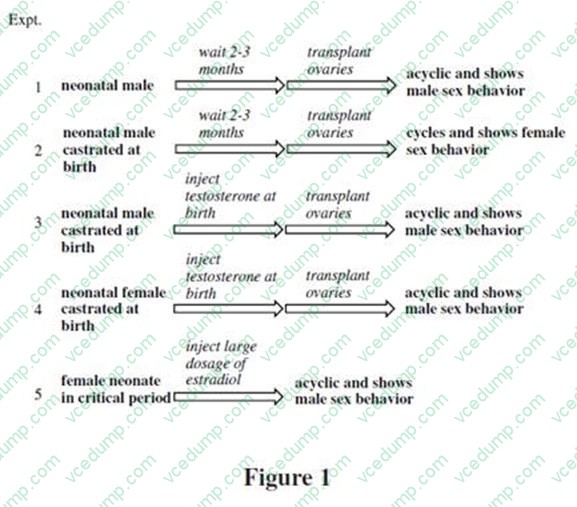
The above research, combined with additional studies, concluded that testosterone has two "organizational" effects on the male rodent brain: Defeminization Moderate levels of testosterone-derived estradiol during the critical period are sufficient for defeminization of the brain. Defeminization of the rodent brain results in loss of estrogen positive feedback on LH and FSH secretion and the ensuing loss of cyclicity, as well as loss of female sex behavior. Masculinization High levels of estradiol due to high levels of testosterone during the critical period results in masculinization of the brain. Masculinization leads to the induction of male sex behavior including antagonism towards other males and the mounting of females.
A mutant male neonatal rodent with a defective aromatase enzyme is injected with large doses of testosterone during the critical period. Which of the following would occur?
A. Induction of male sex behavior
B. Development of female sex behavior
C. Loss of both cyclicity and female sex behavior
D. Loss of both cyclicity and female sex behavior and induction of male sex behavior -
Question 509:
Maternal lineage can be traced by sequencing the mitochondrial DNA because the mitochondrial genome is derived primarily from the mother. The best explanation for this phenomenon is that:
A. sperm have no mitochondria and thus cannot contribute to the mitochondrial genome of the offspring.
B. the zygote divides rapidly, diffusing the paternal mitochondria amongst many cells.
C. following penetration, the sperm derived mitochondria disintegrate within the egg.
D. all the genes coding for mitochondria are located on the X chromosome. -
Question 510:
The breathing system of birds is efficient due to:
A. gills.
B. trachea.
C. air sacs.
D. book lungs.
Related Exams:
Tips on How to Prepare for the Exams
Nowadays, the certification exams become more and more important and required by more and more enterprises when applying for a job. But how to prepare for the exam effectively? How to prepare for the exam in a short time with less efforts? How to get a ideal result and how to find the most reliable resources? Here on Vcedump.com, you will find all the answers. Vcedump.com provide not only Medical Tests exam questions, answers and explanations but also complete assistance on your exam preparation and certification application. If you are confused on your MCAT-TEST exam preparations and Medical Tests certification application, do not hesitate to visit our Vcedump.com to find your solutions here.