MCAT-TEST Exam Details
-
Exam Code
:MCAT-TEST -
Exam Name
:Medical College Admission Test: Verbal Reasoning, Biological Sciences, Physical Sciences, Writing Sample -
Certification
:Medical Tests Certifications -
Vendor
:Medical Tests -
Total Questions
:812 Q&As -
Last Updated
:Jul 16, 2026
Medical Tests MCAT-TEST Online Questions & Answers
-
Question 491:
In the United States, breast cancer is the second leading cause of death for women, and as a result, the American Cancer Society, has recommended annual mammography screening for women age 40 years and older. It is estimated that the risk of mortality can be reduced through this procedure by approximately 20-25% during a ten-year period for women age 40 years and older.
In general, cancer screening behaviors have increased in the United States. According to the National Health Interview Survey, in 1987, approximately 29% of women age 40 years and older reported having had a mammogram in the last 2 years. By 2000, this increased to 70%. However, there are racial disparities, as fewer African American and Hispanic women have mammograms compared to their Caucasian female counterparts. Some studies have looked into these differences. Cultural factors seem to play a role in minority women obtaining fewer mammograms. Asian women, for example, do not like to discuss sensitive topics with strangers. Prevention promotions have been designed to increase awareness for the need of breast cancer screening, particularly for women in racial and ethnic minority groups. An innovative breast cancer education program, called the Educational Intervention Asian Grocery Store-Based Education Program, was designed to target Asian women. Located in 20 different Asian grocery stores in communities, the cancer screening exhibits were placed at the entrances of the stores. As Asian women came into the grocery store, health information was passed out to Asian women. Even though only a small amount of women who were considered non-adherents to breast cancer screening ended up scheduling a screening, the study demonstrated an innovative culturally competent approach to health promotion.
Source: Adapted from G.R. Sadler, P.R. Beerman, K. Lee et al. "Promoting Breast Cancer Screening Among Asian American Women: The Asian Grocery Store Based Cancer Education Program." Copyright 2012 Journal of Cancer Education.
If the goal of the health communication is to influence individuals, families, neighborhoods, medical and social service organizations, and ultimately public health policy, health promoters are adhering to:
A. Urie Bronfenbrenner's ecological systems theory.
B. Murray Bowen's family systems theory.
C. John Bowlby's attachment theory.
D. Milton Gordon's assimilation theory. -
Question 492:
All of the following are example of sensory, or neural, adaptation EXCEPT:
A. After putting on a shirt, you eventually no longer feel the sensation of the fabric on your back.
B. After first walking into a crowded room, you no longer are distracted by the buzz of conversation around you.
C. After first walking outside on a sunny day, you no longer are blinded by the initial brightness of the light.
D. After first walking into an anatomy lab, you no longer notice the smell of formaldehyde. -
Question 493:
A symbolic interactionism researcher who is observing two people enjoying a coffee together at a cafe would primarily point out that:
A. the drinking ritual is symbolic and more important than the drink itself.
B. coffee is a stimulant drug.
C. coffee is the second most valuable commodity in international trade.
D. coffee is a branded and politicized consumption good. -
Question 494:
When Gwendolyn Brooks published her first collection of poetry A Street In Bronzeville in 1945 most reviewers recognized Brooks' versatility and craft as a poet. Yet, while noting her stylistic successes few of her contemporaries discussed the critical question of Brooks' relationship to the Harlem Renaissance. How had she addressed herself, as a poet, to the literary movement's assertion of the folk and African culture, and its promotion of the arts as the agent to define racial integrity? The New Negro poets of the Harlem Renaissance expressed a deep pride in being Black; they found reasons for this pride in ethnic identity and heritage; and they shared a common faith in the fine arts as a means of defining and reinforcing racial pride. But in the literal expression of this impulse, the poets were either romantics, or realists and, quite often within the same poem, both. The realistic impulse, as defined best in the poems of McKay's Harlem Shadows (1922), was a sober reflection upon Blacks as second class citizens, segregated from the mainstream of American socio-economic life, and largely unable to realize the wealth and opportunity that America promised. The romantic impulse, on the other hand, as defined in the poems of Sterling Brown's Southern Road (1932), often found these unrealized dreams in the collective strength and will of the folk masses. In comparing the poems in A Street in Bronzeville with various poems from the Renaissance, it becomes apparent that Brooks brings many unique contributions to bear on this tradition. The first clue that A Street In Bronzeville was, at its time of publication, unlike any other book of poems by a Black American is its insistent emphasis on demystifying romantic love between Black men and women. During the Renaissance, ethnic or racial pride was often focused with romantic idealization upon the Black woman. A casual streetwalker in Hughes' poem, "When Sue Wears Red," for example, is magically transformed into an Egyptian Queen. In A Street In Bronzeville, this romantic impulse runs headlong into the biting ironies of racial discrimination. There are poems in which Hughes, McKay and Brown recognize the realistic underside of urban life for Black women. But for Brooks, unlike the Renaissance poets, the victimization of poor Black women becomes not simply a minor chord but a predominant theme. ...Brooks' relationship with the Harlem Renaissance poets, as A Street in Bronzeville ably demonstrates, was hardly imitative. As one of the important links with the Black poetic tradition of the 1920s and 1930s, she enlarged the element of realism that was an important part of the Renaissance world-view. Although her poetry is often conditioned by the optimism that was also a legacy of the period, Brooks rejects outright their romantic prescriptions for the lives of Black women. And in this regard, she serves as a vital link with the Black Arts Movement of the 1960s that, while it witnessed the flowering of Black women as poets and social activists as well as the rise of Black feminist aesthetics in the 1970s, brought about a curious revival of romanticism in the Renaissance mode.
Suppose that a recently-discovered collection of Gwendolyn Brooks' poems contained female protagonists that embodied the ideal woman. This information would:
A. support the author's contention that women poets were self-serving.
B. negate the author's view that black poets presented women and men with inequality.
C. contradict the author's opinion that Gwendolyn Brooks allowed readers to experience a more accurate description of the modern Black woman.
D. neither support nor contradict the author's claim that Brooks served as an integral link between Harlem Renaissance poets and the Black Arts Movement poets. -
Question 495:
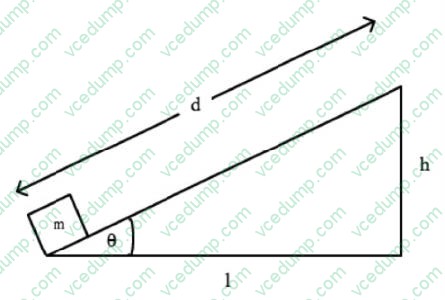
Which of the following expressions best approximates the work required to move the box with a mass m to the top of the ramp? (Assume that the ramp is frictionless.)
A. mglcosT
B. mghsinT
C. mgdcosT
D. mgdsinT -
Question 496:
Glycogen storage disease type V, also known as GSD-V or McArdle disease, is an autosomal recessive disease that results in the deficiency of myophosphorylase, an isoform of glycogen phosphorylase found in muscle cells. Patients with GSD-V experience severe muscle cramps after strenuous exercise and exercise intolerance.
Physicians may order two histology stains of the patient's muscle tissue in order to aid in the diagnosis (see Figure 1):
(A)
A Periodic acid-Schiff (PAS) stain uses periodic acid to detect carbohydrates in tissues. The reaction of the acid with sugar cleaves vicinal diols creating ketone and/or aldehyde fragments, the latter of which then reacts with the Schiff reagent to give a purple color;
(B)
A phosphorylase stain identifies the presence of the enzyme using a dark blue color indicator.

Figure 1A. Comparative histochemistry of GSD-V and healthy individual.
PAS stain of muscle tissue shows an accumulation of glycogen in the GSD-V individual (top) compared to the control (bottom). B) Phosphorylase stain of muscle tissue reveals an absence of phosphorylase in the GSD-V individual (top).
Despite initial pain during exercise, many patients with GSD-V have been able to increase their exercise tolerance by engaging in moderate periods of aerobic exercise. Muscle pain and fatigue subsides after a few minutes, a response that
researchers call the "second wind" phenomenon.
Patients who experienced "second wind" typically experienced lowered heart rate and a reported decrease in exercise effort after 7-10 minutes. A similar effect was seen in the same patients after an intravenous infusion of glucose.
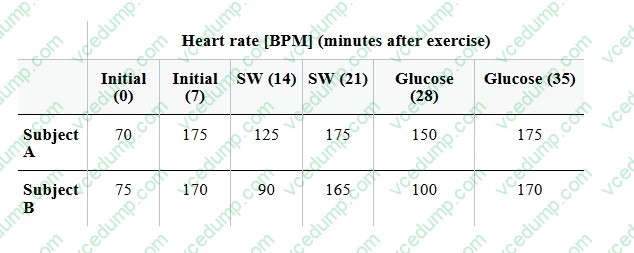
Figure 2. Measured heart rates in two GSD-V patients during sustained exercise.
Two subjects were asked to ride stationary bicycles at a steady rate over the course of 40 minutes. The subjects' heart rates were measured continuously, with high and low values coinciding with 7-minute intervals. Glucose was injected
intravenously after 21 minutes. SW = Second Wind.
Adapted from Bhavaraju-Sanka R, Howard J. Jr, Chahin N (2014). SOJ Neurol 1(1), 1-3. and Haller RG, Vissing J. Arch Neurol. 2002;59(9):1395-1402.
The "second wind" phenomena experienced by GSD-V patients is most likely due to a(n):
A. activation of phosphofructosekinase-1.
B. decrease in venous lactic acid.
C. metabolic switching to oxidative phosphorylation.
D. increase in insulin. -
Question 497:
A continuous spectrum of light, sometimes called blackbody radiation, is emitted from a region of the Sun called the photosphere. Although the continuous spectrum contains light of all wavelengths, the intensity of the emitted light is much greater at some wavelengths than at others. The relationship between the most intense wavelength of blackbody radiation and the temperature of the emitting body is given by Wien's law, λ = 2.9 x 10⁶ /T, where λ is the wavelength in nanometers and T is the temperature in kelvins.
As the blackbody radiation from the Sun passes through the cooler gases in the Sun's atmosphere, some of the photons are absorbed by the atoms in these gases. A photon will be absorbed if it has just enough energy to excite an electron from a lower energy state to a higher one. The absorbed photon will have an energy equal to the energy difference between these two states. The energy of a photon is given by E = hf = hc/λ where h = 6.63 x 10⁻³⁴ J•s, Planck's constant, and c = 3 x 10⁸ m/s, the speed of light in a vacuum.
The Sun is composed primarily of hydrogen. Electron transitions in the hydrogen atom from energy state n = 2 to higher energy states are listed below along with the energy of the absorbed photon:
Final Energy State Energy (x 10-19 J) n = 3
3.02
n = 4
4.08
n = 5
4.57 n = 6
4.84
n = ∞
5.44
If the temperature of the Sun's photosphere is 5800 K, what wavelength of radiation does the Sun emit with the greatest intensity?
A. 2 nm
B. 50 nm
C. 500 nm
D. 4,500 nm -
Question 498:
Sugars are carbohydrates, that is, molecules usually with the empirical formula C(H2O), and structural formulas made up of polyhydroxy aldehydes or ketones. Because of their polyfunctional nature, sugars can undergo a wide variety of
transformations upon treatment with acids, bases, or heat, and upon reaction with other simple reagents and enzymes. While many sugars occur in nature and are thus readily available, the synthesis and modification of simple sugars is a
necessary step in studies of enzymatic processes.
Higher sugars can be synthesized from the simple carbohydrate D-glyceraldehyde with the following procedure:
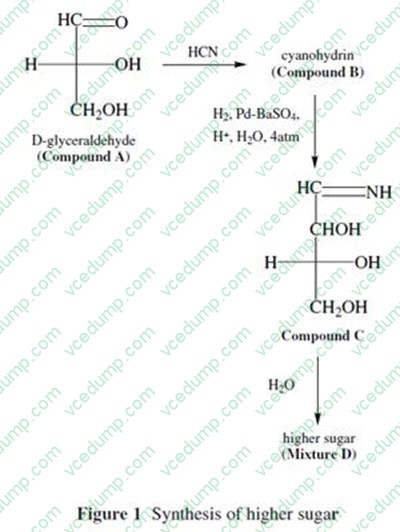
D-glyceraldehyde (Compound A) is reacted with HCN to produce a cyanohydrin (Compound B). Compound B is then treated with hydrogen gas and a modified palladium catalyst (similar to the Lindlar reagent) to give Compound C.
Compound C is hydrolyzed to give the higher sugars in Mixture D. This reaction is summarized in Figure 1. Mixture D contains two compounds, which can be separated by crystallization. Two doublets near 9.5 (, ppm) are observed in the 1H
NMR spectrum of mixture D, with each doublet corresponding to one of the two products present in the mixture. IR spectroscopy shows broad absorptions for both products around 3300 cm?.
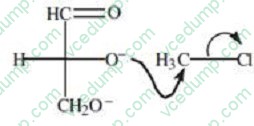
The hydroxyl groups of carbohydrates can also participate in reactions. For example, D-glyceraldehyde can react with chloromethane under basic conditions to yield a completely methylated product. This SN2 reaction is shown in Figure 2.
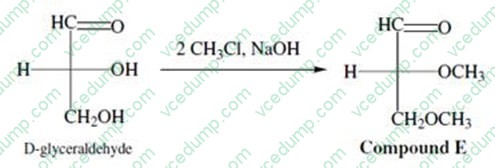
Figure 2 Methylation of D-glyceraldehyde
The reaction shown in Figure 2 most likely proceeds via the formation of a(n):
A. water leaving group.
B. nucleophilic alkoxide ion.
C. carbocation intermediate.
D. tetrahedral intermediate. -
Question 499:
Artificial kidneys have been used for almost 50 years to treat patients with different forms of renal failure. The artificial kidney (dialysis machine) removes unwanted substances from the blood by diffusion. A patient's blood is passed through channels bounded by a porous, semi-permeable membrane that allows the free diffusion in both directions of all plasma constituents except the plasma proteins. Erythrocytes and other cellular components of blood cannot pass through the membrane. The other side of the membrane is exposed to the dialyzing fluid which carries away the unwanted materials. If the concentration of a material in the blood is greater than in the dialyzing fluid, there will be a net flow of the material from the plasma to the dialyzing fluid. If the concentration of a material in the blood is less than in the dialyzing fluid, there will be a net flow of the material from the dialyzing fluid into the blood. The composition of normal plasma, plasma in an individual suffering renal failure, and dialyzing fluid are shown in Table 1.
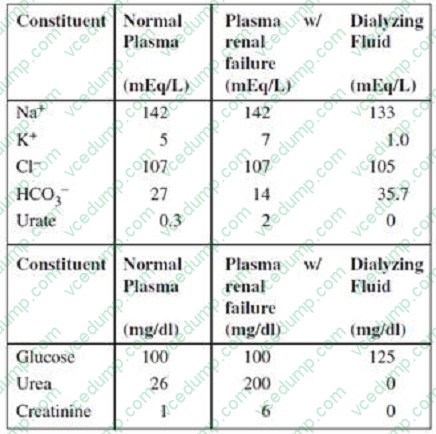
Table 1
Dialysis replaces some functions of the kidneys and attempts to correct the effects of renal failure. For example, patients with renal failure develop acidosis due to a buildup of metabolically produced acids in the circulation. Without dialysis,
the pH of the blood will drop and coma may occur. Dialyzing fluid contains a relatively high concentration of bicarbonate which diffuses into the circulation and neutralizes the acid.
The semi-permeable membrane of the dialysis machine functions in a manner most analogous to which part of the kidney?
A. Glomerulus
B. Ureter
C. Descending loop of Henle endothelium
D. Vasa recta -
Question 500:
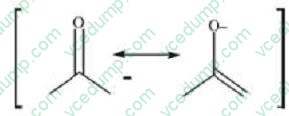
The hydrogens of alkanes have pKa values that are over 30 or 40. In contrast, the -hydrogens of aldehydes and ketones have pKa values that range from 19 to 21. These fairly acidic -hydrogens can be removed by strong bases to form anions called enolates. The enolate ions are strongly stabilized by resonance. Protonation of the enolate at oxygen produces an enol. Interconversion between the keto and enol forms is called tautomerization and is illustrated in Figure 1. The keto form is usually highly favored.

Figure 1
Keto-enol tautomerization has some interesting consequences. For example, if a ketone is treated with acid or base in a solvent of D2O (heavy water), all of the - hydrogens will be exchanged for deuterium. This reaction is shown in Figure 2.
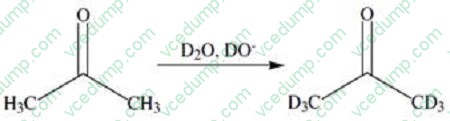
Figure 2 Another consequence of keto-enol tautomerization is the racemization of chiral -carbons. In the enol form, the -carbon adopts a planar configuration and is no longer chiral. Tautomerization back to the ketone produces a racemic mixture of products. This is shown in Figure 3.
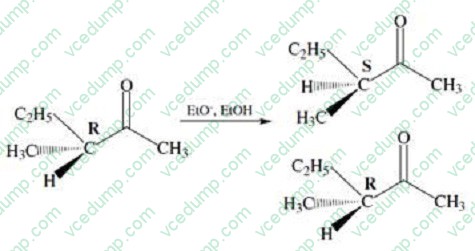
Figure 3
Which of the following ketones will have the most acidic -hydrogen:
A. Option A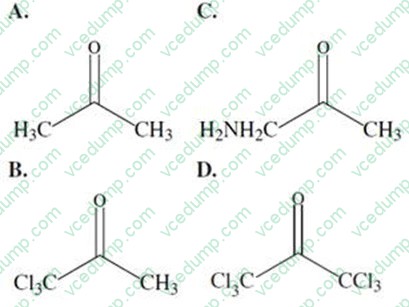
B. Option B
C. Option C
D. Option D
Related Exams:
Tips on How to Prepare for the Exams
Nowadays, the certification exams become more and more important and required by more and more enterprises when applying for a job. But how to prepare for the exam effectively? How to prepare for the exam in a short time with less efforts? How to get a ideal result and how to find the most reliable resources? Here on Vcedump.com, you will find all the answers. Vcedump.com provide not only Medical Tests exam questions, answers and explanations but also complete assistance on your exam preparation and certification application. If you are confused on your MCAT-TEST exam preparations and Medical Tests certification application, do not hesitate to visit our Vcedump.com to find your solutions here.