MCAT-TEST Exam Details
-
Exam Code
:MCAT-TEST -
Exam Name
:Medical College Admission Test: Verbal Reasoning, Biological Sciences, Physical Sciences, Writing Sample -
Certification
:Medical Tests Certifications -
Vendor
:Medical Tests -
Total Questions
:812 Q&As -
Last Updated
:Jul 16, 2026
Medical Tests MCAT-TEST Online Questions & Answers
-
Question 471:
Band theory explains the conductivity of certain solids by stating that the atomic orbitals of the individual atoms in the solid merge to produce a series of atomic orbitals comprising the entire solid. The closely-spaced energy levels of the orbitals form bands. The band corresponding to the outermost occupied subshell of the original atoms is called the valence band. If partially full, as in metals, it serves as a conduction band through which electrons can move freely. If the valence band is full, then electrons must be raised to a higher band for conduction to occur. The greater the band gap between the separate valence and conduction bands, the poorer the material's conductivity. Figure 1 shows the valence and conduction bands of a semiconductor, which is intermediate in conductivity between conductors and insulators.
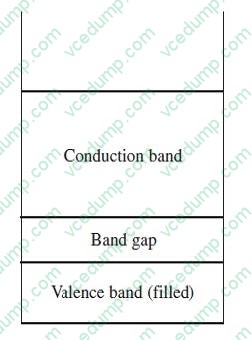
Figure 1
When silicon, a semiconductor with tetrahedral covalent bonds, is heated, a few electrons escape into the conduction band. Doping the silicon with a few phosphorus atoms provides unbonded electrons that escape more easily, increasing conductivity. Doping with boron produces holes in the bonding structure, which may be filled by movement of nearby electrons within the lattice. When a semiconductor in an electric circuit has excess electrons on one side and holes on the other, electron flow occurs more easily from the side with excess electrons to the side with holes than in the reverse direction.
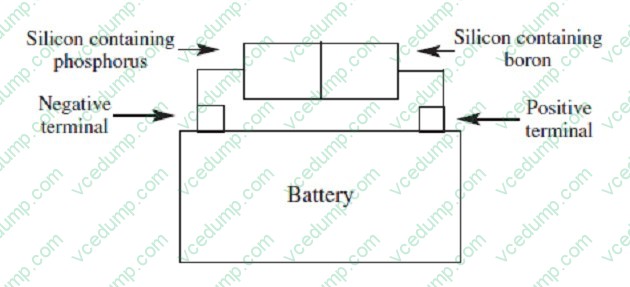
Figure 2
Why is iron a good conductor of electricity?
A. Its 3d electrons only partially fill the valence band.
B. The band gap is small.
C. The 4s and 3d orbitals form a filled valence band.
D. The energy levels of the atomic orbitals are closely separated. -
Question 472:
The Russia which emerged from the terrible civil war after the 1917 Revolution was far from the Bolsheviks' original ideal of a non-exploitative society governed by workers and peasants. By 1921, the regime was weakened by widespread famine, persistent peasant revolts, a collapse of industrial production stemming from the civil war, and the consequent dispersal of the industrial working class -- the Bolsheviks' original base of support. To buy time for recovery, the government in 1921 introduced the New Economic Policy, which allowed private trade in farm products (previously banned) and relied on a fixed grain tax instead of forced requisitions to provide food for the cities. The value of the ruble was stabilized. Trade unions were again allowed to seek higher wages and benefits, and even to strike. However, the Bolsheviks maintained a strict monopoly of power by refusing to legalize other parties. After the death of the Revolution's undisputed leader, Lenin, in January 1924, disputes over the long-range direction of policy led to an open struggle among the main Bolshevik leaders. Since open debate was still possible within the Bolshevik Party in this period, several groups with differing programs emerged in the course of this struggle. The program supported by Nikolai Bukharin -- a major ideological leader of the Bolsheviks with no power base of his own -- called for developing agriculture through good relations with wealthy peasants, or "kulaks." Bukharin favored gradual industrial development, or "advancing towards Socialism at a snail's pace." In foreign affairs, Bukharin's policy was to ally with non-Socialist regimes and movements that were favorable to Russia. A faction led by Leon Trotsky, head of the Red Army and the most respected revolutionary leader after Lenin, called for rapid industrialization and greater central planning of the economy, financed by a heavy tax on the kulaks. Trotsky rejected the idea that a prosperous, human Socialist society could be built in Russia alone (Stalin's slogan of "Socialism in One Country"), and therefore called for continued efforts to promote working-class revolutions abroad. As time went on, he became bitterly critical of the new privileged elite emerging within both the Bolshevik Party and the Russian state. Joseph Stalin, General Secretary of the Bolshevik Party, was initially considered a "center," conciliating figure, not clearly part of a faction. Stalin's eventual supremacy was ensured by three successive struggles within the party, and only during the last did his own program become clear. First, in 1924?5, Stalin isolated Trotsky, allying for this purpose with Grigori Zinoviev and Lev Kamenev, Bolshevik leaders better known than Stalin himself, whom Trotsky mistakenly considered his main rivals. Stalin maneuvered Trotsky out of leadership of the Red Army, his main potential power base. Next, Stalin turned on Zinoviev and Kamenev, using his powers as head of the Party organization to remove them from party leadership in Leningrad and Moscow, their respective power bases. Trotsky, Zinoviev, and Kamenev then belatedly formed the "Joint Opposition" (1926?7). With Bukharin's help, Stalin easily outmaneuvered the Opposition: Bukharin polemicized against Trotsky, while Stalin prevented the newspapers from printing Trotsky's replies, organized gangs of toughs to beat up his followers, and transferred his supporters to administrative posts in remote regions. At the end of 1927, Stalin expelled Trotsky from the Bolshevik Party and exiled him. (Later, in 1940, he had him murdered.) Zinoviev and Kamenev, meanwhile, recanted their views in order to remain within the Party. The final act now began. A move by kulaks to gain higher prices by holding grain off the market touched off a campaign against them by Stalin. Bukharin protested, but with the tradition of Party democracy now all but dead, Stalin had little trouble silencing Bukharin. Meanwhile, he began a campaign to force all peasants -- not just kulaks -- onto state-controlled "collective farms," and initiated a crash industrialization program during which he deprived the trade unions of all rights and cut real wages by 50%. Out of the factional struggle in which he emerged by 1933 as sole dictator of Russia, Stalin's political program of building up heavy industry on the backs of both worker and peasant emerged with full clarity.
The main feature of the New Economic Policy of 1921 was:
A. a strict economic centralization.
B. stimulation of the economy through deliberate inflation.
C. a limitation of trade union activity.
D. a relaxation of economic controls. -
Question 473:
Bebop lives! cries the newest generation of jazz players. During the 1980s, musicians like Wynton Marsalis revived public interest in bebop, the speedy, angular music that first bubbled up out of Harlem in the early 1940s, changing the face of jazz. That Marsalis and others thought of themselves as celebrating and preserving a noble tradition is, in one sense, inevitable. After the excesses of experimental or "free" jazz in the 1960s and the electronic jazz-rock "fusion" of the 70s, it is hardly surprising that people should hearken back to a time when jazz was "purer", perhaps even at the apex of its development. But the recent enthusiasm for bebop is also ironic in light of the music's initial public reception.
In its infancy, during the first two decades of the 20th century, jazz was played by small groups of musicians improvising variations on blues tunes and popular songs. Most of the musicians were unable to read music, and their improvisations were fairly rudimentary. Nevertheless, jazz attained international recognition in the 1920s. Two of the people most responsible for its rise in popularity were Louis Armstrong, the first great jazz soloist, and Fletcher Henderson, leader of the first great jazz band. Armstrong, with his buoyant personality and virtuosic technical skills, greatly expanded the creative range and importance of the soloist in jazz. Henderson, a pianist with extensive training in music theory, foresaw the orchestral possibilities of jazz played by a larger band. He wrote out arrangements of songs for his band members that preserved the spirit of jazz, while at the same time giving soloists a more structured musical background upon which to shape their solo improvisations. In the 1930s, jazz moved further into the mainstream with the advent of the Swing Era. Big bands in the Henderson mold, led by musicians like Benny Goodman, Count Basie and Duke Ellington, achieved unprecedented popularity with jazz-oriented "swing" music that was eminently danceable.
Against this musical backdrop, bebop arrived on the scene. Like other modernist movements in art and literature, bebop music represented a departure from tradition in both form and content, and was met with initial hostility. Bebop tempos were unusually fast, with the soloist often playing at double time to the backing musicians. The rhythms were tricky and complex, the melodies intricate and frequently dissonant, involving chord changes and notes not previously heard in jazz. Before bebop, jazz players had improvised on popular songs such as those produced by Tin-Pan Alley, but bebop tunes were often originals with which jazz audiences were unfamiliar.
Played mainly by small combos rather than big bands, bebop was not danceable; it demanded intellectual concentration. Soon, jazz began to lose its hold on the popular audience, which found the new music disconcerting. Compounding public alienation was the fact that bebop seemed to have arrived on the scene in a completely mature state of development, without that early phase of experimentation that typifies so many movements in the course of Western music. This was as much the result of an accident of history as anything else. The early development of bebop occurred during a three-year ban on recording in this country made necessary by the petrol and vinyl shortages of World War II. By the time the ban was lifted, and the first bebop records were made, the new music seemed to have sprung fully-formed like Athena from the forehead of Zeus. And though a small core of enthusiasts would continue to worship bebop pioneers like Charlie Parker and Dizzy Gillespie, many bebop musicians were never able to gain acceptance with any audience and went on to lead lives of obscurity and deprivation.
According to the passage, all of the following are characteristic of bebop music EXCEPT:
A. eminently danceable tunes.
B. dissonant melodies.
C. complex rhythms.
D. intellectual complexity. -
Question 474:
The equation of state of an ideal gas is given by the ideal gas law:
PV = nRT
where P is the pressure, V is the volume, n is the number of moles of gas, R is the ideal gas constant, and T is the temperature of the gas. The gas particles in a container are constantly moving at various speeds. These speeds are
characterized by the Maxwell shown in the figure below.
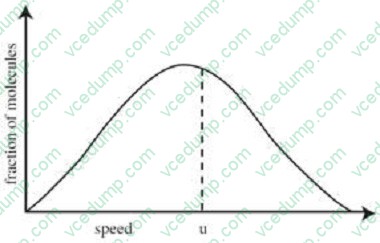
If two particles collide, their velocities change. However, if the gas is in thermal equilibrium, the velocity distribution of the gas as a whole will remain unchanged by the collision. The average kinetic energy (E) of a gas particle is given by:
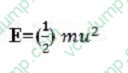
Equation 1
where m is the mass of one particle and u is the root mean square speed (rms speed) of the gas particles: where N is the number of gas particles;
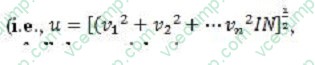
this is different from the average speed). For an ideal gas, the kinetic energy of all the particles is:

Equation 2
where n is the number of moles of gas. Combining these equations gives:
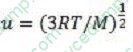
Equation 3
where M is the molar mass of the gas particles.
The average distance a particle travels between collisions is known as the mean free path l. Intuitively, the mean free path (mfp) could be expected to be larger for gases at low pressure, since there is a lot of space between particles.
Similarly, the mfp should be larger when the gas particles are small. The following expression for the mfp shows this to be correct.
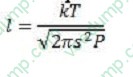
Equation 4 In this equation, s is the atomic diameter (typically on the order of 10?), k is the Boltzmann constant, and P is the pressure. In addition to colliding with one another, gas particles also collide with the walls of their container. If the container wall has a pinhole that is small compared to the mfp of the gas, and a pressure differential exists across the wall, the particles will effuse (or escape) through this pinhole without disturbing the Maxwellian distribution of the particles. The rate of effusion can be described by:
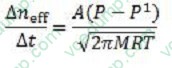
Equation 5
Where neff is the number of moles of effusing particles, A is the area of the pinhole, p and p1 are the pressures on the inside and outside of the container wall respectively, and p>p1.
The mean free path of a gas will be longer if the :
A. pressure of the gas is increased.
B. number of gas particles per unit volume is increased.
C. distance between collisions is decreased.
D. pressure of the gas is decreased. -
Question 475:
An increase in heart rate, blood pressure, and blood glucose concentration are all associated with stimulation of the:
A. parasympathetic nervous system.
B. sympathetic nervous system.
C. somatic nervous system.
D. digestive system. -
Question 476:
Several models have been developed for relating changes in dissociation constants to changes in the tertiary and quaternary structures of oligomeric proteins. One model suggests that the protein's subunits can exist in either of two distinct
conformations, R and T. At equilibrium, there are few R conformation molecules: 10 000 T to 1 R and it is an important feature of the enzyme that this ratio does not change. The substrate is assumed to bind more tightly to the R form than to
the T form, which means that binding of the substrate favors the transition from the T conformation to R.
The conformational transitions of the individual subunits are assumed to be tightly linked, so that if one subunit flips from T to R the others must do the same. The binding of the first molecule of substrate thus promotes the binding of the
second and if substrate is added continuously, all of the enzyme will be in the R form and act on the substrate. Because the concerted transition of all of the subunits from T to R or back, preserves the overall symmetry of the protein, this
model is called the symmetry model. The model further predicts that allosteric activating enzymes make the R conformation even more reactive with the substrate while allosteric inhibitors react with the T conformation so that most of the
enzyme is held back in the T shape.
Experiment Evaluating Non-Symmetry Model Enzymes
Experiments were performed with enzyme conformers that did not obey the symmetry model. The data is summarized in Figure 1.
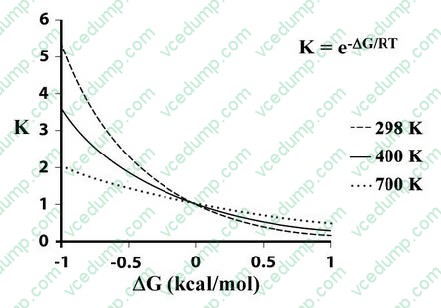
Figure 1: Equilibrium distribution of two conformers at different temperatures given the free energy of their interconversion. (modified from Mr.Holmium). The symmetry model would NOT account for an enzyme:
A. with many different biologically active conformations.
B. which engages in positive cooperativity.
C. with a complex metal cofactor.
D. which is a catalyst for anabolic reactions. -
Question 477:
A student conducts a chemical analysis of the components of a popular soft drink. The beverage label shows that the drink contains carbonated water, phosphoric acid, caffeine, and caramel color, but does not indicate the concentrations of these chemicals.
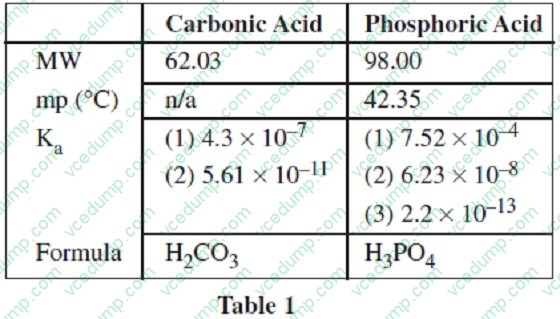
Dissolved carbon dioxide will react reversibly with water to form carbonic acid. In an attempt to analyze the beverage composition, the student conducts the following experiments on a one liter sample of the beverage.
Experiment 1
The sample is placed in a sealed beaker cooled to 10?C and a vacuum is created in the space above the beverage. The gas pumped from this space is passed through a solution of BaCl2, producing a white precipitate. The process
continues until no more precipitate forms. The precipitate is dried and found to have a mass of 9.5 grams.
Experiment 2
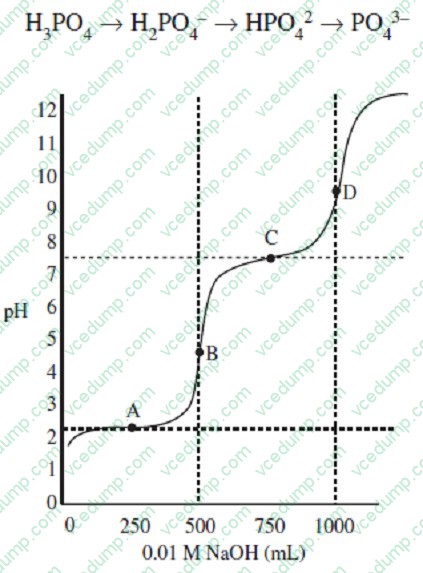
The remaining solution left in the sealed beaker is then titrated with 0.01 M NaOH to give the titration curve shown in Figure 1.
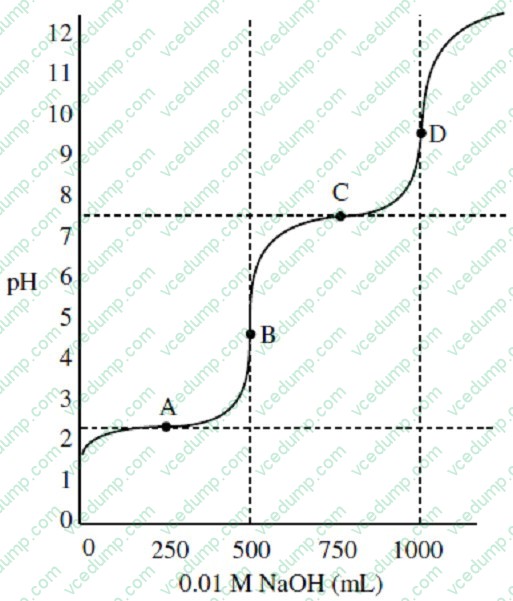
Figure 1
Which of the following plots best indicates the composition of phosphoric acid in the 1 Liter sample during the titration?
A. Option A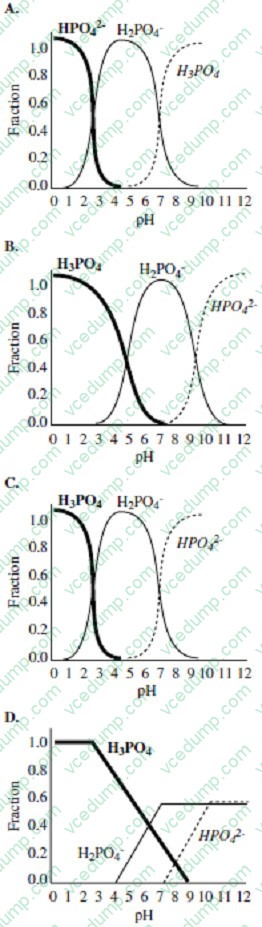
B. Option B
C. Option C
D. Option D -
Question 478:
In the United States, breast cancer is the second leading cause of death for women, and as a result, the American Cancer Society, has recommended annual mammography screening for women age 40 years and older. It is estimated that the risk of mortality can be reduced through this procedure by approximately 20-25% during a ten-year period for women age 40 years and older.
In general, cancer screening behaviors have increased in the United States. According to the National Health Interview Survey, in 1987, approximately 29% of women age 40 years and older reported having had a mammogram in the last 2 years. By 2000, this increased to 70%. However, there are racial disparities, as fewer African American and Hispanic women have mammograms compared to their Caucasian female counterparts. Some studies have looked into these differences. Cultural factors seem to play a role in minority women obtaining fewer mammograms. Asian women, for example, do not like to discuss sensitive topics with strangers.
Prevention promotions have been designed to increase awareness for the need of breast cancer screening, particularly for women in racial and ethnic minority groups. An innovative breast cancer education program, called the Educational Intervention Asian Grocery Store-Based Education Program, was designed to target Asian women. Located in 20 different Asian grocery stores in communities, the cancer screening exhibits were placed at the entrances of the stores. As Asian women came into the grocery store, health information was passed out to Asian women. Even though only a small amount of women who were considered non-adherents to breast cancer screening ended up scheduling a screening, the study demonstrated an innovative culturally competent approach to health promotion. Source: Adapted from G.R. Sadler, P.R. Beerman, K. Lee et al. "Promoting Breast Cancer Screening Among Asian American Women: The Asian Grocery Store Based Cancer Education Program." Copyright 2012 Journal of Cancer Education.
How must promoters of health behaviors communicate with a high-context culture like the Asian?
A. Communicate directly with participants, using informal language mostly, and with little emphasis on nonverbal cues
B. Assume what is being said is what is actually meant
C. Get to the point of the discussion as quickly as possible
D. Employ formal language, rely on nonverbal cues, and be comfortable with silences -
Question 479:
Nitric oxide, NO, has recently been found to have widespread physiological effects, acting as a major regulator in the nervous, cardiovascular, and immune systems. The production of NO in the body is regulated by specific NOS enzymes which exist in at least three different isoforms -- bNOS, eNOS, and macNOS. Each of these isoforms differ in location and function and serve to mediate different physiological responses to NO. Some physiological roles of NO have been demonstrated as follows:
I. In the central nervous system, NO production is regulated by bNOS. Calcium ion concentrations of 200- 400 nM in the central nervous system activate bNOS to catalyze the formation of NO. NO exerts definite effects on brain function although its specific roles are not well established. bNOS inhibitors have been found to block the release of neurotransmitter from presynaptic neurons. Excess levels of NO are also thought to contribute to neurodegenerative disorders such as Alzheimer's disease.
II. In the blood vessels, NO is produced by eNOS which is activated by Ca2+ concentrations of 200-400 nM. NO acts as the major endogenous vasodilator in blood vessels. It diffuses into smooth muscle cells and leads to muscle relaxation by stimulating cGMP formation through activation of guanylyl cyclase. In addition, NO regulates the vascular system by inhibiting platelet aggregation and adhesion.
III. The role of NO in the immune system is regulated by macNOS through a pathway that is not Ca2+ dependent. Rather, exposure to cytokines, including interleukin-1 and interferon- , leads to synthesis of large amounts of NO by activation of macNOS in response to inflammatory stimuli. The NO produced plays a definitive role in the mediation of the activities of macrophages and neutrophils. NO also acts to inhibit the mechanism of viral replication.
Based on information in the passage, which of the following is a possible effect of NO in the brain?
A. Inhibit the fusing of neurotransmitter vesicles at the presynaptic membrane
B. Promote neurotransmitter release into the synaptic cleft
C. Enhance vasoconstriction to maintain blood pressure
D. Decrease neurotransmitter synthesis by the presynaptic neuron
I. In the central nervous system, NO production is regulated by bNOS. Calcium ion concentrations of 200- 400 nM in the central nervous system activate bNOS to catalyze the formation of NO. NO exerts definite effects on brain function although its specific roles are not well established. bNOS inhibitors have been found to block the release of neurotransmitter from presynaptic neurons. Excess levels of NO are also thought to contribute to neurodegenerative disorders such as Alzheimer's disease. II. In the blood vessels, NO is produced by eNOS which is activated by Ca2+ concentrations of 200-400 nM. NO acts as the major endogenous vasodilator in blood vessels. It diffuses into smooth muscle cells and leads to muscle relaxation by stimulating cGMP formation through activation of guanylyl cyclase. In addition, NO regulates the vascular system by inhibiting platelet aggregation and adhesion. III. The role of NO in the immune system is regulated by macNOS through a pathway that is not Ca2+ dependent. Rather, exposure to cytokines, including interleukin-1 and interferon- , leads to synthesis of large amounts of NO by activation of macNOS in response to inflammatory stimuli. The NO produced plays a definitive role in the mediation of the activities of macrophages and neutrophils. NO also acts to inhibit the mechanism of viral replication. Based on information in the passage, which of the following is a possible effect of NO in the brain? -
Question 480:
Researchers are currently trying to develop materials which could be used to replace damaged or destroyed human muscle tissue. One of the more promising avenues of research involves the use of substances that contract with the
application of a small electric current.
Two physicists published an article relating to their work with Substance Q42, a material which contracts with the application of very small electric currents.
The atomic structure of the substance, they report, is designed so that the magnetic fields from each atom maintain a certain distance between adjacent atoms. With the application of an electrical current, the atoms' magnetic fields are
dampened slightly, causing them to draw closer together. The extent to which it contracts is dependent upon the strength of the current passing through it, but will at any rate never exceed a 20% reduction in length.
Moreover, the physicists report, Substance Q42 essentially operated like a spring, but one which can compress itself. The force generated by a spring, Fs, is given by the following equation:
Fs = -kx,
where k is the spring of constant in N/m, and x is the distance of compression (or expansion, but that is irrelevant for this example, since Substance Q42 only compresses).
With this in mind, it is possible to calculate the feasibility of using Substance Q42 as a replacement for human muscle tissue. Assume a section of test Substance Q42 is hooked to a scalable electrical source. The section is 10 cm long at its
fully extended state, and 8 cm long when fully compressed due to an electrical current. How much force does the section apply when it compresses from rest state to 9.5 cm in length? k = 40 000 N/m
A. 100 N
B. 200 N
C. 500 N
D. 1000 N
Related Exams:
Tips on How to Prepare for the Exams
Nowadays, the certification exams become more and more important and required by more and more enterprises when applying for a job. But how to prepare for the exam effectively? How to prepare for the exam in a short time with less efforts? How to get a ideal result and how to find the most reliable resources? Here on Vcedump.com, you will find all the answers. Vcedump.com provide not only Medical Tests exam questions, answers and explanations but also complete assistance on your exam preparation and certification application. If you are confused on your MCAT-TEST exam preparations and Medical Tests certification application, do not hesitate to visit our Vcedump.com to find your solutions here.