MCAT-TEST Exam Details
-
Exam Code
:MCAT-TEST -
Exam Name
:Medical College Admission Test: Verbal Reasoning, Biological Sciences, Physical Sciences, Writing Sample -
Certification
:Medical Tests Certifications -
Vendor
:Medical Tests -
Total Questions
:812 Q&As -
Last Updated
:Jul 16, 2026
Medical Tests MCAT-TEST Online Questions & Answers
-
Question 461:
In the early nineteenth century a large number of communal experiments, both secular and religious, sprang up in the northeastern United States. Perhaps the most famous secular commune was Brook Farm, founded by transcendentalists George Ripley and William H. Channing to promote the pursuit of leisure and culture through the proper application of time and labor. Its members (among the more notable were Nathaniel Hawthorne and Margaret Fuller) pursued field labor by day, art and philosophy by night. For a time the system worked so well that two afternoons a week were set aside for leisure and Brook Farm began outcompeting local farmers at the produce market. But by nature the Farm's members were thinkers, not workers; despite their success they remained mainly interested in the theoretical and philosophical implications of the experiment. Thus, when a devastating fire brought the community considerable financial burdens in its fifth year, the members felt little compunction about closing shop and returning to their comfortable Boston homes.
One of the most notable religious utopias was the Oneida community. Its founder, John Humphrey Noyes, believed that Christ's second coming had already occurred and that everyone alive was favored by Divine grace, which Noyes saw as an imperative to live a better life. Perhaps surprisingly, the Oneidans embraced industry and commerce, achieving success in fruit packing, trap making, and silk thread winding. They owned everything communally, and this principle extended to each other. The Oneidans saw monogamy as a selfish act and asserted that the men and women of the community were united in one "complex" marriage; sex between any two consenting members was perfectly acceptable. The Oneidans maintained order solely through "criticism"--anyone acting out of line was made to stand before the other members and hear his or her faults recounted. Oneida remained viable for some thirty years, until the leadership devolved on Noyes' son, an agnostic. The old religious fervor died out, and the dream degenerated into a joint stock company. Doubtless the most successful communalists were the Shakers, so called for the early propensity to tremble ecstatically during religious worship. Their guiding light, Mother Ann, espoused four key principles: Virgin Purity, Christian Communism, Confession, and Separation from the World. Though the Shakers were less adamant on the last point--maintaining social relations and some commerce with heir neighbors--they insisted on the other three, and renounced both personal property and sex. Men and women lived in a single large "Unitary Dwelling" and were considered complete equals, but they occupied separate wings and could speak together only if a third person were present. Despite their religious strictness, Shakers were known as simple, sincere, intelligent people, healthy and long-lived, producers of lovely books and hymns, and of furniture still prized for its quality and durability. In their eyday, six thousand Shakers lived in fifty-eight separate "families" throughout the Northeast. Later their celibacy, combined with their strict discipline, led to a decline in numbers, but even today a small number of elderly Shakers in two communities in Maine and New Hampshire continue to keep the faith.
According to the passage, all of the following were characteristic of the Oneida community EXCEPT:
A. complex marriage.
B. maintenance of order through social pressure.
C. belief in present grace.
D. shared living quarters. -
Question 462:
Although nihilism is commonly defined as a form of extremist political thought, the term has a broader meaning. Nihilism is in fact a complex intellectual stance with venerable roots in the history of ideas, which forms the theoretical basis for many positive assertions of modern thought. Its essence is the systematic negation of all perceptual orders and assumptions. A complete view must account for the influence of two historical crosscurrents: philosophical skepticism about the ultimacy of any truth, and the mystical quest for that same pure truth. These are united by their categorical rejection of the "known". The outstanding representative of the former current, David Hume (1711?776), maintained that external reality is unknowable, since sense impressions are actually part of the contents of the mind. Their presumed correspondence to external "things" cannot be verified, since it can be checked only by other sense impressions. Hume further asserts that all abstract conceptions turn out, on examination, to be generalizations from sense impressions. He concludes that even such an apparently objective phenomenon as a cause-and-effect relationship between events may be no more than a subjective fabrication of the observer. Stanley Rosen notes: "Hume terminates in skepticism because he finds nothing within the subject but individual impressions and ideas." For mystics of every faith, the "experience of nothingness" is the goal of spiritual practice. Buddhist meditation techniques involve the systematic negation of all spiritual and intellectual constructs to make way for the apprehension of pure truth. St. John of the Cross similarly rejected every physical and mental symbolization of God as illusory. St. John's spiritual legacy is, as Michael Novak puts it, "the constant return to inner solitude, an unbroken awareness of the emptiness at the heart of consciousness. It is a harsh refusal to allow idols to be placed in the sanctuary. It requires also a scorching gaze upon all the bureaucracies, institutions, manipulators, and hucksters who employ technology and its supposed realities to bewitch and bedazzle the psyche". Novak's interpretation points to the way these philosophical and mystical traditions prepared the ground for the political nihilism of the nineteenth and twentieth centuries. The rejection of existing social institutions and their claims to authority is in the most basic sense made possible by Humean skepticism. The political nihilism of the Russian intelligentsia combined this radical skepticism with a near mystical faith in the power of a new beginning. Hence, their desire to destroy becomes a revolutionary affirmation; in the words of Stanley Rosen, "Nihilism is an attempt to overcome or repudiate the past on behalf of an unknown and unknowable, yet hoped-for, future." This fusion of skepticism and mystical re-creation can be traced in contemporary thought, for example as an element in the counterculture of the 1960s.
Which of the following is a necessary assumption underlying Hume's conclusion that external reality is unknowable, as discussed in the passage?
A. Nothing outside the mind exists.
B. The contents of the mind consist exclusively of sense impressions.
C. Causality is a subjective projection of the mind.
D. Sense impressions provide our only information about external reality. -
Question 463:
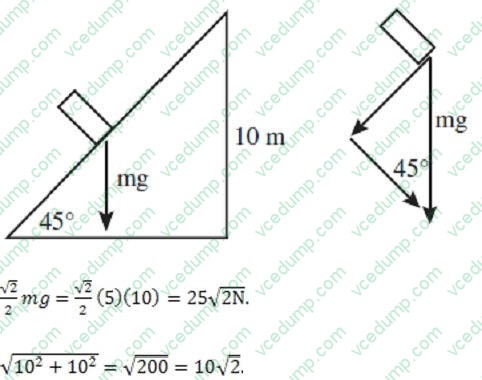
A5-kg mass M is being raised from the ground to the top of the inclined plane using the set-up shown in the diagram below. Assuming that the inclined plane is frictionless, what is the work done by the force F?
A. Option A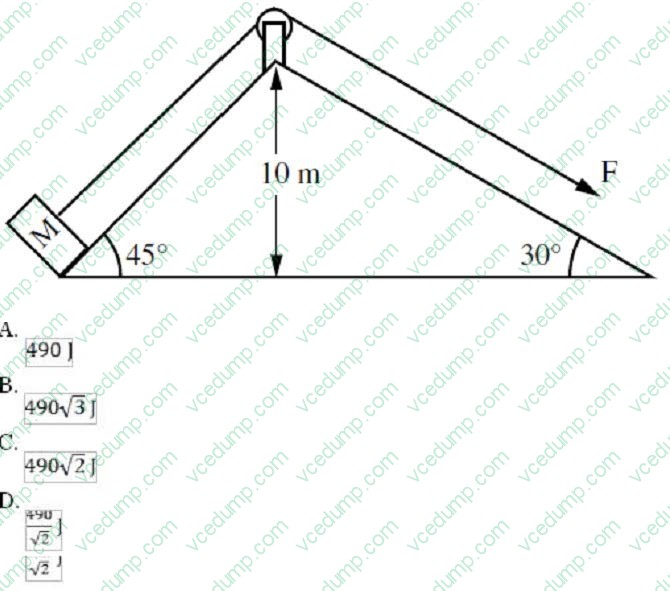
B. Option B
C. Option C
D. Option D -
Question 464:
What is the relationship between suicide rates and social change according to the sociologist Emile Durkheim?
A. A higher suicide rate leads to more social change.
B. A higher suicide rate leads to less social change.
C. Social change leads to suicide rates going up.
D. Social change leads to suicide rates going down. -
Question 465:
Arginine is one of the 20 most common natural amino acids. Most healthy people do not need to supplement with arginine because the body usually produces sufficient quantities. The pathway for arginine synthesis was studied using cells from a red bread mold. This natural form of arginine is illustrated below.

The red bread mold Neurospora crassa grows well on a cultural plate with "minimal" medium which is a fluid containing only a few simple sugars, inorganic salts, and vitamin. Neurospora that grows normally in nature (wild type) has enzymes that convert these simple substances into the amino acids necessary for growth. Mutating any one of the genes that makes an enzyme can produce a Neurospora strain that cannot grow on minimal medium. The mutant would only grow if the enzyme product were to be added as a supplement. On the other hand, if a "complete" medium is provided, containing all required amino acids, then Neurospora would grow, with or without mutation.
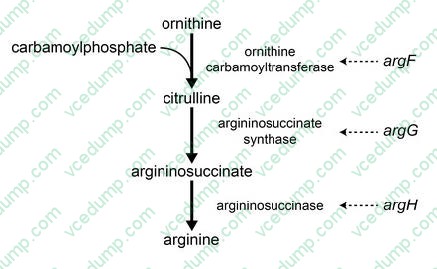
Figure 1 A synthesis pathway for the amino acid arginine. Each gene in italics in the diagram produces one enzyme necessary for the synthesis of this essential amino acid required for growth.

Table 1 Growth response of mutant strains in "minimal" media with supplements (ornithine, citrulline, argininosuccinate, and arginine) as indicated. Strain growth is indicated by (+) and no strain growth is indicated by (-).
Experiments using the two mutant strains P and Q, reveal that strain P accumulates citrulline, but strain Q does not. Which of the following statements is most consistent with the data provided?
A. Strain Q has only one mutation.
B. Strain P has a mutation in argF only.
C. Strain P has mutations in argF, argG and argH.
D. Strain P has a mutation in argG only. -
Question 466:
Due to ever-increasing paranoia about the transmission of hepatitis and AIDS via blood transfusions and the frequent difficulty of procuring matching blood donors for patients, researchers have been working at a feverish pace to produce disease-free and easy-to-use blood substitutes. The difficulty most synthetic blood researches have had is in formulating a substance that combines qualities of sterility, high capacity for carrying oxygen to body tissues, and versatility within the human body. Three major substitute technologies have been developed to date; each has certain advantages and shortcomings. "Red blood," the first of the blood substitute technologies, is derived from hemoglobin which has been recycled from old, dead, or worn-out red blood cells and modified so that it can carry oxygen outside the red blood cell. Hemoglobin, a complex protein, is the blood's natural oxygen carrier and is attractive to scientists for use in synthetic blood because of its oxygen-carrying capacity. However, hemoglobin can sometimes constitute a two-fold threat to humans when it is extracted from the red blood cell and introduced to the body in its naked form. First, hemoglobin molecules are rarely sterile and often remain contaminated by viruses to which they were exposed in the cell. Second, naked hemoglobin is extremely dangerous to the kidneys, causing blood flow at these organs to shut down and leading, ultimately, to renal failure. Additional problems arise from the fact that hemoglobin is adapted to operate optimally within the intricate environment of the red blood cell. Stripped of the protection of the cell, the hemoglobin molecule tends to suffer breakdown within several hours. Although modification has produced more durable hemoglobin molecules which do not cause renal failure, undesired side effects continue to plague patients and hinder the development of hemoglobin-based blood substitutes.
Another synthetic blood alternative, "white blood", is dependent on laboratory synthesized chemicals called perfluorocarbons (PFCs). Unlike blood, PFCs are clear oil like liquids, yet they are capable of absorbing quantities of oxygen up to 50% of their volume, enough of an oxygen carrying potential for oxygen-dependent organisms to survive submerged in the liquid for hours by "breathing" it. Although PFCs imitate real blood by effectively absorbing oxygen, scientists are primarily interested in them as constituents of blood substitutes because they are inherently safer to use than hemoglobin-based substitutes. PFCs do not interact with any chemicals in the body and can be manufactured in near-perfect sterility. The primary pitfall of PFCs is in their tendency to form globules in plasma that can block circulation. Dissolving PFCs in solution can mitigate globulation; however, this procedure also seriously curtails the PFCs' oxygen capacity.
The final and perhaps most ambitious attempt to form a blood substitute involves the synthesis of a modified version of human hemoglobin by genetically-altered bacteria. Fortunately, this synthetic hemoglobin seems to closely mimic the qualities of sterility, and durability outside the cellular environment, and the oxygen-carrying efficiency of blood. Furthermore, researchers have found that if modified hemoglobin genes are added to bacterial DNA, the bacteria will produce the desired product in copious quantities. This procedure is extremely challenging, however, because it requires the isolation of the human gene for the production of hemoglobin, and the modification of the gene to express a molecule that works without support from a living cell.
While all the above technologies have serious drawbacks and difficulties, work to perfect an ideal blood substitute continues. Scientists hope that in the near future safe synthetic blood transfusions may ease blood shortages and resolve the unavailability of various blood types.
According to the passage, PFCs are helpful in the synthesis of blood substitutes because they:
I. mimic the oxygen-carrying capacity of blood.
II. do not react with other body chemicals.
III.
break down in the blood within several hours.
A. I only
B. II only
C. I and II only
D. II and III only
I. mimic the oxygen-carrying capacity of blood. II. do not react with other body chemicals. III. break down in the blood within several hours. -
Question 467:
(1) Fluorescent proteins are found in bioluminescent sea creatures, such as jellyfish. (2) In 1969, the green fluorescent protein was discovered and, since then, prolific research has resulted in the discovery and development of many new fluorescent proteins. (3) Fluorescent proteins can be expressed in cells, making them easily visible under a microscope. (4) In fact, the use of fluorescent proteins revolutionized bio- imaging because the inherently natural nature meant that they could be incorporated into living cells with no deadly toxic effects. (5) Numerous other scientific and medical applications also exploit the unique properties of fluorescent proteins, which is why they were the subject of the 2008 Nobel Prize for Chemistry. (6) However, the science behind fluorescent proteins is still not fully understood and there are many more avenues for exploration.
Which term might you suggest the author abbreviate in this passage?
A. living cells
B. sea creatures
C. fluorescent protein
D. microscope -
Question 468:
The equation of state of an ideal gas is given by the ideal gas law:
PV = nRT
where P is the pressure, V is the volume, n is the number of moles of gas, R is the ideal gas constant, and T is the temperature of the gas. The gas particles in a container are constantly moving at various speeds. These speeds are
characterized by the Maxwell shown in the figure below.
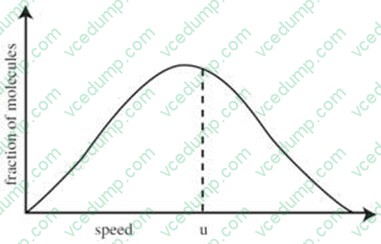
If two particles collide, their velocities change. However, if the gas is in thermal equilibrium, the velocity distribution of the gas as a whole will remain unchanged by the collision. The average kinetic energy (E) of a gas particle is given by:
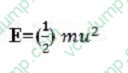
Equation 1
where m is the mass of one particle and u is the root mean square speed (rms speed) of the gas particles:
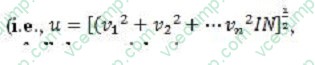
where N is the number of gas particles; this is different from the average speed). For an ideal gas, the kinetic energy of all the particles is:

Equation 2
where n is the number of moles of gas. Combining these equations gives:
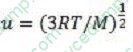
Equation 3
where M is the molar mass of the gas particles.
The average distance a particle travels between collisions is known as the mean free path l. Intuitively, the mean free path (mfp) could be expected to be larger for gases at low pressure, since there is a lot of space between particles.
Similarly, the mfp should be larger when the gas particles are small. The following expression for the mfp shows this to be correct.
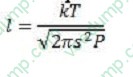
Equation 4 In this equation, s is the atomic diameter (typically on the order of 10?), k is the Boltzmann constant, and P is the pressure. In addition to colliding with one another, gas particles also collide with the walls of their container. If the container wall has a pinhole that is small compared to the mfp of the gas, and a pressure differential exists across the wall, the particles will effuse (or escape) through this pinhole without disturbing the Maxwellian distribution of the particles. The rate of effusion can be described by:
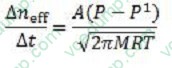
Equation 5
Where neff is the number of moles of effusing particles, A is the area of the pinhole, p and p1 are the pressures on the inside and outside of the container wall respectively, and p>p1.
Which of the following gives values for both standard temperature and pressure?
A. 273 K and 760 Torr
B. 273 K and 1 atm
C. 0°C and 760 mm Hg
D. All of the above -
Question 469:
Many nutrients required by plants exist in soil as basic cations:

A soil's cation-exchange capacity is a measure of its ability to adsorb these basic cations as well as exchangeable hydrogen and aluminum ions. The cation-exchange capacity of soil is derived from two sources: small clay particles called micelles consisting of alternating layers of alumina and silica crystals, and organic colloids.

Replacement of + and + by other cations of lower valence creates a net negative charge within the inner layers of the micelles. This is called the soil's permanent charge. For example, replacement of an atom of aluminum by calcium within a section where the net charge was previously zero, as shown below, produces a net charge of ?, to which other cations can become adsorbed.

Figure 1
A pH-dependent charge develops when hydrogen dissociates from hydroxyl moieties on the outer surfaces of the clay micelles. This leaves negatively-charged oxygen atoms to which basic cations may adsorb. Likewise, a large pH-
dependent charge develops when hydrogen dissociates from carboxylic acids and phenols in organic matter.
In most clays, permanent charges brought about by substitution account for anywhere from half to nearly all of the total cation-exchange capacity. Soils very high in organic matter contain primarily pH-dependent charges. In a research study,
three samples of soil were leached with a 1 N solution of neutral KCl, and the displaced A13+ and basic cations measured. The sample was then leached again with a buffered solution of BaCl2 and triethanolamine at pH 8.2, and the
displaced H+ measured. Table 1 gives results for three soils tested by this method.
Table 1
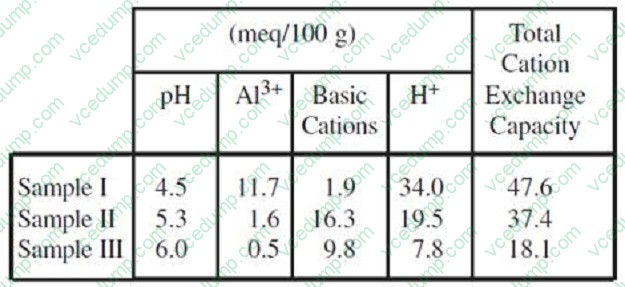
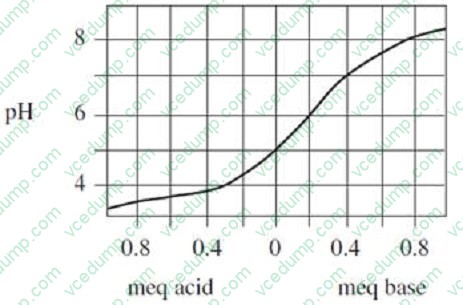
Due to the buffering effect of the soil's cationexchange capacity, just measuring the soil solution's pH will not indicate how much base is needed to change the soil pH. In another experiment, measured amounts of acid and base were added to 10-gram samples of well-mixed soil that had been collected from various locations in a field. The volumes of the samples were equalized by adding water. The results were recorded in Figure 2.
Figure 2.
What would be the effect of leaching the three soil samples in Table 1 with a buffered BaCl2 solution at pH 9.5 instead of 8.3?
A. The measured permanent charge would be greater.
B. The measured pH-dependent charge would be greater.
C. The measured permanent charge would be smaller.
D. The measured pH-dependent charge would be smaller. -
Question 470:
The lining of the digestive tract and the respiratory tract develops from which germ layer?
I. Endoderm
II. Mesoderm
III.
Ectoderm
A. I only
B. II only
C. III only
D. I and II
I. Endoderm II. Mesoderm III. Ectoderm

Related Exams:
Tips on How to Prepare for the Exams
Nowadays, the certification exams become more and more important and required by more and more enterprises when applying for a job. But how to prepare for the exam effectively? How to prepare for the exam in a short time with less efforts? How to get a ideal result and how to find the most reliable resources? Here on Vcedump.com, you will find all the answers. Vcedump.com provide not only Medical Tests exam questions, answers and explanations but also complete assistance on your exam preparation and certification application. If you are confused on your MCAT-TEST exam preparations and Medical Tests certification application, do not hesitate to visit our Vcedump.com to find your solutions here.