MCAT-TEST Exam Details
-
Exam Code
:MCAT-TEST -
Exam Name
:Medical College Admission Test: Verbal Reasoning, Biological Sciences, Physical Sciences, Writing Sample -
Certification
:Medical Tests Certifications -
Vendor
:Medical Tests -
Total Questions
:812 Q&As -
Last Updated
:Jul 16, 2026
Medical Tests MCAT-TEST Online Questions & Answers
-
Question 421:
There are two opposing theories of light: the particle theory and the wave theory. According to the particle theory, light is composed of a stream of tiny particles that are subject to the same physical laws as other types of elementary particles. One consequence of this is that light particles should travel in a straight line unless an external force acts on them. According to the wave theory, light is a wave that shares the characteristics of other waves. Among other things, this means that light waves should interfere with each other under certain conditions.
In support of the wave theory of light, Thomas Young's double slit experiment proves that light does indeed exhibit interference. Figure 1 shows the essential features of the experiment. Parallel rays of monochromatic light pass through two narrow slits and are projected onto a screen. Constructive interference occurs at certain points on the screen, producing bright areas of maximum light intensity. Between these maxima, destructive interference produces light intensity minima. The positions of the maxima are given by the equation dsin = n, where d is the distance between the slits, is the angle shown in Figure 1, the integer n specifies the particular maxima, and is the wavelength of the incident light. (Note: sin tan
for small angles.)

Figure 1
Which of the following supports the particle theory of light?
A. The energy of light is quantitized.
B. Light exhibits interference.
C. Light is subject to the Doppler effect.
D. No particle can have a speed greater than the speed of light. -
Question 422:
One of the basic principles of ecology is that population size is to some extent a function of available food resources. Recent field experiments demonstrate that the interrelationship may be far more complex than hitherto imagined. Specifically, the browsing of certain rodents appears to trigger biochemical reactions in the plants they feed on that help regulate the size of the rodent populations. Two such examples of phytochemical regulation (regulation involving plant chemistry) have been reported so far. Patricia Berger and her colleagues at the University of Utah have demonstrated that instrumentality of 6- methoxybenzoxazolinone (6-MBOA) in triggering reproductive behavior in the mountain vole (Microtus montanus), a small rodent resembling the field mouse. 6-MBOA forms in young mountain grasses in response to browsing by predators such as voles. The experimenters fed rolled oats coated with 6-MBOA to non-breeding winter populations of Microtus. After three weeks, the sample populations revealed a high incidence of pregnancy among the females and pronounced swelling of the testicles among the males. Control populations receiving no 6- MBOA revealed no such signs. Since the timing of reproductive effort is crucial to the short-lived vole in an environment in which the onset of vegetative growth can vary by as much as two months, the phytochemical triggering of copulatory behavior in Microtus represents a significant biological adaptation. A distinct example is reported by John Bryant of the University of Alaska. In this case, plants seem to have adopted a form of phytochemical self-defense against the depredations of the snowshoe hare (Lepus americanus) of Canada and Alaska. Every ten years or so, for reasons that are not entirely understood, the Lepus population swells dramatically. The result is intense overbrowsing of early and mid-successional deciduous trees and shrubs. Bryant has shown that, as if in response, four common boreal forest trees favored by Lepus produce adventitious shoots high in terpene and phenolic resins which effectively discourage hare browsing. He treated mature, non-resinous willow twigs with resinous extracts from the adventitious shoots of other plants and placed treated and untreated bundles at hare feeding stations, weighing them at the end of each day. Bryant found that bundles containing only half the resin concentration of natural twigs were left untouched. The avoidance of these unpalatable resins, he concludes, may play a significant role in the subsequent decline in the Lepus population to its normal level. These results suggest obvious areas for further research. For example, observational data should be reviewed to see whether the periodic population explosions among the prolific lemming (like the vole and the snowshoe hare, a small rodent in a marginal northern environment) occur during years in which there is an early onset of vegetative growth; if so, a triggering mechanism similar to that found in the vole may be involved.
The experiments described in the passage involved all of the following EXCEPT:
A. measuring physiological changes in reproductive organs after a specific compound was ingested.
B. testing whether breeding behavior could be induced in normally non-breeding animals by a change in diet.
C. measuring an animal's consumption of treated and untreated foods.
D. measuring changes in the growth cycle 6-MBOAproducing mountain grasses. -
Question 423:
A solar-power collector has an area of 10 cm2 facing the sun. If the intensity of the sunlight incident upon this surface is 1.5 kW/m2, what is the maximum energy the device can supply in one hour?
A. 1500 J
B. 15000 J
C. 5400 J
D. 54000 J -
Question 424:
Early experimentation on the single-celled organism Acetabularia led to important discoveries about the role of the nucleus in regulating cell function. Acetabularia is an enormous single cell with three distinct regions: a cap, a root-like rhizoid, and a stalk which connects the two. The following experiments were conducted to study the development of the cell:
Experiment 1
The stalk of an Acetabularia was cut, fragmenting the cell. The fragment which included the cap died shortly afterwards while the fragment containing the rhizoid regenerated to form a complete Acetabularia.
Experiment 2
The nucleus from Acetabularia mediterranea, which has a flat cap, was transplanted into Acetabularia crenulata, which has a tufted cap, following removal of the Acetabularia crenulata nucleus. The Acetabularia crenulata cap eventually assumed the flat shape.
Experiment 3
The nucleus of Acetabularia mediterranea was removed from the young cell before it first formed a cap. A normal cap formed several weeks later. The cell proved to be inviable and died shortly thereafter.
Experiment 4
A young Acetabularia was fractioned into a number of portions before it first formed a cap. Several weeks later, both the portion containing the nucleus and the portion containing the apical tip of the stalk formed caps. The other portions did not form caps.
One explanation for the results of Experiment 4 is that the instructions for forming the cap are stored in the apical tip of the stalk several weeks prior to stalk formation. Which of the following pieces of evidence best supports this explanation?
A. Isolation of DNA coding for cap-inducing proteins from samples of Acetabularia taken several weeks prior to stalk formation.
B. Exposure of a young Acetabularia to ribonuclease, which cleaves RNA, blocks cap formation.
C. Exchange of nuclei between Acetabularia crenulata and Acetabularia mediterranea leads to formation of the cap associated with each nucleus.
D. mRNA coding for cap-inducing proteins is found to accumulate in the stalk apex. -
Question 425:
A person suffering from severe dehydration and starvation would NOT be expected to have elevated plasma concentrations for which of the following hormones?
A. Antidiuretic hormone (ADH)
B. Cortisol
C. Aldosterone
D. Insulin -
Question 426:
The bacterial cells and virus particle, both have:
A. a cell membrane.
B. nuclear material.
C. a cell wall.
D. a slime layer. -
Question 427:
Nitric oxide, NO, has recently been found to have widespread physiological effects, acting as a major regulator in the nervous, cardiovascular, and immune systems. The production of NO in the body is regulated by specific NOS enzymes which exist in at least three different isoforms -- bNOS, eNOS, and macNOS. Each of these isoforms differ in location and function and serve to mediate different physiological responses to NO. Some physiological roles of NO have been demonstrated as follows:
I. In the central nervous system, NO production is regulated by bNOS. Calcium ion concentrations of 200- 400 nM in the central nervous system activate bNOS to catalyze the formation of NO. NO exerts definite effects on brain function although its specific roles are not well established. bNOS inhibitors have been found to block the release of neurotransmitter from presynaptic neurons. Excess levels of NO are also thought to contribute to neurodegenerative disorders such as Alzheimer's disease.
II. In the blood vessels, NO is produced by eNOS which is activated by Ca2+ concentrations of 200-400 nM. NO acts as the major endogenous vasodilator in blood vessels. It diffuses into smooth muscle cells and leads to muscle relaxation by stimulating cGMP formation through activation of guanylyl cyclase. In addition, NO regulates the vascular system by inhibiting platelet aggregation and adhesion.
III. The role of NO in the immune system is regulated by macNOS through a pathway that is not Ca2+ dependent. Rather, exposure to cytokines, including interleukin-1 and interferon- , leads to synthesis of large amounts of NO by activation of macNOS in response to inflammatory stimuli. The NO produced plays a definitive role in the mediation of the activities of macrophages and neutrophils. NO also acts to inhibit the mechanism of viral replication.
A patient has accidentally ingested a toxin which acts as an eNOS inhibitor. According to the passage, the effects of this toxin would most likely include:
B. decreased blood pressure.
C. increased immune response.
D. decreased urine production.
E. increased blood pressure.
I. In the central nervous system, NO production is regulated by bNOS. Calcium ion concentrations of 200- 400 nM in the central nervous system activate bNOS to catalyze the formation of NO. NO exerts definite effects on brain function although its specific roles are not well established. bNOS inhibitors have been found to block the release of neurotransmitter from presynaptic neurons. Excess levels of NO are also thought to contribute to neurodegenerative disorders such as Alzheimer's disease. II. In the blood vessels, NO is produced by eNOS which is activated by Ca2+ concentrations of 200-400 nM. NO acts as the major endogenous vasodilator in blood vessels. It diffuses into smooth muscle cells and leads to muscle relaxation by stimulating cGMP formation through activation of guanylyl cyclase. In addition, NO regulates the vascular system by inhibiting platelet aggregation and adhesion. III. The role of NO in the immune system is regulated by macNOS through a pathway that is not Ca2+ dependent. Rather, exposure to cytokines, including interleukin-1 and interferon- , leads to synthesis of large amounts of NO by activation of macNOS in response to inflammatory stimuli. The NO produced plays a definitive role in the mediation of the activities of macrophages and neutrophils. NO also acts to inhibit the mechanism of viral replication. A patient has accidentally ingested a toxin which acts as an eNOS inhibitor. According to the passage, the effects of this toxin would most likely include: -
Question 428:
Just as the ingestion of nutrients is mandatory for human life, so is the excretion of metabolic waste products. One of these nutrients, protein, is used for building muscle, nucleic acids, and countless compounds integral to homeostasis. However, the catabolism of the amino acids generated from protein digestion produces ammonia, which, if not further degraded, can become toxic. Similarly, if the same salts that provide energy and chemical balance to cells are in excess, fluid retention will occur, damaging the circulatory, cardiac, and pulmonary systems.
One of the most important homeostatic organs is the kidney, which closely regulates the excretion and reabsorption of many essential ions and molecules. One mechanism of renal function involves the secretion of antidiuretic hormone (ADH).
Diabetes insipidus (DI), is the condition that occurs when ADH is ineffective. As a result, the kidneys are unable to concentrate urine, leading to excessive water loss. There are two types of DI -- central and nephrogenic. Central DI occurs when there is a deficiency in the quantity or quality of ADH produced. Nephrogenic DI occurs when the kidney tubules are unresponsive to ADH. To differentiate between these two conditions, a patient's urine osmolarity is measured both prior to therapy and after a 24-hour restriction on fluid intake. Exogenous ADH is then administered and urine osmolarity is measured again. The table below gives the results of testing on four patients. Assume that a urine osmolarity of 285 mOsm/L of H2O is normal.
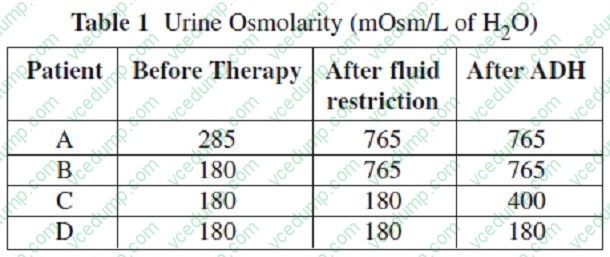
According to the passage, the catabolism of amino acids produces ammonia. Therefore, after a proteinrich meal, would you expect a build-up of ammonia in the lumen of the small intestine?
A. Yes, because the ammonia will not be able to diffuse into the intestinal epithelium.
B. Yes, because the rate at which digestive enzymes degrade ammonia is slower than the rate at which ammonia is produced.
C. No, because the ammonia will diffuse into the intestinal epithelium and will be excreted by the kidneys.
D. No, because the ammonia is produced inside individual cells, not within the lumen of the small intestine. -
Question 429:
Arsenic is widely distributed in sulfide ores of many metals and is obtained as a byproduct of copper smelting. The element, as well as many compounds of arsenic -- for example arsine, AsH3 -- are extremely poisonous. Arsenic compounds, as might be expected, have found use in herbicides and pesticides, but have also been successful in some pharmacological agents. The first useful antisyphilitic agent, Salvarsan, or 3,3'-diamino-4,4'-dihydroxyarsenobenzene dihydrochloride, is an arsenic compound. The element sublimes at 600°C, forming tetrahedral molecules, As4. Arsenic is a metalloid, possessing properties characteristic of both metals and non-metals. Arsenic is a gray-colored, metalliclooking solid, but arsenic vapor is yellow in color, has a garlic-like odor, and is very poisonous. If the arsenic vapor is cooled rapidly, an unstable, yellow crystalline allotrope consisting of As4 molecules is produced. The Marsh test, based on the instability of arsine, is a very sensitive test for the presence of arsenic. This test is commonly employed in the detection of arsenic poisoning -- either before or after death. The apparatus for the Marsh test is shown in Figure 1.
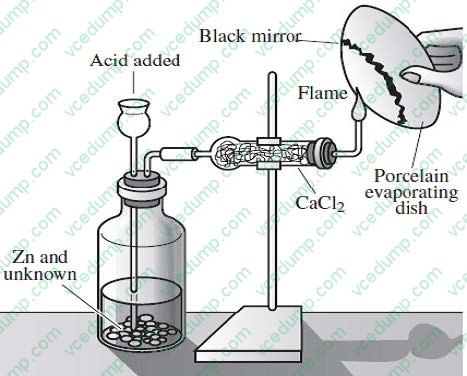
Figure 1
Typically, a sample, usually hair, is taken from a person suspected of being the victim of arsenic poisoning. This sample is then treated in such a way so as to produce arsenic oxide, As4O6. The oxide is then placed into the apparatus shown
in Figure 1 and reacted according to Reaction 1.
As4O6 + 12Zn(s) + 24H+(aq) AsH3(g) + 12Zn2 +(aq) + 6H2O
Reaction 1
When the evolved arsine is ignited it decomposes into its elements. The arsenic vapor is rapidly cooled when it encounters the porcelain evaporating dish and deposits a black mirror of arsenic on the bottom, indicating the presence of arsenic
in the original sample.
A common ore of arsenic is called orpiment, As2S3. What is the oxidation state of arsenic in orpiment?
A. ?
C. +3
D. +6 -
Question 430:
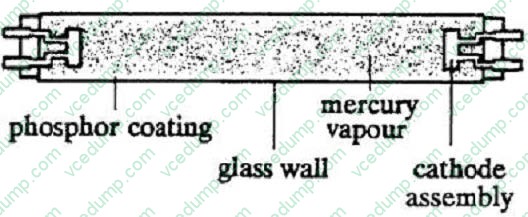
When light in the ultraviolet region of the spectrum is shone on a type of material known as a phosphor, it fluoresces and emits light in the visible region of the spectrum. Lamps that utilize this property, known as fluorescent lamps, are very efficient light sources. The arrangement of a typical fluorescent lamp is shown below. The lamp is a glass tube whose inside walls are covered with a phosphor. The tube has an appreciable length-to-diameter ratio so as to reduce the power losses at each end, and it is filled with argon gas mixed with mercury vapor. Inside each end of the tube are tungsten electrodes covered with an emission material.
Electrons are liberated at the cathode and accelerated by an applied electric field. These free electrons encounter the gas mixture, ionizing some mercury atoms and exciting others. Since it requires more energy to ionize the atoms than to excite the electrons, more excitation than ionization occurs. When the excited electrons revert to their ground state, they radiate ultraviolet photons with a wavelength of 253.7 nm. These photons impinge on the phosphor coating of the tube and excite electrons in the phosphor to higher energy states. The excited electrons in the phosphor return to their ground state in two or more steps, producing radiation in the visible region of the spectrum. Not every fluorescent lamp emits the same color of radiation; the color is dependent on the relative percentages of different heavy metal compounds in the phosphor.
The fluorescent lamp shown operates at 100 volts and draws 400 milliamps of current during normal operation. Of the total power that the lamp consumes, only 25% is converted to light, while the remaining 75% is dissipated as heat. This energy keeps the lamp at its optimum working temperature of 40°C. In the lamp shown, the phosphor coating is calcium metasilicate, which emits orange to yellow light.
Some fluorescent light bulbs are observed to glow for a short period after their power supply has been turned off. This glow is generated mainly by:
A. the incandescence of the hot ionic gas within the bulb surface.
B. emission of light stored as vibrational kinetic energy in the phosphor coating.
C. the dissipation of electric charge built up on the bulb's surface.
D. electrons returning to the ground state from excited states after the power was shut off.

Related Exams:
Tips on How to Prepare for the Exams
Nowadays, the certification exams become more and more important and required by more and more enterprises when applying for a job. But how to prepare for the exam effectively? How to prepare for the exam in a short time with less efforts? How to get a ideal result and how to find the most reliable resources? Here on Vcedump.com, you will find all the answers. Vcedump.com provide not only Medical Tests exam questions, answers and explanations but also complete assistance on your exam preparation and certification application. If you are confused on your MCAT-TEST exam preparations and Medical Tests certification application, do not hesitate to visit our Vcedump.com to find your solutions here.