MCAT-TEST Exam Details
-
Exam Code
:MCAT-TEST -
Exam Name
:Medical College Admission Test: Verbal Reasoning, Biological Sciences, Physical Sciences, Writing Sample -
Certification
:Medical Tests Certifications -
Vendor
:Medical Tests -
Total Questions
:812 Q&As -
Last Updated
:Jul 16, 2026
Medical Tests MCAT-TEST Online Questions & Answers
-
Question 411:
A helium-neon gas discharge laser as shown in Figure 1 below generates a coherent beam of monochromatic light at a wavelength of 632.8 nm.
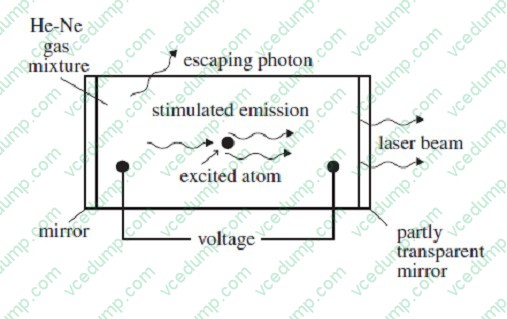
Figure 1
A discharge current of electrons is created in the tube by an applied voltage. When these electrons collide with the helium atoms, they can excite ground-state helium electrons to an energy level of 20.61 eV. The excited electrons cannot decay back to the ground state by emitting a photon because such a transition does not conserve angular momentum. Instead, if the excited helium atom collides with a neon atom, a ground-state electron in the neon atom can be excited to an energy level of 20.66 eV, and the helium electron can return to its ground state. The above process occurs quite often in the tube until the percentage of neon atoms with electrons in the 20.66-eV energy level is greater than the percentage of neon atoms with electrons in lower levels. This condition is called a population inversion. An excited electron in one of the neon atoms can then spontaneously decay by emitting a photon of wavelength 632.8 nm in a random direction. The photon will stimulate the same transition in another excited electron in a neon atom. The photon radiated by this stimulated emission process travels in the same direction as the original photon. The resulting light is then reflected back and forth inside the tube until it escapes through the partially transparent mirror. (Note: A photon's energy in eV is given by E = 1240/, where is the photon's wavelength in nm. The helium and neon ground-state energies are both 0 eV.)
A helium atom with an electron in the 20.61-eV energy level collides with a neon atom with an electron in the ground state. The result is that the helium electron returns to the ground state, and the groundstate neon electron is excited to an energy level of 20.66 eV. What is the minimum kinetic energy lost by the helium atom?
A. 0.05 eV
B. 1.96 eV
C. 10.3 eV
D. 20.61 eV -
Question 412:
Many nutrients required by plants exist in soil as basic cations:

A soil's cation-exchange capacity is a measure of its ability to adsorb these basic cations as well as exchangeable hydrogen and aluminum ions. The cation-exchange capacity of soil is derived from two sources: small clay particles called micelles consisting of alternating layers of alumina and silica crystals, and organic colloids.

Replacement of + and + by other cations of lower valence creates a net negative charge within the inner layers of the micelles. This is called the soil's permanent charge. For example, replacement of an atom of aluminum by calcium within a section where the net charge was previously zero, as shown below, produces a net charge of ?, to which other cations can become adsorbed.

Figure 1
A pH-dependent charge develops when hydrogen dissociates from hydroxyl moieties on the outer surfaces of the clay micelles. This leaves negatively-charged oxygen atoms to which basic cations may adsorb. Likewise, a large pH-
dependent charge develops when hydrogen dissociates from carboxylic acids and phenols in organic matter.
In most clays, permanent charges brought about by substitution account for anywhere from half to nearly all of the total cation-exchange capacity. Soils very high in organic matter contain primarily pH-dependent charges. In a research study,
three samples of soil were leached with a 1 N solution of neutral KCl, and the displaced A13+ and basic cations measured. The sample was then leached again with a buffered solution of BaCl2 and triethanolamine at pH 8.2, and the
displaced H+ measured. Table 1 gives results for three soils tested by this method.
Table 1
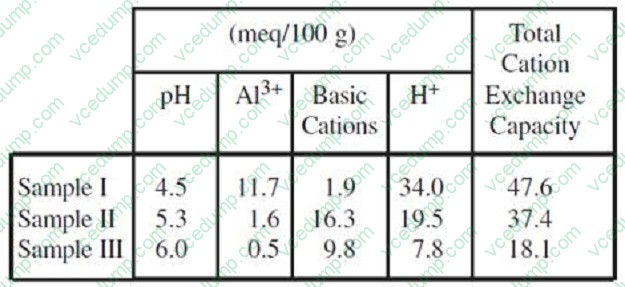
Due to the buffering effect of the soil's cation exchange capacity, just measuring the soil solution's pH will not indicate how much base is needed to change the soil pH. In another experiment, measured amounts of acid and base were added to 10-gram samples of well-mixed soil that had been collected from various locations in a field. The volumes of the samples were equalized by adding water. The results were recorded in Figure 2.
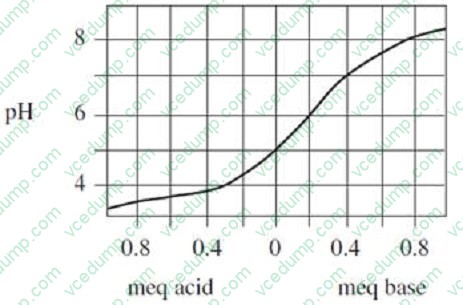
Figure 2.
Solution X boils at 100.26°C and solution Y boils at 101.04°C. Both solutions are at atmospheric pressure and contain the same solute concentration. Which of the following conclusions can be drawn?
A. The freezing point of solution X is lower than that of solution Y.
B. The vapor pressure of solution X is higher than that of solution Y at 100.26°C.
C. C. Solution X and solution Y are immiscible.
D. The vapor pressure of solution X is lower than that of solution Y at 100.26°C. -
Question 413:
Hemoglobin (Hb) and myoglobin (Mb) are the O2-carrying proteins in vertebrates. Hb, which is contained within red blood cells, serves as the O2 carrier in blood and also plays a vital role in the transport of CO2 and H+. Vertebrate Hb consists of four polypeptides (subunits) each with a heme group. The four chains are held together by noncovalent attractions. The affinity of Hb for O2 varies between species and within species depending on such factors as blood pH, stage of development, and body size. For example, small mammals give up O2 more readily than large mammals because small mammals have a higher metabolic rate and require more O2 per gram of tissue.
The binding of O2 to Hb is also dependent on the cooperativity of the Hb subunits. That is, binding at one heme facilitates the binding of O2 at the other hemes within the Hb molecule by altering the conformation of the entire molecule. This conformational change makes subsequent binding of O2 more energetically favorable. Conversely, the unloading of O2 at one heme facilitates the unloading of O2 at the others by a similar mechanism.
Figure 1 depicts the O2-dissociation curves of Hb (Curves A, B, and C) and myoglobin (Curve D), where saturation, Y, is the fractional occupancy of the O2-binding sites. The fraction of O2 that is transferred from Hb as the blood passes through the tissue capillaries is called the utilization coefficient. A normal value is approximately 0.25.
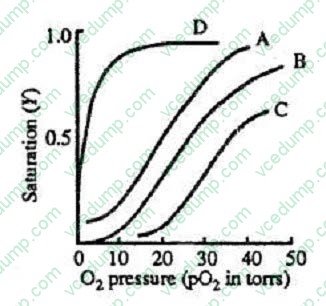
Figure 1
Myoglobin facilitates transport in muscle and serves as a reserve store of O2. Mb is a single polypeptide chain containing a heme group, with a molecular weight of 18 kd. As can be seen in Figure 1, Mb (Curve D) has a greater affinity for than Hb.
The llama is a warm-blooded mammal that lives in regions of unusually high altitudes, and has evolved a type of Hb that adapts it to such an existence. If Curve B represents the O2-dissociation curve for horse Hb, which curve would most closely resemble the curve for llama Hb?
A. Curve A
B. Curve B
C. Curve C
D. Curve D -
Question 414:
Millenialism is, generally speaking, the religious belief that salvation and material benefits will be conferred upon a society in the near future as the result of some apocalyptic event. The term derives from the Latin word for 1,000; in early Christian theology, believers held that Christ would return and establish his kingdom on earth for a period of a thousand years.
Millenialist movements, Christian and non-Christian, have arisen at various points throughout history, usually in times of great crisis or social upheaval. In "nativistic" millenialist movements, a people threatened with cultural disintegration attempts to earn its salvation by rejecting foreign customs and values and returning to the "old ways." One such movement involving the Ghost Dance cults, named after the ceremonial dance which cult members performed in hope of salvation, flourished in the late 19th century among Indians of the western United States.
By the middle of the 19th century, western expansion and settlement by whites was seriously threatening Native American cultures. Mining, agriculture and ranching encroached on and destroyed many Indian land and food sources. Indian resistance led to a series of wars and massacres, culminating in the U.S. Government's policy of resettlement of Indians onto reservations which constituted a fraction of their former territorial base. Under these dire circumstances, a series of millenialist movements began among western tribes.
The first Ghost Dance cult arose in western Nevada around 1870. A Native American prophet named Wodziwob, a member of a Northern Paiute tribe, received the revelation of an imminent apocalypse which would destroy the white man, restore all dead Indians to life, and return to the Indians their lands, food supplies (such as the vanishing buffalo), and old way of life. The apocalypse was to be brought about with the help of a ceremonial dance and songs, and by strict adherence to a moral code which, oddly enough, strongly resembled Christian teaching. In the early 1870s, Wodziwob's Ghost Dance cult spread to several tribes in California and Oregon, but soon died out or was absorbed into other cults.
A second Ghost Dance cult, founded in January 1889, evolved as the result of a similar revelation. This time Wovoka -- another Northern Paiute Indian, whose father had been a disciple of Wodziwob -- received a vision during a solar eclipse in which he died, spoke to God, and was assigned the task of teaching the dance and the millennial message. With white civilization having pushed western tribes ever closer to the brink of cultural disintegration during the previous twenty years, the Ghost Dance movement spread rapidly this time, catching on among tribes from the Canadian border to Texas, and from the Missouri River to the Sierra Nevadas -- an area approximately one-third the size of the continental United States.
Wovoka's Ghost Dance doctrine forbade Indian violence against whites or other Indians; it also involved the wearing of "ghost shirts," which supposedly rendered the wearers invulnerable to the white man's bullets. In 1890, when the Ghost Dance spread to the Sioux Indians, both the ghost shirts and the movement itself were put to the test. Violent resistance to white domination had all but ended among the Sioux by the late 1880s, when government- ordered reductions in the size of their reservations infuriated the Sioux, and made them particularly responsive to the millenialist message of the Ghost Dance. As the Sioux organized themselves in the cult of the dance, an alarmed federal government resorted to armed intervention which ultimately led to the massacre of some 200 Sioux men, women and children at Wounded Knee, South Dakota in December of 1890. The ghost shirts had been worn to no avail, and Wounded Knee marked the end of the second Ghost Dance cult.
The passage implies that the second Ghost Dance cult gained widespread popularity quickly because:
A. the U.S. government no longer attempted to suppress Native American religious practices.
B. many Native Americans felt particularly threatened by white civilization.
C. Wovoka was a more charismatic religious leader than Wodziwob had been.
D. it was founded on the basis of a spiritual revelation. -
Question 415:
Artificial kidneys have been used for almost 50 years to treat patients with different forms of renal failure. The artificial kidney (dialysis machine) removes unwanted substances from the blood by diffusion. A patient's blood is passed through channels bounded by a porous, semi-permeable membrane that allows the free diffusion in both directions of all plasma constituents except the plasma proteins. Erythrocytes and other cellular components of blood cannot pass through the membrane. The other side of the membrane is exposed to the dialyzing fluid which carries away the unwanted materials. If the concentration of a material in the blood is greater than in the dialyzing fluid, there will be a net flow of the material from the plasma to the dialyzing fluid. If the concentration of a material in the blood is less than in the dialyzing fluid, there will be a net flow of the material from the dialyzing fluid into the blood. The composition of normal plasma, plasma in an individual suffering renal failure, and dialyzing fluid are shown in Table 1.
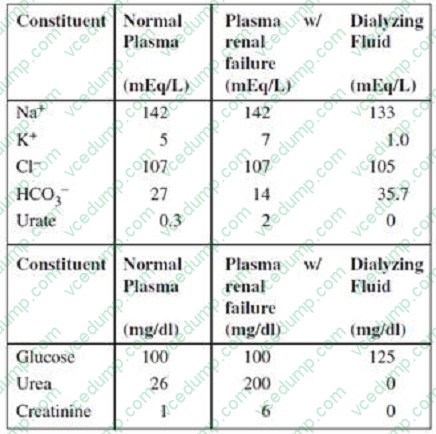
Table 1
Dialysis replaces some functions of the kidneys and attempts to correct the effects of renal failure. For example, patients with renal failure develop acidosis due to a buildup of metabolically produced acids in the circulation. Without dialysis, the pH of the blood will drop and coma may occur. Dialyzing fluid contains a relatively high concentration of bicarbonate which diffuses into the circulation and neutralizes the acid.
A patient with renal failure has nephrons which lack the ability to actively secrete or reabsorb any substances. Which of the following actions will the patient's kidney still be able to perform?
A. Removal of salt from the blood
B. Production of hypertonic urine
C. Production of hypotonic urine
D. Conservation of amino acids -
Question 416:
Many nutrients required by plants exist in soil as basic cations:

A soil's cation-exchange capacity is a measure of its ability to adsorb these basic cations as well as exchangeable hydrogen and aluminum ions. The cation-exchange capacity of soil is derived from two sources: small clay particles called micelles consisting of alternating layers of alumina and silica crystals, and organic colloids.
Replacement of + and + by other cations of lower valence creates a net negative charge within the inner layers of the micelles. This is called the soil's permanent charge. For example, replacement of an atom of aluminum by calcium within a section where the net charge was previously zero, as shown below, produces a net charge of ?, to which other cations can become adsorbed.

Figure 1
A pH-dependent charge develops when hydrogen dissociates from hydroxyl moieties on the outer surfaces of the clay micelles. This leaves negatively-charged oxygen atoms to which basic cations may adsorb. Likewise, a large pH-
dependent charge develops when hydrogen dissociates from carboxylic acids and phenols in organic matter.
In most clays, permanent charges brought about by substitution account for anywhere from half to nearly all of the total cation-exchange capacity. Soils very high in organic matter contain primarily pH-dependent charges. In a research study,
three samples of soil were leached with a 1 N solution of neutral KCl, and the displaced A13+ and basic cations measured. The sample was then leached again with a buffered solution of BaCl2 and triethanolamine at pH 8.2, and the
displaced H+ measured. Table 1 gives results for three soils tested by this method.
Table 1
Due to the buffering effect of the soil's cation exchange capacity, just measuring the soil solution's pH will not indicate how much base is needed to change the soil pH. In another experiment, measured amounts of acid and base were added to 10-gram samples of well-mixed soil that had been collected from various locations in a field. The volumes of the samples were equalized by adding water. The results were recorded in Figure 2.
Figure 2.
Which column(s) in Table 1 represent(s) the permanent charge of the soil micelles?
A. Option A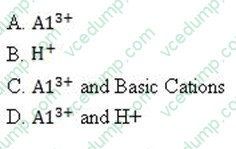
B. Option B
C. Option C
D. Option D -
Question 417:
A cell with a high intracellular K+ concentration, whose plasma membrane is impermeable to K+, is placed in an ATP-rich medium with a low K+ concentration. After several minutes, it is determined that the extracellular concentrations of both K+ and ATP have decreased, while the intracellular K+ concentration has increased. What is the most likely explanation for this phenomenon?
A. The passively diffused from the medium into the cell.
B. The entered the cell by way of facilitated transport.
C. The ATP formed a temporary lipid-soluble complex with the K+, thus enabling the potassium to enter the cell.
D. The entered the cell by way of active transport. -
Question 418:
Before birth, the rodent brain is sexually undifferentiated. It is only in the first few days following birth, during a period referred to as the critical period, that the rodent brain differentiates along male or female lines. The hormone testosterone plays a critical role in this development. Specifically, sexual differentiation is determined by the presence of estradiol, an estrogen derivative of testosterone, in certain areas of the brain. Testosterone is converted to estradiol in critical brain cells that contain the enzyme aromatase. To study the effects of testosterone on the neonatal rodent brain, the following experiments were conducted:
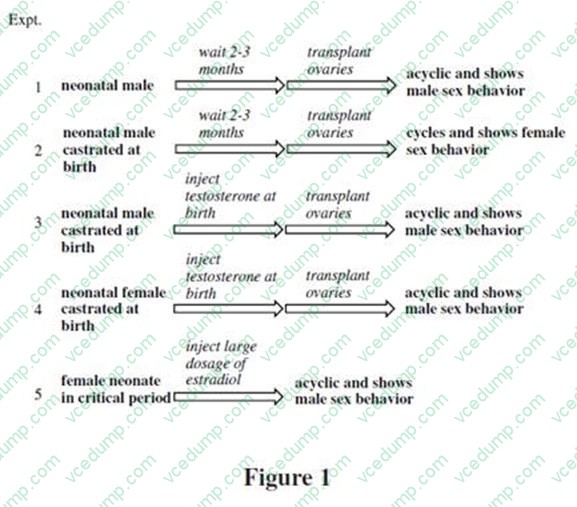
The above research, combined with additional studies, concluded that testosterone has two "organizational" effects on the male rodent brain: Defeminization Moderate levels of testosterone-derived estradiol during the critical period are sufficient for defeminization of the brain. Defeminization of the rodent brain results in loss of estrogen positive feedback on LH and FSH secretion and the ensuing loss of cyclicity, as well as loss of female sex behavior. Masculinization High levels of estradiol due to high levels of testosterone during the critical period results in masculinization of the brain. Masculinization leads to the induction of male sex behavior including antagonism towards other males and the mounting of females.
An adult male rat that is acyclic is observed to mount females. However, the rat also allows itself to be mounted by male rats. According to the passage, the most likely explanation for these observations is that:
A. the rat is hermaphroditic, with both male and female sex organs.
B. the rat has been demasculinized.
C. the rat has been masculinized but not fully defeminized.
D. the rat has been defeminized but not fully masculinized. -
Question 419:
Family violence, such as domestic violence, child abuse, and elder abuse, are serious and pervasive problems in the United States. On an annual basis, the National Crime Survey has found domestic violence results in 21000 hospitalizations, 99800 days of hospitalization, 28700 emergency department visits, and 39900 visits to physicians.
Currently there is little consensus about the definitions of intimate violence. Even the terms employed are varied; for example, domestic violence, conjugal violence, intimate abuse, and partner abuse. Similarly, there are a range of causal explanations, and these are contingent upon the theoretical perspective employed. There is also controversy whether the term "violence," "abuse," or "aggression" should be used. Finally, within the terms adopted, there is no consensus about the victim-perpetrator relationship. For example, do the terms refer to a married co-habiting couple? Two heterosexual individuals who do not reside together but are dating? All this has implications for research, practice, and policy.
The National Violence Against Women Survey was one of the largest studies sponsored by the National Institute of Justice and the Centers for Disease Control and Prevention. It systematically analyzed crime against women in the United States. A total of 8000 men and 8000 women in the United States were interviewed on the phone using a closed-ended survey. Table 1 displays the breakdown of figures when examining life time victimization by racial groups.
Table 1 Percentage of people victimized by an intimate partner in lifetime, by victim gender, type of victimization, and victim race
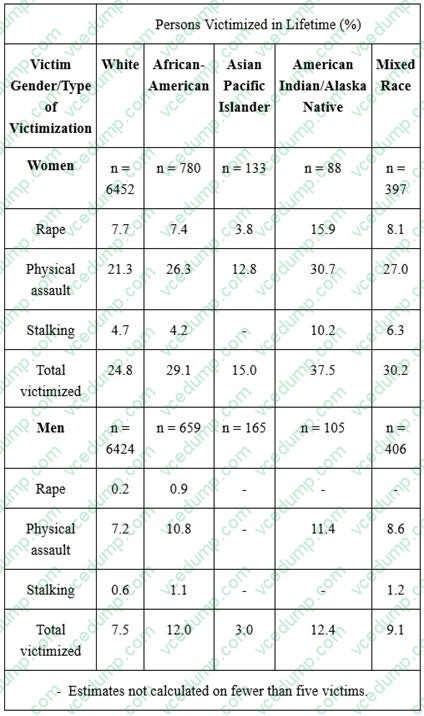
Source: Adapted from P Tjaden and N. Thoennes, "Consequences of Intimate Partner Violence: Findings from the National Violence Against Women Survey." A feminist researcher would most likely want to test out which one of the following hypotheses in a study about domestic violence?
A. Individuals who subscribe to patriarchal assumptions about men's role in society and male domination will more likely justify the use of violence against women.
B. Those who are more egalitarian in their gender role assignments are more likely to endorse and perpetrate physical aggression against their female partners.
C. Higher residential mobility, lower educational levels, and high stress levels will statistically significantly predict men's life time prevalence rates of perpetration of abuse.
D. The frustration aggression hypothesis -
Question 420:
The mind, just like the body, has its needs. The needs of the body are the foundations of society; those of the mind are its amenities. While government and laws provide for the safety and well-being of men when they gather together, the sciences and the arts, which are less despotic but perhaps more powerful, spread garlands of flowers over the iron chains that bind them, stifle in them the sense for that original liberty for which they seem to have been born, cause them to love their own enslavement, and turn them into so-called "civilized people." Necessity raised thrones; the sciences and the arts have strengthened them. O earthly powers: cherish talents and protect those who cultivate them. O civilized people, cultivate them: you happy slaves owe to them that delicate and refined taste of which you are so proud, that gentleness of character and urbanity of manner which make relations among you so amiable and easy -- in other words, that semblance of all the virtues, none of which you actually possess... ...How pleasant it would be to live among us, if our external appearance were always a reflection of what is in our hearts, if decency were virtue, if our maxims served as our rules, and if true philosophy were inseparable from the title of philosopher! But so many qualities are seldom found together, and virtue hardly ever walks in such great pomp. Richness of adornment may be the mark of a man of taste, but a healthy, robust man is known by other signs: it is beneath the rustic clothes of a farmer, and not the gilt of a courtier, that strength and vigor of the body will be found. Ornamentation is just as foreign to virtue, which is the strength and vigor of the soul. The good man is an athlete who prefers to compete in the nude: he disdains all those vile ornaments which would hinder the use of his strength, ornaments which were for the most part invented only to hide some deformity. Before art had molded our manners and taught our passions to speak an affected language, our customs were rustic but natural, and differences in conduct revealed clearly differences in character. Human nature, basically, was no better, but men found security in being able to see through each other easily, and this advantage, which we no longer appreciate, spared them many vices. Now that more subtle refinements and more delicate taste have reduced the art of pleasing to set rules, a base and deceptive uniformity prevails in our behavior, and all minds seem to have been cast in the same mold. Incessantly politeness and propriety make demands on us, and incessantly we follow usage but never our own inclinations. We no longer dare to appear as we are, and under this perpetual constraint, the men who form this herd called society, when placed in the same circumstances, will all act similarly unless stronger motives direct them to do otherwise. Therefore we will never know well those with whom we deal, for to know our friends we will have to wait for some crises to arise -- which is to say that we will have to wait until it is too late, as it is for these very crises that it is essential to know one's friends well. What vice would not accompany this uncertainty? No more sincere friendships, no more genuine esteem, no more well-based confidence. Suspicion, offenses, fears, coldness, reserve, hatred and betrayal will constantly hide under the same false veil of politeness, under that much touted urbanity which we owe to the enlightenment of our times. The name of the Master of the Universe will no longer be profaned by swearing, but insulted by blasphemies that will not offend our scrupulous ears. Men will not boast of their own merits, but belittle those of others. An enemy will not be crudely insulted, but adroitly slandered. National hatreds will die, but so will patriotism. A dangerous skepticism will take the place of the scorning of ignorance. Some excesses will be forbidden, some vices dishonored, but others will be dignified with the name of virtues, and one must either have them or feign them. Let those who want to praise the sobriety of the sages of our time do so; as for me, I see in it only a refinement of intemperance that is as unworthy of my praise as their hypocritical simplicity.
Which of the following is given as a supporting example for the author's concept of the ideal man?
A. One who exhibits courteous behavior.
B. One who maintains a pleasant demeanor.
C. One who rejects ornamentation.
D. One who cultivates talent.
Related Exams:
Tips on How to Prepare for the Exams
Nowadays, the certification exams become more and more important and required by more and more enterprises when applying for a job. But how to prepare for the exam effectively? How to prepare for the exam in a short time with less efforts? How to get a ideal result and how to find the most reliable resources? Here on Vcedump.com, you will find all the answers. Vcedump.com provide not only Medical Tests exam questions, answers and explanations but also complete assistance on your exam preparation and certification application. If you are confused on your MCAT-TEST exam preparations and Medical Tests certification application, do not hesitate to visit our Vcedump.com to find your solutions here.