MCAT-TEST Exam Details
-
Exam Code
:MCAT-TEST -
Exam Name
:Medical College Admission Test: Verbal Reasoning, Biological Sciences, Physical Sciences, Writing Sample -
Certification
:Medical Tests Certifications -
Vendor
:Medical Tests -
Total Questions
:812 Q&As -
Last Updated
:Jul 16, 2026
Medical Tests MCAT-TEST Online Questions & Answers
-
Question 441:
...Squeaking sand produces sounds with very high frequencies -- between 500 and 2,500 hertz, lasting less than a quarter of a second. The peals are musically pure, often containing four or five harmonic overtones. Booming sand makes louder, low-frequency sounds of 50 to 300 hertz, which may last as long as 15 minutes in larger dunes (although typically they last for seconds or less). In addition, they are rather noisy, containing a multitude of nearby frequencies. Booms have never been observed to contain more than one harmonic of the fundamental tone. These dramatic differences once led to a consensus that although both types of sand produce acoustic emissions, the ways in which they do so must be substantially different.... In the late 1970s, however, Peter K. Haff, then at the California Institute of Technology, produced squeaks in booming sand, suggesting a closer connection between the two. Both kinds of sand must be displaced to make sounds. Walking on some sand, for example, forces the sand underfoot to move down and out, producing squeaks. In the case of booming sand, displacement occurs during avalanches. It is within the avalanche that sound begins and where the answers must be hiding. Before an avalanche can occur, winds must build a dune up to a certain angle, usually about 35 degrees for dry desert sand. Once an angle is achieved, the sand on the leeward side of the dune begins to slump. Intact layers of sand slip over the layers below, like a sheared deck of cards. At the same time, the individual grains in the upper layers tumble over the grains underneath, momentarily falling into the spaces between them and bouncing out again to continue their downward journey. Their concerted up-and-down motion is believed to be the secret source of sound. Fully developed avalanches, in which sliding plates of sand remain intact for most of their motion, have the greatest acoustic output. In some places, where large amounts of sand are involved, booming can be heard up to 10 kilometers away. Because it is caused by large volumes of shearing sand, the roaring is also loud. In fact, sounds made by booming sand can be nearly deafening, and the vibrations causing them can be so intense that standing in their midst is nearly impossible. A good place to start in exploring the vibrational properties of sand is with the grains themselves. The mean diameter of most sand grains, whether acoustically active or not, is about 300 microns. Usually the grains in a booming dune are very similar in size, especially near the leeward crest, where the sound most often originates; such uniformity allows for more efficient shearing. Otherwise, the smaller grains impede the smooth motion of the larger ones. Similar sizes do not alone allow sand to boom. On the contrary, the booming sands of Korizo and Gelf Kebib, also in Libya, feature an uncharacteristically broad range of particle sizes. Moreover, silent dune sand often contains grains somewhat similar to nearby booming sand. Grains of booming sand also tend to have uncommonly smooth surfaces, with protrusions on the scale of mere microns. Booming dunes are often found at the downwind end of large sand sources; having bounced and rolled across the desert for long distances, the sand grains in these dunes are usually highly polished. Over time a grain can also be polished by repeated shifts within a moving dune. And squeaking sand as well tends to be exceptionally smooth.... ...Another important factor is humidity, because moisture can modify the friction between grains or cause sand to clump together, thus precluding shearing. Sounds occur in those parts of the dune that dry the fastest. Precipitation may be rare in the desert, but dunes retain water with remarkable efficiency. Sand near the surface dries quickly, however, and sand around a dune's crest tends to dry the fastest.
Booming occurs mostly in big dunes deep in the desert. All of the following, if true, are factors that may plausibly account for this EXCEPT:
A. The grains need to be carried over large distances by wind so they have a chance to be polished down.
B. The sounds created by the booming dunes need a large distance to dissipate.
C. A relatively large sand source is needed so dunes can build up to the requisite volume before an avalanche occurs.
D. The dunes need to be far removed from any source of moisture. -
Question 442:
Which blood vessel carries absorbed food material from intestine to the liver?
A. Vena cava
B. Hepatic artery
C. Hepatic vein
D. Hepatic portal vein -
Question 443:
A researcher in a molecular biology lab planned to carry out an extraction procedure known as an alkaline plasmid prep, which is designed to purify plasmids, small pieces of the hereditary material DNA, from bacterial cells. The bacteria are first placed into a test tube containing liquid nutrient medium and allowed to grow until they reach a high population density. The culture, which consists of solid cells suspended in the medium, is then centrifuged; a solid pellet is formed. The supernatant is poured out, leaving the pellet behind, and the cells are resuspended in a mL of lysis buffer solution (50 mM glucose, 25 mM Tris buffer and 10 mM ethylenediaminetetraacetic acid (EDTA), with 5 mg of the enzyme lysozyme added). They are then incubated for 30 minutes at 0°C, during which time the bacterial cell walls break down and the cell contents are released into the solution. After incubation, 1 mL of 0.4 N sodium hydroxide and 1 mL of 2% sodium dodecyl sulfate (SDS) are added, and the solution is again incubated on ice for 10 minutes. 2 mL of 3 M sodium acetate are added and the mixture is incubated for 30 minutes at 0°C. The test tube is centrifuged once more and the supernatant is decanted into a clean tube, leaving behind the protein and most other cell components in the pellet. Finally, 10 mL of pure ethanol are added to the supernatant from the previous step to precipitate out the DNA, and the test tube is incubated at ?0°C for 60 minutes, during which the mixture remains liquid. The mixture is centrifuged a final time and the supernatant removed. The translucent precipitate that results is washed with 70% ethanol (70% ethanol and 30% water by volume), allowed to dry, and resuspended in 1 mL of TE buffer (10 mM Tris, 1 mM EDTA). In preparation for this experiment, the researcher prepared stock solutions of the various chemicals that she will need in the experiment. Stock solutions are highly concentrated solutions of commonly used chemicals in water from which dilute solutions are prepared for daily use. Table 1 shows the chemicals, their molecular formulas and weights, and the composition of commonly used stock solutions.
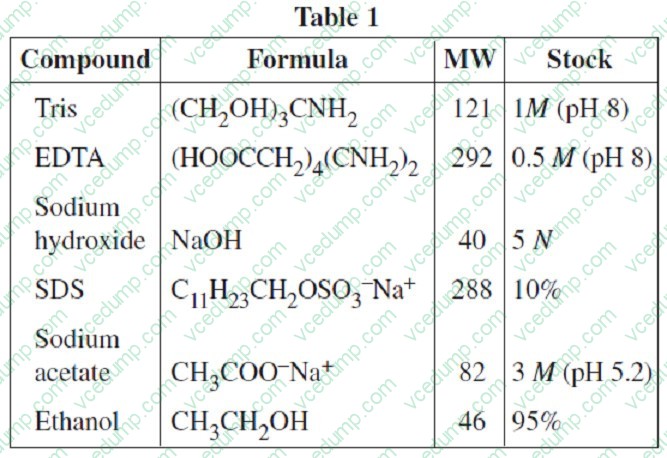
Tris (Tris(hydroxymethyl)aminomethane) is generally used as a buffer. If pH 8.0 is a good buffering region for Tris, then:
I) the pKa of Tris must be near pH 8.0
II) if Tris is titrated with acid, the titration curve will possess a steep region near pH 8.0.
III) a great deal of NaOH would have to be added to pH 8.0 Tris in order to significantly affect the pH.
A. I only
B. III only
C. I and II only
D. I and III only -
Question 444:
As Alice Echols went on to claim, "Nothing seems to conjure up the 1970s quite so effectively as disco. Even at the time, critics remarked upon disco's neat encapsulation of that decade's zeitgeist. `It must be clear by now to everyone with an ear or an eye that this era,' wrote journalist Andrew Kopkind in 1979, `is already the Disco Years, whether it will be called by that name or not.' A former sixties radical, Kopkind was by turns fascinated, bemused, and appalled by the disco epoch, and he likely imagined that in years to come fellow cultural critics would share his interest. But the seventies have not loomed large in our national imagination, except perhaps as comic relief. For many Americans, these were the forgettable years.
That forgettability owes a lot to the 1960s, the outsized decade that dwarfs all others in recent memory. The sixties will always be remembered for their audacity, whether found in the courage of civil rights protesters who put their bodies on the line or in those doomed but beautiful rock stars who tried breaking through to the other side. By contrast, the seventies seem the decade when nothing, or nothing good, happened ?an era memorable for the country's hapless presidents, declining prestige, bad fashions, ludicrous music, and such over-the-top narcissism that Tom Wolfe dubbed it the `Me Decade.' Before the decade was out, this narrative of decline had become routine. `After the poetry of the Beatles comes the monotonous bass-pedal bombardment of Donna Summer,' huffed one New York Times writer in 1979. It is a measure of the era's persistent bad press that a recent book challenging this view carries the pleading title Something Happened.
As for the sixties, it doesn't matter how much silliness went down, we still invest those times with seismic significance. Take Joe Cocker's performance at Woodstock. His spasmodic thrashing about and his vocals, slurred to the point of incomprehensibility, are something of a joke today. Cringe-inducing though it may be, however, Cocker's performance is never made to stand in for the whole of the sixties. The sixties remain enveloped in the gauzy sentimentalism of what might have been. Yet the iconic image of John Travolta as dance-floor king Tony Manero in white polyester suit, arm thrust to the disco heavens, has come to symbolize the narcissistic imbecility and inconsequentiality of the disco years.
Were it not for the Rubaiyat, I, too, might well regard the seventies as a lamentable and regrettable period in American history. The Rubaiyat was, yes, a disco. It was located in the heart of sixtiesland: Ann Arbor, Michigan, the home of the University of Michigan and legendary incubator of radical activism. At the height of the seventies, the town's annual Hash Bash ?a smoke-in to reform marijuana laws ?was still going strong and so were its two food co-ops-one reform, the other orthodox when it came to selling white foods (that is, rice, sugar, and flour of the white variety). Ann Arbor also had bookstores galore, including the original, wonderful Borders Bookstore, and any number of hippie-ish restaurants and bars such as the Fleetwood Diner, the Del Rio, and the Blind Pig. Musically, it prided itself on its vintage music (it hosted one of the earliest blues festivals), but at heart it was a rock town besotted with Iggy Pop and the Stooges and Sonic's Rendezvous, a band fronted by Patti Smith's future husband, Fred Smith. Its leading music store, Schoolkids' Records, stocked disco, but never played it. All of this is to say that disco-averse Ann Arbor came close to providing something of a safe haven from glitterball culture.
The Rubaiyat was no red-velvet-rope disco where fashionista doormen determined who was sufficiently fabulous to gain entry. This would never have worked in a town where down jackets and army surplus were hardly an unusual sight. The club did have some pretensions to classiness, but the mismatched, sagging booths and bordello red defeated occasional efforts at upmarket sophistication. What the Rubaiyat did have were better-than-average speakers, a heterogeneous cliente, and a weekend cover of three dollars."
Echols, A. (2011). Hot stuff: Disco and the Remaking of American Culture. New York: W. W. Norton.
The author most closely means which of the following in paragraph 2 by "narrative of decline"?
A. A work of history that focuses on a period when culture was becoming more stagnant, such as the 60s- 70s.
B. A version of 20th century history in which 60s idealism, peace and progress gave way to 70s crime, violence and racism.
C. A version of history in which an author fits the facts into an overarching schema in which things were becoming dramatically worse.
D. A version of 20th century history that claims the 60s was a failure because its ambitions were not fulfilled. -
Question 445:
A mountain climber living at sea level ascends to a very high altitude during the course of a day long climb. By the end of the day, all of the following acclimatizations will occur EXCEPT:
A. increased tidal volume.
B. increased respiration rate.
C. right shift of the hemoglobin dissociation curve.
D. increased concentration of erythropoietin in the blood. -
Question 446:
Gauguin's attitude toward art marked a break from the past and a beginning to modern art. Like all Post- Impressionist artists, he passed through an Impressionist phase but became quickly dissatisfied with the limitations of the style, and went on to discover a new style that had the directness and universality of a symbol and that concentrated on impressions, ideas and experiences. The beginning of his modern tradition lay in his rejection of Impressionism. He considered naturalism an error to be avoided. He was preoccupied with suggestion rather than description, seeking to portray not the exterior, but the essence of things in their purest, simplest, and most primitive form, which could only be achieved through simplification of the form. He firmly believed throughout his life that "art is an abstraction" and that "this abstraction [must be derived] from nature while dreaming before it." One must think of the creation that will result rather than the model, and not try to render the model exactly as one sees it. This was the birth of "Synthetism" or rather Synthetist-Symbolic, as Gauguin referred to it, using the term "symbolic" to indicate that the forms and patterns in his pictures were meant to suggest mental images or ideas and not simply to record visual experience.
Symbolism flourished around the period of 1885 to 1910 and can be defined as the rejection of direct, literal representation in favor of evocation and suggestion. Painters tried to give a visual expression to emotional experiences, and therefore the movement was a reaction against the naturalistic aims of Impressionism. Satisfying the need for a more spiritual or emotional approach in art, Symbolism is characterized by the desire to seek refuge in a dreamworld of beauty and the belief that color and line in themselves could express ideas. Stylistically, the tendency was towards flattened forms and broad areas of color, and features of the movement were an intense religious feeling and an interest in subjects of death, disease, and sin.
Similarly, "Synthetism" involved the simplification of forms into large-scale patterns and the expressive purification of colors. Form and color had to be simplified for the sake of expression. This style reacted against the "formlessness" of Impressionism and favored painting subjectively and expressing one's ideas rather than relying on external objects as subject matters. It was characterized by areas of pure colors, very defined contours, an emphasis on pattern and decorative qualities, and a relative absence of shadows.
Gauguin's new art form merged these two movements and succeeded in freeing color, form, and line, bringing it to express the artists' emotions, sensibilities, and personal experiences of the world around them. His style created a break with the old tradition of descriptive naturalism and favored the synthesis of observation and imagination. Gauguin sustained that forms are not discovered in nature but in one's wild imagination, and it was in himself that he searched rather than in his surroundings. For this reason, he scorned the Impressionists for their lack of imagination and their mere scientific reasoning. Furthermore, Gauguin used color unnaturalistically for its decorative or emotional effect and reintroduced emphatic outlines. "Synthetism" signified for him that the forms of his pictures were constructed from symbolic patterns of color and linear rhythms and were not mere scientific reproductions of what is seen by the eye.
Dempsey, A., and Dempsey, A. (2010). Styles, Schools and Movements: The Essential Encyclopaedic Guide to Modern Art. London: Thames and Hudson.
Given the passage's discussion of Synthetist-Symbolism, and some undiscussed remarks about how Japanese art influenced Gauguin's work, which of these features of Japanese painting can be reasonably assumed to characterize Gauguin's art form?
A. Use of strong colors and compositional freedom
B. Use of fluid curved lines
C. Use of animals and landscapes as subjects
D. Use of narrative elements to express ideas -
Question 447:
Researchers are currently trying to develop materials which could be used to replace damaged or destroyed human muscle tissue. One of the more promising avenues of research involves the use of substances that contract with the application of a small electric current.
Two physicists published an article relating to their work with Substance Q42, a material which contracts with the application of very small electric currents.
The atomic structure of the substance, they report, is designed so that the magnetic fields from each atom maintain a certain distance between adjacent atoms. With the application of an electrical current, the atoms' magnetic fields are
dampened slightly, causing them to draw closer together. The extent to which it contracts is dependent upon the strength of the current passing through it, but will at any rate never exceed a 20% reduction in length.
Moreover, the physicists report, Substance Q42 essentially operated like a spring, but one which can compress itself. The force generated by a spring, Fs, is given by the following equation:
Fs = -kx,
where k is the spring of constant in N/m, and x is the distance of compression (or expansion, but that is irrelevant for this example, since Substance Q42 only compresses).
With this in mind, it is possible to calculate the feasibility of using Substance Q42 as a replacement for human muscle tissue. Assume a section of test Substance Q42 is hooked to a scalable electrical source. The section is 10 cm long at its
fully extended state, and 8 cm long when fully compressed due to an electrical current.
A force-meter is attached to one end of a section of Substance Q42; the other end of the section is secured to a non-moving surface. When fully compressed, the force-meter registers a force exerted by the section of 250 N. What is the
spring constant?
A. 12 500 N/m
B. 12 800 N/m
C. 16 700 N/m
D. 20 500 N/m -
Question 448:
In 1965, Boris Deryagin reported the discovery of an unusual substance formed during the condensation of water vapor in quartz capillaries. The material, called poly-water, appeared to be a polymer of water monomers and differed from normal water in a number of ways. It had a freezing point of ?0?C and solidified into a glass-like solid with substantially less volumetric expansion than that of ordinary water upon freezing. It had a density 40% greater than water and a refractive index of 1.48.
An intricate apparatus was used to produce the poly-water. Ordinary distilled water was placed in a chamber held at 160?C with pressure below atmospheric pressure. This chamber was connected to a second chamber by a tube held at 500?C in order to prevent the passage of liquid water. The second chamber was held at 0?C and contained a drawn quartz capillary in which the water vapor condensed, forming poly-water.
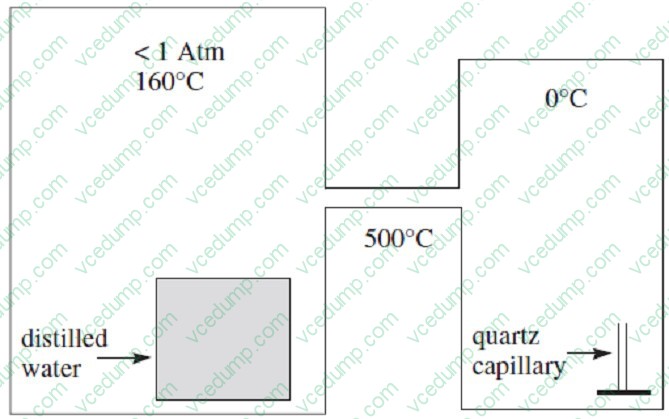
Hypothesis 1
Deryagin proposed that polywater was a polymer of water monomers arranged in a network of hexagonal units. The polymerization was catalyzed by the silicate surface of the quartz capillary.
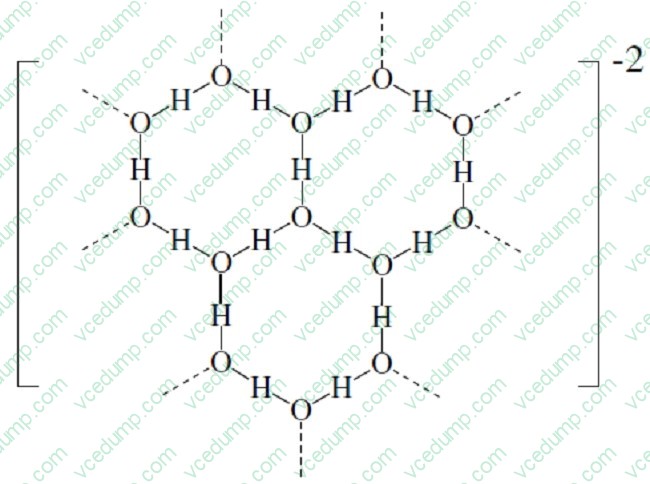
Proposed Structure of Polywater Hypothesis 2
Another researcher was skeptical. Analysis indicated that polywater was merely a solution of water and dissolved particles including silicon, carbon dioxide, and substantial concentrations of ions These contaminants dissolved from the quartz capillary and from materials used in the apparatus.

(constants for normal water : density = 1 g/c , index of refraction = 1.33 , freezing point depression constant = 1.86°C ) According to the passage, polywater has all of the following properties EXCEPT:
A. light entering polywater from air will bend more towards the normal than light entering normal water.
B. polywater can be produced in a variety of conditions.
C. 1 g of water has a larger volume than 1 g of polywater, at room temperature.
D. polywater exists in the liquid state at 0?C. -
Question 449:
Just as the ingestion of nutrients is mandatory for human life, so is the excretion of metabolic waste products. One of these nutrients, protein, is used for building muscle, nucleic acids, and countless compounds integral to homeostasis.
However, the catabolism of the amino acids generated from protein digestion produces ammonia, which, if not further degraded, can become toxic. Similarly, if the same salts that provide energy and chemical balance to cells are in excess,
fluid retention will occur, damaging the circulatory, cardiac, and pulmonary systems.
One of the most important homeostatic organs is the kidney, which closely regulates the excretion and reabsorption of many essential ions and molecules. One mechanism of renal function involves the secretion of antidiuretic hormone
(ADH).
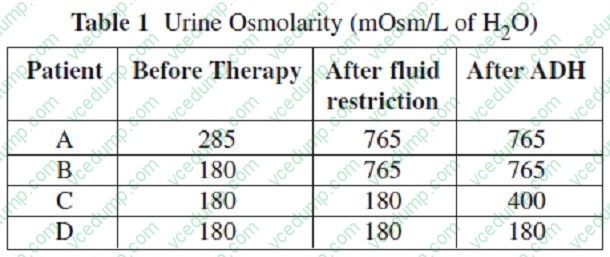
Diabetes insipidus (DI), is the condition that occurs when ADH is ineffective. As a result, the kidneys are unable to concentrate urine, leading to excessive water loss. There are two types of DI -- central and nephrogenic. Central DI occurs when there is a deficiency in the quantity or quality of ADH produced. Nephrogenic DI occurs when the kidney tubules are unresponsive to ADH. To differentiate between these two conditions, a patient's urine osmolarity is measured both prior to therapy and after a 24-hour restriction on fluid intake. Exogenous ADH is then administered and urine osmolarity is measured again. The table below gives the results of testing on four patients. Assume that a urine osmolarity of 285 mOsm/L of H2O is normal.
An elevated and potentially toxic level of ammonia in the blood (hyperammonemia) would most likely result from a defect in an enzyme involved in:
A. glycolysis.
B. fatty acid catabolism.
C. the urea cycle.
D. nucleic acid degradation. -
Question 450:
A local politician starts a task force to reduce prejudice and hate crimes, and the task force provides recommendations for increased access to education, paid community improvement projects open to people from different, possibly conflicted, groups, and stricter anti-hate ordinances to be passed at the local level. These recommendations are based on:
I. Self-esteem hypothesis
II. Contact hypothesis
III. Hypothesis
IV.
Legal hypothesis
A. I, II, and III
B. II, III, and IV
C. I, III, and IV
D. I, II, and IV
I. Self-esteem hypothesis II. Contact hypothesis III. Hypothesis IV. Legal hypothesis

Related Exams:
Tips on How to Prepare for the Exams
Nowadays, the certification exams become more and more important and required by more and more enterprises when applying for a job. But how to prepare for the exam effectively? How to prepare for the exam in a short time with less efforts? How to get a ideal result and how to find the most reliable resources? Here on Vcedump.com, you will find all the answers. Vcedump.com provide not only Medical Tests exam questions, answers and explanations but also complete assistance on your exam preparation and certification application. If you are confused on your MCAT-TEST exam preparations and Medical Tests certification application, do not hesitate to visit our Vcedump.com to find your solutions here.